
I’m Not a “Natural Teacher”: Does That Mean I Should Avoid Academia?
What if you get all the way to attending level, land an academic job… and then realize you’re actually terrible at teaching?
That’s the loop my brain runs at 3 a.m.
On paper, “academic medicine” sounds great: teach, do some research, maybe have protected time, be part of a university. In my head, though? I immediately picture those frighteningly charismatic attendings who can explain heart failure with three dry erase markers and a metaphor about plumbing, while I trip over my words explaining how to log into Epic.
So here’s the fear:
If you’re not a “natural teacher,” does that automatically mean you don’t belong in academic medicine?
Let me be blunt: no. But there are some uncomfortable truths to sort through.
The Myth of the “Natural Teacher” (And Why It Messes With Our Heads)
Somewhere in med school, this narrative pops up:
There are “born teachers” who just… have it. Clear explanations. Perfect analogies. Calm presence. Inspiring stories.
And then there’s you, mumbling through a SOAP note with an M2, praying they don’t ask a question you can’t answer.
The problem is, we tend to only remember the highlight-reel faculty:
- The cardiologist who draws the best pressure-volume loops you’ve ever seen.
- The EM attending who can turn a disaster resus into a teaching case in real time.
- The pre-clinical lecturer who somehow made biochem tolerable.
We don’t see all the average, awkward, learning-on-the-job teachers. And there are a lot of them.
Most people in academic medicine did not start out “natural.” They started out:
- rambling
- over-explaining
- under-explaining
- freezing when asked “why”
- reading off slides
- and then slowly, painfully, getting better.
I’ve watched senior residents who used to be painfully stiff with students become genuinely good teachers over 1–2 years. Same humans. Different reps.
The “natural teacher” myth is just the teaching version of “effortless genius.” It’s mostly crap. But it’s powerful enough that it makes people like us wonder if we should opt out entirely.
What Academic Medicine Actually Requires (Not the Fantasy Version)
Before deciding you’re “not cut out” for academia, you need to be honest about what an academic career usually looks like.
| Aspect | Academic Medicine | Community Practice |
|---|---|---|
| Teaching | Core expectation | Variable/optional |
| Research | Common/valued | Less emphasized |
| Admin roles | More opportunities | Fewer, more local |
| Evaluation | Students, residents, peers | Mainly peers/admins |
| Protected time | Sometimes | Less common |
In many academic jobs, “teaching” is not some optional hobby. It’s your job description:
- Supervising students and residents on wards or in clinic
- Giving didactics or small group sessions
- Writing evaluations
- Possibly mentoring projects or QI
There’s no way to hide completely. Someone’s going to hand you a group of learners and say, “You’re up.”
So the question isn’t:
“Am I a natural teacher?”
It’s:
“Can I become a good enough teacher that I’m not harming learners and not hating myself every day?”
That’s a very different bar. And a much more realistic one.
Your Specific Fears (Yes, I Have Them Too)
Let me just list the greatest hits that people quietly worry about, because I’ve heard these whispered in call rooms and after sign-out way too often:
- “What if I’m boring and they tune me out?”
- “What if they know more guidelines than me and I look incompetent?”
- “What if my feedback is too harsh and I ruin someone’s confidence?”
- “What if my feedback is too soft and I fail them by not being honest?”
- “What if my evals are bad and that kills my promotion?”
- “What if a student complains about me and it goes to the dean’s office?”
You’re not crazy for worrying about any of this. A lot of attendings feel this, they just don’t talk about it.
Here’s the uncomfortable truth:
Some of that will happen.
You will give a bad talk.
You will miss a teaching moment.
You will get an eval that stings.
You will have a learner who doesn’t click with you.
That’s not because you’re “not a teacher.” It’s because you’re human and teaching is a skill that you only learn by doing it publicly.
What Actually Makes Someone a “Good Enough” Teacher
There are teaching rockstars. Fine. That’s not the standard you need to meet to have a career in academic medicine.
The bar for “good enough teacher” is lower and way more attainable than your anxious brain thinks.
Here’s what I’ve seen consistently in solid, respected academic attendings who started off pretty shaky:
They prepare small, not huge.
They don’t walk in with a 50-slide deck every time. But they do think ahead: “If I have downtime on rounds, I’ll ask about COPD management and have 2–3 key points ready.”
They ask, then teach.
They start with: “What do you already know about X?” Instead of launching into a monologue. It feels like a conversation, not a lecture.
They admit uncertainty.
“I’m not totally sure; let’s look that up together.” That builds trust more than pretending you know everything.
They give specific feedback, not personality feedback.
“Your assessment was detailed, but I couldn’t see your main impression. Let’s work on putting the ‘one-liner’ first.” That’s concrete. It’s fixable.
They care, visibly.
You can feel when an attending gives a damn about you getting better. That matters more than them being funny or charismatic.
None of that requires you to be a TED-talk-level performer. It requires intention, a little humility, and practice.
But What If I Genuinely Don’t Like Teaching?
This is the question most people are scared to say out loud.
What if you don’t enjoy explaining things? What if you find it draining? What if you’d honestly rather just see your patients, document, go home?
If that’s you, then yeah, pure clinical academic medicine might not be a great long-term fit. Because you’ll be fighting your own job description every day.
But there are a few nuances before you write yourself off:
You might not “like teaching” yet because all you’ve experienced is chaotic, high-pressure, zero-support teaching. Being handed a terrified M3 on a 30-patient list with a sinking census and no structure is not “real teaching.” It’s survival.
You might not like badly set-up teaching. When you have a little control—like a small group, some prep time, or repeating a session you’ve polished—it feels very different.
You might enjoy certain teaching situations but hate others. Some people love one-on-one coaching but hate giving lectures. Or love teaching procedures but hate basic science review. Academic roles can sometimes be tailored around those preferences.
The only time I’d say genuinely: “Yeah, maybe steer away from traditional academic jobs” is if, over and over, in different settings, you find yourself resenting learners being around at all. Like you consistently think, “My day would be better if they weren’t here.”
In that case, it’s not a moral failing. It just means your personality and recharge needs might align better with community practice, or a hybrid job where teaching is limited or optional.
You Can Actually Learn How To Teach (There Are Tools, Not Just Vibes)
The part that gets ignored way too often: teaching in medicine is a trainable skill. Not magic.
Schools and hospitals literally have entire programs dedicated to teaching clinicians how to teach. You don’t have to just wing it forever.
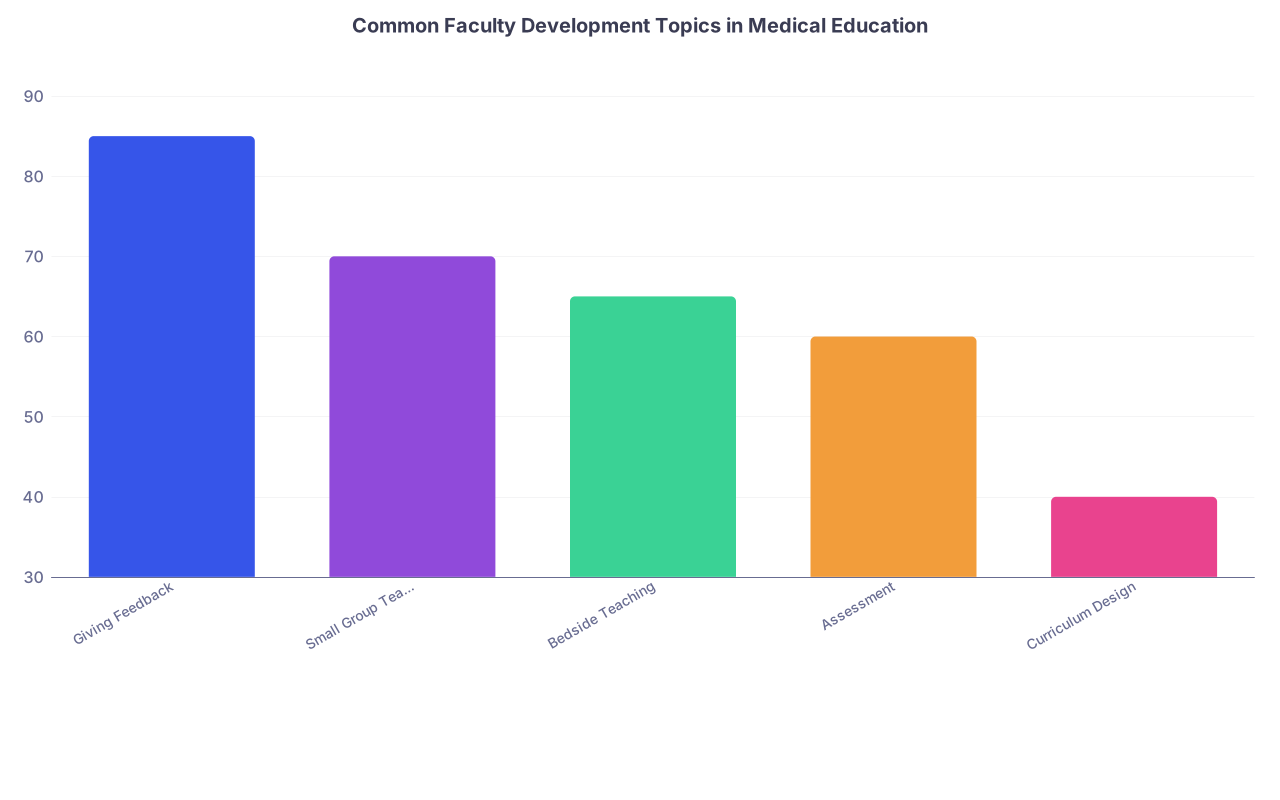
| Category | Value |
|---|---|
| Giving Feedback | 85 |
| Small Group Teaching | 70 |
| Bedside Teaching | 65 |
| Assessment | 60 |
| Curriculum Design | 40 |
Most academic centers offer faculty development workshops on:
- Feedback that doesn’t crush souls
- Bedside teaching without slowing rounds to a crawl
- How to run a small group
- Writing useful evaluations
- Basic principles of adult learning
I’ve watched attendings come out of a 2-hour workshop and completely change how they structure their feedback: from “Good job, keep reading” to “Tomorrow, let’s focus just on your presentations.” That’s not personality. That’s training.
And if your institution isn’t great at this? There are online medical education fellowships, certificate programs, and courses. Seriously, you can study this just like cardiology or ID.
So if right now you’re an awkward, hesitant teacher? That’s data about your starting point, not your ceiling.
How To Test Whether Academia Is Actually Wrong For You (Instead of Just Scary)
This is where I’d push you a bit, in a friendly way. Because anxious brains tend to make career decisions based on imagined disaster, not real exposure.
You need real-world experiments.
1. Say yes to small, low-stakes teaching
Not a grand rounds. Not some huge lecture.
Offer to:
- Run a 20-minute session for M1s on how to write a basic H&P
- Take 1–2 students for a short, focused bedside exam teaching session
- Lead a tiny chalk talk for juniors on one topic you know cold
After each one, ask yourself honestly:
- Did I feel dread the entire time?
- Was there any part of it that felt satisfying? (Even a small moment where something clicked for them?)
- Did I feel drained in a horrible way, or that “tired but that was worth it” way?
That data matters more than your catastrophizing.
2. Ask for real feedback from learners you trust
Not just “That was fine.” Actually ask:
- “What was one thing I did that helped you learn?”
- “What’s one thing I should do differently next time to make this clearer?”
Yes, this is terrifying. But learners are often kinder and more specific than you expect. And you may hear patterns like: “You explain your thought process really clearly” or “I like that you admit when you don’t know.”
Those are teachable strengths.
3. Watch how you feel without learners
If you do a rotation without students or residents, do you miss teaching? Or does it feel like a relief?
Be brutally honest. Your body often knows before your brain admits it.
The Career Risk of Avoiding Academia Just Because You’re Anxious
Here’s the part that scares me for people like us:
We overestimate the risk of “failing” in academic medicine and underestimate the risk of regret if we never try.
You might be exactly the kind of thoughtful, humble, reflective physician that academic medicine desperately needs. And the only reason you’d never get there is because you let “I’m not a natural teacher” write the ending for you.
I’ve seen objectively mediocre clinicians with huge confidence become prominent in academic centers. Not because they were amazing. Because they were loud and unafraid.
Meanwhile, the quieter, anxious, actually-care-a-lot-about-patients people tiptoe to the sidelines because they’re scared of looking bad.
That feels backwards.
So yeah, protect yourself from misery. Don’t force yourself into a pure educator track if teaching drains you dry.
But at least give yourself enough real experience to know if you’re avoiding academia for a good reason, or just because anxiety is louder than reality.
Visualizing an Academic Teaching Path (That Doesn’t Demand Perfection Instantly)
Sometimes it helps to see this as stages, not all-or-nothing.

| Step | Description |
|---|---|
| Step 1 | Student tutor |
| Step 2 | Resident bedside teaching |
| Step 3 | Give small talk to juniors |
| Step 4 | Local teaching workshop |
| Step 5 | Faculty with learners on service |
| Step 6 | Refine niche teaching style |
You don’t go from “awkward MS3” to “program director who wins teaching awards every year” in one jump.
You stack small experiences, small bits of training, and figure out what kind of teaching fits you.
A Quiet Reality: Most Academic Teachers Are Not Superstars
Let me say this plainly because your brain is probably comparing you to the top 1% of teacher-legend attendings:
Most academic physicians are solid, not spectacular, teachers.
They:
- Repeat the same teaching points a lot
- Have a handful of go-to topics
- Give decent but not life-changing feedback
- Are sometimes boring
- Are sometimes great
- Are almost never as polished as your memory makes them
And yet—students learn. Residents grow. Patients get good care.
You’re allowed to be a “B+ teacher” in academic medicine. You don’t need to be the next Osler.
If you care, if you’re willing to learn, and if you don’t actively resent the presence of learners, you’re already on better footing than many.
Use Your Anxiety as a Feature, Not a Bug
The fact that you’re worried about being a bad teacher is actually a weird kind of strength.
I trust the attending who thinks, “Was I fair? Did they actually understand that?” far more than the one who walks around certain they’re God’s gift to education.
Your anxiety will push you to:
- Prepare more thoughtfully
- Check in with learners more often
- Seek out feedback and improve
- Avoid shaming or humiliating students (because you’ve probably felt that yourself)
Of course, you have to keep it from paralyzing you. But the antidote to that isn’t avoidance. It’s small, real experiences plus support and training.
FAQ (Exactly the Stuff You’re Probably Still Worried About)
1. What if my teaching evaluations are bad—will that destroy my academic career?
Not automatically. One set of bad evals isn’t a career death sentence. Programs look at patterns over time. If you have a rough start and then show improvement—especially if you’ve engaged in faculty development or mentorship—that actually looks good. It shows you’re self-aware and coachable. The real red flag is someone who gets repeated concerning feedback and never changes anything.
2. Can I be in academic medicine if I’m introverted and not a charismatic “performer”?
Yes. Some of the best teachers I’ve seen are quiet, calm, and not flashy at all. They run small groups well, they listen, they give thoughtful feedback, and they model good clinical reasoning. Academic medicine needs different styles. You don’t have to be the stand-up comedian lecturer. You just need a way of teaching that’s effective and sustainable for you.
3. What if I realize later that I actually hate teaching—am I stuck in academia forever?
You’re not trapped. People move from academic to community practice all the time. You can shift to a more clinically focused role, drop certain teaching responsibilities, or change institutions. Is it paperwork and politics? Yes. But you’re not signing a lifelong contract that says “must love teaching until death.” Careers evolve.
4. How can I tell now, as a student or resident, whether an academic career is realistic for me?
Run small experiments. Tutor peers. Teach a workshop. Offer a 10–15 minute chalk talk on rounds. Ask for real feedback from someone you trust. Pay attention to your energy: do you feel only dread, or is there any part that feels meaningful or even slightly enjoyable? Talk to actual academic attendings about how they started; you’ll hear a lot of “I wasn’t good at this at first” stories. If you find that, with support and some training, teaching feels tolerable or occasionally rewarding, academia is absolutely still on the table.
Today, do one tiny thing:
Message a junior student or resident and offer to walk them through one case, or one skill (presenting, writing orders, interpreting an EKG) for 15 minutes.
Then afterwards, ask them: “What helped? What could I do differently next time?”
That’s it. One rep. Open the door a crack instead of slamming it shut on “academic medicine” before you’ve even really tried.