
It’s September 1st. You’ve been on faculty for six weeks. Your badge still squeaks when you open the workroom door, and you’re just starting to remember which conference room is “Med Ed 3B.”
And now the emails are hitting your inbox:
- “Looking for volunteers for the EHR Optimization Workgroup”
- “AI Governance Committee seeking clinical champions”
- “Epic Physician Advisory Council applications due next month”
You’re flattered. Also: mildly panicked. You want a voice in how this stuff is built. But you also want to make it through your first promotion clock without burning out.
Here’s the timeline I’d follow—and what I tell new faculty when they ask, “When should I actually say yes to EHR or AI committees?”
Months 0–3: Do Not Join Anything Yet (Observe and Take Notes)
At this point you should be:
- Learning your clinical workflows cold
- Mapping out your academic focus
- Quietly studying how your institution handles EHR and AI
During the first three months, your only job with respect to committees: watch and listen. Do not sign up for any standing EHR or AI committee yet.
Weeks 1–4: Survive and Take Inventory
You’re still trying to find the right order sets and figure out where your notes go in the chart. This is not the time to fix the EHR for the whole hospital.
Focus on:
Mastering the EHR as a user
- Build your own templates and SmartPhrases (or the Cerner/Meditech equivalent).
- Shadow a power user—often the crusty associate professor who documents in half the time you do.
- Keep a running list of pain points:
- Clicks that feel pointless
- Alerts that are obviously noise
- AI suggestions that are wrong or irrelevant
Understanding local politics around tech Ask people privately:
- “Who actually controls EHR changes here?”
- “When people complain about the EHR, where does that feedback go?”
- “Who are the clinical informatics people?” (Get those names.)
Clarifying your academic lane You cannot be “the EHR person” and “the AI person” and “the med ed person” and “the outcomes researcher.” Not in year 1.
Have a blunt conversation with:
- Your division chief
- Your assigned mentor (if you have one)
Ask:
- “For my promotion to assistant/associate, what do you expect—papers, teaching, QI, clinical leadership?”
- “Is informatics or AI actually valued here, or does nobody care unless it brings RVUs or grants?”
| Do This | Avoid This |
|---|---|
| Build templates, SmartPhrases | Joining standing EHR committees |
| Track EHR/AI pain points | Leading a new AI pilot project |
| Meet informatics leaders | Volunteering as ‘clinical champion’ yet |
| Clarify academic goals | Saying yes to every tech email |
| Ask about promotion metrics | Assuming tech work will automatically count |
Weeks 5–12: Targeted Exploration, Still No Formal Committees
Now you can start sticking your nose in—but strategically.
Attend, don’t join
- Sit in as a guest on:
- One EHR advisory meeting
- One AI governance / digital innovation meeting
- Your line: “I’m new faculty, I’m interested in this space, and I’d love to observe a meeting or two to understand how decisions are made.”
Watch for:
- Who actually speaks versus who is just filling a seat.
- Whether clinical voices are respected or ignored.
- Whether AI is hype (“ChatGPT for everything!”) or disciplined (“We have a governance process, bias review, and clear use cases”).
- Sit in as a guest on:
Find out what counts for promotion Ask your chair or promotions person:
- “If I join an EHR or AI committee, how is that documented?”
- “Does leading an EHR optimization project count as QI? Leadership? Service?”
- “Do we have a clinician informatics track or FTE for this work?”
If the answer is a fuzzy “uh, we’ll see,” assume:
- This is service, not academic currency.
- You must cap it ruthlessly.
Start a small, selfish micro‑project
- Build one better note template and show it to your immediate group.
- Fix one annoying order set with the help of your local EHR physician builder.
- Pilot one AI tool in your personal workflow (secure, approved only) and see if it actually saves you time.
Right now, your goal is to learn the terrain, not to sit on a ballot.
Months 4–6: Choose One Small, Low‑Risk Role (If Any)
At this point you should:
- Decide if EHR/AI will be part of your “brand” or just background noise.
- If yes, pick one small commitment aligned with your goals.
- If no, keep observing but do not sign up.
Month 4: Make a Yes/No Call on Tech as a Career Thread
Ask yourself:
- Do I genuinely like thinking about systems, workflows, and data?
- Do I find myself ranting about alert fatigue and documentation burden more than others?
- Do I read about AI in medicine for fun?
If the answer is no:
- Your default answer for year 1: “I’m focusing on clinical and academic ramp‑up this year—please keep me in mind next year.” And that’s it.
If the answer is yes:
- You’re allowed one committee or formal role, not three.
Month 5: The Right Kind of First Committee
Here’s where people screw up: they join some huge enterprise EHR steering committee where they’re one of 25 silent people. That’s useless for you.
Early on, you want local and tangible, not grand and political.
Ideal first roles in months 4–6:
- Department / division EHR champion
- Clinical documentation workgroup for your specialty
- A task‑focused AI pilot group (e.g., sepsis alert refinement, radiology triage AI)
- Resident/fellow EHR advisory liaison if you still work closely with trainees
Avoid in year 1:
- Enterprise‑wide EHR steering committee
- System‑wide AI governance board as “the young tech person”
- Any board that meets monthly and produces glossy slide decks but no changes
Script to use when approached with too‑big committees:
“I’m very interested, but I’m in my first year and trying to make sure I build depth before I spread myself too thin. Do you have a smaller, project‑based group where I can contribute in a focused way this year?”
Month 6: Check Your Time and ROI
By six months, look hard at your calendar.
- How many hours per month are you spending on this tech work?
- What’s the output? (One revised order set? A pilot AI project? Or just meetings and complaints?)
If it’s just talk, not impact, you’re allowed to quietly back away:
“Thank you for letting me sit in this cycle. I need to refocus on my clinical and academic ramp‑up for now, but I’d be happy to re‑engage on specific projects next year.”
Months 7–9: Align EHR/AI Work With Promotion and Funding
At this point you should:
- Decide if this becomes a pillar of your promotion packet or stays as low‑volume service.
- Attach your tech work to something measurable: publications, QI metrics, leadership titles, or funding.
Month 7: Convert Committee Time Into a Project
If you’re still on an EHR or AI group at month 7, it needs to turn into something real.
Typical conversions:
From “EHR optimization group member” to
“Lead: ED chest pain order set redesign with 20% reduction in unnecessary testing.”From “AI committee attendee” to
“Clinical lead: evaluate and implement AI-based readmission risk model on the medicine service.”
Turn it into:
- A QI project with IRB if needed
- A presentation at your institution’s quality or informatics day
- A short paper or poster
Month 8: Start Documenting Outcomes
You’ll thank yourself in three years when you’re building your promotion packet.
Track:
Baseline vs post‑implementation metrics:
- Time to complete a standard note
- Number of clicks per admission or discharge
- Alert volume vs acceptance rate
- AI model performance (sensitivity/specificity, equity across subgroups)
Your role:
- “Led clinical workflow design”
- “Developed training and adoption plan”
- “Performed chart review validation of AI outputs”
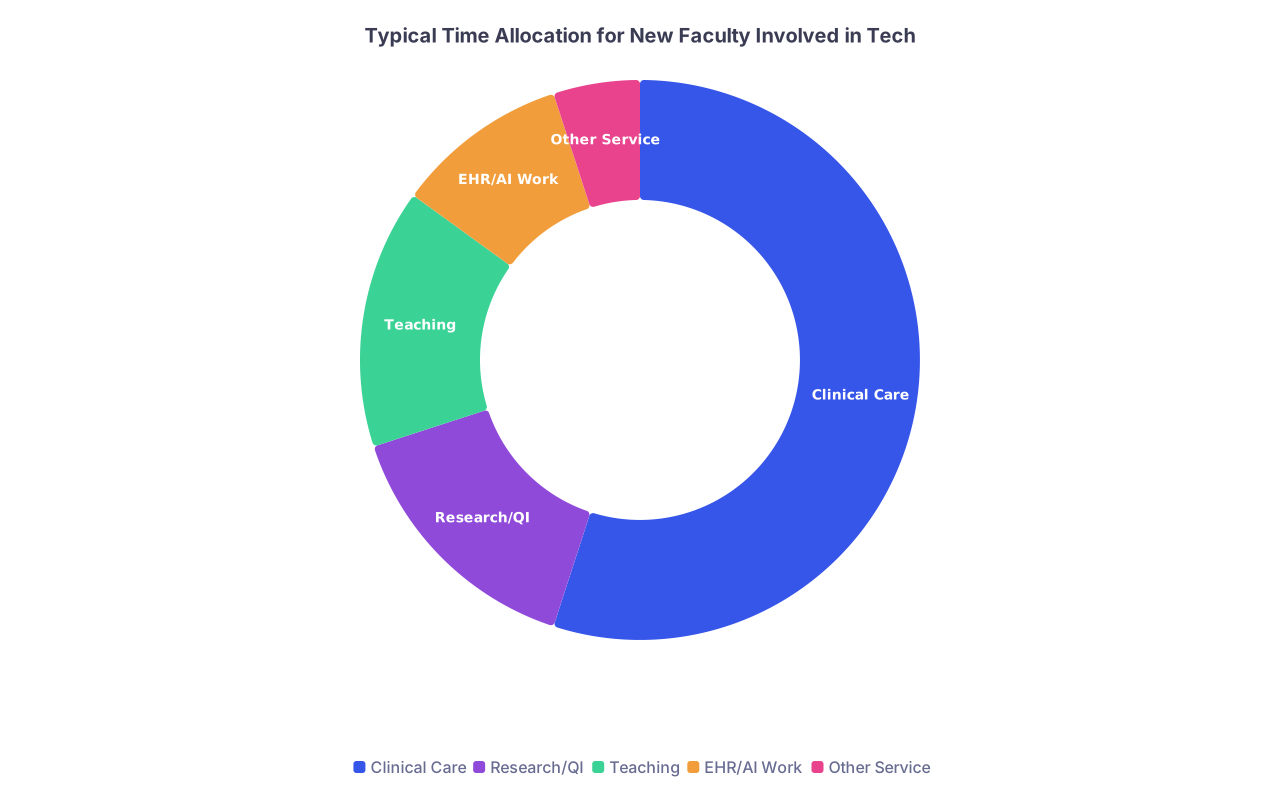
| Category | Value |
|---|---|
| Clinical Care | 55 |
| Research/QI | 15 |
| Teaching | 15 |
| EHR/AI Work | 10 |
| Other Service | 5 |
If EHR/AI is eating more than ~10% of your total time in year 1 and you have no grants, titles, or publications from it, that’s a red flag.
Month 9: Decide If You Want a Formal Informatics Path
This is when you start seeing the fork in the road.
If you’re thinking:
- “I like this enough to invest real time”
- “I might want a clinical informatics board or a formal role”
Then:
- Talk to your CMIO, Chief Digital Officer, or equivalent.
- Ask bluntly:
- “What did you do early on that actually advanced your career versus just filling committees?”
- “Is there protected time or FTE here for clinical informatics or AI work for junior faculty?”
- “Who should I work with if I want to publish or get funding?”
If the answer is “we just volunteer our time,” be careful. That’s how you end up doing unpaid IT consulting while trying to write grants at 10 pm.
Months 10–12: Say Yes Strategically, Say No Aggressively
At this point you should:
- Either be all‑in with one or two focused roles
- Or consciously back tech down to background service
Month 10: Prune Commitments Before Year 2
Look at every EHR/AI commitment and ask:
- Does this move my CV in a direction I actually want?
- Would I put this on the first page of my promotion packet?
- Is there a clear deliverable in the next 6–12 months?
If not, your move is:
“I’ve really appreciated being part of this group. For the next year, I need to narrow my focus to projects that are tightly aligned with my promotion goals. I’m happy to advise ad hoc, but I need to step off as a standing member.”
You do not owe your institution free labor to fix the EHR at the expense of your own career.
Month 11: Choose Your Year‑2 Positioning
You’re basically setting up your story:
Tech as major theme of your career
- 1–2 formal roles:
- Division EHR/AI lead
- Clinical lead on an AI pilot with measurable outcomes
- A clear plan:
- Abstract submission to AMIA, HIMSS, ATS/ACC/etc with informatics track
- Maybe a certificate program or starting to plan for a clinical informatics fellowship (if early enough)
- 1–2 formal roles:
Tech as minor but visible strength
- 1 small role:
- Department EHR champion for inpatient medicine
- 1–2 concrete wins:
- “Reduced note time by 20% for residents with new templates”
- “Piloted AI-based dictation tool and trained faculty”
- 1 small role:
Tech as minimal background service
- No standing committees
- Some documented suggestions / feedback that led to small changes
- Your energy goes to research, teaching, or clinical leadership instead
Month 12: Lock In Your Strategy for Year 2
By the end of year 1, your EHR/AI story should look like one of these:
| Track | Committees | Output by End of Year 1 |
|---|---|---|
| Major Informatics Focus | 1–2 focused groups | QI project, poster, pilot project |
| Moderate Involvement | 1 small group | Local workflow change, teaching |
| Minimal Involvement | 0–1 ad hoc roles | Documented suggestions only |
Do not drift into year 2 still “kind of on” three different committees that meet monthly, send long minutes, and never produce anything.
Quick Day‑by‑Day / Week‑by‑Week Triggers
To make this more concrete, here’s how I’d react in real time across the year.
Day 10: First “join our EHR committee” email
Your response:
“I’m in my first month and focused on getting clinically settled. Could we revisit this in 4–6 months once I have a better sense of where I can be most useful?”
Week 8: You see a terrible AI discharge summary suggestion in the EHR
Your actions:
- Screenshot it (de‑identified)
- Send to your local EHR champion or informatics contact:
- “I’ve seen this type of AI suggestion be clinically misleading. Is there a process for reviewing or tuning this?”
You’re signaling interest without joining a committee.
Month 4: You’re invited to “AI Innovation Council”
You ask:
- “How often does it meet?”
- “What decisions does this group actually make?”
- “Can you send me the last three agendas and outcomes?”
If answers are:
- “We’re still figuring that out”
- “We mostly discuss opportunities”
You decline for year 1.
Month 6: You’re asked to be ‘the young person who understands tech’
Translation: they want optics. Not necessarily impact.
Your line:
“I’m happy to give feedback on tools and represent junior faculty perspectives, but for year 1 I can only commit to projects with clear goals and timeframes. What specific deliverable would you want from me by the end of the year?”
If they cannot answer, step back.
Visual Timeline of Year 1 Strategy
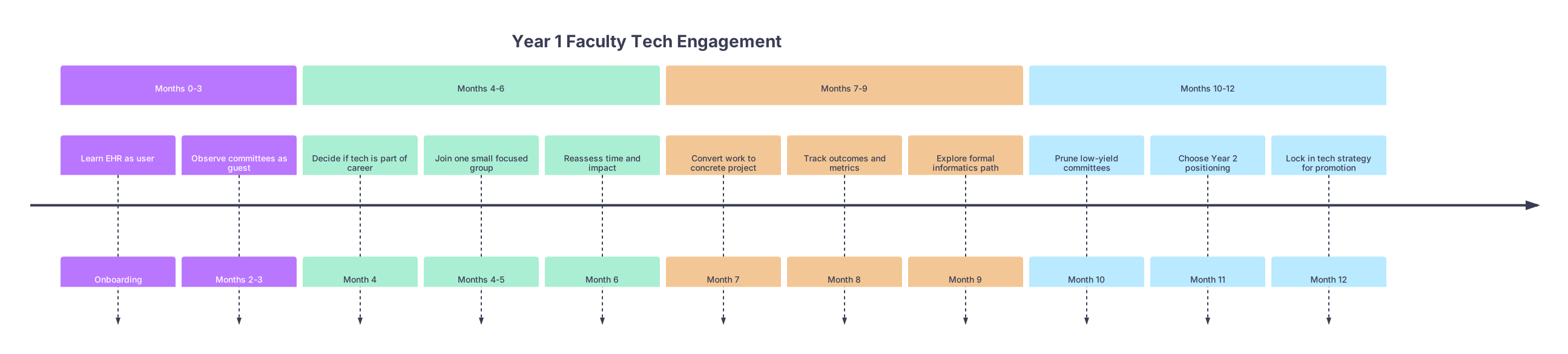
| Period | Event |
|---|---|
| Months 0-3 - Learn EHR as user | Onboarding |
| Months 0-3 - Observe committees as guest | Months 2-3 |
| Months 4-6 - Decide if tech is part of career | Month 4 |
| Months 4-6 - Join one small focused group | Months 4-5 |
| Months 4-6 - Reassess time and impact | Month 6 |
| Months 7-9 - Convert work to concrete project | Month 7 |
| Months 7-9 - Track outcomes and metrics | Month 8 |
| Months 7-9 - Explore formal informatics path | Month 9 |
| Months 10-12 - Prune low-yield committees | Month 10 |
| Months 10-12 - Choose Year 2 positioning | Month 11 |
| Months 10-12 - Lock in tech strategy for promotion | Month 12 |
Final Takeaways
- First 3–6 months: observe only. Learn the EHR, understand the politics, and do not join standing EHR/AI committees yet.
- Year 1: one focused role max. If you engage in tech, make it small, concrete, and tightly aligned with your promotion story.
- By month 12: have a clear story. Either tech is a real pillar of your career with measurable output—or it’s minimal service. Drifting on five committees helping IT for free is the worst of all worlds.