
Is Mindfulness Unprofessional in the OR?
Why do so many surgeons roll their eyes when someone mentions “mindfulness” in the operating room, but happily embrace “focus,” “situation awareness,” and “staying in the zone”—which are, functionally, the same thing?
Let me be direct: the idea that mindfulness is unprofessional in the OR is a culture problem, not a data problem. The evidence is, frankly, lopsided.
The tension is obvious. The OR is supposed to be a place of relentless action, decisiveness, and intensity. Mindfulness sounds slow. Soft. Borderline “wellness retreat.” And surgeons do not want to be associated with soft.
But the literature, from anesthesiology to surgery to critical care, keeps saying the same thing: clinicians who train their attention—through mindfulness or closely related methods—make fewer errors, handle crises better, and burn out less. That’s not woo. That’s measurable outcomes.
Let’s dismantle the myths one by one.
Myth 1: “Mindfulness Makes You Slower and Less Decisive”
This is the most common complaint I’ve heard in OR lounges: “I don’t have time to meditate; I have cases to run.” Fair. You should not be doing a 30‑minute body scan between induction and incision.
But that argument confuses trait mindfulness with time‑consuming meditation exercises.
Trait mindfulness is basically:
Can you sustain attention on what matters, notice distraction or emotional reactivity early, and return your focus without getting hijacked?
That is not slowness. That is high‑end cognitive control.
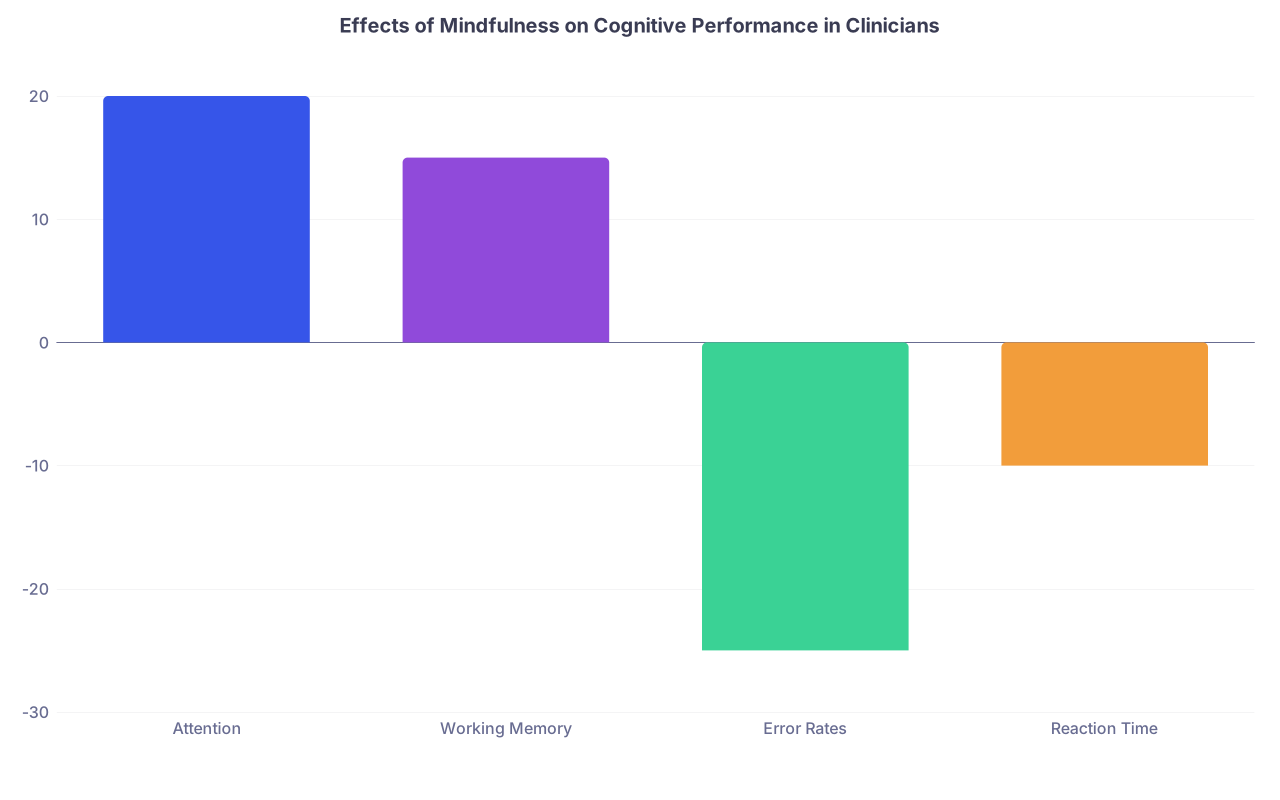
| Category | Value |
|---|---|
| Attention | 20 |
| Working Memory | 15 |
| Error Rates | -25 |
| Reaction Time | -10 |
These are representative effect directions from multiple clinician and high‑stress population studies (numbers as relative percentage improvement or reduction):
- Attention: improves
- Working memory: improves
- Error rates: drop
- Reaction time: modestly faster or unchanged
There are randomized trials on nurses, residents, and attending physicians doing structured mindfulness‑based interventions (e.g., modified MBSR, brief mindfulness training). They don’t come out slower and indecisive. They come out less distracted under pressure and less likely to cognitively freeze.
In simulation studies where anesthesiologists manage crises, mindfulness or attention‑training is associated with better adherence to algorithms and fewer overlooked steps, not dithering. Same story in aviation and other high‑reliability fields: attention training improves timely decision‑making, particularly when the pressure spikes.
The irony: the “cowboy” surgeon who prides himself on moving fast and ignoring his own internal state is often the one who hesitates in the moment that actually counts—because he never trained noticing that surge of panic, anger, or tunnel vision. He just rides it. And sometimes it rides him.
Mindfulness, done correctly, is not about slowing the OR. It’s about trimming the cognitive noise so the speed you do use is clean, not frantic.
Myth 2: “Stopping to Breathe or ‘Center’ Looks Unprofessional”
I’ve heard attendings say this almost verbatim: “If my resident closed his eyes to take a breath mid‑case, I’d think he was losing it.”
Translation: we’ve normalized visible agitation but pathologized visible composure.
The key issue here is how mindfulness shows up behaviorally. Nobody’s asking you to sit cross‑legged next to the Mayo stand. We’re talking about micro‑behaviors that take five seconds and change nothing about sterility, timing, or professionalism.
Examples I have actually watched in real ORs:
- Senior surgeon pauses with hands on the drape, looks briefly at anesthesia and the scrub nurse, and says, “Okay, time out, everyone with me,” in a calm, grounded tone. That’s basically a micro‑mindfulness plus team‑orientation ritual.
- Anesthesia attending, during a tough airway, does one visible inhale and exhale before making the next move. Nobody dies because of the 3‑second pause; the patient is safer because the next step isn’t made in full sympathetic overdrive.
- Trauma surgeon, before a massive re‑exploration, quietly says to the team, “Let’s slow our minds, not our hands. I want clear calls, no talking over each other.” Again—mindfulness, stripped of yoga branding.

The data on pre‑procedure checklists and “timeouts” is now overwhelming: they improve communication, catch errors, and reduce complications. And what is a high‑quality timeout if not a structured mindful moment? You stop. You bring everyone’s attention to shared reality. You verbalize the plan.
Surgeons who treat that ritual as a throwaway formality, mumbling through it while the scrub is still counting and the circulator is distracted, are objectively being less professional, not more.
The “looks unprofessional” argument is basically: “Anything that doesn’t fit our old stoic‑cowboy aesthetic must be wrong.” That’s nostalgia, not evidence.
Myth 3: “Mindfulness is Self‑Indulgent; Patients Need You Focused Outward”
This one sounds noble. “I’m here for the patient, not for my feelings.” The problem is that your internal state doesn’t politely stand aside while you operate.
You know the case: 5 p.m., third add‑on, frail patient, everything is sticky. The rep is whispering, anesthesia is edgy about pressure, scrub is new. You’re tired. Slightly resentful. Maybe angry this case was scheduled like this.
If you don’t acknowledge that internal storm, it leaks. In your voice. In how you snap at the resident. In the micro‑hesitations when you’re dissecting near the nerve because your mind is still half‑locked on the earlier complication or the pager that won’t stop.
Mindfulness, clinically applied, is ruthless about this:
Notice what’s here → label it → don’t fight it → choose your next action based on the job, not the emotion.
This isn’t self‑indulgence. It’s emotional containment.
There are studies linking mindfulness among clinicians to:
- Lower emotional exhaustion and depersonalization
- Increased sense of personal accomplishment
- Better patient‑reported communication and empathy
Not because people are sitting around feeling their breath while patients code. But because they aren’t running on unexamined, chronic, low‑grade emotional overload.
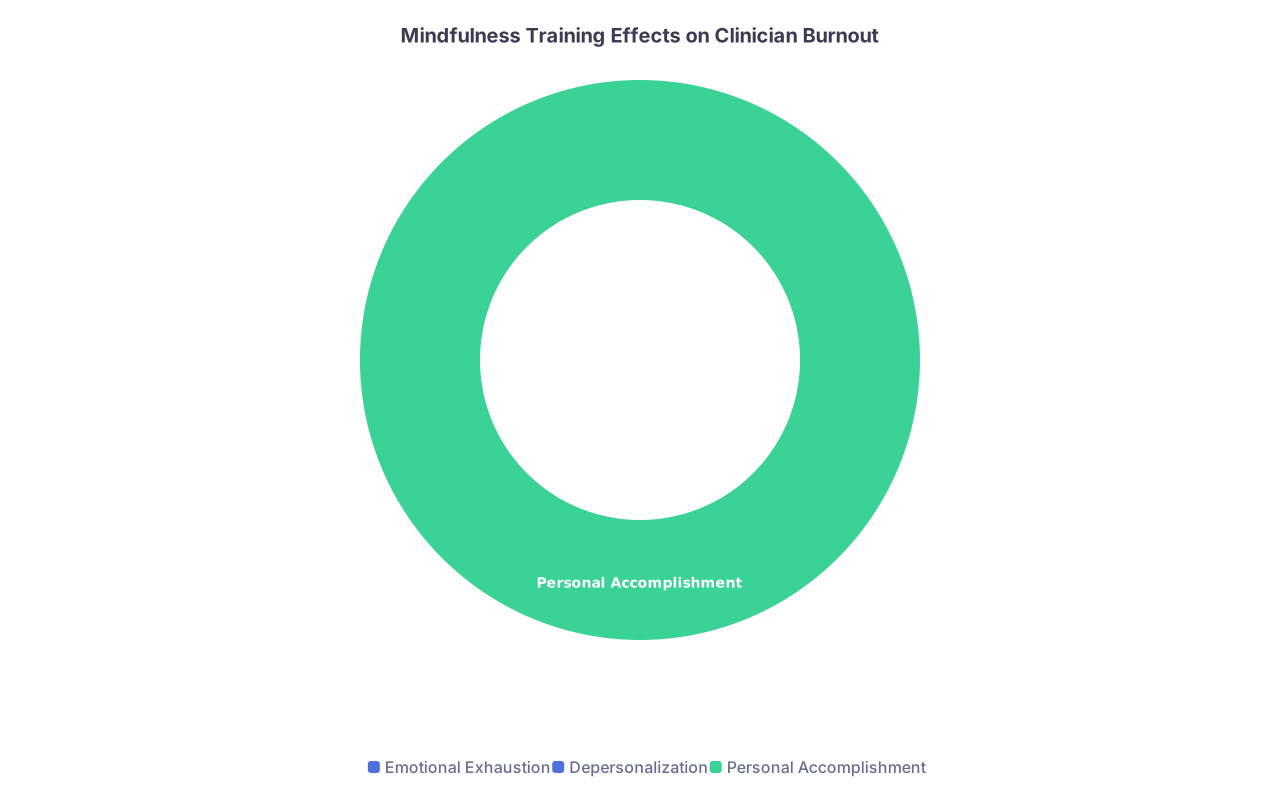
| Category | Value |
|---|---|
| Emotional Exhaustion | -25 |
| Depersonalization | -20 |
| Personal Accomplishment | 15 |
Again, the directions reflect what multiple trials show: exhaustion and depersonalization drop, personal accomplishment rises. That’s not just “feeling better.” That’s a clinician more likely to stay present with the patient at 6 p.m. the same way they were at 8 a.m.
The idea that paying attention to your own mind steals attention from the patient is backwards. Unexamined emotional noise steals far more.
What the Evidence in High‑Reliability Fields Actually Shows
Let’s zoom out. Medicine is late to this party.
Military, aviation, elite athletics, and even law enforcement have been testing and using mindfulness‑based or attention‑training programs for years. Why? Because if you care about split‑second performance under stress, you do not rely on “grit” alone.
There are RCTs in:
- Special forces trainees: mindfulness yielding better working memory and less performance degradation under intense stress.
- Airline crew and air traffic controllers: attention‑training decreasing error rates and improving situational awareness.
- Police officers: mindfulness training associated with lower physiological stress reactivity and better decision‑making in shoot/don’t‑shoot simulations.
Medicine has its own version of this, but we rename it to make it more palatable: “nontechnical skills,” “CRM,” “situational awareness,” “team communication.”
| Concept | Typical Mindfulness Term | OR / Safety Culture Term |
|---|---|---|
| Sustained attention | Focused awareness | Situational awareness |
| Monitoring thoughts | Meta-cognition | Cognitive vigilance |
| Emotional regulation | Non-reactivity | Composure under stress |
| Noticing distractions | Present-moment noticing | Distraction management |
| Intentional pausing | Mindful pause | Tactical pause / time out |
Same underlying skills. Different branding.
When anesthesiology conferences talk about “cognitive aids” and “managing cognitive load,” they are functionally inviting mindfulness into the OR. They just avoid words that trigger wellness‑culture skepticism.
Professionalism: What It Actually Means in the OR
If professionalism in the OR means:
- Maximal patient safety
- Respect for teammates
- Steady, predictable performance under stress
Then the question becomes: does mindfulness help or hurt those?
Look at the communication data. Teams that adopt brief centering rituals—pre‑case huddles, explicit shared mental models, conscious check‑ins after critical events—have better teamwork scores and lower error rates. Those rituals are behavioral expressions of mindfulness.
Look at the burnout and error literature. Clinician burnout is linked to higher self‑reported error, lower patient satisfaction, and higher turnover. Mindfulness‑based programs, when implemented decently (not as a band‑aid for toxic systems), reliably move burnout metrics in the right direction. Are they magic? No. But they are one of the few interventions that repeatedly show benefit without adding risk.
The unprofessional thing isn’t taking 10 seconds to orient your mind and your team. The unprofessional thing is pretending your cognitive and emotional state has no bearing on the patient’s outcome.

| Step | Description |
|---|---|
| Step 1 | Stress Trigger in OR |
| Step 2 | Notice Body and Thoughts |
| Step 3 | Snapping, Tunnel Vision, Errors |
| Step 4 | Brief Mindful Pause |
| Step 5 | Reorient to Patient and Plan |
| Step 6 | Deliberate Next Action |
| Step 7 | React Automatically? |
That tiny fork—automatic reaction vs. brief mindful pause—is the difference between a professional response and a regrettable one in many OR blowups I’ve seen.
The Real Objection: Culture, Ego, and Branding
So if the evidence is largely in favor, why the persistent skepticism?
Three main reasons.
First, mindfulness got wrapped in wellness and self‑help marketing. Apps, influencers, “manifest your best life” nonsense. Surgeons understandably recoil. They don’t want that brand anywhere near their identity.
Second, old‑guard culture. Many current attendings were trained in environments where showing any internal life—stress, uncertainty, fatigue—was ridiculed. You coped by suppression and dark humor. Anything that looks like acknowledging inner experience feels like violating an unspoken rule.
Third, fear of looking weak in front of trainees and peers. Closing your eyes for a breath, calling for a “pause,” or saying “I’m noticing the room is getting noisy, let’s reset” feels vulnerable in some rooms. So people don’t do it. And then, of course, it never becomes normalized.
None of these are evidence‑based objections. They’re cultural reflexes.
What Mindfulness in the OR Actually Looks Like
If you’re imagining someone meditating in lotus pose while a patient bleeds, you’ve already lost the plot.
Here’s what evidence‑aligned, professional mindfulness in the OR looks like:
- A deliberate breath and silent mental checklist before incision.
- Using the timeout as a real shared focus point, not theater.
- Noticing when your heart rate spikes or your jaw tightens—and using that as a cue to slow your mind while your hands keep working.
- Calling a “tactical pause” in a chaotic moment: “Everyone stop for five seconds. I want the room quiet and one voice at a time.”
- After a near‑miss, running a quick internal debrief: “What was happening in my head? Where did my attention go? What will I do differently next time?” instead of just blaming externals.
None of that compromises sterility, efficiency, or authority. It is authority. Authority over your own nervous system and the climate of your OR.
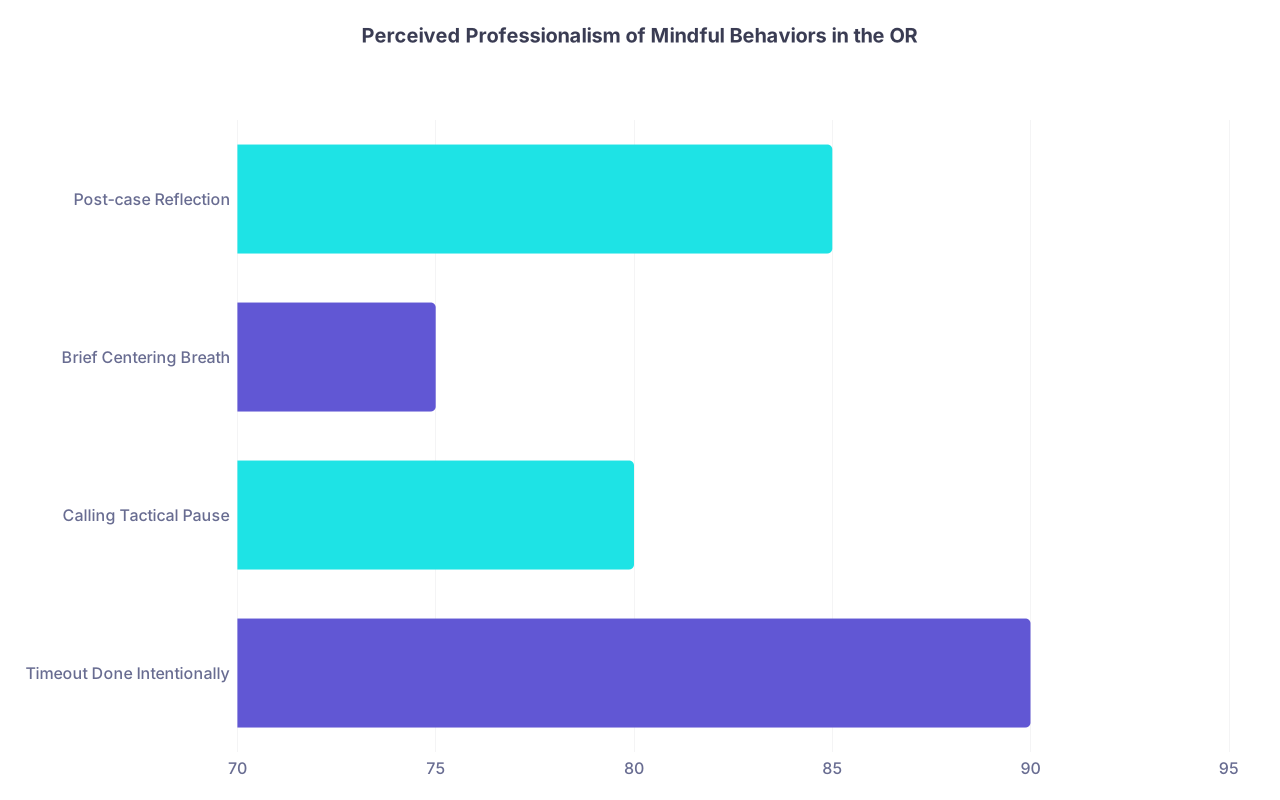
| Category | Value |
|---|---|
| Timeout Done Intentionally | 90 |
| Calling Tactical Pause | 80 |
| Brief Centering Breath | 75 |
| Post-case Reflection | 85 |
Surveys of trainees and nurses often show something striking: they see attendings who do these things as more professional, not less. More composed. More in control. More trustworthy.
The “unprofessional” label mostly comes from people who’ve never seen these behaviors modeled consistently by respected senior surgeons.
Where This Crosses Into Ethics
You put “medical ethics” in the header for a reason. Let’s go there.
If we know there are low‑cost, low‑risk practices that measurably improve attention, reduce cognitive errors, and support better emotional regulation under stress, choosing to ignore them isn’t just a “style” decision. It edges into ethical territory.
You’re expected to stay up‑to‑date on technical skills, infection control, and safety culture. Why should nontechnical cognitive skills be exempt? Why is it ethically unacceptable to refuse a checklist, but acceptable to refuse any training in managing your own cognitive overload?
No one is going to file a complaint because you refused to ever try a 5‑minute mindfulness exercise. But if your unregulated stress responses lead to recurrent OR blowups, abusive behavior, or avoidable errors, that will be framed as a professionalism issue. Maybe even a patient safety issue.
Mindfulness is one of the few tools that targets the root of that: how your mind behaves when things go sideways.
Ignoring that because it feels vaguely “soft” is not a strong ethical position.
The Bottom Line
Three points, no fluff:
The evidence from medicine and other high‑reliability fields is clear: training attention and emotional regulation via mindfulness‑type methods improves performance under stress, reduces errors, and supports professionalism—not the opposite.
What looks “unprofessional” in the OR is not a 3‑second centering breath or a deliberate timeout; it’s uncontrolled reactivity, tunnel vision, and ego‑driven chaos. Mindfulness targets exactly those failure modes.
At this point, dismissing mindfulness in the OR is mostly about culture and branding, not data. If you care about patient safety, team function, and your own longevity in this work, you do not have to like the word “mindfulness”—but you cannot honestly ignore the skills it describes.