
The standard RVU-heavy pay model punishes thoughtful doctors and rewards hamster-wheel medicine. You are right to push back.
If your job is trying to load you up with RVU risk while keeping base pay small, you are not “bad at business” for objecting. You just understand math and burnout better than whoever wrote that template contract.
Here is exactly how to ask for more base pay and less RVU exposure—step by step, with real phrases you can lift verbatim.
1. Understand What You’re Actually Arguing For
Before you walk into any negotiation, you need a clean mental model:
- Base pay = stability
- RVU incentive = risk and upside
- Too much RVU risk = unpaid call, overbooking, moral injury, and burnout
You are not asking for “more money because I deserve it.” You are asking for:
A compensation structure that aligns with safe care, predictable income, and realistic volume.
That framing matters. Administrators do not care about your feelings. They care about:
- Budget predictability
- Coverage and access metrics
- Turnover and recruitment costs
- Quality and patient satisfaction scores
Your ask has to connect to those, not just “I would like a higher base.”
| Category | Value |
|---|---|
| Base Salary | 55 |
| RVU Incentive | 35 |
| Other (call, stipends, admin) | 10 |
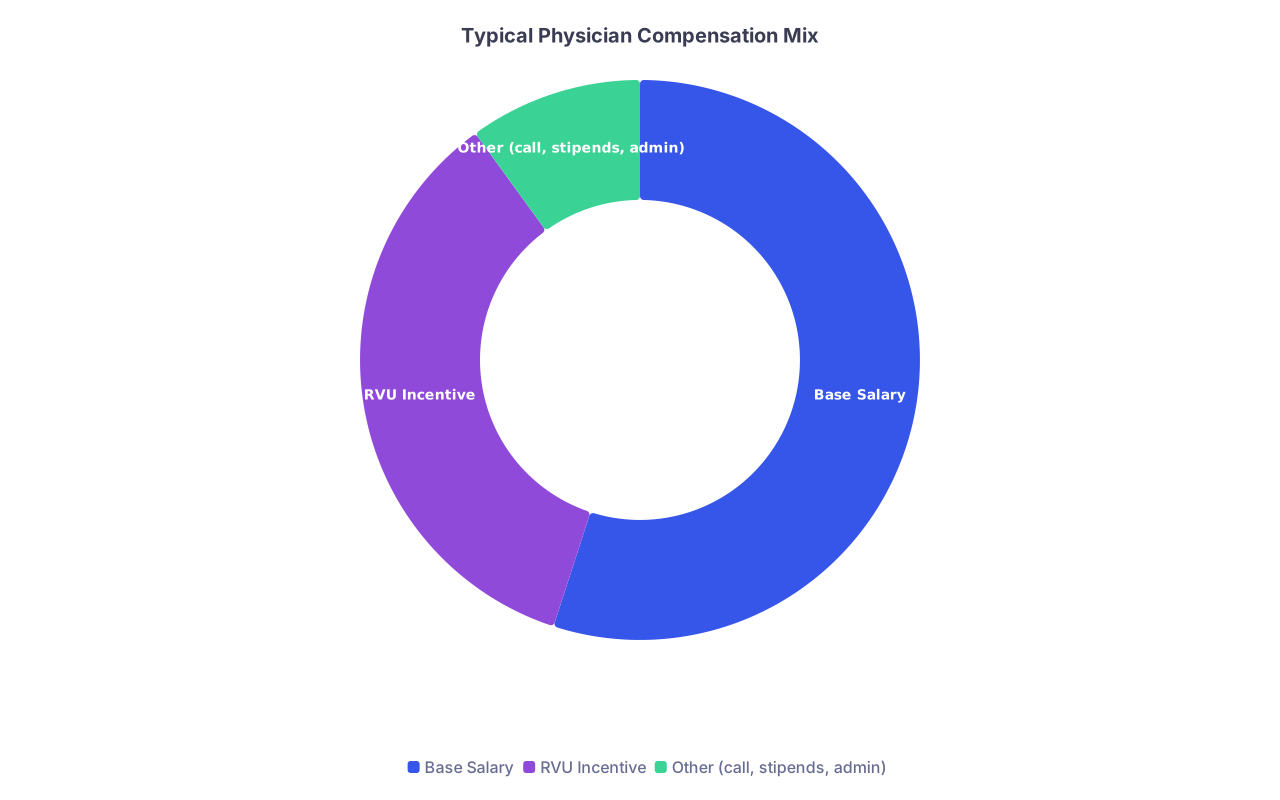
In many hospital-employed models, the “standard” split is something like:
- 50–60% base
- 30–40% RVU incentive
- 5–15% in stipends, call, admin roles, bonuses
You are going to argue toward something like 70–80% base, 10–25% RVU, with guardrails.
2. Get Your Numbers Straight Before You Talk
Do not wing this conversation. You need three buckets of data:
- Your actual or projected RVUs
- Benchmark data
- Your personal risk floor (minimum acceptable guaranteed income)
A. Know your current or expected numbers
If you are already in the job:
- Pull your last 12 months of:
- Total RVUs
- Collections (if available)
- Shifts/clinic sessions
- Call burden
If this is a new job:
- Ask, in writing:
- “What is the median and 75th percentile wRVU production for physicians in this role at our site?”
- “What percentage of current physicians in this role meet or exceed the RVU target?”
- “What was the turnover in this position over the last 3 years?”
If they dodge these, that is a red flag.
B. Get external benchmarks
Use:
- MGMA or AMGA data if you have access
- Specialty society compensation surveys
- Word-of-mouth from colleagues at similar systems
You are not going to argue “MGMA says I should be paid X so pay me X.” That rarely works. You are going to use ranges to show that your ask is reasonable.
C. Decide your minimum base
Decide privately:
“What minimum guaranteed annual salary do I need to feel safe and not constantly chasing RVUs?”
That is your walk-away floor. Write it down. If the offer cannot get there, you need to seriously consider saying no.

3. The Core Strategy: Shift the Frame from “More Money” to “Less Risk”
The dumb way to negotiate:
“I want 40k more base because I do a lot for this hospital.”
The smart way:
“Given the inherent variability in RVUs, I want to shift some of the compensation mix from at-risk RVU dollars into guaranteed base, while preserving a reasonable upside for high performance. That aligns better with quality care and reduces the pressure to over-volume.”
Administrators understand “risk mix” and “at-risk comp.” Use their language.
Your key talking points:
- Clinical risk and quality
- Too much RVU pressure = rushed visits, overbooking, burnout.
- Recruitment and retention
- Stable income = less turnover, easier to recruit, less disruption.
- Coverage
- If you are always chasing RVUs, you avoid low-RVU but high-importance work (teaching, complex cases, admin). Stable base pays for the “unbillable glue” that keeps the department functioning.
4. A Practical Script for the Meeting
Here’s the full script you can modify. Use this for a scheduled comp meeting with your chair, medical director, or HR.
Step 1: Opening and Framing
“Thanks for taking the time to talk about my compensation structure. I want to focus specifically on the balance between guaranteed base pay and RVU-based incentive, and how we can adjust that mix to be more sustainable long term—both for me and for the service.”
Pause. Let them agree this is the topic.
Step 2: State your current reality
If you are already in the role:
“Right now, my compensation is roughly structured as:
- Base of $___
- RVU target of ___ with a rate of $___ per RVU beyond that
- Which means about ___% of my income is at risk, tied directly to RVU volume.
Over the last year, I produced about ___ RVUs, which put me at [above/at/below] target. I have done that while taking on [X call shifts / Y committee roles / Z teaching duties].”
If this is a new offer:
“From the offer, I understand the structure as:
- Base of $___
- Annual RVU target of ___ at $___ per RVU over that
So roughly ___% of total expected comp assumes I hit or exceed target.”
Step 3: Translate that into risk
“The challenge with that structure is that a significant portion of my income depends on variables I do not fully control—clinic scheduling, template design, no-shows, payer mix, and hospital volume. When too much compensation is RVU-based, physicians are put in a position where safe, thoughtful care and adequate documentation time are in tension with compensation goals. That is not where I want to practice.”
You are not whining. You are stating a system design problem.

| Step | Description |
|---|---|
| Step 1 | Prepare data |
| Step 2 | Schedule meeting |
| Step 3 | State current structure |
| Step 4 | Explain risk concerns |
| Step 5 | Propose new mix |
| Step 6 | Clarify details |
| Step 7 | Negotiate options |
| Step 8 | Decide stay or walk |
| Step 9 | Admin response |
Step 4: Propose a specific new structure
Now the part most physicians screw up: they hint at dissatisfaction but never put a clear number on the table.
You will.
“What I would like to propose is shifting the mix toward more guaranteed base and less RVU risk, while still keeping an incentive component for high performance. Specifically, I am asking for:
- A base salary of $___
- With a lower RVU target of ___
- And an incentive rate of $___ per RVU above that, capped or structured so that the majority of my income—about 70–80%—is guaranteed.”
Do not leave it vague. They need a concrete model to react to.
If you want a template, use something like this:
Current:
- Base: $260k
- Target: 6,000 RVU at $50/RVU, expected income ≈ $350k
- Mix: 74% expected from base/RVUs-at-target, ~26% from “at risk” overage
Your proposal:
- Base: $310k
- Target: 5,000 RVU at $45/RVU, expected income ≈ $350–365k
- Mix: 85–90% likely guaranteed, 10–15% upside
You are not necessarily asking for more total comp. You are reshaping the risk. That is often easier to sell.
| Model | Base | RVU Target | RVU Rate | Expected Total | At-Risk % |
|---|---|---|---|---|---|
| Current Offer | 260k | 6000 | $50 | 350k | ~25% |
| Physician Ask | 310k | 5000 | $45 | 350–365k | ~10–15% |
| Compromise Idea | 290k | 5500 | $47 | 345–360k | ~18–20% |
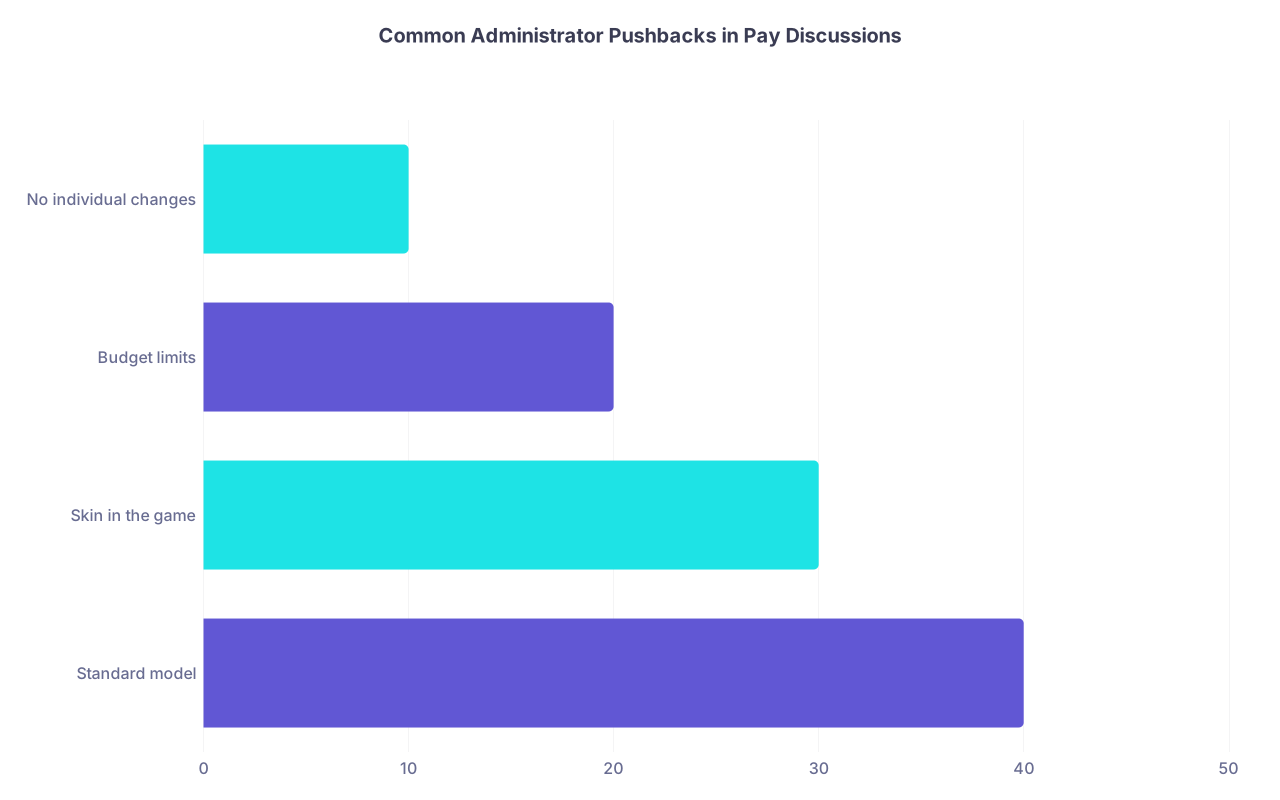
5. Specific Lines to Use for Common Pushbacks
You will hear the same tired objections. Have ready-made answers.
Objection 1: “This is our standard model.”
Response:
“I understand this is the default template. My concern is that the standard model puts too much income at risk for a role with high non-RVU responsibilities and variable volume. I am asking for an adjustment based on the actual work I am doing and the sustainability of the position.
Other systems have successfully moved toward higher base / lower RVU risk models to address burnout and retention. I want to make sure I can stay here and practice in a way that is safe and sustainable.”
Objection 2: “We need physicians to have skin in the game.”
Response:
“I agree completely. I am not asking to remove incentives. I am asking to right-size them.
Having 10–20% of my income tied to RVUs still keeps me highly motivated. Having 30–40% at risk can push people toward unsafe volume and shortcuts. I would rather be rewarded for consistent, high-quality work than forced into chasing marginal RVUs to cover my mortgage.”
Objection 3: “We cannot increase base without increasing expectations.”
Response:
“That is exactly my point: the current RVU expectations already assume a very high level of productivity. I am already [or, this role already] produces at or above benchmarks. I am trading some upside risk for a more predictable floor. The hospital benefits by:
- Lower turnover risk
- More willingness on my part to take on non-RVU tasks (teaching, committees, complex cases)
- Less pressure to overbook for volume
If the concern is budget, I am open to keeping total expected compensation roughly neutral, as long as more of it is guaranteed base rather than RVU risk.”
Objection 4: “We do not adjust contracts for individuals.”
Response:
“You have already adjusted for individuals—call stipends, leadership roles, sign-on bonuses, and retention bonuses are all individualized. This is not about special treatment. It is about making the structure match the actual work.
I want a model where I can stay long term. A modest shift in base vs RVU mix now is far cheaper than recruiting a replacement if I burn out or leave.”
| Category | Value |
|---|---|
| Standard model | 40 |
| Skin in the game | 30 |
| Budget limits | 20 |
| No individual changes | 10 |
6. How to Integrate Moonlighting and Other Income Streams
If the category is “moonlighting and benefits,” this part matters.
When you negotiate more base and less RVU risk, you are also buying yourself:
- Bandwidth to moonlight on your terms
- A stable floor that makes extra shifts optional, not mandatory
- Mental space to say “no” to exploitative extra work
A. Use moonlighting as leverage, not a crutch
Do not say:
“I need more base because I do not want to moonlight.”
Do say:
“Right now, I am supplementing income with extra work outside the system. If we can adjust my base to a reasonable level, I am willing to shift some of that effort internally—for example, additional shifts, backup call, or specific service coverage—under a predictable stipend model rather than pure RVUs.”
You are essentially offering them:
- Less leakage of your labor to outside hospitals
- More internal availability, but under sane terms
B. Separate base/RVU from moonlighting pay
Never let them blend:
- Your contract base + RVU
- With “oh, and also we might give you extra shifts at the same RVU rate”
You want moonlighting defined clearly:
- Flat hourly rate or shift rate
- Not tied to your main RVU target
- Ideally outside your primary wRVU expectations
You can say:
“For additional coverage beyond my core FTE, I would prefer a flat hourly or shift-based moonlighting rate, separate from my RVU targets. That avoids the situation where I am essentially working extra just to hit a moving RVU floor.”

7. Concrete Negotiation Variations You Can Propose
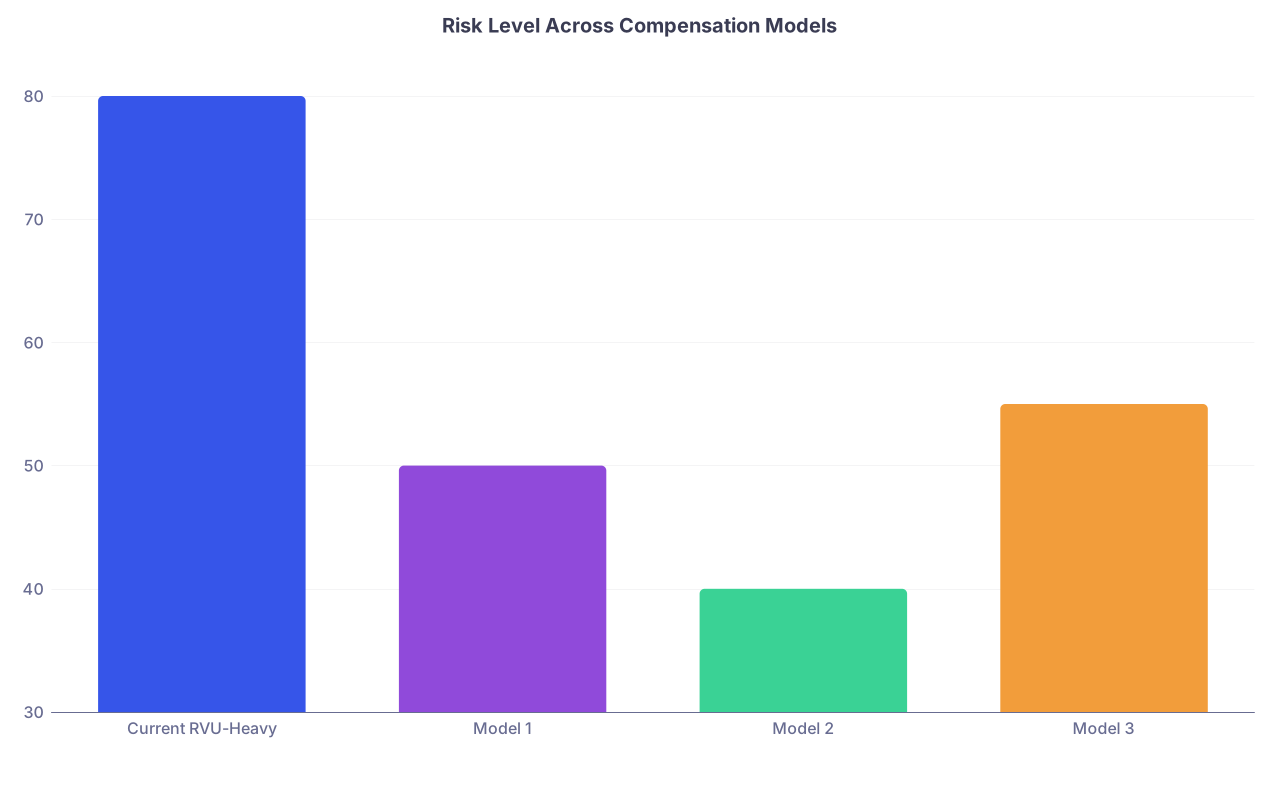
You do not have to get everything you ask for. But you should show options. Here are three models you can offer.
Model 1: Straight Base Increase / RVU Decrease
“Increase base by $X, lower target by Y RVUs, keep RVU rate similar.”
Good when:
- Your department is understaffed
- Your RVUs are already strong
- They are desperate to keep you
Model 2: Hybrid with Floor and Band
“Set a guaranteed minimum total compensation floor with a modest RVU band above and below.”
Example:
- Guaranteed minimum: $320k
- Expected: $350k if you hit target
- If you fall slightly short (e.g., 90–100% of target), you still get $320k
- If you exceed, you get bonus per RVU above
Phrase it like this:
“I would like a guaranteed minimum of $___, with an RVU-based band above that for high production. That protects against volume dips outside my control while still rewarding strong performance.”
Model 3: Partial Shift + Added Stipends
“Keep base similar but:
- Slightly lower RVU target
- Add a fixed stipend for non-RVU work (teaching, admin, complex case management)”
This removes some pressure without needing a big paper change in the base.
You can say:
“If increasing base is difficult from a budget category standpoint, I am open to a combination: modest base adjustment, slightly lower RVU target, and a fixed stipend for the non-RVU work I am already doing—[examples]. That effectively shifts income from at-risk to guaranteed without blowing up the comp model.”
| Category | Value |
|---|---|
| Current RVU-Heavy | 80 |
| Model 1 | 50 |
| Model 2 | 40 |
| Model 3 | 55 |
8. How to Close the Conversation Like a Professional, Not a Pleader
Do not end with: “So… what do you think?”
End with a clear next step.
“I would like to know two things:
- Conceptually, are you open to shifting some of my compensation from RVU risk into guaranteed base or stipends?
- If yes, who needs to be involved to revise the structure and what timeline are we looking at?”
If they seem open but noncommittal:
“I can send a one-page summary of the structure I am proposing—the base, target, and incentive. That way you have something concrete to review with finance. What would be a reasonable time for us to reconnect after you have looked at it?”
If they flatly refuse:
“I appreciate the clarity. For my own planning, that helps me understand the limits of what is possible here. I will need to think about whether this structure is sustainable for me long term.”
You do not threaten. You simply signal that you have options.
9. Red Flags That Tell You To Stop Negotiating and Start Planning an Exit
Some behaviors tell you the problem is cultural, not just contractual:
- They refuse to disclose average RVUs or comp for current physicians
- They insist “everyone here hits target, no problem” but cannot show data
- They dismiss burnout or quality concerns as “excuses”
- They tie every possible dollar (even admin roles) to RVUs
- They scoff at the idea of guaranteed minimums
If you see these, your best “negotiation” move may be:
- Take the experience you have
- Start discreetly exploring markets that already offer higher base, lower RVU risk
- Use your next offer as leverage—or as your escape hatch
Do not stay in a system that is structurally designed to grind you down.

FAQ (Exactly 3 Questions)
1. What if my RVU production is actually low—do I still have leverage to ask for more base pay?
Yes, but your argument shifts. You stop leaning on productivity and instead focus on role value and system design. Emphasize things like complex case mix, non-RVU responsibilities (teaching, QI, committees), and structural barriers to higher RVUs (limited templates, support staff shortages, capped OR time). Your ask becomes: “Given the constraints of this practice environment and the non-billable work I do, I need a more stable base to make this role sustainable.” You may not get big raises, but you can often negotiate a better risk mix.
2. Is it better to negotiate total compensation first and then talk about base vs RVU, or do it together?
Do it together. If you negotiate only total comp, they will often maintain the RVU-heavy mix and simply bump your target or offer a higher per-RVU rate—so you end up with more upside but also more risk. You want to anchor the conversation around structure: “I care about total compensation, but equally about the stability vs risk mix. I would accept slightly less potential upside in exchange for a higher guaranteed base.” That framing helps avoid being trapped in a pure “How much?” tug-of-war.
3. Can I use another job offer to push for more base and less RVU risk in my current position?
You can, but you must do it cleanly. Once you have a written offer elsewhere with a stronger base / lower RVU risk model, you can say: “I have another offer that structurally aligns better with my priorities—higher base, lower RVU risk, and clearer support for non-RVU work. I would prefer to stay here if we can get closer to that model. Is there room to adjust my base and RVU expectations to remain competitive?” Do not bluff. Only use this if you are willing to walk. If they say no, you already know your next step.
Open your contract—or draft offer—right now and write in the margin: “Current base: ___; Current at-risk RVU %: ___.” If you cannot answer those in 60 seconds, that is your first problem to fix this week.