
Competitive specialties do not care about “volunteering” the way premed advisors taught you to think about it. They care about signal, not hours.
Let me be blunt. If you are applying to dermatology, plastic surgery, orthopedic surgery, ENT, neurosurgery, ophtho, or any other bloodbath specialty and you are still obsessing over “how many volunteer hours is enough,” you are asking the wrong question. And probably listening to the wrong people.
Let’s break the myth properly.
The Big Myth: “You Need Tons of Volunteer Hours To Match Competitive”
Here’s the story I hear over and over:
“I need 200+ volunteer hours or they’ll think I don’t care about service.”
“My advisor said derm wants to see ‘commitment to community.’”
“I’m joining three more clinics this year so my app looks more well-rounded.”
No. That’s premed brain talking, not residency reality.
When program directors in competitive specialties look at your file, they are not sorting applicants by “total volunteer hours.” They’re looking for:
- Can this person handle the workload and complexity of the specialty?
- Do they have the academic and clinical chops?
- Have they shown specific interest and alignment with our field?
- Are they likely to be a normal, functional human on our team at 3 a.m.?
“Volunteering” only matters to the extent it answers one of those questions. And in most applications, it doesn’t. It just sits there as fluff.
What The Data Actually Shows
Let’s look at the numbers instead of vibes.
The NRMP Program Director Survey (yes, the actual survey programs fill out) gives you a window into how much different factors matter. They ask PDs to rate how important various components are and how often they use them to decide whom to interview.
Here’s a simplified comparison for a few competitive specialties using typical patterns from recent surveys:
| Specialty | Step 2 CK / COMLEX | Class rank / Grades | Research output | Volunteer / Service |
|---|---|---|---|---|
| Dermatology | Very high | Very high | Very high | Low–Moderate |
| Plastic Surg | Very high | Very high | Very high | Low–Moderate |
| Ortho Surg | Very high | Very high | Moderate–High | Low |
| ENT | Very high | Very high | High | Low–Moderate |
| Neurosurgery | Very high | Very high | Very high | Low |
You will not see “total volunteer hours” anywhere near the top of the list. What you do see:
- Board scores / exams
- Clinical grades
- Letters of recommendation
- Class rank / AOA / honors
- Research productivity, especially in the specialty
- Audition rotations performance
Volunteer/service shows up as “considered,” but very rarely as a major deciding factor.
Now look at where students actually put their time.
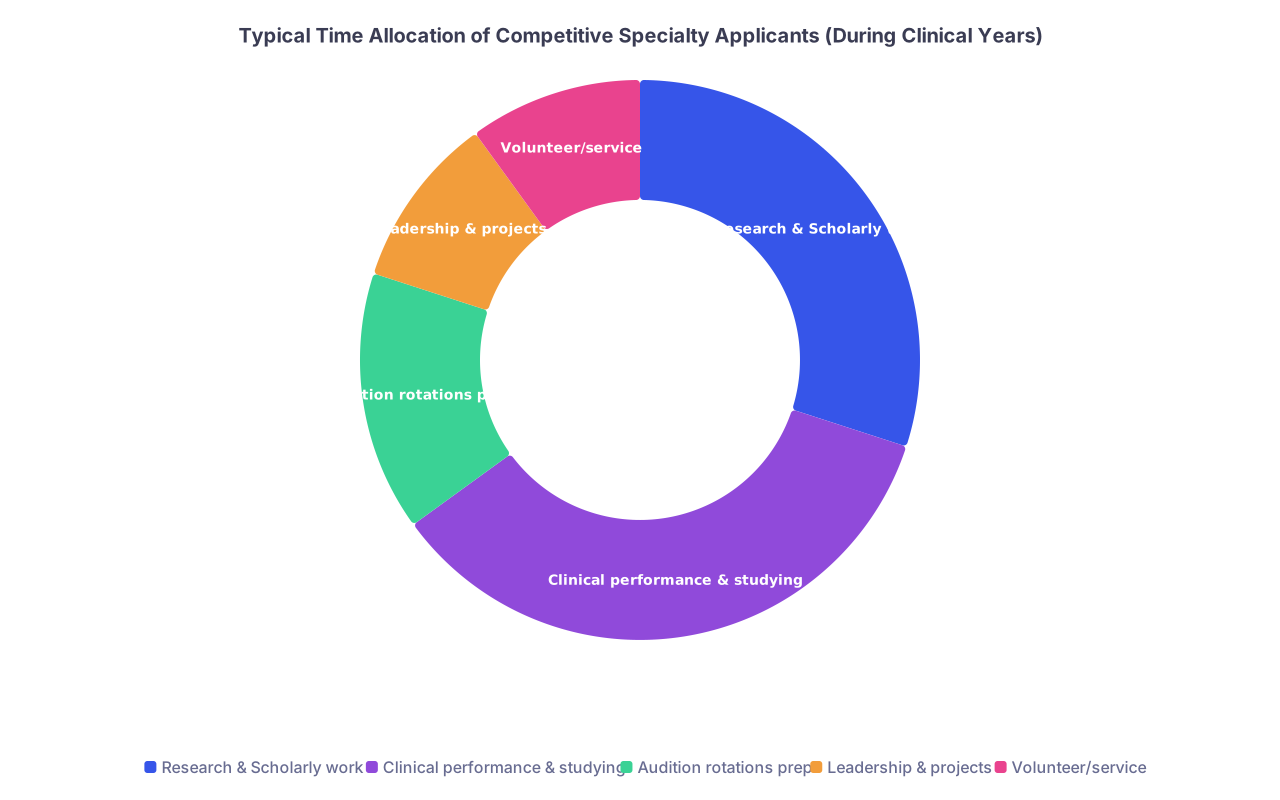
| Category | Value |
|---|---|
| Research & Scholarly work | 30 |
| Clinical performance & studying | 35 |
| Audition rotations prep | 15 |
| Leadership & projects | 10 |
| Volunteer/service | 10 |
The top applicants are not doing 300 hours of generic service. They’re doing a smaller amount of highly targeted, high-signal work.
What Programs Really Infer From “Volunteer Work”
Here’s the uncomfortable truth: most volunteer entries are invisible.
I’ve sat with residents flipping through ERAS. What gets attention?
- “Free clinic volunteer, 2019–2023, 400 hours” – skimmed, maybe a “nice” if someone is feeling generous.
- “Organizer, student-run derm screening fair for migrant workers, 3 years, led grant, 2 quality improvement projects, 1 poster at AAD” – people actually stop and talk.
Same category (“service”), completely different signal.
Programs use your experiences to infer:
- Interest in the specialty
- Free clinic? Fine. Free clinic with focused derm procedures, ophtho screening, ortho/joint clinic → much higher signal.
- Reliability and follow-through
- One-off events = whatever.
- Multi-year involvement, increasing responsibility = this person actually shows up.
- Team behavior and leadership
- Did you just “volunteer”? Or did you build, organize, fix something that made the system better?
- Likelihood you’re not a robot
- They want evidence you’re a normal human who can work with others and not implode under stress.
They do not care whether you hit some magic threshold of hours.
Specialty By Specialty: How Much Do They Actually Care?
Let’s get into some specifics.
Dermatology
Derm has a reputation for “wanting service.” Misleading shorthand.
What derm actually wants:
- High Step 2 / COMLEX scores
- Honors in core rotations, especially medicine
- Hefty research in derm or adjacent fields
- Strong letters from derm faculty
- Evidence you understand what derm actually is (not just “lifestyle”)
Service fits in as: sustained, dermatology-relevant, impact-oriented work. Examples that catch attention:
- Running skin cancer screening clinics for uninsured populations
- Creating an eczema education program for pediatrics and presenting results
- Long-term involvement in a psoriasis support or telederm access initiative
Stuff that doesn’t move the needle much:
- Generic hospital volunteering
- “Health fair” volunteer with no continuity
- Random non-clinical charity work with no story and no leadership
Orthopedic Surgery
Ortho cares about grit, work ethic, and being someone they can stand on trauma call.
They prioritize:
- Board scores and clinical performance
- Performance on ortho rotations and sub-Is
- Research, especially with ortho surgeons
- Letters from surgeons who actually worked with you
Volunteer work is often background noise unless:
- It shows physical commitment or teamwork (long-term coaching, adaptive sports, military/vet rehab programs).
- It pairs with ortho – e.g., organizing follow-up care for uninsured fracture patients, mobility clinics, amputee support.
Hours at a generic “volunteer office” won’t hurt you. But they won’t save you either.
Plastic Surgery (Integrated)
Plastic surgery is savage on research and excellence.
They love:
- Big research portfolios (especially plastics, wound healing, microsurgery, outcomes)
- Artistic, design, or fine motor skill evidence (yes, this actually comes up)
- Strong letters from plastics faculty
- Evidence of vision and initiative
Service that stands out:
- Global surgery or reconstructive trips that led to QI projects or protocols
- Setting up a flap monitoring protocol or patient education program and studying its outcomes
- Longitudinal work with burn survivors or craniofacial patient families
Again: targeted, long-term, and integrated with your plastics story.
Neurosurgery
Neurosurgery doesn’t care if you did 250 hours tutoring middle schoolers. They want:
- Near-top-of-class academic performance
- Very strong research (often multiple neurosurg publications)
- Showing up early and staying late on neurosurg rotations
- Composure under pressure and weird hours
Service is bonus if it shows psychological resilience and commitment, like:
- Longstanding work with brain injury support groups
- Building a community seizure safety or stroke recognition program with measurable outcomes
But “general volunteer work” is nowhere near the top of their mental checklist.
The pattern is clear: competitive specialties want a coherent narrative more than they want raw volunteer hours.
The “Well-Rounded Applicant” Trap
The phrase that messes people up is “we want well-rounded applicants.”
You hear that and translate it into:
“I must stack my CV with different types of volunteering so I look balanced.”
Programs mean something different. “Well-rounded” to them:
- Not a social disaster
- Not a pure test-taking machine with zero evidence of teamwork
- Has some interests or commitments beyond raw self-advancement
- Doesn’t raise red flags on professionalism
They do not mean:
- “Show us eight different volunteer projects so we know you care.”
I’ve seen numerous unmatched applicants to derm/ortho/ENT with tons of volunteer hours and nice “service statements,” but mediocre research or weak letters. They thought service would compensate. It doesn’t.
What Actually Helps vs. What Just Fills Space
Let me draw the line more clearly.
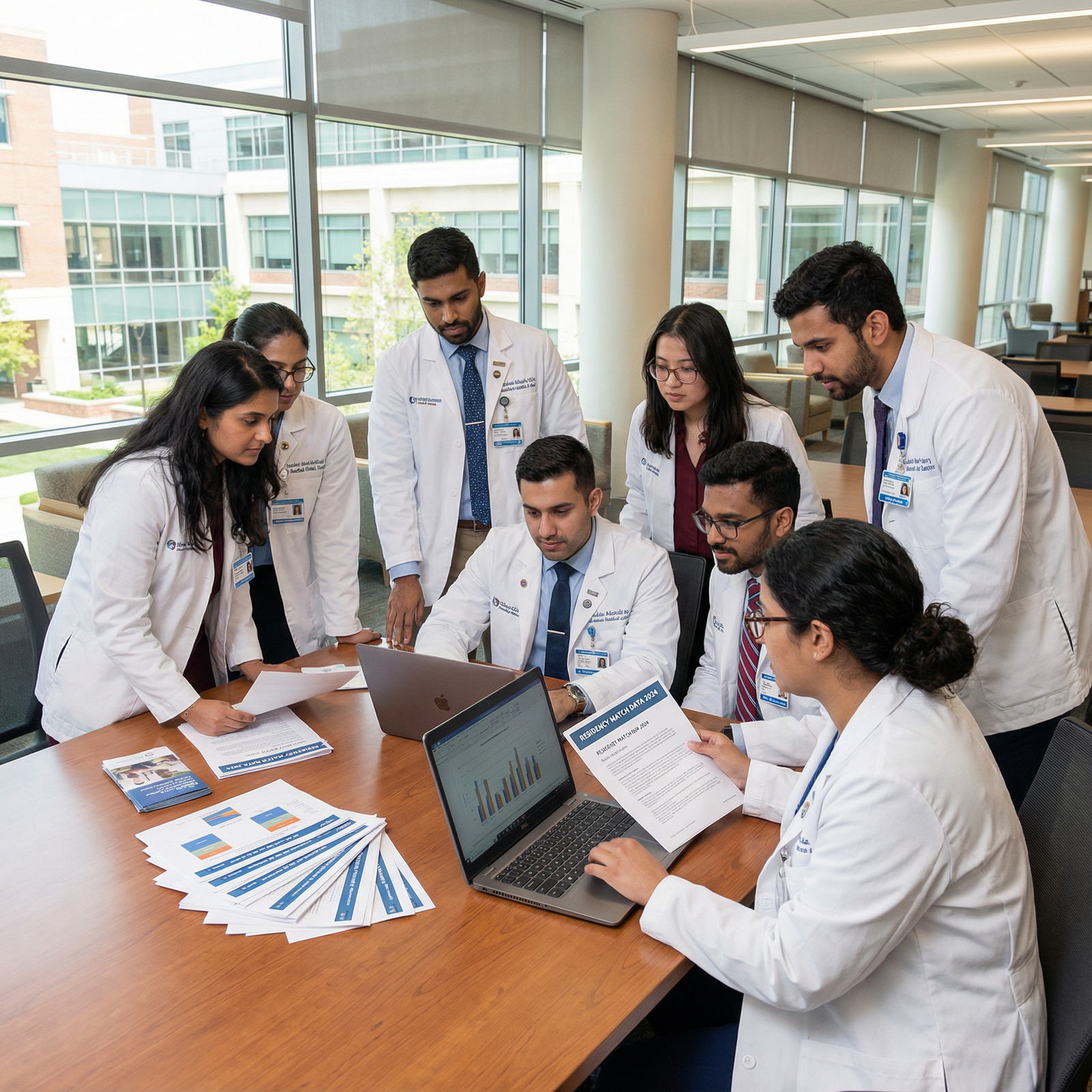
High-yield “volunteer/service” for competitive specialties:
- Long-term (years), not months
- Increasing responsibility: member → coordinator → director
- Direct connection to your specialty or to patient care systems
- Produces something concrete: QI project, poster, protocol change, measurable outcomes
- Gives your letter writers a compelling story to tell about you
Low-yield volunteering:
- One-day or single-week events
- Generic roles like “hospital volunteer,” “greeter,” “gift shop worker” with no evolution
- Short bursts of activity scattered everywhere (“1 month here, 2 months there”)
- High hours, low depth, no narrative thread
Programs reading hundreds of apps develop a sixth sense for “padding.” You won’t trick them with volume.
How Volunteer Work Does Matter – Indirectly
Here’s the nuance people miss. Volunteer work can matter a lot indirectly, through:
- Letters of Recommendation
- If a faculty member watched you build and run a clinic for 3 years, that letter will destroy 10 generic “hard worker” letters.
- Interview Talking Points
- Real, sustained work gives you rich stories for, “Tell me about a time you…”
- Burnout Protection
- Some applicants only grind. You can feel it in interviews. Deep, meaningful service gives some proof you’re not hollow.
- Red Flag Prevention
- If your app is 100% self-serving (scores, research, awards) with zero evidence of working with or for others, some PDs do side-eye that.
So yes, service can matter. But it’s better to think of it as a way to generate substance rather than “points.”
If You’re Early: How To Build Service That Actually Counts
If you’re MS1 or early MS2 and eyeing a competitive specialty, here’s a smarter approach.

| Step | Description |
|---|---|
| Step 1 | Pick Specialty Interest |
| Step 2 | Find Related Clinic or Group |
| Step 3 | Commit for 1 to 3 Years |
| Step 4 | Take On Responsibility |
| Step 5 | Link With QI or Research |
| Step 6 | Present or Publish Outcomes |
| Step 7 | Ask For Strong Letter |
Strategic path, not “sign up for 6 random things.”
Examples:
- Derm: Join a skin cancer screening program, then build a tracking system to follow up abnormal findings and present your data.
- Ortho: Volunteer with a mobility clinic or adaptive sports program and create a small outcomes project around patient function or satisfaction.
- Plastics: Work with a burn unit support group and help create educational materials, then evaluate their impact.
- ENT: Long-term work with kids with hearing loss, then partner with audiology to improve follow-up attendance.
This way, your “volunteer work” becomes:
- Longitudinal
- Specialty-aligned
- Measurable
- A source of letters, posters, and interview stories
You can do that in 2–4 hours a week, consistently, and it will beat 200 random hours every single time.
If You’re Late: Stop Chasing Hours
If you’re MS3/MS4 or approaching application season and realizing your volunteer hours look “thin,” don’t panic and don’t start hour-chasing.
You’re far better off:
- Shoring up research output (especially getting something submitted or accepted)
- Maximizing performance on sub-Is / away rotations
- Tightening relationships with letter writers
- Doing one focused, meaningful project rather than five superficial new activities
Last-minute volunteering reads exactly like last-minute volunteering. Programs know the application calendar too.
The Quiet Reality: Some Programs Do Like Service – But Not the Way You Think
Yes, there are academic centers and certain fields (peds, FM, psych) where service and advocacy are more central. Even some derm and ENT programs have a strong community mission and explicitly value outreach.
But again, it’s not about raw hours. It’s about alignment and authenticity.
I’ve heard more than one PD say something like:
“If someone’s deeply involved in meaningful service for years, that tells me more about them than one extra case report.”
Key word: deeply.
Not “joined the outreach committee three months before ERAS opened.”
Quick Reality Check: Where You Actually Stand
Take 5 minutes and audit your own app.
| Domain | Strong? (Y/N) | Comments |
|---|---|---|
| Exams (Step 2/COMLEX) | ||
| Clinical grades | ||
| Research in specialty | ||
| Strong specialty letters | ||
| Specialty-related service | ||
| Generic service only |
If your “service” box is the only strong one, you have a problem. If it’s completely empty but everything else is stellar, you probably don’t.
Now look at how your service connects to your specialty. If it doesn’t, think in terms of:
- Can I tie this to a small QI or outcomes project quickly?
- Can I get a meaningful story and letter from this?
- Does this show attributes that match my specialty’s culture?
If not, stop worrying about the hours and focus on the parts of your app that actually drive interviews.
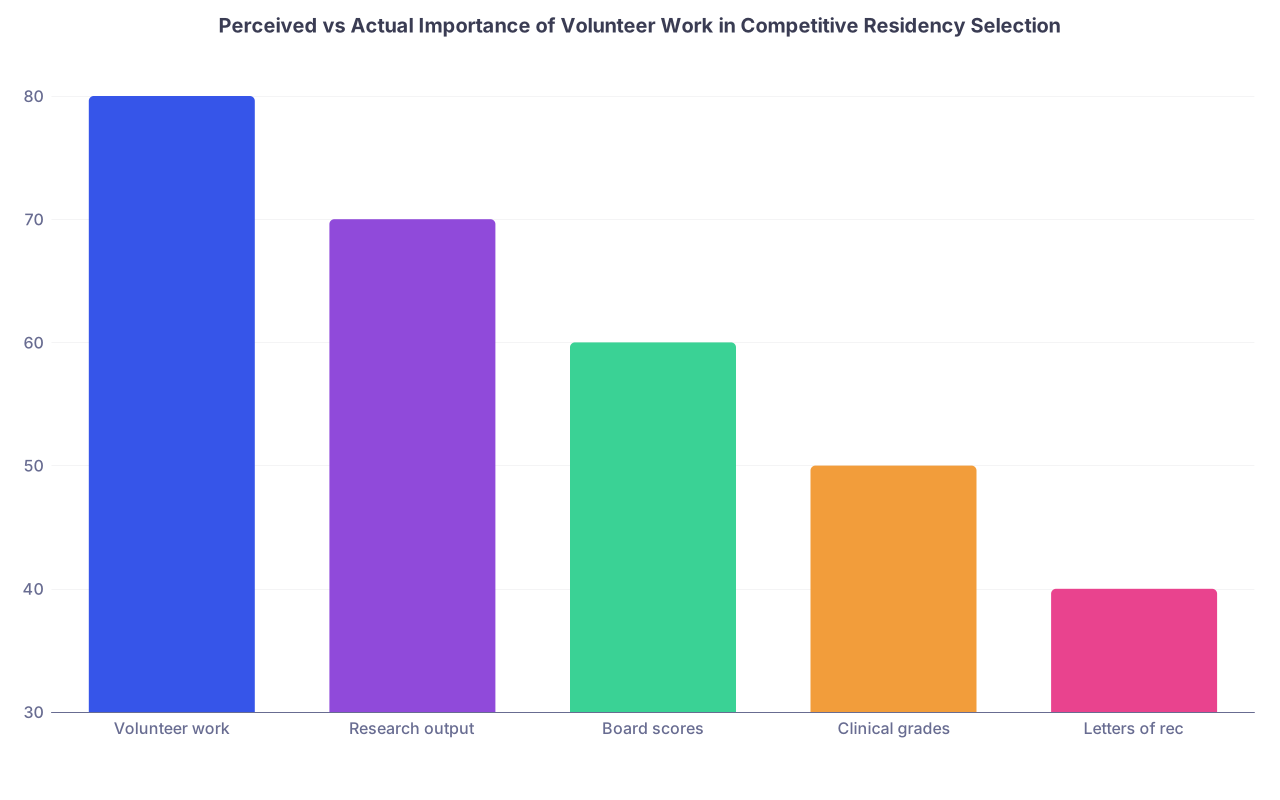
| Category | Value |
|---|---|
| Volunteer work | 80 |
| Research output | 70 |
| Board scores | 60 |
| Clinical grades | 50 |
| Letters of rec | 40 |
Correction: That’s how students rank it in their heads. Programs invert that list.
The Bottom Line
Let’s end cleanly.
- Competitive specialties do not care about your total volunteer hours; they care about high-signal, longitudinal, specialty-aligned work that proves something about you.
- Generic, short-term, scattershot volunteering is essentially decorative on a competitive application; it will not rescue weak scores, weak research, or weak letters.
- If you want service to matter, make it deep, sustained, tied to your specialty, and ideally linked to a tangible outcome—then stop chasing hours and fix the rest of your application.