Three Years Out: Long-Range Planning for Residents Targeting Competitive Fellowships
It’s July 1st of PGY-1. You just figured out how to log into the EMR without calling IT. Your pager won’t shut up. And somewhere between your third admission and the cross-cover disaster, someone says:
“So, what are you thinking? Cards? Heme/Onc? GI? Anything academic?”
You mumble something noncommittal, but here’s the truth: for the most competitive fellowships, the clock already started. You are three years out from applications, and what you do in the next 6–12 months will quietly decide if you’re near the top of the pile or an easy screen-out.
I’m going to walk you through this chronologically. Year by year, then quarter by quarter, and for the crunch times, week by week. Think of it as the resident version of a flight plan.
We’re talking about things like:
- Cardiology
- GI
- Heme/Onc
- Pulm/CCM
- Allergy/Immunology
- Occasionally others (Endo, Rheum, academic-heavy tracks) depending on your institution
If you want a competitive academic spot or a big-name program, treat this as your baseline, not your stretch goal.
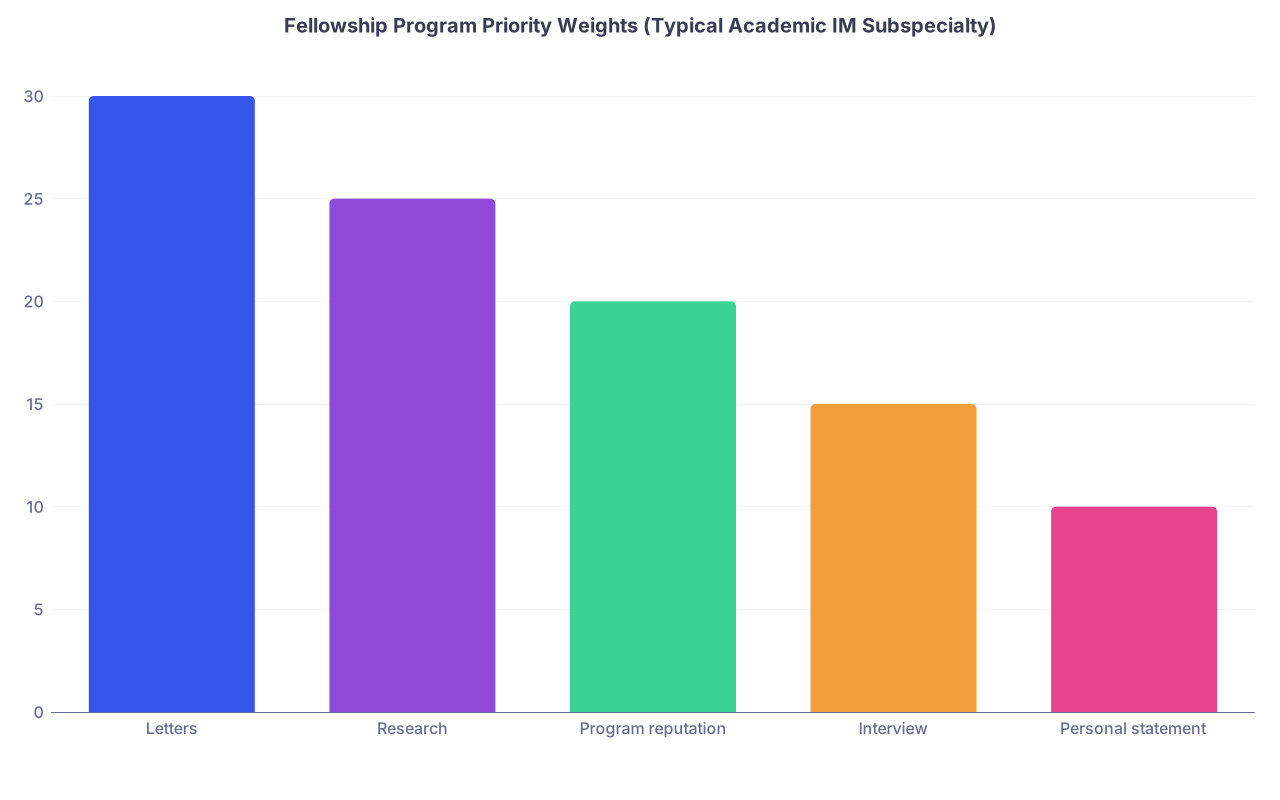
| Category | Value |
|---|---|
| Letters | 30 |
| Research | 25 |
| Program reputation | 20 |
| Interview | 15 |
| Personal statement | 10 |
PGY-1: Foundation Year (T–3 Years From Fellowship Start, ~T–2 Years From Application)
At this point you should not be “doing everything.” You should be quietly laying the rails so that PGY-2 and early PGY-3 are productive instead of panic-driven.
Months 1–3 (July–September, PGY-1)
Your only job clinically: survive and become safe. From a fellowship standpoint:
At this point you should:
- Clarify your target zone, even if it’s fuzzy
- Identify 1–2 potential mentors
- Protect specific rotations and time
Concrete moves:
Pick a direction, not a prison sentence.
You don’t have to swear a blood oath to cardiology vs Heme/Onc yet, but you do need a working direction so you know who to talk to and what to read.- Direction examples:
- “Procedure-heavy ICU/cardiology path”
- “Onc and clinical trials”
- “GI with interest in IBD and QI”
- Wrong answer: “I’ll decide PGY-3.” That’s how you end up with zero meaningful outputs.
- Direction examples:
Map your program’s ecosystem.
Spend 1–2 nights on:- Department website → which faculty publish a lot?
- Who runs the fellowship? Who runs resident research?
- Which attendings are known for “getting residents into good fellowships”?
Ask senior residents directly:
“Who actually gets stuff done for residents applying to cards / Heme/Onc / GI?”Plant mentor seeds.
During rotations with subspecialty attendings:- Stay 10–15 minutes after rounds twice a week
- Ask 1–2 smart, specific questions
- When you click with someone, say:
- “I’m a PGY-1 thinking long-term about GI. Could I set up a short meeting to ask about how to structure residency for that?”
You’re not asking for a project yet. You’re building familiarity so when you do ask, you’re not some random intern.
Protect future elective time.
Talk to chief residents / scheduler by the end of Q1:- Request at least:
- 1 subspecialty elective in your target area in late PGY-1 or early PGY-2
- 1 research elective (even if “tentative”) PGY-2 If you wait until PGY-2 to ask, those blocks are usually gone.
- Request at least:
Months 4–6 (October–December, PGY-1)
You’re less terrified. Good. Time to be intentional.
At this point you should:
- Lock in at least one concrete project
- Start tracking your CV in real time
- Make yourself visible to the fellowship division
Get on a project with a realistic output.
You don’t need an RCT. You need something that can produce a line on your CV within 12–18 months:- Case series with clear publishable angle
- Retrospective chart review
- QI project with genuine data and outcomes
- Sub-analysis on an existing database
When you approach a mentor, ask:
- “Is there a small piece of work where I could realistically be first or second author by the end of PGY-2 if I start now?”
If they hesitate or say “we’ll see” with nothing specific → find a second mentor. I’ve watched residents lose 18 months to vague promises.
Start a living CV file.
One Google Doc or Word file:- Education
- Exams (include Step 1/2, ITE scores as you get them)
- Research / QI / presentations (even pending)
- Teaching / leadership Update it monthly. Future-you will not remember the date of that obscure noon-conference talk.
Show up to subspecialty conferences.
Once a month, drag yourself (post-call if you must) to:- Cardiology conference / tumor board / ILD conference / IBD conference, etc.
- Say hello to the fellowship PD a couple of times across the year. You’re not pitching yet, you’re becoming a familiar face.
Months 7–12 (January–June, PGY-1)
Now you should start acting like someone with a plan.
At this point you should:
- Have at least one active project with defined tasks
- Be circling toward one primary mentor
- Start aligning your clinical performance with your target field
Turn project ideas into timelines.
Sit with your project mentor and hammer out:- Specific aim(s)
- Your role
- Data source
- Target output: abstract vs manuscript, where to submit
- Timeline:
- Data pull by X date
- Analysis by Y
- Draft by Z
Put the dates in your calendar. Treat them like call schedules.
Deliberately impress subspecialists on service.
On consult or specialty wards in your field:- Pre-round well, write tight notes
- Read 1 primary paper / guideline per week in that field and mention it when relevant
- Send 1–2 follow-up emails after rotation:
- “Thank you for the teaching this month, I especially appreciated [specific]. I’m interested in [field] and would love to work with you in the future if projects arise.”
Fix any glaring weaknesses now.
End-of-year feedback harsh on:- Professionalism
- Efficiency
- Communication
Those will tank letters. Clean them up before PGY-2. Ask your PD point-blank: - “I’m aiming for a competitive subspecialty. What would worry you about writing me a strong letter a year from now?”
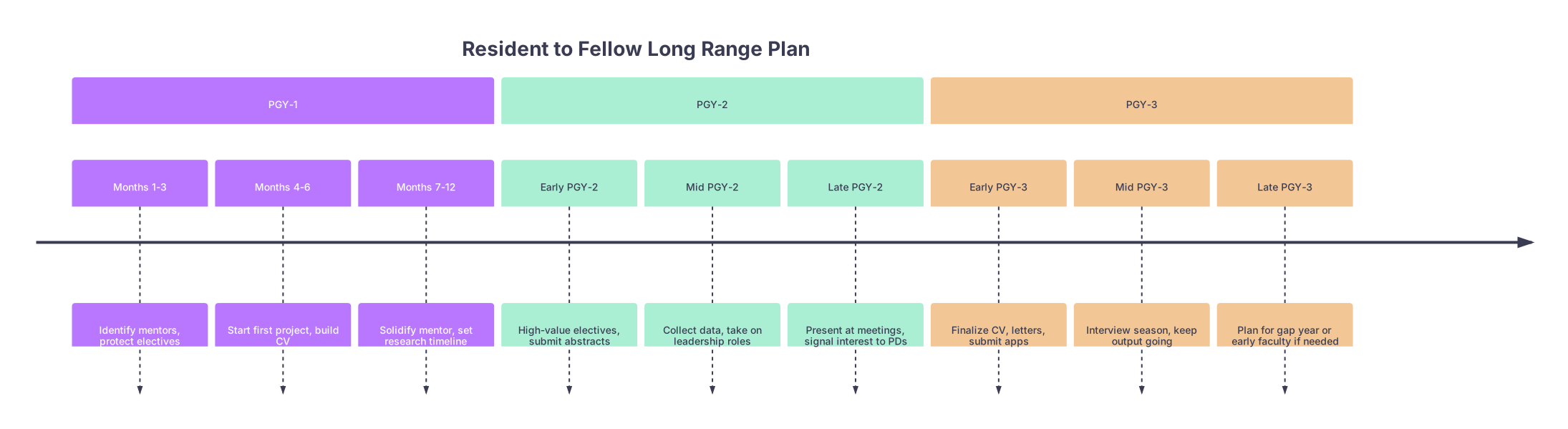
| Period | Event |
|---|---|
| PGY-1 - Months 1-3 | Identify mentors, protect electives |
| PGY-1 - Months 4-6 | Start first project, build CV |
| PGY-1 - Months 7-12 | Solidify mentor, set research timeline |
| PGY-2 - Early PGY-2 | High-value electives, submit abstracts |
| PGY-2 - Mid PGY-2 | Collect data, take on leadership roles |
| PGY-2 - Late PGY-2 | Present at meetings, signal interest to PDs |
| PGY-3 - Early PGY-3 | Finalize CV, letters, submit apps |
| PGY-3 - Mid PGY-3 | Interview season, keep output going |
| PGY-3 - Late PGY-3 | Plan for gap year or early faculty if needed |
PGY-2: Production Year (T–2 to T–1 Years From Fellowship Start)
This is where careers separate. Some PGY-2s just “do second-year things.” The ones who match competitive fellowships treat PGY-2 like a two-job year: clinician + portfolio builder.
Early PGY-2 (July–October)
At this point you should:
- Be on a first-name basis with at least one key faculty in your target field
- Have one main project actively moving, ideally a second brewing
- Be strategically choosing electives and clinics
Subspecialty electives with intent.
During your target-field elective:- Ask to attend:
- Division conference
- Journal club
- Research meeting if they allow it
- Ask 2–3 attendings during the month:
- “I’m aiming for a fellowship in [field]. What separates your strongest applicants from the average ones?”
Collect patterns. You’ll hear the same 3–4 themes again and again.
- Ask to attend:
Clinic selection matters more than residents admit.
If your program allows:- Grab a continuity clinic with:
- A well-known subspecialist
- Or someone who sits on the fellowship selection committee That attending will see you 2–3x/month for years. That’s gold for letters.
- Grab a continuity clinic with:
Make your first abstract happen.
By the end of calendar year PGY-2, you want:- At least one abstract submitted to:
- A national meeting (AHA, ASCO, ATS, ACG, etc.)
or - A strong regional meeting if national is too far yet Abstracts → posters → lines on your CV → talking points for interviews.
- A national meeting (AHA, ASCO, ATS, ACG, etc.)
- At least one abstract submitted to:
Mid PGY-2 (November–February)
This is research grind time.
At this point you should:
- Be regularly blocking time for project work
- Be visible as “the resident who is serious about [field]”
- Start collecting informal advocates
Time-block project work like shifts.
Hospital will eat every unscheduled minute. So schedule “research shifts”:- 2–3 blocks/week of 60–90 minutes on lighter weeks
- Protected on days off when not post-call Use them for:
- Data cleaning
- Drafting abstracts
- Literature review
Ask for interim feedback on your trajectory.
Short meetings with:- Your main mentor
- Program leadership (APD/PD) Discussion points:
- “I’m targeting a good academic [cards/GI/Onc/etc] fellowship.”
- “Here’s what I have so far. What’s still missing for me to be a strong applicant at [e.g., top 30 programs]?”
Push for specifics: another project, teaching role, leadership title, etc.
Start one more small, fast project if feasible.
Not a monster. A surgical strike:- Case report with strong teaching point
- Small QI project with quick pre/post data Aim: An additional abstract or short paper before fellowship apps.
Late PGY-2 (March–June)
This is your “public record” year. What you present and publish now is what programs will see on your application.
At this point you should:
- Have at least one presentation, ideally at a reputable meeting
- Be building a clear narrative: “I’m Serious About X and Here’s My Track Record”
- Start softly signaling interest to fellowship PDs
Present, then leverage the presentation.
After you present a poster or talk:- Email your PD and division chief:
- “Wanted to share that our abstract on [topic] was presented at [meeting]. Thank you for your support.”
- Update your CV immediately:
- Include authors, title, meeting name, date
If the fellowship PD is at that meeting, introduce yourself briefly. You’re planting seeds.
- Email your PD and division chief:
Formal mentor meeting: fellowship application strategy.
Before the end of PGY-2 year:- Sit with your primary mentor and ask:
- “Where do you see me as competitive?”
- “Which programs should be reach/target/safety for me?”
- “Who can write my 3–4 strongest letters?” This should not be a mystery going into PGY-3.
- Sit with your primary mentor and ask:
Start building your “hook.”
Competitive fellowships like trajectories, not random activity. Examples:- Cardiology:
- HF readmissions QI project + echo elective + HF clinic
- Heme/Onc:
- Solid tumor outcomes project + tumor board attendance + oncology clinic
- GI:
- IBD database work + IBD clinic exposure + colonoscopy quality QI
The story should be obvious to a stranger reading your CV in 60 seconds.
- IBD database work + IBD clinic exposure + colonoscopy quality QI
- Cardiology:
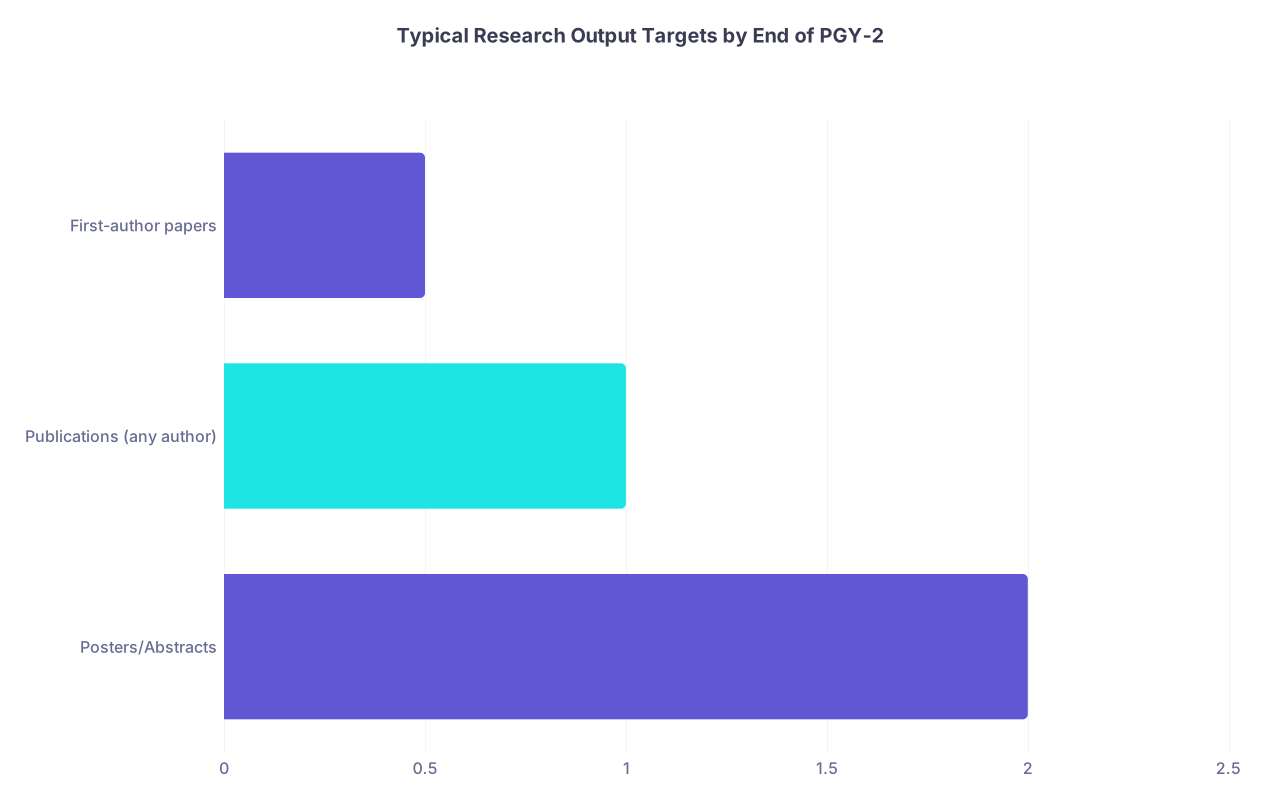
| Category | Value |
|---|---|
| Posters/Abstracts | 2 |
| Publications (any author) | 1 |
| First-author papers | 0.5 |
Early PGY-3: Application Year (T–1 Year From Fellowship Start)
This is where the calendar gets tight. Most subspecialty fellowship applications (ERAS) go in around late June–July of PGY-3 for a start date the following July.
So by July 1 of PGY-3, you are essentially at the 4–6 month warning for applications.
PGY-3 Pre-Game (March–June of PGY-2, functionally)
You already started some of this, but tighten it now:
At this point you should:
- Know your letter writers and have their verbal commitment
- Have a nearly clean CV draft
- Be finishing at least one manuscript or major abstract
Lock your letter writers by name.
You want 3–4 strong letters:- 1 from your PD or APD
- 1–2 from subspecialists in your field (one ideally well-known)
- 1 from a research mentor (if different from above)
Ask them by late PGY-2:
- “Would you feel comfortable writing me a strong letter for [field] fellowship?”
If they hesitate or hedge, pivot. Do not chase tepid letters.
Aim to have “submitted” or “in preparation” status.
Programs know manuscripts take time. Having:- 1–2 submitted manuscripts
- 2–4 abstracts/posters total looks markedly different from:
- “Started a project, data collection ongoing”
Fix any lingering professionalism/competence concerns.
PDs talk. If there were issues PGY-1/2, you want:- A documented story of improvement
- A PD who can honestly say: “They had early challenges but are now outstanding.”
PGY-3, Months 1–3 (July–September): Application Launch
This is the crunch.
At this point you should:
- Submit ERAS on time or early
- Have all letters requested with plenty of lead time
- Be ready to answer “Why this field? Why here?” without sounding generic
ERAS Application Strategy (June–July).
Key deadlines vary, but:- Personal statement:
- Get a draft done by May
- Edited by mentor and PD by June
- CV: Convert your running document into ERAS format
- Program list:
- Use PD/mentor input to stratify:
- Reach
- Realistic
- Safer options
- Use PD/mentor input to stratify:
- Personal statement:
Personal statement content (no fluff).
You are not writing a novel. You are doing 3 things:- State your interest and focus within the field
- Show evidence: specific rotations, projects, patient stories that led to this
- Nod toward your future direction (academics, research area, teaching)
If most of your statement applies equally to any subspecialty, you’re doing it wrong.
Letters: deadlines and nudges.
Ask letter writers:- “Would end of June be a reasonable deadline for having the letter in the system?”
Then: - Gentle email nudge 3–4 weeks before
- Another if needed 1–2 weeks before ERAS opens for programs
- “Would end of June be a reasonable deadline for having the letter in the system?”
PGY-3, Months 4–6 (October–December): Interview Season
You’ll be juggling:
- Fellowship interviews
- Senior resident responsibilities
- Maybe ongoing projects
At this point you should:
- Interview like a future colleague, not a nervous student
- Use each interview to refine your story
- Keep some academic output trickling
Interview prep in concentrated bursts.
Week before interview-heavy stretches:- 1-page summary on each program:
- Strengths
- Unique tracks
- Faculty with similar interests
- 5–7 questions you actually care about (not “tell me about your program”)
- 1-page summary on each program:
Have 3–4 anchor stories ready.
For common themes:- Tough clinical case that shaped you
- Conflict you handled professionally
- A failure or challenge and what changed afterward
- Project you led and what you learned
Keep the home program happy.
Do not become the senior who disappears because of interviews:- Proactively trade shifts
- Tell chiefs your heavy interview weeks early
- Keep evaluations strong; fellowship PDs ask your PD, “How are they as a senior?”
PGY-3 Late and Beyond: Contingency Planning
Match goes your way? Great. You’re lining up licensure, visas (if applicable), and wrapping projects.
If you do not match a highly competitive fellowship, this is not career death. But you need a plan, not denial.
If You Match
At this point you should:
- Close the loop on projects
- Strengthen bridges, don’t burn them
- Start thinking 2–3 years beyond fellowship
Actions:
- Convert remaining abstracts into manuscripts
- Stay in touch with mentors; you might need them for job letters
- Clarify your likely path after fellowship (academics vs community with niche, etc.)
If You Do Not Match
No sugarcoating: it stings. But I’ve seen many people regroup and end up in great fellowships a year later.
At this point you should:
- Get an honest post-mortem from PD and mentors
- Decide between:
- Reapplying with a research/clinical gap year
- Pivoting to a different but related field
- Aiming for a different type of practice
Common productive routes:
- 1-year research fellowship in the same field
- Chief resident year with deliberate academic/research focus
- Hospitalist year with intense research collaboration and reapplication
| Timepoint | Minimum You Should Have |
|---|---|
| End of PGY-1 | 1 active project, 1 mentor, electives set |
| Mid PGY-2 | 1 submitted abstract, clear field choice |
| End of PGY-2 | 2+ abstracts, 1 manuscript in progress, letter writers identified |
| ERAS Submission (PGY-3) | Strong letters, coherent narrative, updated CV |
| Before Interviews | 1–2 presentations, ongoing work, PD support clearly strong |
Final Takeaways
- Three years out, you’re not “too early.” For competitive fellowships, PGY-1 is when you quietly put the structure in place: mentors, projects, electives.
- PGY-2 is your production year. At this point you should be turning effort into visible output—abstracts, manuscripts, teaching, and a clear narrative within your chosen field.
- By early PGY-3, there should be no surprises. Letters lined up, CV cleaned, story coherent. If you’re still “figuring it out” at that point, you’re handing spots to the residents who treated this like a three-year plan, not a three-month scramble.