
If Rumors Spread Your New Program Might Merge or Close: What to Do
It’s a random Tuesday post-call. You’re half asleep, scrolling your phone, and you see it in a group chat: “Hey, did you hear? Admin is talking about merging our program with [Nearby Hospital]. Might even close ours in a couple years.”
Your stomach drops. Suddenly every annoying thing about your “new” residency program — thin faculty numbers, shaky call schedules, the half-finished clinic build-out — looks like a warning sign you should’ve noticed. You start spiraling: Will my program be accredited when I graduate? Will fellowship directors side-eye my application? Should I be looking to transfer? Did I just waste a year of my life?
You’re not the first person to be here. And you absolutely are not powerless.
Let’s go straight at it: what to do, step by step, when rumors start that your brand-new residency program might merge or close.
Step 1: Separate Noise From Signal
Rumors in residency spread faster than RSV in a peds ward. Most are garbage. Some are early warning flares. You need to figure out which you’re dealing with.
First thing you do: do not confront your PD in a hallway with “So I heard we’re closing.” That’s how you get a useless, defensive answer.
Instead, quietly gather data.
| Checkpoint | What to Look For |
|---|---|
| ACGME status | Any recent citations or warnings |
| Hospital finances | Layoffs, service line closures, merger news |
| Faculty turnover | Key core faculty leaving suddenly |
| Resident recruitment | Fewer positions, unfilled spots, NRMP changes |
| Leadership behavior | Sudden meetings, vague emails, “strategic realignment” language |
Here’s how to do this without turning into the conspiracy theorist of your class:
Check ACGME data
Go to the ACGME public site and look up your program. You’re looking for:- “Continued accreditation with warning”
- Probation
- Major recent citations (if public)
If you see a status change you didn’t know about, that’s a red flag. Not proof you’re doomed, but you’re not crazy to be concerned.
Watch hospital-level moves
See if:- The hospital system announced a merger or acquisition locally.
- There’s been sudden hiring freezes, closure of inpatient units, or service line consolidations.
- Rumors match any publicly filed merger documents or press releases.
Use hospital website press releases, local news, and state health system news. Don’t rely on the “my attending said at 2 a.m.” pipeline.
Take faculty temperature, quietly
Pick one or two attendings you trust (people who actually tell residents the truth, not the eternal cheerleaders). Ask something like:“I’m hearing some rumors about potential changes to the program or hospital structure. I don’t want gossip, but I do want to understand my training stability. Is there anything on the horizon I should be aware of?”
You’re listening for:
- “No, that’s nonsense, we just got approval for X” (reassuring if they give specifics)
- “Well, there have been discussions about partnership/merger/realignment…” (signal)
- “I can’t really talk about that” (usually means something’s up)
Talk to upper-levels, especially the cynical ones
PGY-3s and 4s who’ve been around since the beginning usually know what’s been brewing. Ask what they’ve heard over time, not just this week.Pattern to watch: they say, “We’ve been hearing versions of this every few months, nothing ever happens,” versus, “This is the first time it’s been this concrete. They mentioned dates and partner institutions.”
You’re not deciding what to do yet. You’re trying to answer one question:
Is there a nonzero chance of restructure/closure/merger in the next 1–3 years?
If the answer is yes, move on to the next step.
Step 2: Understand the Actual Risks to You
Ignore the admin spin. Ignore the catastrophizing. Here’s what matters in practical terms:
- Will my program remain ACGME-accredited through my graduation?
- Will my case volume and training quality still meet requirements?
- How will this affect:
- My board eligibility
- My fellowship or job applications
- My day-to-day life for the next 1–3 years?
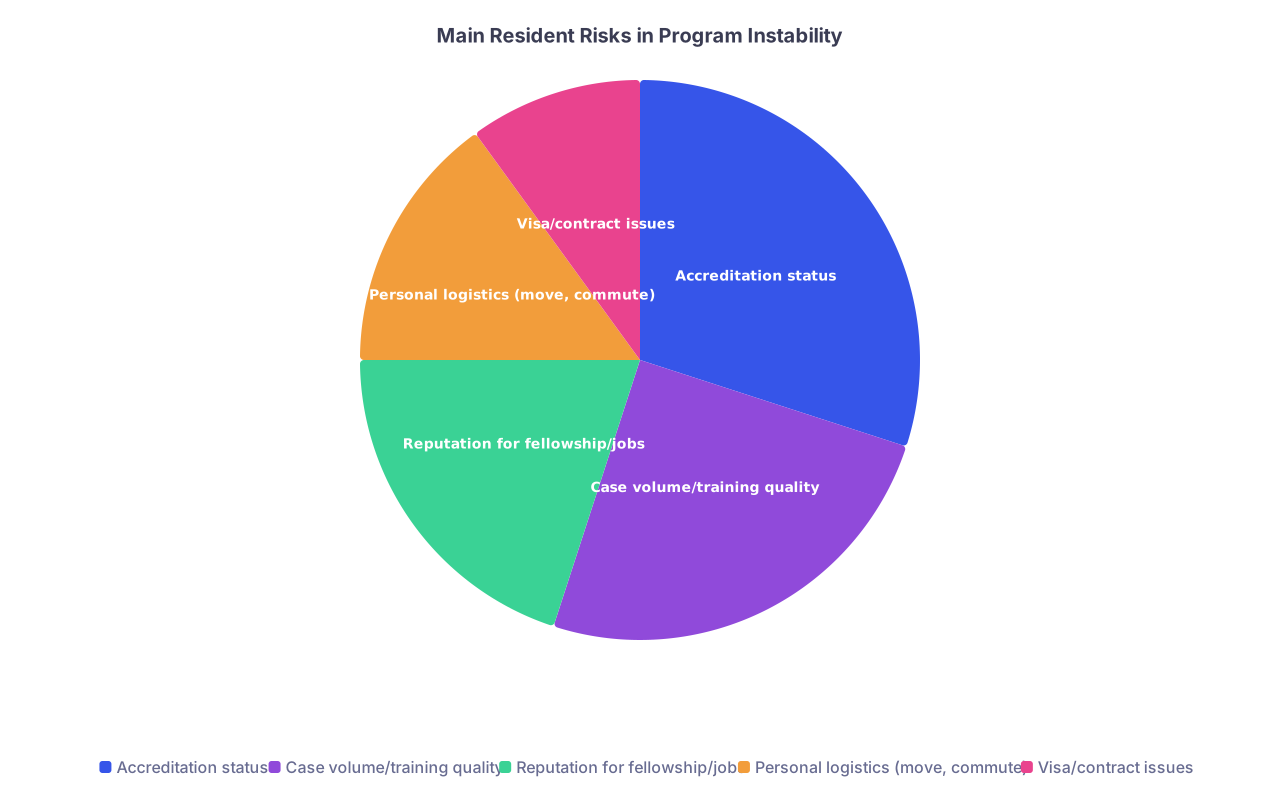
| Category | Value |
|---|---|
| Accreditation status | 30 |
| Case volume/training quality | 25 |
| Reputation for fellowship/jobs | 20 |
| Personal logistics (move, commute) | 15 |
| Visa/contract issues | 10 |
Accreditation and Board Eligibility
Bottom line: if your program remains accredited while you are there and you complete the ACGME requirements, you’re generally fine for boards. The disaster scenario is:
- Program gets put on probation
- Then loses accreditation
- And there’s no clear plan to place residents in other accredited programs
If rumors are serious, ask directly in a scheduled meeting with PD or APD:
“Can you speak to the long-term stability of the program’s accreditation and what contingency plans are in place for residents if there are structural changes?”
If they dance around that question with zero specifics, that’s data.
Training Quality and Volume
Mergers and closures often crush the middle of your training:
- Faculty leave before anything official.
- Rotations get cut or reshuffled.
- Community partners pull back.
You care about:
- Are key services (ICU, ED, OB, surgery, continuity clinic) stable?
- Are rotations at partner sites secure or “under renegotiation”?
- Any recent loss of major patient volume (e.g., big competing hospital opened across town)?
If you’re in a newer program that already struggled with volume, any disruption matters more. You’re not overreacting. You’re being realistic.
Step 3: Go Get Official Information (Without Torching Relationships)
At some point, you have to stop speculating and ask leadership. The trick is doing it in a way that gets you clarity without being labeled “the difficult resident.”
Do not ambush anyone. Email for a meeting. Something like:
“I’d like to schedule a brief meeting to discuss questions I have about the long-term structure and stability of the residency. I’ve been hearing various things from different sources and want to make sure I understand the official plans so I can focus on my training.”
In the meeting, you want three main answers:
- Are there active discussions about merger/closure/major restructuring?
- If yes, what is the anticipated timeline?
- What protections and contingency plans exist for current residents?
Some phrases are red flags:
- “We’re exploring all options.”
- “Nothing has been finalized, so there is nothing to share.”
- “At this time, your training is not affected.” (Translation: something is coming that will affect you.)
Push gently for specifics:
- “When you say ‘exploring options,’ does that include potential merger or program consolidation?”
- “Is there any scenario where current residents might need to transfer to another institution?”
- “If a merger occurs, is the expectation that residents will physically move or just that administration changes?”
Take notes. Right after the meeting, write yourself a dated summary of what was said. I’ve seen those notes become critical later when programs rewrote history.
Step 4: Quietly Map Your Worst-Case Backup Plan
You hope none of this is needed. But you’ll sleep better if you know what you’d do if the program actually announces closure or something that guts your training.
Think in three time frames:
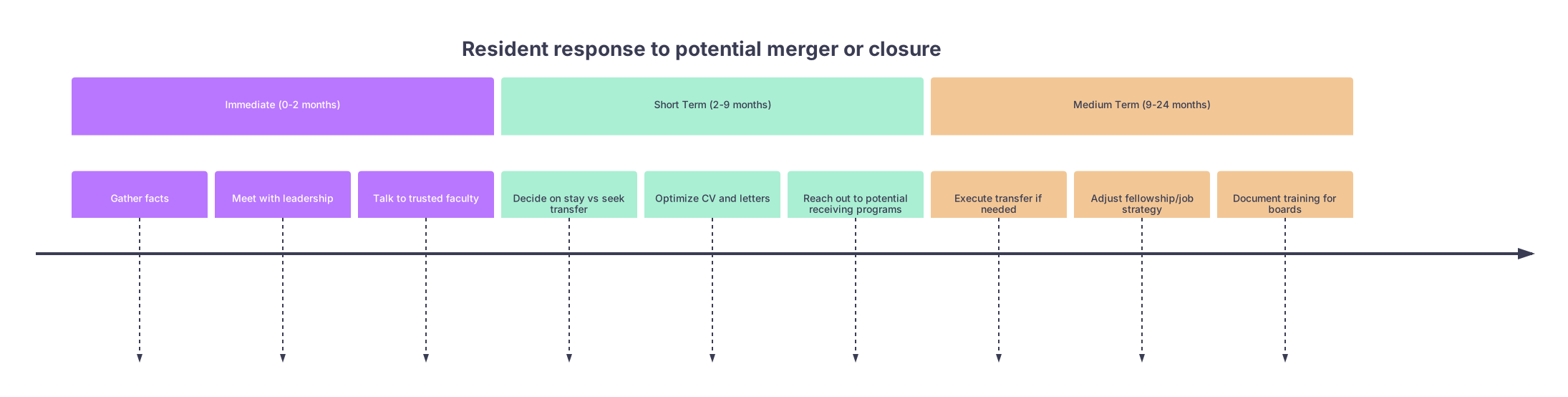
If Things Go Really Sideways, What Are Your Options?
Stay and ride it out
Sometimes programs merge but residents actually end up better off (more volume, bigger institution). This tends to be true when:- Accreditation is secure.
- Receiving institution is well-established.
- Faculty you care about are also moving.
Transfer programs
Painful but possible. Harder in some specialties (rad onc, derm, plastics) than others (IM, FM, psych).You’d need to:
- Quietly tell your PD you want to explore transfer “in light of uncertainty” and ask if they will support you.
- Collect rotation evaluations, procedure logs, and ACGME Milestone data.
- Identify programs with historically unfilled spots or recent expansion.
Lean into fellowship or job planning differently
If your program’s reputation may take a hit, you compensate by:- Stronger letters from well-known people at away or elective sites.
- Research or QI projects with external collaborators.
- Board scores and concrete procedural numbers to prove competence.
This is what you’re doing right now: sketching which of these paths would be realistic for you if leadership announces something awful six months from now.
Step 5: Protect Your Future File — Starting This Month
You cannot control hospital politics. You can absolutely control how bulletproof your individual training record looks.
Over the next 6–12 months:
Lock in strong letter writers external to your fragile system
Try to rotate at:- Affiliates with stable reputations
- Nearby big academic centers
- Nationally known specialists in your field
The goal: at least one letter from a person whose name or institution overrides concerns about your home program.
Document like a paranoid lawyer
Save:- Case logs
- Procedure logs
- Evaluation summaries
- Any official communication about program structure changes
If you ever need to prove to a fellowship or certifying board that you got adequate training despite program drama, documentation wins.
Get your exam profile airtight
If you know your program’s name may raise eyebrows, you want:- Strong in-training exam performance
- Passing boards on first try (obviously)
- Any relevant certifications (e.g., echo, POCUS, subspecialty courses) if your field has them
Do at least one visible project that’s portable
Not “we made a local protocol.” Something like:- Multi-site QI
- National poster or oral presentation
- Paper with outside co-authors
You want something on your CV that tells fellowship directors, “Yes, my program was small/weird/merged, but I operated at a high standard anyway.”
Step 6: Decide If You’re Staying or Actively Looking to Leave
Here’s the honest part most people won’t say out loud: there is a point where staying becomes stupid.
You need to define for yourself: “If X happens, I’m out.”
Common X’s I’ve seen:
- Program receives probation or serious citation and leadership offers no clear corrective plan.
- More than 30–40% of core faculty leave within one year.
- Your case volume drops so much you’re worried about meeting minimums.
- The hospital system announces actual closure or full service line shutdowns in your specialty.
If you reach your X:
Tell your PD directly (if they’re not the problem)
“Given the recent changes and my concern for my long-term training, I’d like to explore transfer options. I value what I’ve gotten here, but I also have to make sure I will be fully prepared and board-eligible.”Simultaneously start your external search
Look for:- Programs that recently expanded or have new funding.
- Places that historically go unfilled in SOAP.
- Institutions in systems that just merged and might now want more residents.
Use your network aggressively
Ask attendings, fellowship directors, even that consultant you impressed in the ICU:
“Do you know any programs that might be open to a transfer resident given our current situation?”
This is where the work you did in Steps 4 and 5 pays off. People are much more willing to absorb a transfer who shows up with clean documentation, good evaluations, and strong external letters.
Step 7: Don’t Let the Rumor Itself Wreck Your Training
There’s a weird phenomenon I’ve watched more than once: residents panic over possible closure, mentally check out, and even if the program ends up stable, their own performance tanks. That hurts them more than any merger could.
You have to run two tracks at once:
- Track A: keep showing up as a solid, reliable resident.
- Track B: quietly hedge against instability.
If your behavior shifts from attentive, engaged trainee to constantly bitter gossip spreader, guess what PDs and faculty will say in your letters and calls? Not “tragically affected by unstable program.” Just “unprofessional when stressed.”
So:
- Vent to one or two trusted people, not to every med student and nurse on the floor.
- Don’t blast the program on social media, even vaguely. Those screenshots live forever.
- Keep doing good work clinically. People remember.
Key Red Flags vs Manageable Changes
To make this concrete, here’s how I’d roughly categorize stuff:
| Situation | How Worried to Be |
|---|---|
| Official email: exploring academic affiliation with larger center | Low–moderate |
| Sudden departure of 1–2 faculty | Low alone, moderate if repeated |
| Change in program director with clear handoff | Moderate, watch closely |
| ACGME status: continued accreditation with warning | High |
| Loss of core rotation site with no replacement plan | High |
| Announcement of hospital closure or major service line shutdown | Very high |
None of these single things mean “run immediately.” But once you stack multiple high/very high items, you’re in the zone where planning exit options is rational, not dramatic.
FAQs
1. If my program closes while I’m a resident, will I still be able to sit for boards?
Usually yes, as long as:
- You complete the required length of training in ACGME-accredited programs.
- You meet the case/procedure/clinic requirements for your specialty. Often, when a closure is planned, there’s a “teach-out” plan or residents are placed into other accredited programs. But you should aggressively document your training and keep every official communication about the closure or merger.
2. How early is too early to look for a transfer if I’m just hearing rumors?
If you only have vague gossip and zero concrete signs (no ACGME changes, no official discussions, stable faculty), I’d hold off on active transfer moves. What you should do early is:
- Improve your file (letters, projects, external rotations).
- Clarify things with leadership. Start actual transfer outreach if you see multiple hard indicators: accreditation warnings, major faculty exodus, or official announcements about closure/merger without a clear resident plan.
3. Will coming from a merged or “problem” program kill my fellowship chances?
Not automatically. Fellowship directors care more about:
- Your individual performance (letters, evaluations, board scores).
- Concrete experience (case logs, research, projects).
- How you talk about the experience. If you sound bitter and chaotic, that hurts you. If you’re calm, specific, and can articulate what you learned and how you compensated, many will actually respect that you thrived in a messy environment.
4. Should I warn incoming applicants or students rotating with us about the rumors?
Be honest but measured. If a student asks, you can say:
“There have been discussions about X and leadership says Y. Day-to-day, my training has looked like Z. I’d recommend you ask the PD directly about long-term structure during your interview.”
Do not go on a crusade to destroy the program’s reputation, even if you’re angry. That almost always comes back to bite you more than it hurts leadership.
Bottom line:
- Get facts, not just hallway gossip.
- Protect your training record and options, regardless of what the institution does.
- Define your personal line where staying becomes unacceptable — and if you cross it, act decisively, not emotionally.