
What happens when your hospital suddenly announces, “We’re starting a residency program,” and you’re already an attending on the ground?
First: Understand What This Actually Means For You
A lot of people hear “new residency program” and think: more help, more prestige, more teaching. Sometimes that’s true. Sometimes it’s “same workload, more meetings, more chaos.”
Before you decide if this is good, bad, or a career opportunity, you need to know what’s actually being built around you.
Here’s what you ask, directly and early. Not in vague terms—in actual numbers and timelines.
| Topic | Concrete Question |
|---|---|
| Timeline | When is the FIRST class starting, and how many residents? |
| Accreditation | Are we already ACGME-accredited, or still in the application phase? |
| Service vs Education | What percentage of their time will be true education vs plugging service gaps? |
| Faculty expectations | How many hours/week of teaching, supervising, feedback, and meetings are expected? |
| Compensation | Is there protected time or extra pay/stipend for core faculty roles? |
| Evaluation burden | What system are we using for assessments, and how many per resident per rotation? |
Get these answers from someone who actually knows: the incoming PD, DIO, or CMO. Not hallway gossip.
Because here’s the reality I’ve watched play out in multiple hospitals:
- Year 0–1: Meetings, Subcommittees, PD hired, “vision” decks, everyone excited.
- Year 1–2: First class arrives. Everyone realizes they severely underestimated the time and supervision burden.
- Year 3+: Either it smooths out and becomes a decent academic shop, or faculty get burned out, residents get salty, and recruitment becomes a problem.
You want to position yourself so you’re not accidentally volunteering as tribute.
Decide What Role (If Any) You Actually Want
You don’t have to either “go all in as core faculty” or “opt out completely.” There’s a spectrum. You choose, or the system will choose for you.
The main buckets:
- Core faculty / leadership
- Rotational teaching / clinical educator
- Minimal involvement, just doing your job and supervising when assigned
Let’s walk through them like real options, not abstract titles.
Option 1: You Go For Core Faculty or Leadership
This is for you if:
- You genuinely like teaching and mentoring.
- You can tolerate meetings and structure.
- You care about curriculum, evaluation, and culture, not just day-to-day cases.
Concrete moves if you’re even considering this:
Meet the PD early, intentionally.
Say something like: “I’m interested in teaching and possibly in a more formal role. What are the specific core faculty expectations here—time, admin, and academic output?”Listen for specifics, not fluff:
- “About 0.1–0.3 FTE protected.”
- “Faculty expected to produce X scholarly activity per year.”
- “Monthly CCC meetings, annual didactics, semiannual evaluations.”
Ask what problems they actually need solved.
PDs do not need 12 people all wanting to “do mentoring.” They need:- Someone to own a rotation and its schedule.
- Someone to run simulation.
- Someone to run QI, M&M, or scholarly activity pipelines.
- Someone to be reliable with evaluations and remediation plans.
You want to be the solution to a clearly defined pain point, because that’s where security and leverage are.
Clarify what you get in return.
Do not skip this step. Ask directly:- “How much protected time is written into my contract if I’m core faculty?”
- “Will there be a title change? Promotion track? Stipend?”
- “Is teaching/evaluations part of my RVU requirement, or separate?”
If they start talking about “intangibles” and “professional fulfillment” without concrete numbers, that’s your cue: they want free labor.
Insist responsibilities are written down.
Verbal promises are worthless when the PD changes or the CMO leaves. Get:- A written role description.
- An FTE allocation in your contract or a formal addendum.
- Clarity on how your clinical volume will be adjusted.
If you want to build something and possibly angle toward PD or APD in the future, this is the path. But do it with your eyes open, not as an unpaid hobby.
Option 2: You Stay Clinical With Targeted Teaching
This is where most sane attendings should land, especially in the first few years of a brand-new program.
You’re willing to:
- Take residents on your service or in your clinic.
- Teach on rounds, involve them in cases, give feedback.
- Maybe give a few lectures or participate in simulation days.
You’re not willing to:
- Sit through 3-hour curriculum meetings twice a month.
- Design milestone-based evaluations from scratch.
- Manage residents who are in serious academic or behavioral trouble.
Your playbook here:
- Tell the PD: “I’m happy to teach clinically and precept, probably X weeks per year, and possibly give a few lectures. But I don’t want formal core faculty responsibilities right now.”
- Ask: “What’s the expectation for attendings who are not core? Evaluation frequency? Didactic contributions?”
- Set personal boundaries:
- How many residents per attending per shift you consider safe.
- What types of procedures you’re comfortable supervising at what PGY level.
- When you’ll say no: “No, I’m not comfortable with them doing that independently yet.”
This role lets you contribute without getting buried.
Option 3: Minimal Involvement (And That’s Okay)
Some of you are burned out. Some are two years out of training yourselves and barely keeping your head above water. Some are planning to leave in 18 months.
You don’t owe the hospital your unpaid curriculum dev work.
If you want minimal involvement:
- Be honest early: “I’m not looking for any formal educational role right now, but I’ll of course follow supervision and documentation policies.”
- Find out the minimum required teaching/supervision you can’t escape, especially if residents will be rotating through your service regardless.
- Protect your schedule from creeping “voluntold” committee work.
Silence is what gets you trapped in responsibilities you never asked for.
Watch For The Trap: Service Disguised As Education
A lot of new programs are born because admin wants cheaper labor and prestige. They wrap that in “academic mission” language.
You need to distinguish:
- True education: protected didactics, structured teaching, faculty development, real feedback.
- Service padding: residents covering chronic gaps, night float built entirely around staffing holes, “clinics” that are basically full attending schedules plus learners slowing you down.
Here’s what I ask when I’m sniffing this out:
- “What percentage of resident time is in protected didactics each week?”
If the answer is “We’re working on that” or “It’ll depend on census,” that’s a red flag. - “Who covers the work when residents are in conference?”
If it’s “well…the attendings,” with no clinical adjustment, that’s another red flag. - “How many FTE of APPs / hospitalists / nocturnists are we adding vs replacing with residents?”
New residencies should supplement, not replace, stable staffing.
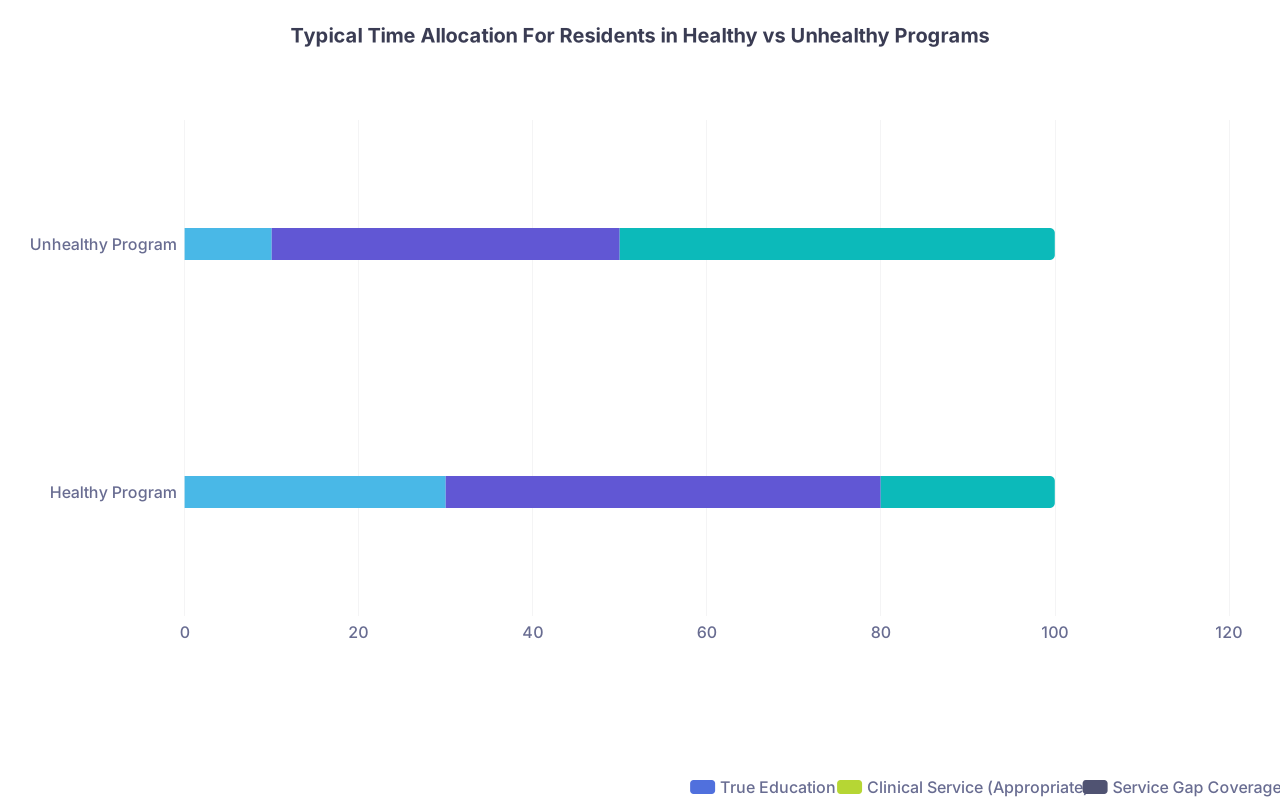
| Category | True Education | Clinical Service (Appropriate) | Service Gap Coverage |
|---|---|---|---|
| Healthy Program | 30 | 50 | 20 |
| Unhealthy Program | 10 | 40 | 50 |
You can absolutely say: “I support education, but I’m not okay with this amount of uncompensated service creep on my plate.”
If they treat that as disloyal instead of pragmatic, that tells you something about the institution.
Protect Your Time, Sanity, and Liability
New residency = new risk. Educational, legal, emotional.
Time and cognitive load
Early on, there’s always underestimation of:
- How long it takes to directly observe a resident perform a procedure.
- How much slower rounds are with learners.
- How long honest feedback and evaluations actually take.
Do not let people pretend this is “just normal work plus a bit of teaching.”
Specific safeguards:
- For any rotation you agree to own or staff heavily:
- Define caps: “X patients per team” or “Y new admits per shift with a resident.”
- Haggle for adjusted RVU targets, or at minimum clear expectations that your productivity will change.
- Insist on streamlined evaluation tools:
- Short, behavior-based forms.
- Fewer, higher-yield evaluations rather than 20 micro-forms per month.
If your practice has already been pushed to the edge, layering a residency onto it without adjustment is a recipe for burnout.
Supervision and medico-legal risk
You’re now responsible not only for your patients, but also for the actions of partially trained physicians. Look at:
- Hospital policies on:
- What PGY level may do which procedures and under what level of supervision.
- Who cosigns notes, orders, and critical results.
- How “indirect supervision” is defined:
- Onsite? In-house but not on the unit? Available by phone only?
If the culture feels like: “We’ll just trust your judgment, do what you think is right,” and nothing is written down—that’s not “freedom,” that’s exposure.
You say: “Before we start, I want to see written supervision policies by PGY level, and I want alignment with risk management.”
That’s not being difficult. That’s being sane.
Decide if This Changes Your Career Trajectory
A new residency can be:
- The step that turns you from “service attending” into “educator with an academic CV.”
- Or the step that convinces you to leave.
You should actively choose.
If you want to build an academic profile
A new program is a wide-open lane. Nobody has seniority yet.
You can:
- Start small:
- Lead journal club.
- Run a simulation series.
- Build a modest QI curriculum.
- Turn normal clinical work into scholarship:
- Track a QI project on sepsis bundle timing, handoffs, or discharge summaries.
- Turn that into a poster or presentation.
- Get your name on:
- Program policies.
- Curricular development.
- Local/regional conference abstracts.
Ask the PD or DIO bluntly: “If I invest in this now, what’s the realistic path to APD, site director, or promotion?”
If they give concrete steps—good sign. If it’s vague rah-rah, take notes but don’t bet your career on it.
If you’re already half out the door
If you’re thinking:
- “I was already planning to leave this job in 1–2 years.”
- “I don’t want more meetings, ever again.”
- “I don’t want to live on ACGME milestones and CCC drama.”
Then your job is to not get sucked in.
You protect yourself by:
- Declining core roles: “I’m honored, but my bandwidth and long-term plans don’t make me a good fit for core faculty.”
- Being minimally cooperative, not obstructive. Do your required supervision well, but don’t overcommit.
- Quietly updating your CV and using the presence of a new residency as talking points when you interview elsewhere: “I’ve supervised early residents in a new program, helped build X rotation, etc.”
You don’t need to burn bridges. Just don’t build new ones you know you’ll walk away from.
How This Will Actually Feel The First 1–3 Years
Let me paint it honestly.
Year 1 (before residents arrive or with only interns):
- There’s excitement. Town halls. Branding. “We’re training the next generation.”
- Faculty are flattered: “We want you as core faculty.”
- Meetings feel generative. You’re actually shaping things.
- Work hasn’t fully shifted yet. The pain is mostly administrative.
Year 2–3 (first residents on the wards, ED, clinics):
- The pager starts to ring more. “Can you come see this with me?” “Can you review this note?”
- Rounds are slower. Discharges delayed because teaching and note-writing take time.
- Evaluation emails flood in. You owe 14 assessments and it’s already the 20th.
- One or two residents struggle. Remediation eats time and energy.
- The gap between “what we said we’d do educationally” and “what service demands allow” becomes obvious.
This is where you see whether the institution is serious.
If leadership starts cancelling didactics “just this once” for census, or punishing you for lost RVUs, or dumping more residents onto already unsafe services—that’s all you need to know.
On the other hand, if they:
- Add backup coverage when residents come on.
- Actually protect conferences.
- Adjust faculty expectations and give real credit for teaching.
- Support you when you say, “That’s not safe for this PGY level.”
Then the residency can become the best part of your job.
How To Be Useful Without Being Used
Let’s say you want to contribute, but not become a martyr. Here’s a balanced play.
Pick one or two lanes only:
- “I’ll be a strong clinical teacher on rounds.”
- “I’ll run simulation once a month.”
- “I’ll own the QI rotation but I’m not joining three committees.”
Set explicit limits with the PD:
- “I can commit about 10% of my time to education—beyond that will encroach on my bandwidth and patient care.”
- “I’m okay supervising procedures A, B, C, but not D until we have clearer guidelines.”
Be good at what you do take on:
- Show up on time for teaching.
- Give specific feedback, not generic “good job.”
- Finish evaluations on time.
Say no to scope creep:
- “That sounds like a core faculty responsibility and I’m not in that role.”
- “I can’t join another standing committee, but I can give input on X document or process once.”

| Step | Description |
|---|---|
| Step 1 | Hospital announces new residency |
| Step 2 | Meet PD and discuss core faculty |
| Step 3 | Choose focused teaching role |
| Step 4 | Minimal required supervision only |
| Step 5 | Negotiate protected time and written role |
| Step 6 | Define clear limits and expectations |
| Step 7 | Clarify minimum obligations and boundaries |
| Step 8 | Do you want a long term academic role |
Don’t confuse being helpful with being endlessly available. The latter is how you end up angry at 11 pm filling out milestone evaluations you never agreed to do.
If You’re In a Smaller or Community Hospital
One more layer here. If your hospital has never had residents before, the learning curve is brutal.
Watch out for:
- No existing GME infrastructure: No coordinator, no faculty development, no established policies.
- Admin thinking residents = cheaper coverage, full stop.
- Culture shock: Nurses, consultants, and even other attendings not used to having residents write notes, orders, and call consults.
If that’s your environment:
- Push harder for faculty development sessions. You’re not born knowing how to remediate a struggling PGY-1.
- Ask for at least one experienced PD or APD from an established program to consult or mentor.
- Advocate for nursing and other services to be included in orientation and planning.
New residency without system buy-in is chaos. You either help shape it early, or you brace for impact later.
Bottom Line
If your hospital announces a new residency while you’re already an attending, do three things:
- Get specific: timeline, numbers, expectations, compensation, and supervision policies. Vague “academic mission” talk doesn’t cut it.
- Choose your lane deliberately: core faculty, focused clinical teacher, or minimal involvement—and get your role and boundaries in writing.
- Watch for service creep disguised as education, and protect your time, your sanity, and your liability. If the institution backs you and truly supports education, lean in. If not, keep your distance—or update your CV.