Matched Only at a New Residency Program: How to Make It Work for You
You opened your Match email, saw a hospital you barely recognize, and then realized: it’s a brand-new program. First or second year of existence. No track record. No graduating class. Your only match. Now what?
Let me be blunt: this can either be one of the best things that ever happened to you… or a slow-motion disaster. The difference is not luck. It’s how you handle the first six to twelve months.
This is for you if:
- You matched only at a new or very young residency program
- You’re quietly panicking about boards, fellowship, and reputation
- Your classmates are going to “name” places and you feel like you drew the short straw
You did not. You just got a different type of challenge. Here’s how to turn it into leverage instead of a liability.
1. Understand What You Actually Signed Up For
New programs are not all the same. Some are “new” on paper only, others are duct-taped together in real time.
You need to figure out which one you got. Fast.
Use the first month as reconnaissance
Your goal in the first 4 weeks is to answer these questions honestly:
-
- Not just “PD on the website.”
- Who actually makes things happen?
- The PD?
- The APD who answers emails at 10 pm?
- The GME office?
- Department chair pulling strings behind the scenes?
Is there hidden experience behind the “new” label?
- Program converted from a long-standing osteopathic program?
- Community site that has hosted university residents for years?
- Hospital that has been a major teaching affiliate but just got its own ACGME accreditation?
- Or truly from-scratch with no prior residents?
What’s the vibe from attendings? Listen for:
- “We’re figuring it out as we go” (honest, not necessarily bad)
- “We used to do it this way when I was at [big program]” (good, they have a model)
- “We don’t really know what ACGME wants” (red flag)
Is there a real educational structure? Look for:
- A written didactic schedule (even if rough)
- A rotation curriculum with goals/objectives
- Evaluation forms that don’t look like they were made last night
- Someone actually tracking duty hours
If you can’t answer these after your first month, you’re being too passive. Ask. Notice. Pay attention to who’s stressed and who’s pretending.
2. Accept the Trade: Flexibility for Uncertainty
You gave up the comfort of a legacy program. In exchange, you get something most of your classmates will never see: outsized influence.
At established programs:
- Systems are baked in. You fit into them.
At new programs: - Systems are wet cement. You’re literally shaping them with your footsteps.
That’s not motivational fluff. I’ve watched interns at new programs:
- Write the first ICU orientation manual
- Design the ultrasound curriculum
- Build the first MedEd website
- Connect their program to a bigger institution for electives and research
Those same people later:
- Matched into competitive fellowships
- Became chief residents
- Used “I helped build a program” as a major selling point
But you only get that upside if you accept this reality:
Nobody is coming to save you. You have to drive your own education.
That means:
- You do not wait for someone to assign you a mentor. You ask 2–3 attendings directly.
- You do not assume board prep will be integrated. You build your own system from day one.
- You do not accept “we’re new” as an excuse for chronic dysfunction. You document and escalate when needed.
3. Protect Your Core: Boards, Clinical Skills, and Letters
Everything else is negotiable. These are not.
A. Board performance: do not outsource this
New programs often overestimate how “just seeing patients” will prep you for boards. It won’t.
Your goals:
- Be in the top quartile of your specialty’s in-training exam
- Have a rock-solid board pass probability, regardless of program history (because there is no history yet)
Here’s how you handle it:
Pick one main Q-bank and commit
- IM: UWorld + MKSAP
- FM: AAFP questions + a reputable FM Q-bank
- Surgery: TrueLearn, SCORE, etc.
- EM: Rosh, SAEM, etc.
Build a non-negotiable schedule
- Intern year: 5–10 questions/day on non-call days, 20–30 on golden weekends
- PGY-2: 15–20 questions/day most days
- Review missed questions weekly; make micro-notes, not novels
Use the in-training exam as your checkpoint
- Before exam: 6–8 weeks of more aggressive questions
- After exam: meet with PD and ask directly:
“I want to be beyond safe for boards. Based on my ITE and performance, what do I need to adjust?”
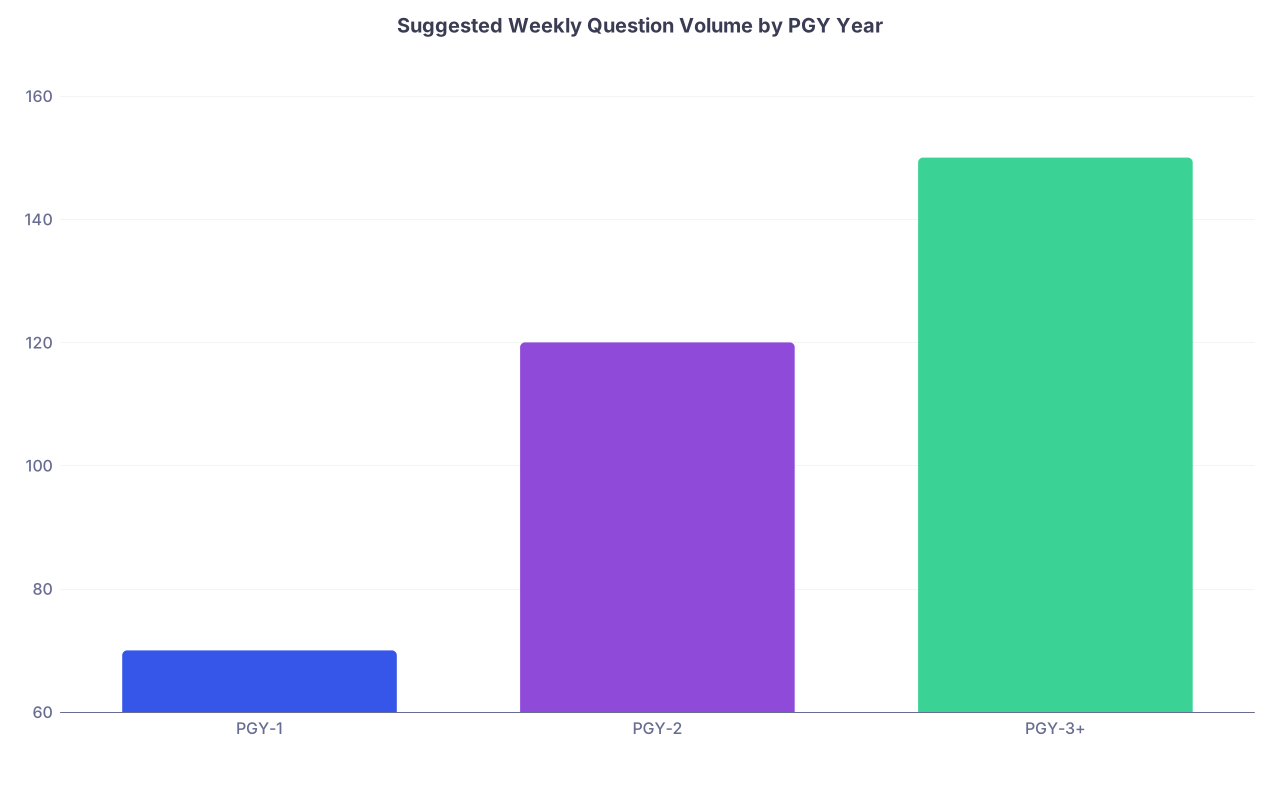
| Category | Value |
|---|---|
| PGY-1 | 70 |
| PGY-2 | 120 |
| PGY-3+ | 150 |
B. Clinical skills: manufacture complexity if needed
New programs at community hospitals often have this problem: they see a lot of bread-and-butter but not enough complex cases.
If your days are all cellulitis, CHF tune-ups, and “r/o ACS” with negative everything, you need to stretch yourself.
Do this:
- Volunteer for higher-acuity rotations early: ICU, ED, night float
- When possible, admit the sickest patient instead of the easiest one
- Ask ICU or subspecialty attendings:
“I want more reps with ventilators/pressors/complex endocrine cases. Can I be the point person for these when they come in?”
And if your home hospital just doesn’t have the volume:
- Push hard for away rotations at a busier tertiary center during PGY-2
- Get it approved early – GME and legal can drag this out for months
C. Letters: be intentional from month 1
For fellowships or future jobs, your LOR writers matter more than your program’s age.
You want:
- 2–3 strong letters from respected attendings, ideally with known names or strong institutional affiliations
- At least one letter that speaks to your role in building/leading at a young program
Tactically:
- Pick 3 attendings by the end of PGY-1 you’d like letters from
- Act like a future letter-writer is following you every shift: deadlines met, notes done, proactive, calm on bad days
- Around mid-PGY-2, say this directly:
“I’m planning to apply for [fellowship/job] this upcoming cycle. I really value your mentorship. Would you feel comfortable writing a strong letter of recommendation for me?”
If they hesitate, thank them and pivot to someone else. Don’t beg a lukewarm writer.
4. Shape the Program Without Becoming Its Emotional Trash Can
New programs bring drama. Guaranteed.
You’ll see:
- Schedules built the night before
- Conflicting messages from PD vs GME vs attendings
- Nurses who say, “The last group of residents from [big-name school] did it differently”
- Consultants who aren’t thrilled residents are “in their way”
Your job is to be part of the solution without being the unpaid program coordinator.
Create a “resident brain trust”
If you’re in the first 1–3 classes, do this:
- Form a small, functional core group of residents who actually get things done (3–6 people, max)
- Meet monthly, off the record if you have to
- Keep a running list of:
- Broken systems
- Easy wins
- Bigger structural issues needing PD/GME involvement
Then be strategic:
- For easy wins (call-room supplies, EMR phrases, sign-out template): just fix them
- For medium stuff (lecture schedule improvements, simulation time): bring a written proposal, not complaints
- For big structural failures (chronic duty-hour violations, unsafe attendings, call structures that break ACGME rules): document, then escalate through PD → DIO → GME committee
You want a reputation as:
- “The residents who bring solutions, not just problems”
Not: - “The class that whines about everything”

| Step | Description |
|---|---|
| Step 1 | Identify Problem |
| Step 2 | Document specifics |
| Step 3 | Discuss with Chief or Senior |
| Step 4 | Meet with PD |
| Step 5 | Brainstorm fix with peers |
| Step 6 | Propose simple solution |
| Step 7 | Monitor |
| Step 8 | Escalate to DIO GME |
| Step 9 | Safety or ACGME violation |
| Step 10 | Resolved? |
Protect yourself from becoming the dumping ground
There’s always one resident who ends up absorbing everyone’s frustration, staying after every “feedback” meeting, responding to every GME email.
That person burns out. And when they finally snap, leadership is “surprised.”
If you’re that person by temperament, put guardrails in place:
- Say “I can’t take that on this month, but I support someone else doing it”
- Rotate responsibilities among residents
- Set a hard limit: X committees, Y projects at once
You’re there to become a competent physician first. Program hero second.
5. Compensate for the Reputation Gap
You’re worried about the name on your badge. Fine. Let’s deal with that head-on.
New programs don’t have alumni, board stats, or a legacy. So you manufacture your own credibility.
Build external anchors
You want things on your CV that are not entirely dependent on your program’s reputation:
- Regional or national presentations (ACP, AAFP, CHEST, ATS, ACEP, specialty society for your field)
- Multi-institutional research or QI projects
- Committee roles in national organizations’ resident/fellow sections
Aim for at least 1–2 of the following by mid-PGY-2:
- Poster or oral presentation at a regional/national meeting
- Authorship on a paper/case report/letter to editor
- Active membership in a relevant national society committee
How to start when your program has no research machine:
- Ask attendings: “Do you have any ongoing projects that need help with data collection or writing?”
- Email faculty at affiliated academic centers: “I’m a resident at [X]. Our program is new and I’m looking to contribute to [field]-related projects. Any chance I could help with something you’re already doing?”
- Start with case reports or QI – unsexy but achievable
| Strategy | Time to Impact | Difficulty |
|---|---|---|
| Case report with attending | 2–6 months | Low |
| Regional poster presentation | 6–12 months | Medium |
| National society committee | 6–18 months | Medium |
| Multi-center research | 12–24 months | High |
Own your narrative in interviews
When you apply for fellowship or jobs, you will be asked:
“So your program is pretty new, right? How has that been?”
You don’t flinch. You say something like:
- “Yes, we’re in our [X] year. It’s been intense, but it forced me to be very intentional about my training. I took a lead role in [specific thing], and I sought out [external experiences] to round out my education.”
- “The upside is we get a lot of autonomy and direct attending contact. The trade-off is less built-in structure, so I built my own around boards, procedures, and research.”
You frame it as:
- Exposure to autonomy
- Leadership opportunities
- Evidence you can thrive in ambiguity
Not:
- “Yeah, it’s been kind of rough…” (even if that’s true privately)
You’re not lying. You’re picking the part of the truth that sells your resilience instead of your scars.
6. Decide When “New” Has Crossed Into “Unacceptable”
Not every new program deserves your loyalty. Some are just chaotic; some are unsafe.
You need a mental list of deal-breakers where you’d seriously consider transferring or involving ACGME/GME in a serious way.
Red lines to watch for over 6–12 months:
- Persistent, unaddressed duty-hour violations, especially with pressure to falsify hours
- Regularly being forced to operate/do procedures far beyond your level without adequate supervision
- Retaliation when residents bring up legitimate concerns
- No PD leadership – constant turnover, absentee PD, or a PD who openly says they “don’t have time for residents”
- Systemic dishonesty: promised rotations never materialize, call structure completely different from what was advertised and stays that way despite feedback
If you’re seeing multiple of these:
- Document specifics: dates, who was involved, what was said, what the impact was
- Talk to a trusted faculty member or chief not obviously part of the problem
- Request a formal meeting with the PD and then, if needed, the DIO (Designated Institutional Official)
- If still stonewalled and you truly believe your training or safety is compromised, look into:
- Quietly exploring transfer options
- Resident union or legal counseling (in unionized states)
- ACGME resident complaint process (last resort, but it exists)
Is transferring easy? No. Does it happen? Yes. I’ve seen residents pull it off when they had documentation and a clear, non-emotional case.
7. Manage Your Head: Impostor Syndrome and Comparison
Here’s the part most people won’t say out loud.
You will watch classmates on Instagram posting from marquee places: Mayo, MGH, UCSF, Hopkins. You’ll see their white coats with big logos. You’ll see glossy noon conference pics.
You’ll be at a community hospital where the lounge coffee machine barely works.
You will start thinking:
- “Did I screw up?”
- “Am I going to be second tier forever?”
That spiral kills focus.
You need a few counterweights:
Look at where people end up, not just where they start
Plenty of folks from mid-tier or new programs match GI, Cards, Heme/Onc, EM subspecialties, etc.
Their common traits: outworked the average, built external credibility, got strong letters. That’s replicable.Compare skills, not branding
When you rotate or moonlight with residents from bigger-name programs, quietly assess:
Are you actually behind in clinical reasoning? Procedures? Sick vs not sick?
Often you’ll find you’re totally fine—or better in some areas due to more autonomy.Keep a receipts list
Maintain a small doc where you record:- Hard cases you handled
- Procedures you did
- Compliments or strong feedback from attendings
- Projects you completed
When your brain says “you’re behind,” read it.
8. Use the “Future of Medicine” Angle to Your Advantage
Category-wise, you’re in “new residency programs” and “future of medicine” whether you like it or not. Might as well lean in.
Newer programs are often:
- In growing health systems
- Experimenting with telemedicine, hospital-at-home, interdisciplinary care teams
- More flexible with curriculum (point-of-care ultrasound, informatics, quality improvement, AI tools)
If you’re smart, you’ll ride that wave.
Pick one “future-facing” niche to get good at:
- POCUS
- QI and patient safety
- Hospital operations and throughput
- Informatics / EMR optimization
- Telehealth workflows
Become the resident who:
- Actually understands it
- Can teach others
- Has a couple of projects or outcomes attached to their name in that domain
That positions you very well for:
- Chief roles
- Fellowship interviews
- Non-traditional jobs (admin, informatics, startup/consulting roles later)
New programs are more open to letting residents help build these things. Established ones usually have “the way we’ve always done it.”
Key Takeaways
- New program = more uncertainty, but also more flexibility and influence. You can absolutely get top-tier training if you drive it yourself.
- Protect the core: boards, clinical competence, and strong letters. Everything else is negotiable.
- Shape the program strategically, build external credibility, and know your red lines. You’re not stuck—you’re in a position to build something and make it work for you.