
Reinventing Yourself: The Path from Teacher to Doctor
Introduction: When the Classroom Leads to the Clinic
Career transitions have become a defining feature of modern work life. Many professionals are realizing that one career, even a meaningful one, may not fully encompass their evolving interests and aspirations. Among the most inspiring of these Career Transition stories are those of educators who decide to pursue medicine and join the broader world of Healthcare Careers.
Moving from teacher to doctor is not simply a job change; it is a profound reinvention that touches every aspect of your identity, schedule, finances, and long-term goals. It is a demanding, multi-year journey that requires courage, reflection, and persistence—but it can also be deeply rewarding, both personally and professionally.
This guide is designed for current and former teachers considering or actively pursuing a path to medicine. You will find:
- Common motivations and challenges unique to educators
- How to assess your readiness and align your goals
- A detailed roadmap for academic preparation, the MCAT, and applications
- Financial planning considerations for non-traditional applicants
- Strategies to leverage your teaching skills in medical training
- Practical tips for maintaining resilience and Personal Growth throughout the process
Why Teachers Transition to Medicine
Educators are uniquely positioned to take on the challenge of medicine. You are already used to high responsibility, emotional labor, and working for the benefit of others. Still, understanding why you want to pursue this path is essential to sustaining your motivation over years of training.
Core Motivations Behind the Shift
1. Desire for a Different Type of Impact
Teaching shapes minds, builds confidence, and alters life trajectories. Many teachers feel proud of this impact, yet some still find themselves craving a more direct, tangible role in improving physical health and well-being.
- In medicine, you see immediate effects: relieving pain, diagnosing illnesses, counseling patients on life-altering decisions.
- For some educators, the ability to support people at their most vulnerable moments feels like a natural extension of their commitment to helping others—just in a different arena.
2. Personal Encounters with Healthcare
Experiences such as:
- Managing your own chronic illness
- Supporting a family member through a health crisis
- Helping students navigate limited access to care or mental health challenges
can spark a deeper interest in medicine. These experiences often shift priorities and awaken a sense of calling toward healthcare.
3. Longstanding Interest in Science and Human Biology
Many teachers—especially those in biology, chemistry, or health education—already have a foundation in scientific thinking. Over time, you may realize:
- You enjoy exploring human physiology and pathophysiology
- You are drawn to problem-solving at the cellular, organ, or systems level
- You want to participate directly in scientific and clinical decision-making
Medicine allows you to marry your love of science with your love of people.
4. Evolving Career Goals and Job Satisfaction
Teaching can be fulfilling but also challenging in ways that lead some to reconsider their long-term career trajectory:
- Burnout from large class sizes, administrative pressures, or limited support
- Desire for more autonomy or different types of professional responsibility
- Interest in lifelong learning within a dynamic field like medicine
Transitioning into medicine can satisfy a craving for new challenges, a different work environment, and alternative ways of measuring impact.
Embracing a Non-Traditional Path
Choosing medicine after years in another field places you squarely in the “non-traditional” applicant category. That is not a disadvantage. In fact, admissions committees increasingly value:
- Maturity
- Real-world experience
- Diverse perspectives
- Evidence of sustained commitment to service and Education
Your teaching background becomes one of your greatest assets—if you learn how to present it effectively.
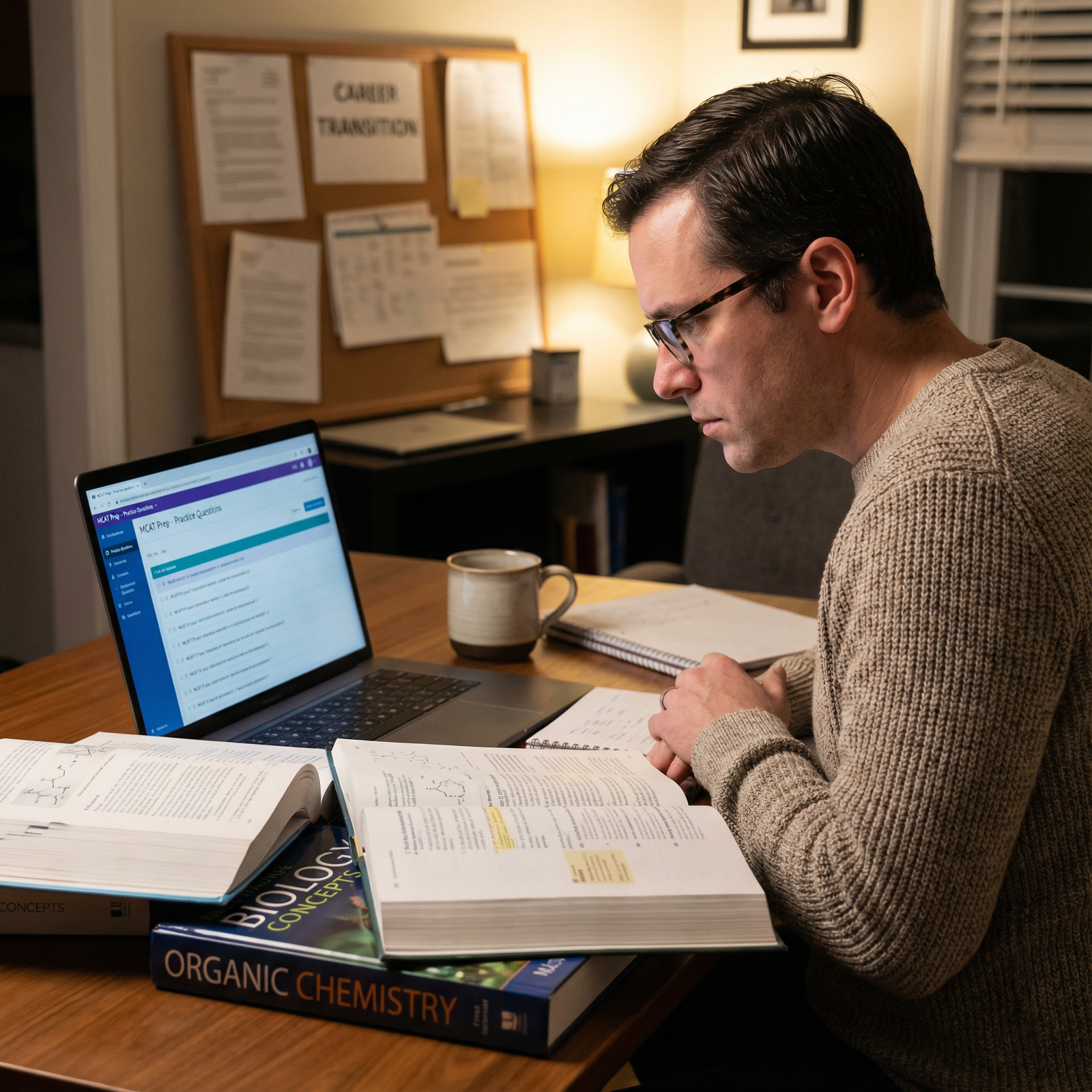
Assessing Your Readiness for a Major Career Transition
Before enrolling in pre-med courses or signing up for the MCAT, take time for honest reflection. A thoughtful self-assessment will help you make deliberate, sustainable decisions.
Key Questions to Ask Yourself
1. Why Medicine, and Why Now?
Go deeper than “I want to help people.” Consider:
- What aspects of medicine specifically excite you? (e.g., complex problem-solving, patient counseling, procedures)
- What has changed in your life or values that makes this the right time?
- If teaching conditions improved, would you still want to pursue medicine?
A clear, well-articulated “why” will become central to your personal statement and interview responses.
2. Am I Prepared for the Demands of Medical Training?
Medical training is long and intense:
- 1–3 years of pre-med work (if needed)
- 4 years of medical school
- 3–7+ years of residency, depending on specialty
Ask yourself:
- Can I handle rigorous science coursework after time away from formal study?
- Am I prepared for long hours and high emotional intensity?
- How will this affect my family, relationships, and personal life?
This doesn’t mean you must have every answer now, but you should be aware of what lies ahead.
3. What Sacrifices Am I Willing to Make?
A Career Transition into medicine often involves:
- Reduced income during school and residency
- Less free time and flexibility
- Possible relocation for school or training
- Delayed major life plans (home purchase, additional children, travel)
Clarify which sacrifices you and your support system are willing and able to make.
4. What Strengths Do I Bring from Teaching?
Instead of focusing on what you lack, identify what you already have:
- Ability to manage large workloads
- Resilience in emotionally demanding situations
- Experience communicating with diverse populations
- Comfort with continuous assessment and feedback
List specific examples from your teaching career that illustrate these strengths—they will be useful in future essays and interviews.
Creating a Personal Transition Plan
Once you’ve reflected, draft a plan:
- Target start date for medical school
- Timeline for prerequisite courses and the MCAT
- Financial plan (savings, loans, scholarships)
- Strategies for family and social support
This plan will evolve, but having a roadmap provides direction and reduces anxiety.
Leveraging Transferable Skills from Education to Medicine
Your years in Education are not a detour—they’re a powerful foundation for a healthcare career. Many skills you honed in the classroom directly enhance your effectiveness as a medical student and future physician.
Communication: Translating Complexity into Clarity
As a teacher, you already:
- Break complicated topics into digestible pieces
- Adapt explanations to different learning styles
- Use stories, analogies, and visuals to aid understanding
In medicine, this skill becomes vital when:
- Explaining complex diagnoses to patients and families
- Discussing treatment options and risks
- Collaborating with interdisciplinary healthcare teams
Admissions committees know that doctors who communicate clearly reduce errors, increase adherence, and build stronger therapeutic relationships. Highlight specific stories—such as teaching a struggling student or delivering difficult feedback—that showcase your communication skills.
Empathy, Patience, and Relationship-Building
Teachers constantly navigate:
- Students’ emotional and behavioral challenges
- Family stressors impacting learning
- Diverse cultural and socioeconomic backgrounds
These experiences translate well to:
- Understanding patients’ fears, values, and barriers to care
- Managing sensitive conversations around illness, prognosis, and lifestyle change
- Building trust with patients from different backgrounds
Your teaching history provides rich examples of empathy in action—exactly what medical schools look for.
Problem-Solving and Adaptability
In the classroom, you regularly:
- Adjust lesson plans on the spot
- Handle disruptive behaviors
- Find creative ways to engage students with limited resources
In medicine, this becomes:
- Rapid clinical reasoning under pressure
- Adapting care to patient preferences and constraints
- Persisting through diagnostic uncertainty
Emphasize your comfort with ambiguity, creativity in problem-solving, and ability to function under stress.
Time Management and Organization
Balancing:
- Lesson planning
- Grading
- Parent communication
- Professional development
is excellent preparation for:
- Managing large volumes of reading and studying
- Preparing for exams while attending lectures and clinical sessions
- Coordinating patient care and documentation
You already know how to prioritize and stay organized under time pressure. That’s a huge advantage in medical school.
Academic Preparation: From Lesson Plans to Premed Requirements
For most teachers, the biggest technical hurdle is completing (or refreshing) the science coursework required for medical school admission.
Understanding Medical School Prerequisites
Requirements vary by school, but typically include:
- 1 year of General Biology with lab
- 1 year of General Chemistry with lab
- 1 year of Organic Chemistry with lab (some schools now accept Biochemistry instead)
- 1 year of Physics with lab
- 1–2 semesters of Mathematics (often including Statistics)
- 1–2 semesters of English/writing-intensive coursework
- Recommended: Biochemistry, Psychology, Sociology, Genetics
Action steps:
- Make a list of potential schools you might apply to.
- Visit each school’s admissions website and note specific course requirements.
- Compare those to your existing transcript to identify gaps.
Choosing How to Complete Prerequisites
If you lack many science courses or they are very old, consider:
1. Formal Post-Baccalaureate (Post-Bacc) Programs
Designed for career changers, these programs offer:
- Structured curriculum covering all prerequisite sciences
- Advising tailored to non-traditional premeds
- Committee letters of recommendation
- Peer cohort and support
They may be more expensive but can streamline your path and strengthen your application.
2. Individual Courses at a University or Community College
Suitable if you:
- Already have most prerequisites and need only a few courses
- Prefer part-time study while still teaching
- Have budget constraints
Many successful doctors have taken prerequisites at community colleges—just be prepared to explain your choices and demonstrate academic excellence.
MCAT Preparation for Non-Science Majors and Career Changers
The MCAT tests:
- Biology and Biochemistry
- Chemistry and Physics
- Psychology and Sociology
- Critical Analysis and Reasoning Skills (CARS)
As a teacher, you may excel at reading comprehension and critical analysis, giving you a head start in CARS. However, you’ll need a structured strategy for science-heavy sections.
MCAT preparation tips:
- Start early: Plan 6–12 months ahead, depending on your background and available time.
- Use a mix of resources: Commercial prep books, question banks, AAMC materials, and online video lectures.
- Leverage your teaching skills: “Teach back” complex concepts to a peer, family member, or even aloud to yourself.
- Simulate test conditions: Take full-length practice exams under timed, distraction-free conditions.
- Form study groups: Join other premeds—your experience organizing classroom sessions can help structure effective group study.
Schedule the MCAT for a time that aligns with your application cycle and when you can dedicate consistent hours to preparation.
Applying to Medical School as a Former Teacher
Your application will look different from a traditional premed’s—and that is a strength when you present your story coherently and confidently.
Crafting a Compelling Personal Statement
Your personal statement should:
- Connect your teaching background to your decision to pursue medicine
- Highlight specific moments that crystalized your interest in healthcare
- Demonstrate reflection, self-awareness, and Personal Growth over time
- Explain why now and why you are prepared for the transition
Avoid framing teaching as a “fallback” career or something you merely endured. Instead, portray it as an important chapter that prepared you for a new way of serving others.
Securing Strong Letters of Recommendation
Aim for a mix of:
- Academic science letters: From professors who can speak to your performance in rigorous science coursework
- Professional letters: From school administrators, department chairs, or colleagues who can attest to your work ethic, professionalism, and interpersonal skills
- Clinical or volunteer supervisors: From physicians or healthcare professionals who observed you in patient-related settings
Ensure your recommenders understand your Career Transition story and can contextualize your strengths as a non-traditional applicant.
Gaining Clinical and Volunteer Experience
Medical schools will want to see that you understand what practicing medicine involves.
Consider:
- Shadowing physicians in different specialties (primary care, pediatrics, internal medicine, etc.)
- Volunteering in hospitals, clinics, hospice, or community health settings
- Assisting with school-based or community health education programs
- Participating in medical scribing, EMT work, or patient support roles if time allows
These experiences will deepen your conviction, inform your specialty interests, and provide concrete stories for essays and interviews.
Financial Planning and Life Logistics for the Transition
Switching from a stable teaching position to years of training requires careful financial and logistical planning.
Understanding the True Cost of Medical Training
Financial considerations include:
- Application costs (MCAT fees, primary and secondary applications, interview travel if applicable)
- Tuition and fees for prerequisites and post-bacc programs
- Medical school tuition and fees
- Living expenses during medical school and potentially during residency
Create a realistic multi-year budget including:
- Current savings and expected income during transition years
- Expected loan amounts and interest
- Household expenses, childcare, and healthcare insurance
Funding Your Education
Options include:
- Federal student loans: Often the backbone of financing for medical students
- Scholarships and grants: Including those specifically for non-traditional students, educators, or individuals entering Healthcare Careers from other fields
- Loan repayment and forgiveness programs: For physicians working in underserved areas or specific public service roles
- Part-time work: Limited during heavy coursework, but some non-traditional students take on flexible, low-hour roles before starting medical school
Consult a financial planner familiar with professional/graduate education if possible, and revisit your plan regularly as you progress.
Supporting Your Personal Life During Transition
Honest communication with partners, children, and close family is crucial. Discuss:
- Expected time commitments and schedule changes
- Possible relocations for school or residency
- Shared financial goals and sacrifices
- Strategies for maintaining connection and support
Many successful physicians began their path later, with families and responsibilities. It’s challenging, but with planning and a strong support network, it is achievable.

Thriving in Medical School as a Former Teacher
Once you are accepted, the transition from classroom instructor to full-time learner can feel both exciting and disorienting.
Adapting Your Learning Strategies
Use your insight as an educator:
- Active learning: Teach concepts to peers, create concept maps, and design mini “lessons” for complex topics.
- Metacognition: Monitor how you learn best and adjust study methods accordingly.
- Structured schedules: Just as you planned lessons, plan your study blocks, breaks, and review sessions.
Your maturity and self-discipline can be tremendous assets compared to students who are new to self-directed learning.
Maintaining Well-Being and Balance
The rigors of training can strain physical and mental health. Prioritize:
- Regular exercise, even short walks or home workouts
- Sleep hygiene, as much as your schedule allows
- Maintaining hobbies that bring you joy and identity beyond medicine
- Access to counseling or wellness resources through your institution
Remember: sustainable success in medicine comes from pacing yourself, not from burning out early.
Embracing Your Unique Perspective
Your background in Education gives you:
- Deep understanding of how people learn—useful in patient education and later, in teaching medical students and residents
- Insight into social determinants of health impacting students and families
- Credibility when advocating for health literacy and community engagement
Lean into this identity. Many physicians with teaching backgrounds become exceptional clinician-educators, medical school faculty, or leaders in public health education.
FAQs: Transitioning from Teacher to Doctor
How long does it typically take to go from teacher to doctor?
From the time you start prerequisites, the timeline often looks like:
- 1–3 years: Completing pre-med coursework and MCAT preparation (depending on your starting point and whether you study full- or part-time)
- 4 years: Medical school
- 3–7+ years: Residency training, depending on the specialty (e.g., 3 years for internal medicine or pediatrics, 5+ for surgery)
In total, you are looking at roughly 8–14 years from the beginning of your Career Transition to independent practice. While this may feel daunting, many non-traditional students find the years move quickly because they are finally pursuing a deeply meaningful goal.
What if I haven’t taken science courses in many years—or at all?
You are not alone. Many non-traditional applicants start with minimal recent science background. Options include:
- Enrolling in a structured post-baccalaureate program for career changers
- Taking prerequisite courses at a local university or community college
- Starting with foundational courses (like introductory biology or chemistry) before tackling upper-level classes
Demonstrating recent academic success in science courses is crucial, especially if your earlier GPA was modest or unrelated to science.
Can my teaching experience make me a stronger medical school applicant?
Absolutely. Admissions committees consistently emphasize the value of:
- Strong communication skills
- Experience working with diverse populations
- Evidence of leadership and service
- Emotional intelligence and resilience
As a teacher, you have abundant examples of these skills. The key is to translate classroom experiences into healthcare-relevant competencies in your essays, activities descriptions, and interviews.
Is the MCAT especially challenging for those from non-science backgrounds?
The MCAT is challenging for everyone, but non-science majors and career changers often:
- Need more time to build core content knowledge
- May excel in CARS and reasoning due to extensive reading, writing, and critical thinking experience
Success is absolutely possible with:
- A solid foundation in prerequisites
- A structured study plan and consistent practice
- Use of high-quality resources and full-length exams
- Willingness to adjust strategies based on practice test performance
How can I prepare financially for leaving a teaching salary to pursue medicine?
Practical steps include:
- Creating a detailed multi-year budget (transition period, medical school, residency)
- Building an emergency fund before leaving full-time work if possible
- Researching scholarships and grants for non-traditional students or educators
- Understanding federal loan programs and repayment/forgiveness options
- Considering part-time teaching or tutoring work during your prerequisite years if your schedule and energy allow
Speaking with current non-traditional medical students about how they managed finances can also provide realistic and encouraging perspectives.
Transitioning from teacher to doctor is a bold act of reinvention and Personal Growth. Your years in Education have already proven your dedication to others, your capacity for hard work, and your commitment to meaningful impact. With intentional planning, honest self-reflection, and a strong support system, you can successfully navigate this non-traditional path to medicine and build a deeply fulfilling career in healthcare.