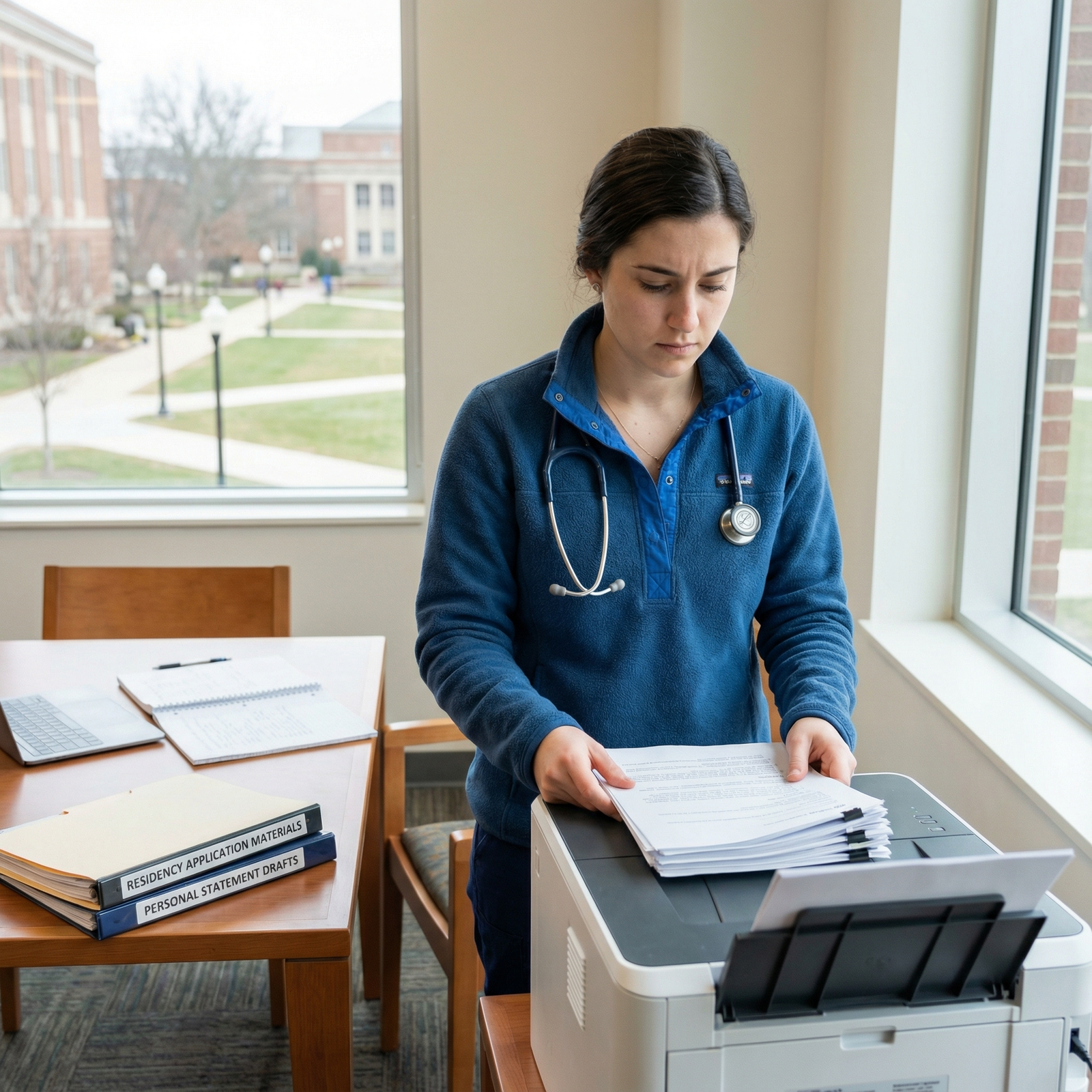
You’re staring at the blank document, cursor blinking. Two M1 orientation photos sit on your phone—two different schools, two different cities. You transferred between medical schools and now you have to explain yourself to residency programs without sounding unstable, bitter, or like you’re hiding something.
Let’s walk through exactly how to approach your personal statement when you’ve transferred between medical schools—so the transfer becomes context, not a red flag.
Step 1: Get Clear On What Programs Will See Anyway
Before you write a single word, understand what’s visible to them without your explanation. This dictates how transparent you need to be.
They will almost always see:
- Both medical schools on your transcript
- A disrupted timeline (M1/M2 at one school, then another)
- Possibly a change in grading systems or curriculum style
- Letters from two different institutions (if you use both)
They may or may not see:
- The detailed reason you transferred
- Any formal documentation about conflict, harassment, or family hardship
- Dean’s letters from both schools (varies, but often only your graduating school’s MSPE is sent)
The mistake I see: applicants assume “maybe they won’t notice.” They will. A transfer between medical schools is unusual in the U.S. system. Program directors are instantly curious: Why?
Your job in the personal statement is not to dump your whole story. It’s to answer that “Why?” in a way that:
- Feels honest and consistent
- Does not sound like a grievance letter
- Reinforces your fit and maturity as an applicant
Step 2: Decide Whether the Transfer Belongs in the Main Narrative
There are three realistic approaches:
| Approach | When To Use |
|---|---|
| Central part of the main story | Transfer deeply shaped your path, specialty choice, or growth |
| Brief paragraph in the middle | Transfer was significant but not the core of your narrative |
| Left out of PS; covered elsewhere | Transfer reason is sensitive or messy (legal, harassment, major conflict) |
When the transfer belongs in the main narrative
Use it centrally if:
- The transfer is tightly linked to your specialty choice
- You moved to care for a sick family member and that experience shaped who you are as a physician
- You changed to a school with a strong track record in your chosen specialty and actually used those opportunities well
- The contrast between schools gave you perspective you now bring to patient care or teamwork
Example:
You started at a problem-based learning school with minimal clinical exposure early on. You transferred to a school with early longitudinal clinic and discovered, say, family medicine through that longitudinal continuity. That’s story material.
When it should be acknowledged but not featured
This is most common.
Use a brief, matter-of-fact paragraph if:
- The transfer was mostly logistical or geographic
- You weren’t running from a disaster; you were moving toward a better fit
- You just need to show you’re not hiding it, but it didn’t fundamentally redefine you
Something like: one clean paragraph, 3–5 sentences, that explains context, shows maturity, and then moves on.
When to keep it out of the personal statement
Do not foreground the transfer when:
- It involved serious interpersonal conflict, discrimination, legal issues, or ongoing complaints that you cannot discuss professionally without sounding angry or vague
- Your explanation will raise more questions than it answers
- You already have a clean, focused narrative for your specialty and your transfer is better handled in an advisor note, MSPE, or — if asked — at interviews
If the reason is messy, it’s often smarter to let your dean’s letter or an advisor’s note carry the explanation in formal terms.
Step 3: Get Your Story Straight (Before You Start Writing)
You need a one-sentence internal answer to:
“Why did you transfer medical schools?”
Not the whole truth with every detail. The professional truth.
Examples of clean, program-director-friendly reasons:
- “I transferred to be closer to family during a significant health issue.”
- “I transferred to a school with stronger clinical resources and dedicated tracks in X, which aligned better with my goals in Y specialty.”
- “I transferred to return to my home state school for financial and support reasons.”
Bad answers (even if emotionally true):
- “My first school was toxic.”
- “The administration was incompetent / unfair.”
- “I just hated it there.”
- “I wanted a better name on my diploma.”
If your real story is one of the “bad” ones, that’s fine. You still need a professional version that’s true but not inflammatory.
Step 4: Structure Your Personal Statement Around Your Specialty, Not Your Transfer
You’re not writing a “Why I Transferred” essay. You’re writing a residency personal statement that happens to need transfer context.
Use a simple structure:
- Opening: A clinical moment or experience that grounds your interest in the specialty
- Middle: Development of that interest – rotations, roles, responsibilities, skills
- Transfer paragraph (if used): Brief explanation + reflection
- Ending: Who you are now and what you’re looking for in residency
The transfer paragraph should sit in the middle, after the reader already understands:
- You are serious about this specialty
- You’ve done real clinical work
- You function in teams and with patients
That way, the transfer reads as one event on your path, not your entire identity.
Step 5: How To Phrase The Transfer — Exact Language You Can Steal
Here’s the template:
- One sentence: What happened (fact).
- One to two sentences: Why (professional, concise).
- One to two sentences: What you learned / how you grew.
- Pivot line: Move back to your current capabilities and goals.
Example 1 – Geographic/family reason:
“After completing my first year at [School A], I transferred to [School B] to be closer to my family during a significant health issue. This change allowed me to support them while continuing my training in a setting with strong [relevant specialty/clinical] opportunities. Balancing family responsibilities with academic demands forced me to become more deliberate about my time, communication, and priorities. The experience reinforced my commitment to being fully present for patients facing similar uncertainty.”
Then a pivot:
“At [School B], I’ve sought out…” and you move into what you did there.
Example 2 – Educational/resources reason:
“Following my pre-clinical years at [School A], I transferred to [School B], where the curriculum emphasized early exposure to [inpatient medicine/OR/continuity clinic] and offered dedicated tracks in [your specialty]. That environment fit my learning style and career goals more closely. Experiencing two very different training models made me more adaptable and more intentional about how I learn from diverse teams and systems.”
Again, pivot to concrete things you did at School B.
Example 3 – Curriculum style mismatch:
“I began my training at [School A], a problem-based learning program. Over time I recognized that I thrive with more structured teaching and earlier clinical immersion. I transferred to [School B] for its stronger alignment with that style and with my interest in [specialty]. Adjusting to a new system mid-training challenged me to quickly identify gaps in my knowledge and develop more disciplined study and feedback habits.”
Notice what these do not do:
- No blame
- No emotional venting
- No dragging the old school
- No oversharing of personal drama
You can be truthful without giving them a reason to doubt your professionalism.
Step 6: Make Sure Your Story Shows Progression, Not Instability
A transfer can easily look like instability. Your job is to flip that.
Signal stability by:
- Showing continuity in your specialty interest across both schools
- Demonstrating increasing levels of responsibility (tutor, chief of something, QI project, leadership roles)
- Emphasizing long-standing commitments (same research group for years, long-term clinic, advocacy work)
- Showing you’ve stuck with a interest area, even across institutions
Bad version:
“I started med school thinking about neurosurgery, then psychiatry, then took time off, then transferred, then realized I like dermatology.”
Program directors read that and think: “What are we stepping into?”
Better version:
“I started with a broad interest in [X area], and over time, through experiences at both [School A] and [School B], I refined that into a clear commitment to [specialty].”
Then prove it with specific examples.
Step 7: Align Your Personal Statement With The Rest Of Your Application
Your personal statement can’t live in its own fantasy world. It has to match your:
- MSPE / dean’s letter
- Transcript
- ERAS experiences
- Letters of recommendation
- Any advisor comments about the transfer
Quick alignment checklist:
- If you say you transferred for educational opportunities in X specialty, do you actually have experiences at School B in that specialty?
- If you mention a family health issue, is the timeline consistent with any leaves of absence, grade changes, or location changes?
- If your MSPE already explains the transfer neutrally, don’t contradict that tone with a dramatic, emotional narrative. Keep your tone similar: professional, reflective.
Where possible, sync language with your dean or advisor. If your school’s official line is: “Student transferred due to family relocation and desire to be closer to home,” don’t write, “I was deeply unhappy and felt unsupported at my original institution.”
Step 8: Things You Must Avoid Saying (Even If You’re Tempted)
Let me be blunt: there are landmines here. Step on them and your transfer will overshadow everything.
Avoid:
Blaming or criticizing your original school.
Even if they deserve it. Program directors will think, “In a few years will they be writing a bitter statement about us?”Talking like a victim.
Being honest about hardship is fine. Framing your whole story as “things that were done to me” is not.Overexplaining.
If you need three paragraphs to explain the transfer, you’ve lost the point of the personal statement. Keep it tight.Sounding defensive or apologetic.
No “I know transferring looks bad, but…” or “I hope you can see past…” You made a decision; own it calmly.Contradicting yourself.
Example: you say you transferred “for better research opportunities in cardiology” but you have zero cardiology research at School B. That just looks like spin.
Step 9: Use Both Schools As Assets — Without Overstuffing The Essay
You have a built-in advantage: you’ve seen two different systems up close. Use that.
But use it subtly.
Instead of bragging:
“I had the unique advantage of training at two medical schools…” (which sounds like spin)
Try:
“Training at both [School A] and [School B] exposed me to different patient populations and institutional cultures. At [School A], I learned X. At [School B], I developed Y. Together, those experiences shaped how I approach [something specific in your specialty: communication, procedures, complex patients, system-based practice].”
Make it practical:
- Maybe School A was urban and high-acuity; School B was community-based and continuity-focused
- Maybe one had strong simulation; the other had hands-on early OR experience
- Maybe one emphasized student independence; the other, structured multidisciplinary teams
Translate that into what you bring to residency, not just a travelogue of your education.
Step 10: How To Handle This If You’re An International/IMG Transfer
If you transferred from an international school to a U.S. school, the stakes are higher. Program directors will assume:
- You didn’t like the first program
- You may have academic or visa complications
- There’s more to the story
Tighten your explanation:
“After beginning medical school at [International School], I transferred to [U.S. School] to complete my training in the clinical environment where I hope to practice. This move allowed me to build experience with U.S. healthcare systems, electronic records, and interprofessional teams while continuing to deepen my interest in [specialty].”
Then prove you’ve made good use of the U.S. setting:
- U.S.-based clinical experiences
- U.S. research or QI
- Strong U.S. letters of recommendation
Do not spend the essay justifying why you started abroad. Focus on what you’ve done since you arrived in the U.S. system.
Step 11: Quick Drafting Blueprint You Can Follow Today
Here’s a concrete outline you can literally plug into a document:
Hook (1–2 paragraphs)
- Short clinical story or patient interaction tied to your specialty interest.
- Show your role, your reaction, and what it clarified for you.
Development of interest (2–3 paragraphs)
- Rotations, sub-Is, research, leadership related to this specialty.
- Be specific: what did you actually do and learn?
Transfer paragraph (1 paragraph)
- 3–5 sentences using the template we went through.
- One sentence of facts, one of why, one of growth, one of pivot.
Who you are as a future resident (1–2 paragraphs)
- Skills and qualities you bring (grounded in examples, not adjectives only).
- What kind of training environment you’re seeking (tie to your experience at both schools).
Close (1 short paragraph)
- Echo your opening in a clean way: same kind of patient, same type of challenge, but now with you more prepared.

| Category | Value |
|---|---|
| Facts (what/when) | 20 |
| Reason (why) | 25 |
| Growth/Reflection | 35 |
| Transition back to specialty | 20 |
Common Scenarios — And How I’d Handle Them
Scenario 1: You transferred for a partner/spouse’s job
Use: concise, neutral language.
“I transferred to [School B] after my M1 year to join my spouse, whose job relocated to [city]. Remaining together provided the stability and support I needed to fully engage in my training. At [School B], I’ve…” then move on to what you did.
Do not:
- Over-romanticize it
- Turn the essay into a relationship story
Scenario 2: You transferred after a rough M1 academically but then thrived
Be honest but forward-looking.
“After a challenging first year at [School A], I transferred to [School B], where a more structured curriculum and stronger academic support helped me rebuild my foundations. I adopted new study strategies, sought regular feedback, and over time my performance improved significantly, particularly in [key areas]. That experience made me more resilient and more intentional about how I learn.”
Back this up with:
- Upward grade trends
- Better clerkship comments
- Maybe a faculty letter commenting on your growth

| Step | Description |
|---|---|
| Step 1 | Transfer between med schools |
| Step 2 | Include in main narrative |
| Step 3 | Brief middle paragraph |
| Step 4 | Leave out of PS, handle via MSPE/advisor |
| Step 5 | Did it shape your specialty path or identity? |
| Step 6 | Is the reason clean and explainable? |
FAQ (Exactly 4 Questions)
1. Do I need to explicitly use the word “transfer” in my personal statement?
Yes. Do not play cute and pretend it did not happen. A single clear sentence like “I transferred from [School A] to [School B] after M1” removes ambiguity. If you dance around it, program directors will assume you’re hiding something.
2. What if my transfer reason is very personal (abuse, discrimination, major conflict)?
You don’t have to share details in the personal statement. Use a high-level, professional explanation: “I transferred to [School B] to continue my training in an environment better aligned with my needs and values.” Then let your dean’s office decide what goes into the MSPE or an institutional letter. Save detailed discussion for private conversations if you choose to have them.
3. Should I get a letter from my first medical school?
Only if there’s someone who can write you an unambiguously strong, supportive letter that doesn’t re-litigate the transfer. If your best letters are from your graduating school, that’s usually enough. Do not force a letter from School A just to “explain” the transfer; that’s not what letters are for.
4. Will transferring automatically hurt my chances of matching?
No. I’ve seen plenty of transferred students match into solid programs, including competitive ones. What hurts you is unexplained or poorly explained transfer plus weak clinical performance. If your story is coherent, your reason is professional, and your clinical evaluations and letters are strong, a transfer becomes a footnote, not a barrier.
Open your current personal statement draft right now. Find the section where you either ignored the transfer or overexplained it. Replace it with one tight paragraph using the four-part structure: fact, reason, growth, pivot. Then read the essay start to finish and ask yourself: “If I were a PD, would I see a stable, maturing future resident—or someone still stuck on the move?” Adjust until the answer is obvious.