
12% of residents end up in the exact subspecialty they claimed as their “lifelong dream” in their personal statement.
Let that sink in.
Programs know this. Faculty know this. The only people who keep pretending you must perfectly predict your subspecialty in your personal statement are anxious applicants and bad advice-givers on Reddit.
You asked the right question: does your personal statement have to match your future subspecialty?
Short answer: no. Longer answer: if you try too hard to force a subspecialty narrative, you actually make your application worse, not better.
Let’s dismantle the mythology.
What Programs Actually Use Your Personal Statement For
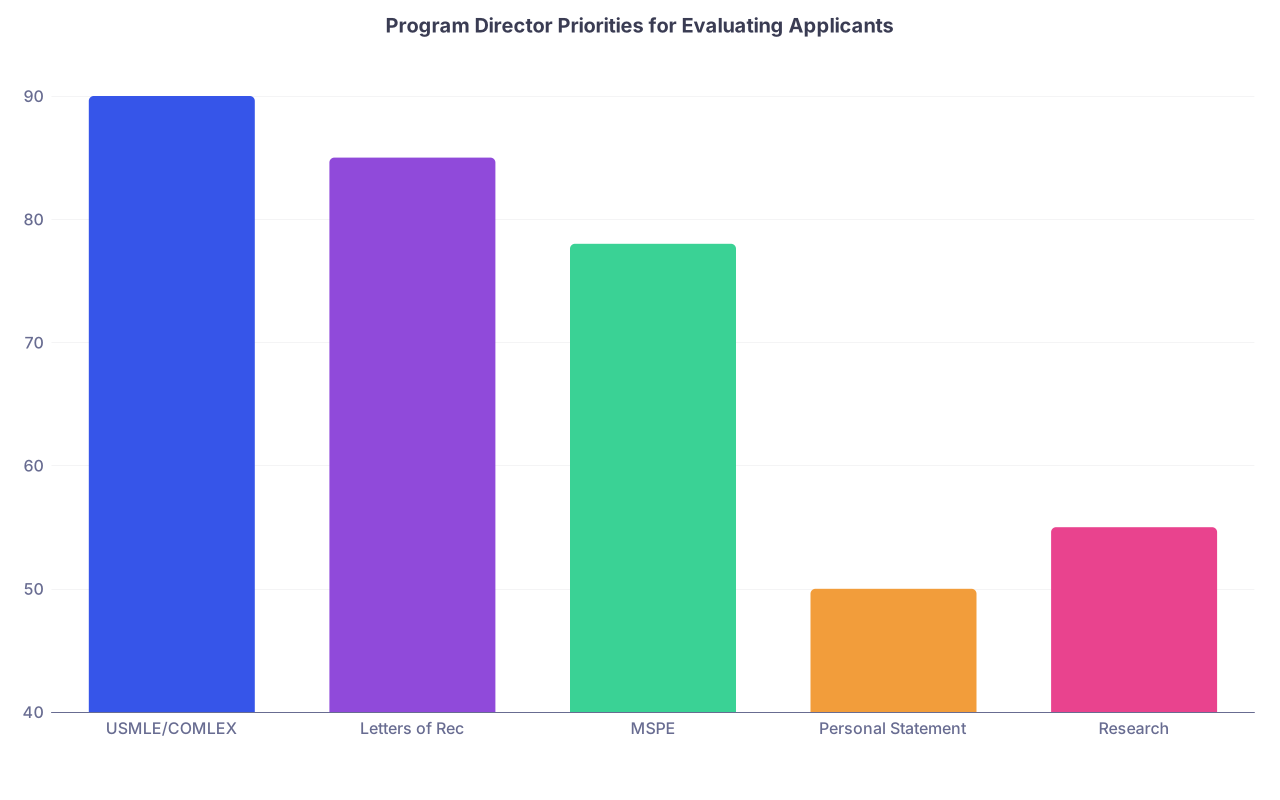
| Category | Value |
|---|---|
| USMLE/COMLEX | 90 |
| Letters of Rec | 85 |
| MSPE | 78 |
| Personal Statement | 50 |
| Research | 55 |
That chart roughly tracks what multiple NRMP Program Director Surveys have shown for years: the personal statement matters, but it’s not top of the pile. It’s middle of the pack.
And here’s the first myth:
Myth: Programs read your personal statement to see if your story matches a specific subspecialty and to check for “commitment to the field.”
No. They use it to answer a few much simpler questions:
- Can this person write like an adult human being?
- Do they seem normal or are there red flags (arrogant, bitter, dishonest, unprofessional)?
- Do I get some sense of who this person is beyond scores and bullets?
- Do they fit our general specialty, not a narrow subspecialty?
That’s it. Attending physicians reading 80 statements a night are not playing “subspecialty prediction bingo” with your essay.
I’ve watched faculty literally skim like this:
“Intro paragraph… okay, not a tragedy essay. They like patient care, teaching, some research… they seem reasonable. Next.”
Nobody said: “But where is their clear commitment to interventional cardiology?”
Because they know two things:
- Most applicants have no clue what they’ll actually subspecialize in.
- The system itself will change that choice multiple times.
Why “Declaring” a Subspecialty Can Actually Hurt You
The idea that you must loudly declare a future subspecialty in your personal statement is terrible advice for most people.
Here’s why it backfires.
1. You narrow yourself in a field that wants flexibility
Residency programs want residents who:
- Are open enough to enjoy multiple rotations
- Will not emotionally collapse if they don’t match into the one ultra-competitive fellowship they tattooed onto their forehead
- Can fill a variety of service needs over 3–7 years
If your internal medicine personal statement reads like a campaign speech for GI fellowship—“Since I was a child, I knew I wanted to be a gastroenterologist”—you’ve just told them:
- You might be miserable on cards, ICU, or clinic months
- You might fight every schedule that isn’t your subspecialty of choice
- You might bail if you don’t get that exact fellowship
Programs have been burned by that before. They remember.
2. You sound fake because you are guessing
You’ve done, what, one ENT elective and suddenly you “cannot imagine a life without otolaryngology”?
They don’t believe you. They shouldn’t.
Most attendings vividly remember their own med school selves, “committed” to 3–4 different fields in three years. They know one month on a rotation doesn’t give you deep understanding of a subspecialty lifestyle, politics, or burnout risk. So when a student oversells it, it reads as naïve at best, dishonest at worst.
3. You risk misalignment with the actual program strengths
| Program Type | What They Emphasize | What an Over-Narrow Statement Signals |
|---|---|---|
| Community IM | Broad clinical training | “I only care about cards” → bad fit |
| Academic IM | Research + teaching | “All I want is outpatient primary care” (with no research) |
| Large Surgical | Trauma + acute care | “I only care about cosmetic plastics” |
| Peds Program | General + underserved | “My entire identity is peds cardiology” |
If your statement screams “I am basically already a future interventional cardiologist,” and the program is heavy on general medicine and weak on cath lab exposure, they’re going to wonder if you’ll be constantly disappointed.
Not because they hate ambition. Because they hate mismatch.
Where Subspecialty Focus Does Make Sense
Now, here’s where nuance matters. I’m not saying “never mention any future interests.” I’m saying: be strategic.
There are a few specific situations where leaning into a subspecialty lightly helps you, but you still don’t need a 100% match between essay and future self.
1. Highly academic, research-heavy programs
If you’re applying to research powerhouse programs and you have:
- Multiple publications or abstracts in a clearly defined area
- A longitudinal project (2+ years) with consistency
- A mentor who is a recognizable name in that niche
Then yes, it makes sense to say something like:
“I’m particularly interested in advanced heart failure and transplant cardiology, an interest that grew out of three years working with Dr. X on outcomes in LVAD patients. I’m excited to continue exploring these questions in residency while remaining open to other aspects of cardiology and general internal medicine.”
Notice the difference:
- It shows a trajectory, not a fantasy
- It leaves the door open
- It doesn’t pretend you already know your exact fellowship and job description in 15 years
2. Niche specialties where focus is part of the culture
Some specialties really are narrower from day one—like radiation oncology, neurosurgery, or dermatology. Even then, you’re usually not pinning yourself to a micro-subspecialty within them in your personal statement.
You do not need: “I am destined for pediatric epilepsy functional neurosurgery, specifically laser ablation.” Calm down.
You do need:
- Clear reasons you understand the core specialty
- Some sustained exposure that proves this wasn’t a one-week crush
- Maturity about lifestyle, demands, and training path
3. When your whole application already screams a subspecialty
If your CV, letters, and MSPE collectively point to one clear area—say, you’ve done 3 orthopedics research projects, ortho leadership roles, and away rotations in joints—your statement can safely acknowledge that pattern without overcommitting.
But again, you still don’t need to script your entire future.
How Honest You Can Be About “Not Knowing Yet”
Here’s the part students underestimate: you’re allowed to say you’re not sure about your ultimate subspecialty.
You just have to say it intelligently.
Compare these two:
- Weak: “I am not really sure what I want to do yet, but I am open to anything.”
- Strong: “I’m drawn to both critical care and nephrology, and I expect residency will refine that interest. What I’m certain about is that I want a career that combines complex inpatient medicine, teaching, and long-term relationships with patients.”
Programs are fine with the second version. Many actually prefer it. They want residents who:
- Have some directional leanings
- Are curious enough to explore
- Don’t melt down if their initial plan shifts
They are not expecting 100% certainty. They are expecting 100% sanity.
The Real Alignment That Does Matter

Here’s the alignment you should actually care about in your personal statement:
Specialty-level fit, not subspecialty-level fantasy
Surgery vs internal medicine vs pediatrics vs psych vs EM—that level. Your statement should make sense for the specialty you’re applying into. A surgery statement talking only about motivational interviewing and continuity clinic is weird. A psych statement that reads like an ortho bro brag sheet is also weird.Program type fit
Academic vs community, research-heavy vs clinically focused, underserved vs affluent patient populations. You don’t have to call it out by name, but your values and interests should line up with reality.Trajectory that matches your track record
If you’ve done zero research, don’t announce your destiny as an R01-funded scientist. If you’ve ducked every teaching opportunity, don’t claim your deepest passion is academic education. Programs check for internal consistency.
None of those require picking “future interventional pulmonology” as your brand.
What About Applying to Multiple Specialties?
This is where people get really twisted up.
You’re applying to, say, both internal medicine and neurology. Or EM and IM. Or psych and FM. Do you need to lock in the same “future subspecialty identity” across both to look coherent?
No. That’s actually a trap.
You need separate statements that are:
- Honest for each specialty
- Internally consistent with the experiences you highlight there
- Not obviously copy-paste with search-and-replace on the specialty name
You do not need:
- The same supposed “one true calling” story in both
- Some contorted subspecialty (like “I’m passionate about neuro-cardiology!”) to bridge them
Programs don’t cross-reference your application to other specialties. They can’t see the other ERAS applications. They’re not sitting in a back room saying, “But in his IM application, he said he loved kidneys more than brains.”
That paranoia is in your head, not in the system.
Concrete Examples: How Much Subspecialty to Show (and How)
Let’s put this into actual language-level examples.
Example 1: Good level of specificity (IM applicant)
“During third year I found myself especially energized on cardiology and ICU rotations—the mix of physiology, uncertainty, and team-based decision-making kept me engaged on even the longest days. I can see myself pursuing a career in a field like cardiology or critical care, but I’m equally excited to build a strong foundation in general internal medicine and to explore other avenues during residency.”
What this tells programs:
- You have interests
- You understand some parts of the field
- You’re not rigid or delusional
Example 2: Too narrow and off-putting (IM applicant)
“My lifelong dream is to become an interventional cardiologist at a major academic center. All of my experiences, from shadowing in high school to my cardiology rotation, have confirmed that the cath lab is where I belong. I am applying to internal medicine solely as the next step on the path to this goal.”
This screams:
- Using IM as a stepping stone only
- Might be miserable if cardiology or interventional doesn’t happen
- Naïve understanding of how competitive and uncertain fellowships can be
A lot of programs will quietly move you down the list for this alone.
The Fellowship vs Personal Statement Reality Check
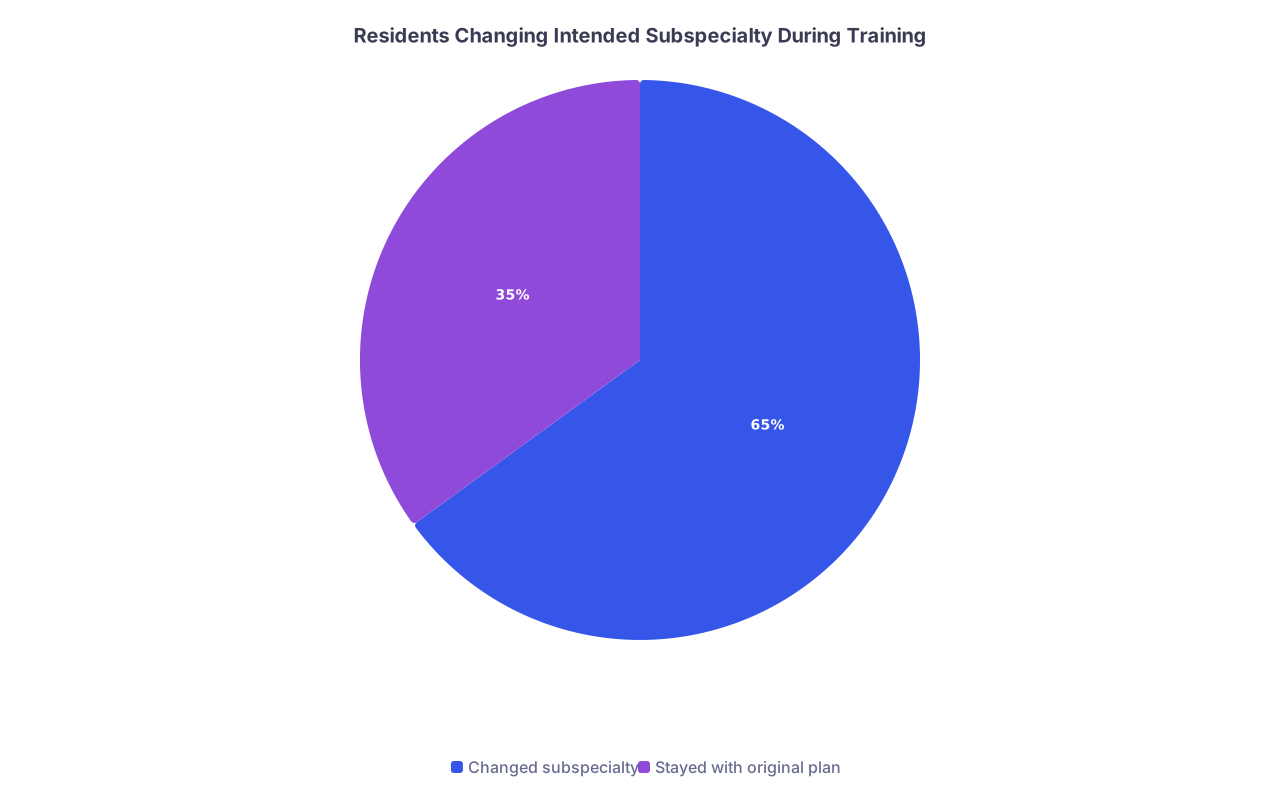
| Category | Value |
|---|---|
| Changed subspecialty | 65 |
| Stayed with original plan | 35 |
Does every specialty have this exact percentage? No. But across fields, the pattern is consistent: a majority of residents shift their subspecialty interests during training.
Which leads to the most important reality check:
Your personal statement is not a contract.
It’s a snapshot of how you think now.
Programs know your views will evolve. They are not going to chase you down in PGY-3 and say, “But in your ERAS statement, you wrote that you loved nephrology!”
What they care about is whether your statement demonstrates:
- Self-awareness
- Capacity for reflection
- Some coherent motivation for choosing the core specialty
If you hit that, you’re done. You don’t earn bonus points for overconfident micro-predictions about 2035.
A Practical Framework You Can Actually Use

| Step | Description |
|---|---|
| Step 1 | Start Draft |
| Step 2 | Focus on core specialty motivations |
| Step 3 | Lightly mention as interest, keep open |
| Step 4 | Connect to research/experiences |
| Step 5 | Describe values, patient care style, learning goals |
| Step 6 | Check for internal consistency with CV |
| Step 7 | Remove rigid lifetime predictions |
| Step 8 | Finalize Statement |
| Step 9 | Know exact subspecialty? |
Use that as your mental checklist. Notice there’s no box that says “Lock in exact fellowship choice and defend it to the death.”
So, Does Your Personal Statement Have to Match Your Future Subspecialty?
No—and trying to force that match often makes things worse.
If you remember nothing else, keep these three points:
- Programs care about specialty-level fit and sanity, not whether you can name your 2035 subspecialty with surgical precision.
- Over-selling a specific fellowship goal makes you look naïve, rigid, or misaligned with many programs’ actual strengths.
- The safest, strongest move: describe your genuine interests, show a coherent trajectory, and stay openly flexible about how your subspecialty choice will evolve during residency.
Write for the doctor you’re becoming, not a subspecialty fantasy you’re guessing at from the outside.