
Is My Personal Statement Too Honest About Burnout and Struggle?
What if the thing you’re most proud of in your personal statement is exactly what makes a program toss your application in the “risk” pile?
That’s the voice in your head, right? You finally wrote something real. You talked about burnout. The nights you wondered if medicine was a mistake. The panic, the therapy, the leave of absence, or the barely-holding-it-together phase. And now you’re thinking:
“Did I just ruin my chances by being honest?”
Let me say the uncomfortable part out loud: programs do worry about burnout, mental health, and “red flags.” They’re thinking: Can this person handle residency? Will they crumble on nights? Will they need a leave halfway through PGY-2?
So you’re not crazy for worrying. You’re not overthinking. This actually matters.
But “too honest” isn’t the real problem. The problem is how that honesty is shaped.
Let’s walk through this in a way that doesn’t sugarcoat what PDs actually think, but also doesn’t leave you feeling like you have to lie to get in.
What Programs Really Think When You Mention Burnout
Nobody reading residency personal statements in 2026 is shocked that med students burn out. They see it daily. Hell, half the attendings are burnt to a crisp.
The question isn’t: “Have you ever struggled?”
The question is: “What do your struggles predict about you as a resident?”
Here’s the mental checklist a program director is running when they hit a paragraph about burnout, depression, anxiety, or serious struggle:
- Is this person currently unstable or in crisis?
- Did this struggle cause performance issues, professionalism problems, or leaves?
- Did they show insight and growth, or are they just venting?
- Does this make them look fragile, unsafe, or unreliable?
- Is this going to become my problem at 3 a.m. when they’re the only resident on call?
They are not your therapist. They are trying to staff a hospital.
So when your personal statement reads like a diary entry, or your darkest year in medical school laid out with graphic detail, you’re making them do risk assessment in their head. Not “wow, inspiring.” More “am I about to inherit this?”
That’s where “too honest” can hurt you.
The Line Between Real and Overshare
You don’t have to pretend your training has been sunshine and anatomy labs. But there’s a difference between:
“I went through burnout and learned how to build a sustainable way of being a physician”
and
“I was so numb and empty that I cried every day and thought about quitting medicine constantly.”
One shows reflection and stability.
The other triggers concern and liability alarms.
Ask yourself a few brutal questions about your current draft:
- Am I asking the reader to worry about me?
- Would someone who doesn’t know me think I’m still fragile or barely hanging on?
- Is there at least as much space devoted to insight, coping, and growth as there is to describing the pain?
- If my darkest paragraph was screenshotted alone, out of context, would it freak out a PD?
If the answer to 1 or 2 is “yes” and 3 is “no,” your statement is probably too heavy on the struggle and too light on the “here’s who I am now and why I’m ready for residency.”
You can be honest. But you can’t be uncontained.
Concrete Examples: What’s Risky vs. What’s Safer
Let’s talk specifics, because vague advice like “focus on resilience” just makes everyone more anxious.
Example 1: Raw Burnout
Risky version:
“I was completely burnt out. Some days I couldn’t get out of bed, I dreaded going to the hospital, and I questioned whether I even wanted to be a doctor anymore.”
Safer version:
“During my clerkship year, I hit a point of profound emotional exhaustion. For the first time, I genuinely questioned whether the way I was approaching medicine was sustainable. With support from mentors and a therapist, I learned how to set boundaries, ask for help, and maintain habits that make me more present for patients rather than less.”
See the difference? The safer version doesn’t hide the struggle, but it shows you did something about it. It suggests stability now.
Example 2: Mental Health Diagnosis
Risky version:
“I was diagnosed with major depression and started medication after several months of feeling hopeless and struggling to keep up with my responsibilities.”
Safer version (if you feel you must mention it):
“I went through a period of significant depression during my second year. With professional treatment and support, I developed a much healthier way of coping with stress, which I’ve maintained for over two years. That experience has made me more empathetic with patients facing mental health challenges and more proactive in protecting my own wellbeing.”
Again: time frame, treatment, stability, and what changed. You’re not just bleeding on the page.
When Your Honesty Will Almost Definitely Backfire
There are situations where I’d tell you flat out: do not center this in your personal statement.
- Ongoing, unstable mental health issues with no clear period of recovery
- Details of suicidal ideation, self-harm, or hospitalization
- Graphic descriptions of panic attacks, breakdowns, or loss of functioning
- Active substance use issues
- Anything that sounds like you still kind of hate medicine or resent patients
Is that fair? Not really. But this isn’t a fairness exercise. It’s a selection process where they’re terrified of residents going out on leave or struggling dangerously on call.
You can still get help. You can still be human. You just don’t have to turn your personal statement into a psychiatric HPI.
If something was so serious it affected your transcript (leave of absence, failing a course, remediation), that belongs in the Additional Information section or a brief explanation, not as the emotional core of your personal statement. The statement should convince them why they want you, not why they should feel sorry for you.
How Much “Struggle” Is Actually Helpful?
Programs do like hearing you’ve been tested. They’re not recruiting robots. They know residency is ugly at times.
Struggle is helpful when:
- It connects to your values as a physician: empathy, humility, boundaries, advocacy.
- It shows you understand the realities of medicine and still choose it with open eyes.
- It demonstrates growth: you learned, changed, and now function better.
Struggle is harmful when:
- It dominates the story.
- The “resolution” is vague or feels rushed: “but I overcame it!” with no real proof of how.
- It makes it sound like residency will be your next breaking point.
If you read your statement and the main emotion is “wow, that was dark,” instead of “this person has been through it and is now steady,” that’s a problem.
A Simple Test For Your Draft
Do this with your current personal statement:
- Highlight every sentence about pain, burnout, doubt, exhaustion, or mental health.
- Highlight every sentence about growth, insight, concrete coping strategies, and how you function now.
- Compare.
If your “pain” highlighting outweighs the “growth” highlighting, or if your growth is generic (“I became more resilient”) without specifics, it will worry people.
You want the reader walking away with: “They’ve seen hard things, but I’d trust them with a service and a team.” Not: “I hope they don’t crash in PGY-1.”
What Programs Actually Want to See Instead
- Know medicine is hard and messy, not just the shiny parts.
- Have developed some adult-level coping skills: saying no, asking for help, using therapy, sleep, exercise, community, faith, whatever works for you.
- Won’t martyr yourself until you collapse, then blame the system alone.
- Can articulate how your struggle shaped the physician you’re becoming.
They’re not looking for “perfect.” They’re looking for “stable and self-aware.”
Here’s where honesty helps: when you can say, in a grounded way, “I’ve hit a wall before, I know what my red flags look like, and I know what to do when they show up.” That’s miles better than pretending you’re immune to burnout (no one believes that).
When To Tone It Down (Or Cut It Completely)
Your personal statement is not the only place to be honest. You also have:
- ERAS “experiences” and “other impactful experiences”
- Additional comments section
- Dean’s letter/MSPE
- Interview conversations (when trust has been built)
If your gut is screaming that you overshared, or your trusted readers look a little uncomfortable and say things like “Wow, that was really powerful,” but don’t say “Programs will love this” — that’s your sign.
Sometimes the better move is:
- One or two sentences acknowledging a tough period
- One or two sentences about what changed and how you grew
- Then move on. Talk about your actual interest in the specialty, your patients, what you’re like on a team.
You are not your burnout story. And if you turn your whole statement into that, you flatten yourself into “the burned out applicant.”
You don’t want that label.
A Quick Comparison: Statement Focus Options
Here’s a rough sense of how much “struggle content” is typically safe versus risky:
| Focus Mix (Struggle : Growth/Interest) | How It Often Lands With Programs |
|---|---|
| 10% : 90% | Grounded, realistic, safe |
| 30% : 70% | Honest but reassuring |
| 50% : 50% | Starting to feel heavy/risky |
| >60% struggle | Red-flag territory |
This isn’t math. But it tracks with what people reading thousands of statements actually feel.
Visualizing Your Story Balance
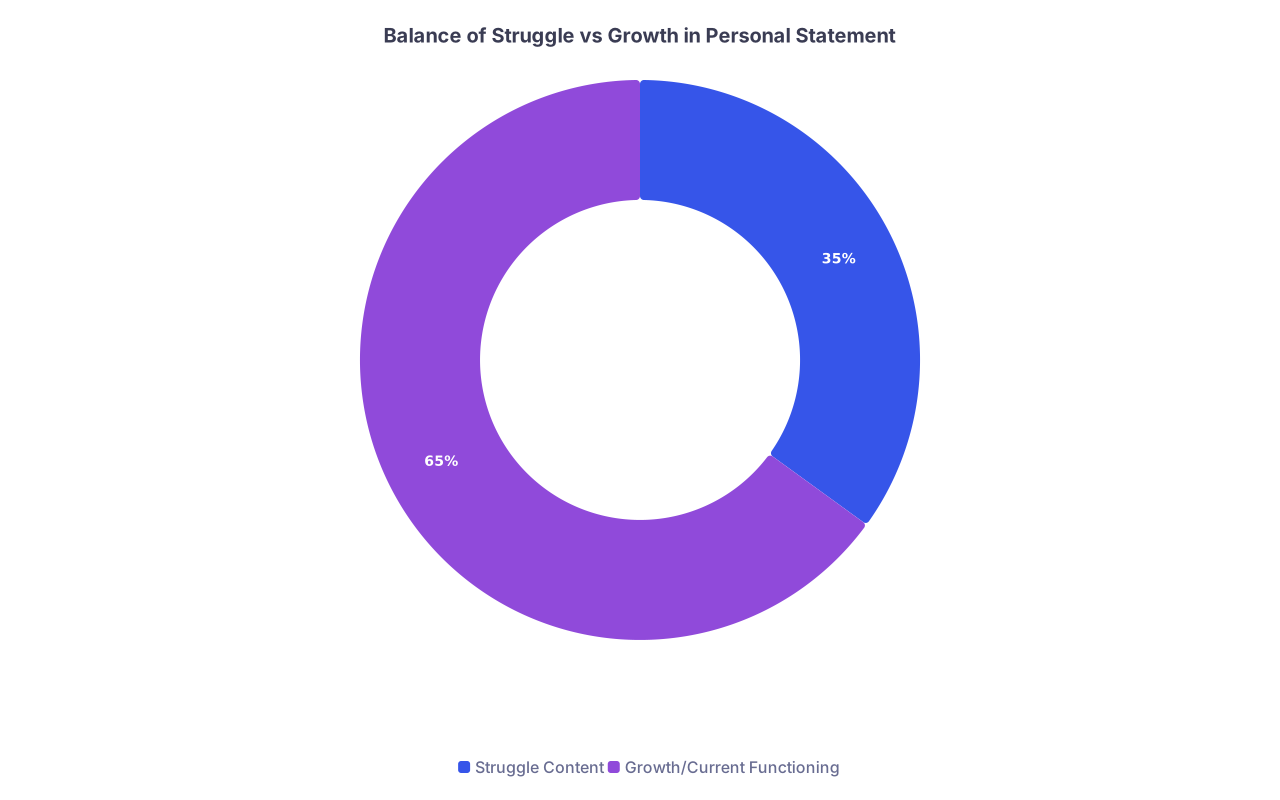
| Category | Value |
|---|---|
| Struggle Content | 35 |
| Growth/Current Functioning | 65 |
If your version of this chart in your head looks more like 70/30, you already know what to revise.
What To Do If You Already Submitted It
Here’s the nightmare scenario you’re probably spinning: “I already submitted ERAS. They’re all going to see it. I’m doomed.”
No. You’re not.
Reality:
- Some PDs skim statements. Some don’t read them at all unless they’re on the fence.
- If your scores, letters, and experiences are strong, those carry a ton of weight.
- If you get interviews, you can subtly recalibrate your story: emphasize your current stability, how you function now, what support systems you use.
If your statement is truly alarming, a few things might happen:
- Fewer interviews than your stats predict.
- Questions in interviews that gently probe your resilience and coping.
You can’t un-send it. But you can decide how you talk about yourself from this point forward — in interviews, in emails, in how you carry yourself on interview day.
And if you haven’t submitted yet and your stomach fell out reading this? You probably need to revise.
When It’s Okay To Be Very Honest
There are rare times where a very raw story belongs in your statement:
- You had a major life event (serious illness, caregiver role, trauma) that directly shaped why you chose your specialty AND you’ve clearly been functioning well for a while.
- You’re applying in a field where vulnerability and reflection are heavily valued (psych, palliative, sometimes FM), and mentors in that field have read and endorsed your statement.
- Your story explains something glaring in your application (e.g., a leave of absence) and your advisor specifically told you it’s best to address it in the PS.
Even then, “honest” doesn’t mean “unedited.” You still frame it like a clinician, not like a confessional.
A Simple Revision Framework
If you’re staring at your draft thinking, “Okay, but how do I fix this without lying?” here’s a quick structure:
- One short paragraph: Set the scene of the struggle (focused, not graphic).
- One short paragraph: What specifically you realized about yourself/medicine.
- One medium paragraph: Concrete changes you made (therapy, schedule habits, boundaries, mentorship, communication).
- Rest of the statement: Your interest in the specialty, meaningful clinical experiences, what kind of resident you’ll be.
Struggle is the setup, not the whole plot. The story is who you are now.
FAQ (Exactly 4 Questions)
1. Do I have to mention my burnout or mental health at all?
No. You don’t owe programs your full psychological history. If your burnout or mental health never affected your academic record or professionalism, you can keep it to yourself or just hint at “challenging periods” without specifics. Your personal statement is a sales document, not a confession.
2. Will programs think I’m lying if I don’t mention the hardest parts?
They’re not cross-referencing your soul with a database. They expect you to present a professional, curated version of your story. That’s not lying; that’s being appropriate. Everyone has stuff they don’t put in writing in a high-stakes application.
3. How do I know if my personal statement is a red flag?
Show it to someone who’s actually sat on a residency selection committee or at least a blunt advisor. Watch their face when they read the “burnout/struggle” section. If they pause and say, “This is very personal,” or “Are you sure you want to share this much?” that’s your answer. You can also use the highlight test: if more than about a third of your PS is focused on struggle, it’s likely too much.
4. Is it better to be “fake positive” than honest?
You don’t need to be fake, but you do need to be strategic. You can be honest and selective. “I went through a difficult period and learned how to take care of myself so I can better care for patients” is truthful without pulling the fire alarm. Full, unfiltered honesty is for your therapist, your friends, and maybe your journal — not necessarily for the PD deciding if you can safely handle a 28-hour call.
Key points: You’re not wrong to worry about being “too honest” — programs do care how you present struggle. Your goal isn’t to hide everything; it’s to show that whatever you went through led to real, stable growth, not ongoing crisis. And if your statement currently feels more like a cry for help than a professional narrative, you can fix that.