
You are here
It is late March. You just read the ominous “We regret to inform you…” email from the last program you were holding out hope for. You went unmatched. Again.
Your friends are posting Match Day photos. Your phone is mostly silent. And somewhere in the back of your mind, a miserable thought is already forming: I have to rewrite that personal statement.
You are not starting from zero. You have:
- An old ERAS application
- At least one unmatched cycle’s worth of feedback (even if indirect)
- A year ahead that can either fix your trajectory or repeat the same disaster
So let’s treat this like what it is: a 12‑month project. At each point in the year, you should be doing very specific, targeted work on your personal statement as a reapplicant. Not “eventually.” On schedule.
I will walk you month-by-month from right after an unmatched cycle to the day you hit “Certify and Submit” on ERAS again—focused only on your personal statement and the experiences that will feed it.
Late March–April: Post‑Match Autopsy and Reality Check
At this point you should not start writing. You should diagnose.
Weeks 1–2 after Match Week: Emotional triage, not drafting
For 1–2 weeks:
- Do not open your old personal statement.
- Do not start typing a new one.
Instead:
- Give yourself space to feel lousy. Because you will not think clearly while you are in free-fall.
- Tell exactly 2–3 trusted people what happened (advisor, mentor, close friend). Keep the circle small but honest.
Then, by the end of week 2, you should:
Pull your entire prior application
- Old personal statement(s)
- ERAS experiences section
- Letters of recommendation list
- Programs you applied to and how many interviews you received
Get a brutally honest external review Schedule 30–45 minute conversations with:
- A faculty mentor in your chosen specialty
- A program director or APD if you can get one (even from a program that never interviewed you)
- A resident in the specialty who has sat on an application review committee
Send them:
- Your old personal statement
- Your ERAS PDF
- Your interview count and where you got them
And ask them directly:
- “If this application came across your desk, what would you assume about this applicant?”
- “Would you have invited me to interview? Why or why not?”
- “What is wrong with this personal statement? Say it directly.”
You need unvarnished feedback right now, not ego preservation.
Weeks 3–4: Identify what category of problem you are in
By the end of April, you should know which bucket you primarily fall into:
| Category | Main Issue |
|---|---|
| Numbers | Step/COMLEX scores, failures |
| CV / Experience | Weak clinical, research, gaps |
| Fit / Specialty | Unclear commitment to specialty |
| Story / PS Quality | Generic, cliché, confusing |
| Geography / Strategy | Bad school list, late apps |
Your personal statement strategy depends on this.
- If your scores are weak but your story is strong → PS must emphasize growth, maturity, concrete improvement.
- If your scores are fine but you had few interviews → your old PS and experiences probably read generic or confusing.
- If you are switching specialties → your PS is essentially being reset from scratch.
At this point you should write a one-paragraph diagnostic of your previous personal statement:
- What did it try to say?
- What did it actually convey?
- What do your reviewers universally agree did not work?
That paragraph will sit at the top of your planning document for the rest of the year.
May–June: Rebuilding Your Narrative Foundation
Now you start reconstructing. Still not formal drafting—structural work.
Early May: Decide your specialty and angle, for real
If you are debating changing specialties, you cannot keep that undecided past May.
By the second week of May, you should have:
- A final decision on specialty (including dual-apply or not, but that is another mess)
- A clear main message for your reapplication year, something like:
- “I am an unmatched prelim IM resident who has spent a year proving I can function as a categorical-level resident and I want to stay in IM long-term.”
- “I am reapplying to EM with focused clinical EM exposure, QI work, and stronger SLOEs after an initial weak cycle.”
- “I am transitioning from IM to Psychiatry with concrete exposure and mentorship in psych this year.”
Write this main message in 2–3 sentences. This is not the PS. This is the thesis your statement will prove.
Mid–May: Inventory your new material
Your old cycle is stale. Programs will want to know:
- What did you do with the unmatched year?
- Did you actually fix the obvious weaknesses?
So, make three lists:
Existing strengths you can keep:
- Strong narrative elements from your prior life story
- Any well-described patient encounters that genuinely worked
- Clear motivations for your specialty that still feel true
Gaps that must be addressed explicitly:
- Failed Step/COMLEX, low score, or multiple attempts
- No continuity clinical work during the off year
- Switch in specialty without a coherent explanation
Planned experiences before ERAS opens (this matters for your PS):
- Research positions, prelim or TY spots, externships, scribe work, MPH, etc.
- Where you will gain fresh, specific stories that can go into the new PS
If you look at your calendar and realize:
“I will not have any meaningful, new clinical exposure by July” → that is a problem. Fix it now. Your reapplicant personal statement cannot just be a rearranged version of last year’s.
Late May–June: High-level outline and narrative arc
By the end of June, you should have a 1-page PS planning document containing:
- Thesis (those 2–3 sentences from above)
- Key story pillars (3–4 bullet points), for example:
- A pivotal patient encounter from your unmatched year
- A project or QI effort showing leadership and accountability
- A moment where you confronted your earlier failure and changed your behavior
- Necessary explanation points:
- “I failed Step 1, here is what changed.”
- “I did not match last year; here is how I responded.”
- Tone commitments:
- No self-pity.
- Honest about failure, but concrete about growth.
- Less “ever since I was a child,” more “this is how I perform now.”
You should not be writing pretty sentences yet. Just bullets and structure.
July: Pre‑ERAS Opening – First Real Draft
ERAS typically opens in June for data entry, but programs cannot see your application until September. July is your heavy-drafting month.
At this point you should aim for Draft 1 finished by July 31.
Early July (Week 1–2): Rough Draft 1
Open a new document. Do not recycle paragraphs from last year. That voice is contaminated with the previous failure.
Structure that works for reapplicants:
Opening paragraph – Current you, not childhood you
- Start in the unmatched year or in a recent clinical encounter.
- Example: caring for a difficult patient on your prelim year or in a post‑grad role that tested you.
- Show competence and reflection, not melodrama.
Middle paragraphs – Experiences that prove readiness
- 1 paragraph on your path into the specialty (brief, not your life story)
- 1 paragraph on what you did after not matching / or after your main setback
- 1 paragraph on what you offer now (skills, maturity, work habits, insight)
Address the elephant – Direct, contained, non-defensive
- A short, clear acknowledgement of the failed match / exam issue
- Example pattern:
- Name the issue in one sentence.
- Give 2–3 sentences on specific changes you made (study method, time management, feedback-seeking).
- Move on to how that change has translated into performance (scores, evals, new responsibilities).
Conclusion – Forward-looking, program-centered
- Why you are prepared to contribute this year.
- Emphasis on what kind of resident you will be, not what you want them to give you.
Word count target: 650–750 words. Anything above 800 tends to get skimmed.
Late July (Week 3–4): First feedback cycle
By the end of July, at this point you should have:
- Draft 1 done
- Sent it to 3 types of reviewers:
- 1 content-focused mentor (knows you and your field)
- 1 harsh editor (good with language, can cut fluff)
- 1 near-peer (recently matched in your specialty)
Ask very narrow questions:
- “What do you think my main message is?”
- “Where do you get bored?”
- “Do you trust me more after reading this, or less?”
If people say “It’s good!” but cannot state your main point in one sentence, your draft is not good.
August: Revision, Precision, and Program Strategy
By early August, ERAS is open and you are entering data. Programs will see your PS in September, but your revision work must largely be finished before life gets chaotic.
Early August: Draft 2 – Structural revisions
This round is not about commas. It is about clarity and credibility.
At this point you should:
Remove weak content
- Any cliché intros (“I first realized I wanted to be a doctor when…”)
- Generic phrases: “I am passionate about,” “I have always wanted,” “This experience taught me…”
- Repetitions of your CV that add zero insight.
Sharpen your unmatched narrative If you are a reapplicant, your statement must answer silently:
- Did this person actually learn from last cycle?
- Have they done something real to address the gap?
- Are they more stable and reliable now than last year?
Weak:
“I did not match last year, which was disappointing, but I remain passionate about internal medicine.”
Strong:
“I did not match in 2025. My feedback was consistent: thin clinical experience and weak letters. Over the past year I have worked full-time as a hospital medicine fellow at X community hospital, taken overnight call, and become the go-to resident for new admissions. Those months turned an abstract interest in internal medicine into daily, accountable work.”
- Check for desperation
Programs are allergic to neediness. Remove:
- Pleading (“I hope you will take a chance on me…”)
- Over-apologizing
- Long explanations of unfairness, personal injustice, or blaming others
Mid–August: Draft 3 – Language tightening
By the middle of August, your structure should be set. Now you focus on:
- Shorter sentences
- Concrete verbs
- Specific details
Replace:
- “I am hardworking and dedicated” → Show a 1–2 line example of staying late for a complex case or taking responsibility when you could have bailed.
- “I developed my communication skills” → One instance where your communication changed a patient outcome or team decision.
At this point you should do a read-aloud pass. If you feel cringe reading it out loud, fix that. Your voice should sound like you speaking in an interview, not in a scholarship essay competition.
Late August: Versioning for dual or adjacent specialties (if needed)
If you are dual-applying (e.g., IM and FM, or Anesthesiology and IM), do not use a single generic personal statement.
By late August, you should have:
- One primary statement per specialty
- 80–85% overlap is acceptable, but:
- The opening story and conclusion must be specialty-specific
- The language describing your future career must match that field
Do not get caught with “as a future internist” in a statement sent to a family medicine program. It happens more than you think.
September: Final Polish and Upload
Programs start downloading applications in September. Your window to tweak without panic is early September.
Early September (Week 1): Final mentor review
At this point you should:
- Send what you consider your final draft to 1–2 mentors.
- Ask only: “If this were on your desk as a PD, would you be comfortable interviewing this person?”
If the answer is anything less than a direct “yes,” do one more revision pass.
Do not overhaul structure in September unless the draft is truly broken. Minor tuning only:
- Clarify one sentence here, adjust a transition there.
- Remove 1–2 unnecessary lines to get down to a tight 650–700 words.
ERAS Upload Checklist
Before you paste into ERAS:
- Copy the statement into a plain text editor to strip weird formatting.
- Check:
- Spacing and paragraphs preserved
- No weird characters
- Your name is not in the body text (ERAS attaches it anyway)
- Confirm:
- Correct statement attached to correct specialty
- No leftover references to “reapplying to surgery” in your psych statement, etc.
At this point, you should lock it. Endless tinkering on September 10 will not move your match odds more than applying to 10 additional realistic programs will.
October–January: Using Your Statement in Interviews
Interviews will come, even as a reapplicant, if your year and your story are substantially better.
Your personal statement now becomes a script for:
- “Tell me about yourself.”
- “Walk me through your journey since not matching.”
- “What did you change from last year?”
Print your PS. Highlight:
- Any claim of growth
- Any described skill
- Any story you referenced
For each highlight, you should prepare a 1–2 minute spoken expansion. If you wrote “I fundamentally changed my study habits after failing Step 1,” you need a concrete, sober description of that new system.
Do not say anything in your statement that you cannot defend calmly and clearly on Zoom at 7 AM.
Quick Timeline Snapshot
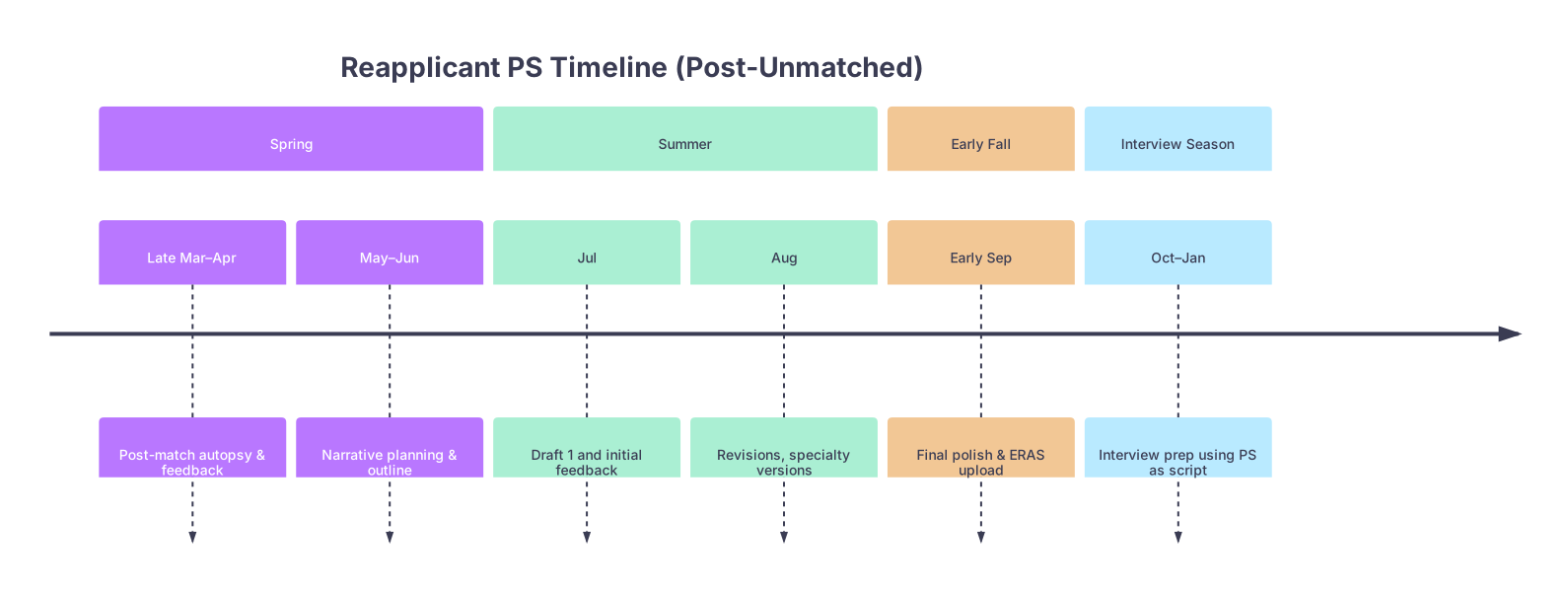
| Period | Event |
|---|---|
| Spring - Late Mar–Apr | Post-match autopsy & feedback |
| Spring - May–Jun | Narrative planning & outline |
| Summer - Jul | Draft 1 and initial feedback |
| Summer - Aug | Revisions, specialty versions |
| Early Fall - Early Sep | Final polish & ERAS upload |
| Interview Season - Oct–Jan | Interview prep using PS as script |
Red Flags You Must Avoid as a Reapplicant
A few patterns kill reapplicant statements instantly. If you recognize yourself here, fix it before you upload.
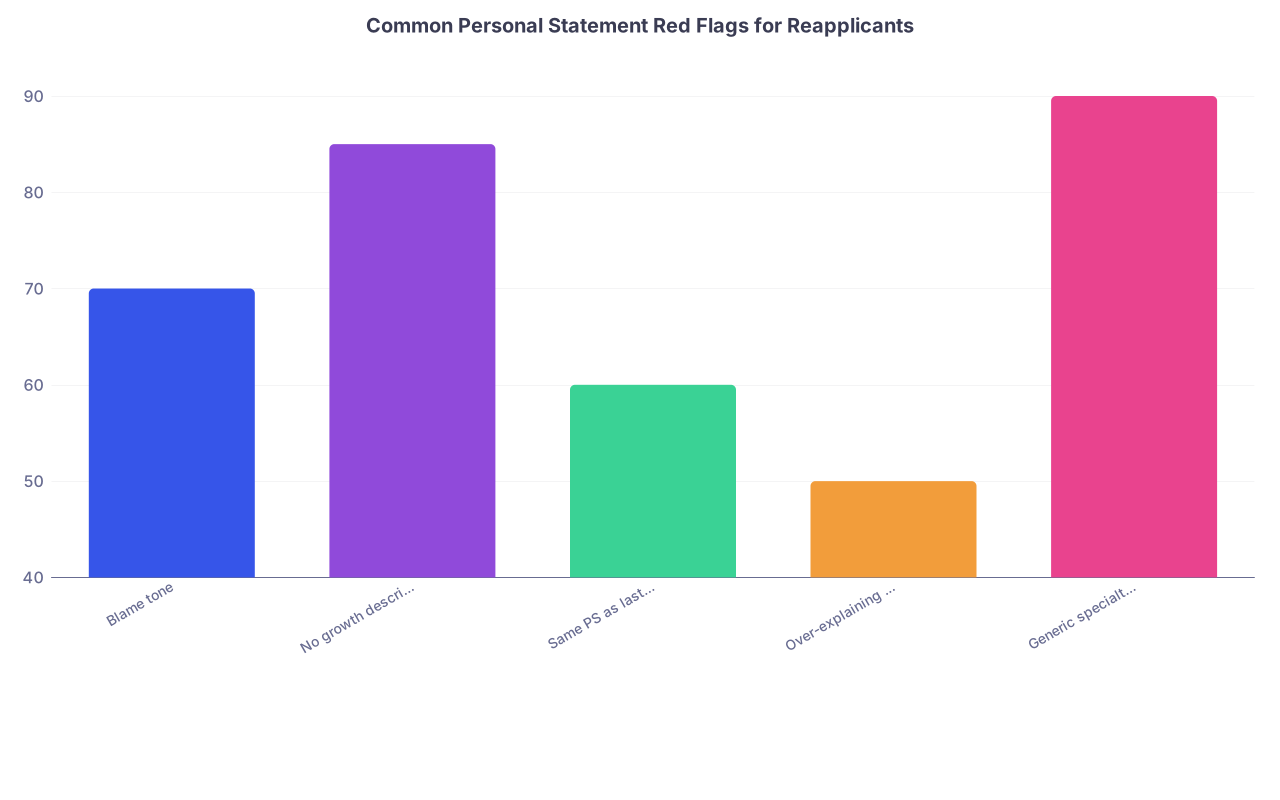
| Category | Value |
|---|---|
| Blame tone | 70 |
| No growth described | 85 |
| Same PS as last year | 60 |
| Over-explaining failure | 50 |
| Generic specialty interest | 90 |
Top offenders:
- Blame-heavy narrative – Long paragraphs about unfairness, toxic attendings, biased committees. Programs will assume you are a headache.
- No new evidence – You talk about “growth” but show no new scores, no new responsibilities, no concrete work.
- Recycled essay – PDs remember. Residents screening apps remember. If your statement is basically last year’s with three new sentences, you have wasted your second chance.
- Over-explaining – Two full paragraphs about why you failed an exam? No. A tight, honest 3–4 sentences is enough. Then demonstrate who you are now.
- Still choosing the wrong audience – Writing as if to a scholarship committee instead of a residency program that needs reliable colleagues at 2 AM.
Example Weekly Micro-Plan (June–August)
To keep you from drifting, here’s what a focused 8‑week stretch looks like.
| Week | Main Task |
|---|---|
| 1 | Finalize specialty + thesis |
| 2 | Build story pillars + outline |
| 3 | Write rough Draft 1 (no editing) |
| 4 | Revise Draft 1, send to 3 readers |
| 5 | Implement feedback → Draft 2 |
| 6 | Tighten language → Draft 3 |
| 7 | Create alternate specialty version |
| 8 | Final mentor review & polish |
Treat these weeks like a rotation. Show up. Do the work. Do not cram this into one weekend.
Visual: Growth From First to Final Draft
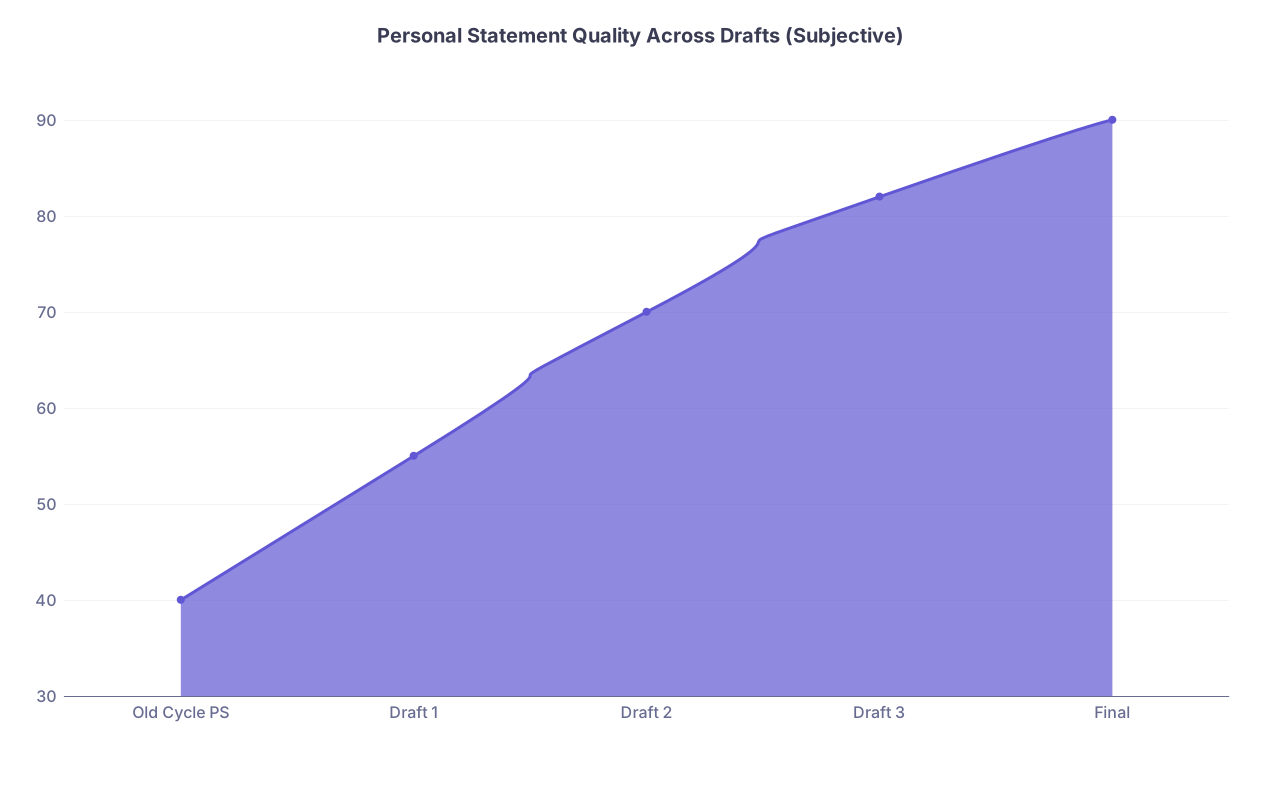
| Category | Value |
|---|---|
| Old Cycle PS | 40 |
| Draft 1 | 55 |
| Draft 2 | 70 |
| Draft 3 | 82 |
| Final | 90 |
The point is not perfection. It is visible, concrete improvement from who you were last cycle.
Final Key Points
- As a reapplicant, your personal statement must do two things simultaneously: acknowledge the past cycle’s failure without wallowing, and prove—with specifics—that you are a stronger, more reliable resident candidate now.
- The timeline matters. If you wait until August to start thinking about your narrative, you will either recycle last year’s statement or turn in something panicked and shallow.
- Every month between March and September should move you from autopsy → plan → new experiences → structured draft → precise, honest final statement. Follow the timeline, and your PS will finally match the caliber of resident you are trying to become.