
The default personal statement advice for residency will absolutely flatten a physician-scientist story if you follow it blindly.
If you’re trying to match into a physician-scientist track, PSTP, or research-heavy residency, you cannot write the same “patient encounter, lightbulb moment, I love teamwork” essay everyone else is turning in. You’ll get buried.
This is the playbook for one very specific situation:
You are a research-heavy applicant (PhD, significant gap years, MSTP, or serious research portfolio) applying for residency and you need to show programs you are not “just a lab person” and not “just a clinician,” but a real bridge between discovery and care.
If that’s you, here’s how to write a personal statement that sounds like an actual future physician-scientist instead of a generic “I like both science and people” brochure.
Step 1: Decide Which Version of You This Statement Is Selling
You need to answer one question before you write a single sentence:
“Am I applying as a future attending who happens to like research, or as a physician-scientist whose career centers on research?”
Those are not the same thing. Programs read for this distinction in 10–15 seconds.
Use this table to get brutally honest about where you land:
| Signal | Mostly Clinician | True Physician-Scientist |
|---|---|---|
| Time in research | 0–1 dedicated years | 2+ years or PhD |
| First-author papers | 0–1 | 2+ (or major middle-author in big labs) |
| Grants/fellowships | None | T32, F30/F31, HHMI, similar |
| Talks | Local posters only | National talks or major posters |
| Future time split | “Open to research” | Explicit 70/30 or 80/20 research/clinical |
If you’re on the right-hand side, your statement must:
- Explicitly name you as a future physician-scientist. Use the words.
- Articulate a research program, not just “I like inquiry.”
- Prove you actually like patient care and can handle residency.
If you’re more in the left column but still research-leaning, your job is different: emphasize being a strong clinician who brings a research mindset, without overselling the hardcore PSTP identity (or you’ll sound mismatched).
Pick one identity. Then write for that. Split-the-difference essays are forgettable.
Step 2: Structure Your Statement Around One Core Thread
Stop trying to tell your whole life story. Physician-scientist statements work best when they follow one clear through-line:
“Here’s the problem I care about, here’s how I’ve attacked it at the bench, here’s how I’ve seen it at the bedside, and here’s what I want to do about it as a resident and beyond.”
Use this simple structure:
- Opening snapshot – A concrete moment that shows your bridge role (not just a dramatic ICU scene).
- Research spine – What you worked on, what you actually did, and how your thinking matured.
- Clinical spine – Key clinical experiences that changed how you see the science.
- Integration – How bench and bedside inform each other in your head.
- Looking forward – Specific trajectory in this specialty and the kind of program you’re looking for.
If you’re MSTP or PhD-heavy, your big risk is sounding like a postdoc who happens to have an MD. This structure forces clinical reality into the narrative.
Step 3: Start with the Right Kind of Opening
The classic trap: you open with a single patient vignette and write 3 paragraphs that could have come from any purely clinical applicant.
You’re not that. You need an opening that already shows your two-worlds brain working.
Strong openings for physician-scientists:
- The first time a clinical problem broke your research brain open
- A lab meeting where a clinical case changed a hypothesis
- A patient encounter that clashed with what your own data “should” have predicted
- A moment you realized your research was too detached from the people it was meant to help
Weak openings:
- “As I walked into the room of Mr. X, I did not yet know how much he would impact me…”
- “From an early age I loved science and helping people…”
- “Medicine stands at the crossroads of science and humanity…” (Every committee has read that sentence 500 times.)
Example pattern (fill with your specifics):
“The fourth admission that month with steroid-refractory GVHD came in on a Tuesday. By Friday I was back in lab, staring at our elegant murine survival curves and feeling vaguely annoyed. Our mice were doing better than my patients. That disconnect—between clean Kaplan-Meier plots and messy nights on heme/onc call—has shaped how I see my role as a future physician-scientist in [specialty].”
See what’s going on there: clinical reality + research context + clear specialty + identity (“future physician-scientist”) in the first paragraph.
Step 4: Talk About Your Research Like a Colleague, Not a CV
You must walk a knife-edge here. Two common failures:
- CV regurgitation: “I worked in Dr. X’s lab studying Y… I then worked with Dr. Z on A…”
- Overtechnical wall of jargon that no busy internist or surgeon on the committee wants to decipher at 10:30 pm.
Here’s how to do it right.
One-sentence plain-language problem statement.
“My work has focused on why some patients with sepsis progress rapidly to multi-organ failure while others with similar initial presentations do not.”What you actually did (methods, but in human language).
“In Dr. Smith’s lab, I led a project using single-cell RNA sequencing of ICU patients’ blood to map early immune signatures of deterioration.”Your role. Be clear and honest.
“I designed the study, built the analysis pipeline in R, and coordinated enrollment with the ICU team.”What you found or learned (does not have to be a Nature paper).
“We identified a reproducible monocyte signature that preceded clinical deterioration by 24–48 hours, which we’re now validating prospectively.”How it changed how you think clinically.
“On the wards, I now look at ‘borderline’ sepsis patients and wonder which ones already harbor that signature we cannot yet see.”
That last step is the difference between “good grad student” and “future physician-scientist.” Tie your intellectual work to real patients, even hypothetically.
Here’s the litmus test: a non-research-heavy attending in your target specialty should be able to read your research section without feeling stupid or annoyed.
Step 5: Prove You Actually Want to Take Care of Patients
Program directors are wary of lab rats who will resent residency.
You must quietly but firmly answer the question: “Will this person show up at 4:45 am to pre-round and not act like they’re above it?”
You do this in three ways:
Show real enjoyment of clinical work.
Not just “I care about patients,” but something like:- “I like the puzzle of a vague complaint at 2 am and the satisfaction of getting the first draft of the plan right.”
- “I enjoy the rhythm of inpatient medicine—the constant re-prioritization, the shared work on rounds.”
Acknowledge the grind without whining.
One sentence that shows you’re not naïve:- “I’m aware that the hours and acuity of [specialty] training will temporarily shift my time away from the bench, and I’m ready for that. I want to be clinically excellent first.”
Describe a specific clinical moment that hit you emotionally or intellectually, without turning it into melodrama.
Not the “I cried in my car and realized…” trope. Instead:- “I still remember the discomfort of telling a patient his chemotherapy options, knowing that I had once pipetted the drug that likely caused his cardiomyopathy. That dual responsibility—first do no harm, then do better—that’s what keeps me committed to this path.”
If your file screams “10 years in lab,” you don’t need to oversell research. You need to close the perceived clinical gap.
Step 6: Make Your Future Plans Concrete (and Realistic)
The worst ending for a physician-scientist essay is vague ambition.
“I hope to combine my love of research and clinical care to advance the field and improve patient lives.”
That sentence does nothing.
You need to say:
- What kind of clinical niche you imagine
- What kind of research program you want to run
- How you see your time split (even if approximate)
- What kind of training environment supports that
Example of a strong closing vision:
“Looking ahead, I hope to build a career as an academic endocrinologist focused on obesity and metabolic disease, with a lab studying adipose tissue immunometabolism and a clinic centered on young adults with severe obesity. I see myself in a role where 70–80% of my time is protected for science, grounded by a longitudinal clinic that keeps me honest to the problems that matter. I’m looking for a residency that not only tolerates that goal but actively prepares me for a physician-scientist pathway—through structured mentorship, protected research time, and early exposure to investigative faculty.”
That’s clear. It’s directional without being locked in to a sub-sub-subfield.
If you’re applying specifically to PSTP or physician-scientist tracks, you can be even more explicit: mention K-award trajectory, T32 environments, or desire for post-residency research fellowships. Just don’t sound like you think a K08 is guaranteed.
Step 7: Calibrate for Specialty and Track
A physician-scientist personal statement for internal medicine PSTP is not the same as one for categorical IM, and definitely not the same as one for neurosurgery.
You adjust the dials on three things:
Intensity of research language
- PSTP / research tracks: Lean in. Use “physician-scientist” explicitly. Mention grant-writing, long-term investigative trajectory.
- Categorical only: Still emphasize research, but frame it as value-added to being a strong clinician. You don’t want them thinking you’ll be miserable doing full-time clinical years.
Amount of technical detail
Surgical and procedural specialties often want to see some hands-on, team, or OR-flavored content alongside your science.
IM, neuro, peds, etc. tolerate more mechanistic description.Type of “bridge” you’re building
- IM/Onc: Mechanism → trials → guidelines
- Neuro: Biomarkers → imaging → functional outcomes
- Surgery: Devices, techniques, outcomes research alongside translational work
If you’re applying to both categorical and PSTP programs in the same specialty, you can usually use one statement, but you must make sure:
- You sound grateful, not resentful about the clinical years
- You acknowledge that clinical competence is foundational to credible science
If you’re applying to two different specialties (e.g., IM and Neurology) as a researcher, you need separate statements. Full stop.
Step 8: Avoid the Landmines That Kill Strong Research Applicants
I’ve watched really promising physician-scientist applicants sink themselves with preventable mistakes.
Here are the big ones:
Arrogant tone toward clinical medicine.
Phrases that get under attendings’ skin:- “While the day-to-day details of residency are less important to me than my long-term research career…”
- “I view residency primarily as a necessary hurdle on the way to my real work in the lab.”
If that’s how you feel, do not put it in writing. Or frankly, reconsider applying right now.
Overclaiming impact.
Saying your project “revolutionized our understanding” or “will transform care” when it’s a modest piece of a much larger puzzle. Committees are full of people who’ve actually moved needles. They can smell exaggeration.Name-dropping instead of substance.
Listing famous labs and PIs as if their name alone proves your value. You’re not trying to win the “proximity to prestige” contest. Show what you did.Sloppy explanation of gaps.
Long PhD, failed experiments, pivots—these are normal. But if you had:- A long leave
- A lab change with drama
- Big gaps in productivity
Then 2–3 clean sentences in the statement can frame that without sounding defensive:
“My first two years of PhD work were spent on a project that ultimately proved non-viable technically. While it was frustrating, it forced me to learn [X] and led me to the question that has since driven my work.”Trying to be too cute or literary.
You’re applying as a scientist. Clear beats “beautiful”. If your best sentence sounds like it belongs in a MFA workshop, cut it.
Step 9: Align Your Statement With the Rest of Your Application
Your personal statement doesn’t live alone. Committees read it against:
- Your ERAS experiences
- Your pubs list
- Your letters (especially from PIs)
- Your CV gaps
And they mentally check for alignment.
Do a 15-minute consistency scan:
- Does your research timeline in the statement match your CV and ERAS?
- Are the projects you emphasize in the statement the same ones your PIs wrote about in letters?
- If you say “I love inpatient medicine,” do your experiences show actual inpatient rotations or electives in that field?
- If you claim a passion for a specific disease, is that reflected anywhere else?
One quiet power move: echo a phrase or concept you know is in a PI letter (without obviously quoting it). It creates a sense of coherence when two documents land on the same idea about you.
Step 10: A Practical Drafting Process That Won’t Waste Your Time
Here’s a concrete way to get from blank page to solid physician-scientist statement without writing three novels first.
10-minute brain dump
Answer these, bullet-style, no editing:- One patient that changed how you see your research
- One research failure that actually helped you grow
- One moment you felt “I could do this for 30 years” (either lab or clinic)
- One thing you want to be known for in your field 15 years from now
Pick your opening moment from that list.
If it doesn’t connect science and patients in some way, pick a different one.Write the “future plans” paragraph next, not last.
When you know where you’re headed, the middle is easier to shape.Fill in the research section using the 5-part template from Step 4.
Add 1–2 clinical paragraphs that:
- Show you functioning on a team
- Hint at your specialty choice reasoning
- Prove you like (or at least respect) real-world medicine
Do a “jargon and ego” pass.
Highlight every phrase that:- A PGY-1 outside your subspecialty wouldn’t understand
- Sounds like you’re bragging instead of describing
Then clean those up.
Give it to exactly two people:
- A research mentor who is not precious about wording, but will check scientific accuracy
- A clinically strong resident or fellow in your target specialty who can flag eye-roll moments
Ignore line edits that turn your voice into theirs. You’re protecting clarity, humility, and accuracy, not chasing perfect prose.
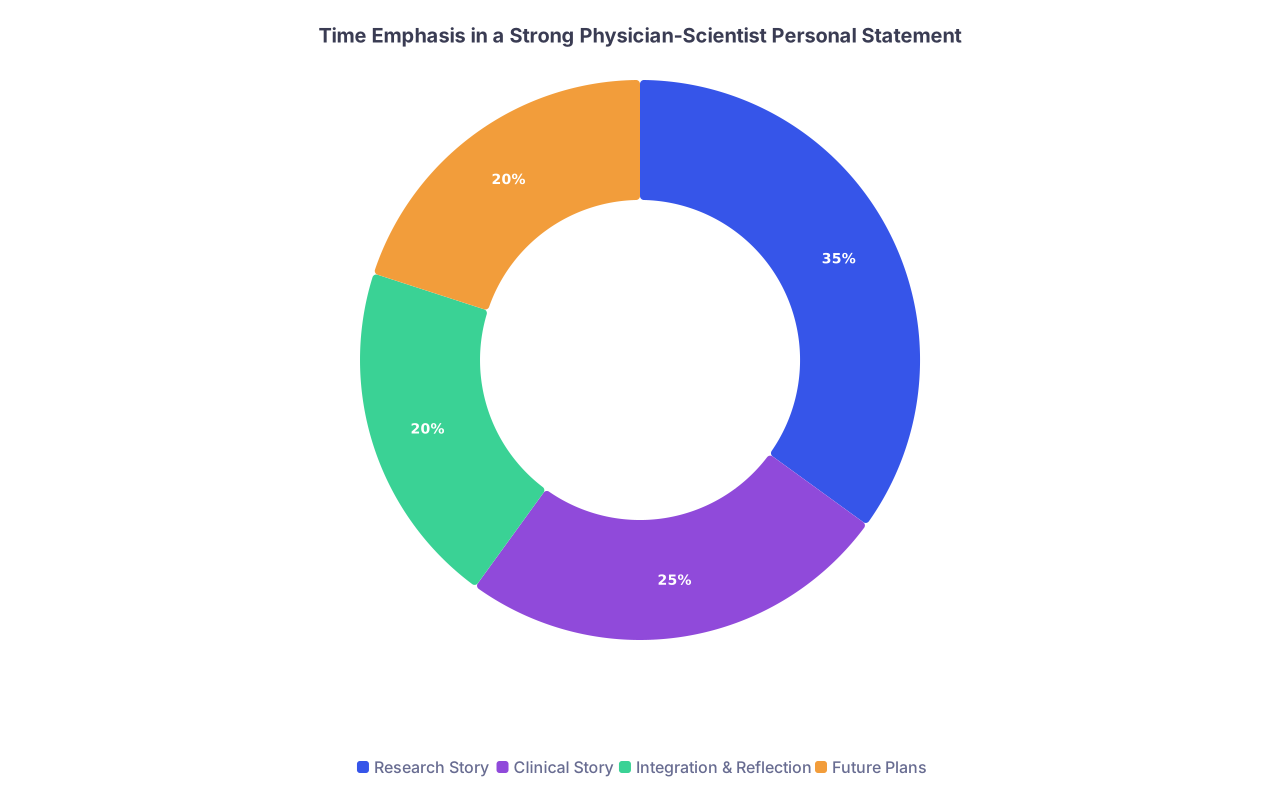
| Category | Value |
|---|---|
| Research Story | 35 |
| Clinical Story | 25 |
| Integration & Reflection | 20 |
| Future Plans | 20 |

| Step | Description |
|---|---|
| Step 1 | Opening Snapshot Bench + Bedside |
| Step 2 | Research Spine |
| Step 3 | Clinical Spine |
| Step 4 | Integration: Bridge Both Worlds |
| Step 5 | Future Plans & Fit |
FAQ (Exactly 4 Questions)
1. Should I write separate personal statements for PSTP / research tracks and categorical programs in the same specialty?
Usually you can use one, if you’re careful. Write it as a physician-scientist statement that clearly respects clinical training as central, then customize a few lines in the last paragraph:
- For PSTP: Explicitly mention structured research time, mentorship, K-award preparation, and a long-term investigative path.
- For categorical: Emphasize becoming a superb clinician first, with research as a key complement you hope to integrate, not the only thing you care about.
If you read your draft and think, “If I were a purely clinical PD, I’d worry this person will be miserable,” then it’s too research-heavy for categorical-only programs.
2. How much technical detail about my research is appropriate?
Enough that they believe you actually did real science, not so much that a tired hospitalist gives up halfway through the paragraph. If a non-research-inclined attending in your specialty couldn’t roughly summarize what you worked on after one read, you’ve gone too far.
Rule of thumb:
1–2 sentences on the problem,
1–2 sentences on your approach and role,
1–2 sentences on what you found or learned,
1–2 sentences on how it informs your clinical thinking.
If you need more than that for a single project, you’re probably flexing, not clarifying.
3. Where do I explain a long PhD, failed projects, or low publication count despite years in lab?
Use the personal statement to frame it once, cleanly, then move on. Two or three sentences in the research section is enough:
- State the reality without drama: “My first three years were spent on a project that ultimately proved technically infeasible.”
- Name what you gained: new skills, resilience, redirection to a better question.
- Show that it didn’t break you: “That experience taught me to kill bad projects early and pushed me toward the question that has since defined my work.”
Do not write a whole “defense of my productivity.” You’re explaining context, not arguing a case.
4. How explicit should I be about wanting a 70/30 or 80/20 research/clinical split?
If you’re applying to PSTPs or research-heavy academic programs, be explicit. They want that. It signals you actually understand what a physician-scientist life looks like.
Phrase it with some humility about the early years:
“I anticipate my long-term career involving 70–80% protected research time, grounded by a focused clinical practice in [niche]. In residency, I’m eager to build strong clinical foundations while starting to develop the skills and relationships that will support that trajectory.”
If you’re applying mostly to community or clinically focused programs, I’d keep the numbers softer: emphasize that you want academic involvement, quality improvement, clinical research, or smaller-scale translational projects, without sounding like full-time lab life is the only acceptable outcome.
Key Takeaways
- Pick a clear identity: you’re either a clinician with research strengths or a true physician-scientist—write like one, not both.
- Show the bridge: tie your research to specific clinical experiences and future plans in your specialty, in plain language that a busy attending can follow.
- Prove you’ll show up: demonstrate respect for residency training, enjoyment (or at least commitment) to patient care, and a realistic, concrete vision for how you’ll integrate bench and bedside over a career.