
It’s 11:47 p.m. Your co-resident group chat is blowing up with “lol just wrote ‘synergy’ in my personal statement” and “does anyone have a good hardship paragraph?” You’re staring at a blank document with one thought looping:
“I’m starting late. How do I explain that without sounding like a liability?”
You’re not 22 with a straight-through path. You’ve been a teacher, an engineer, a PA, a project manager, a software dev, a paramedic, a business analyst—something that came with a salary and maybe even direct reports. Now you’re applying to residency and you need to make sense of the jump.
Here’s the real problem: if you tell this story wrong, your “unique background” reads as:
- Couldn’t decide.
- Ran away from last career.
- Red flag for burnout or lack of commitment.
But if you tell it right, it reads as:
- Deliberate.
- Battle-tested.
- Asset to the team on day one.
That framing happens in your personal statement. Let’s build that narrative like an adult who knows what they’re doing.
Step 1: Decide What Story You’re Actually Telling

If your internal story is “I’m behind,” it will leak into your writing. The subtext in every sentence will be apology.
You need a different frame before you write a single word:
Not “I am late.”
“I am experienced.”
Those are not the same thing.
Let me be blunt: programs do not care that you’re older. They care whether you’re:
- Trainable
- Stable
- Likely to finish
- Easy to work with
- Useful on day 1
Everything in your statement has to feed those five questions.
So answer these prompts on scratch paper before you draft anything:
- What, specifically, did I learn in my former career that makes me better as a physician-in-training?
- When, exactly, did medicine stop being a vague interest and become a committed decision?
- What evidence do I have that once I commit to something big, I finish it?
- What am I not going to apologize for?
Write actual bullet answers. No fluff. If you cannot answer these, your statement will default to a defensive autobiography.
Step 2: Choose Your Former Career Angle (And Avoid the Trap)
Your previous life is not the main character. It’s supporting. If you spend 80% of your statement explaining your last job, it will look like you’re still half there.
You have three main angles to choose from. Pick one primary, one secondary, and drop the rest.
| Angle | Use If… | Avoid If… |
|---|---|---|
| Skill Transfer | Career gave clear, usable skills | You only have vague “people skills” |
| Commitment Pivot | Big, deliberate change after reflection | It looks impulsive or reactive |
| Resilience & Grit | You overcame real obstacles to switch | You’re tempted to trauma-dump |
1. Skill Transfer
This is the “my old world made me better at this world” story.
Good if you can say things like:
- Former ICU nurse → now applying to anesthesia / EM / critical care oriented IM.
- Former software engineer → now applying to radiology or pathology, talks about systems, pattern recognition, troubleshooting under uncertainty.
- Former teacher → now applying to pediatrics, FM, psych, or anything with education and communication.
Bad if the best you’ve got is: “I worked with people, so now I can work with patients.” That’s fluff. Programs read that 400 times a year.
You want concrete, residency-relevant translation, not generic praise of your old job.
Examples:
- “Leading a team of 12 technicians on overnight manufacturing shifts taught me how to keep people focused and supported at 3 a.m. on hour eleven. Intern call felt familiar, not shocking.”
- “As a high school teacher, I learned fast that saying something once does not mean it was understood. That same skill now shapes how I explain insulin adjustments to patients who are overwhelmed and scared.”
2. Commitment Pivot
This angle is about timing and seriousness. You’re answering: Why the late switch, and is this a pattern?
You need to show:
- You weren’t drifting aimlessly for a decade.
- The decision to pursue medicine was deliberate, not a midlife crisis.
- Once you decided, your actions matched the level of commitment (post-bacc, MCAT, working + classes, etc.).
You do not need a dramatic conversion moment. “My grandfather got sick and I realized I wanted to be a doctor” is fine but overused. What matters is what you did after the realization.
Stronger pivot statement:
“At 27, I was managing a team of consultants and should have felt satisfied. Instead, I saw myself optimizing billing while the physicians I worked with were optimizing care. That gap bothered me for two years before I did something about it. Committing to medicine meant night classes, weekend volunteering in the ED, and eventually walking away from a promotion to start medical school.”
Notice the time horizon. Two years. That reads as thoughtful, not impulsive.
3. Resilience & Grit
This is not “I’m old, therefore resilient.” Age alone proves nothing.
This angle works when:
- You carried major responsibility (kids, mortgage, elder care) while making the transition.
- You had to un-learn a stable identity (“I was the person people came to as the attending in my prior field”) and become a beginner again.
- You’ve already demonstrated you can grind for years (military service, prior training, high-stakes career) without bailing.
The key is not to wallow. You’re not applying for sympathy; you’re demonstrating that you can handle residency without falling apart.
Step 3: Avoid the Five Classic “Late Starter” Mistakes

I see the same errors over and over from applicants who came to medicine later. If you fix only these, your statement jumps a full tier.
Mistake 1: Apology Tour
Phrases like:
- “Although I am a nontraditional applicant…”
- “Despite starting later than most…”
- “Even though I took a longer route…”
Stop. You’re telling the reader your story is a problem before they’ve decided that.
Reframe them as strength or context:
- “Before medical school, I spent seven years as a paramedic responding to…”
- “My first career in finance taught me to…”
Facts, not apologies.
Mistake 2: Over-Explaining the Past
If your former career takes more space than:
- Why this specialty
- Who you are clinically / on rotations
- What kind of resident you will be
…you’re off balance.
Rough proportions for a late-starter PS:
- 20–25% Former career + pivot moment
- 50–60% Medical school + clinical growth + specialty fit
- 20–30% What you bring to residency and future goals
If you’re at 50% talking about being a project manager or lab tech—cut.
Mistake 3: Zero Clinical Translation
If your statement reads like you could copy-paste it into an MBA application, it’s dead.
Every time you mention a past skill, either:
- Tie it to a specific patient interaction
- Or tie it to a residency reality (handoffs, night float, consults, etc.)
Weak: “I learned time management as a consultant.”
Stronger: “Juggling five client projects at once taught me to track dozens of moving parts. On my medicine sub-I, I relied on the same system—structured to-do lists and early communication—to keep my patient tasks from piling up at 4 p.m. sign-out.”
Mistake 4: Emotional Dump Without Containment
Yes, some people come to medicine after burnout, layoffs, family illness, immigration upheaval. Those are real. But if your statement feels like a therapy session, it will worry programs.
General rule: one paragraph of hardship, max, followed by what you did with it and how you’re functioning now.
Not: “Here is everything bad that ever happened.”
Instead: “Here is the pressure I was under, how I adapted, and why it means I will hold up during residency.”
Mistake 5: Being Vague About the Future
Programs do not expect a 10-year plan with fellowship and research niche. But they do want to know:
- You understand what this specialty’s life looks like.
- Your past career is not going to pull you back out of medicine.
So don’t say: “Whether in academic or community practice, I look forward to contributing.” That’s wallpaper.
Say something anchored:
- “I see myself in a busy community ED with residents, where I can keep a clinical load but still teach.”
- “Longer-term, I want to build on my background in engineering to streamline workflow in radiology departments.”
You’re telling them: I’m not just trying this out. I see myself here.
Step 4: Build a Clear Before → Pivot → Now → Resident Structure

| Step | Description |
|---|---|
| Step 1 | Former Career Snapshot |
| Step 2 | Pivot Decision & Why |
| Step 3 | Medical School & Clinical Growth |
| Step 4 | Specialty Choice & Fit |
| Step 5 | What I Bring as a Resident |
Use this spine. Customize it, but don’t get cute. Clarity beats clever.
1. Former Career Snapshot (But Tight)
One paragraph. Two, max.
What you’re doing here:
- Name the role(s) and timeframe.
- Give 1–2 concrete elements that clearly translate.
- Hint at the discomfort / misalignment that pushed you to medicine (if relevant).
Example skeleton:
“For six years, I worked as a civil engineer leading infrastructure projects in underserved rural counties. My role was part technical design, part on-the-ground problem solving with local officials and residents. I enjoyed the tangible impact of seeing a road or bridge open, but over time I realized that the moments that stayed with me were not the ribbon cuttings; they were the conversations with community members about access—to jobs, to schools, and to healthcare.”
You’re not writing a resume. Just enough to set the stage.
2. Pivot Decision & Why
This is one focused paragraph or a paragraph plus one follow-up.
Answer:
- What exactly tipped you from “dissatisfied” to “I’m doing this”?
- How did you test the decision (shadowing, volunteering, clinical jobs)?
- How big of a sacrifice did you actually make (without bragging)?
You want the reader thinking: “Okay, this person didn’t impulsively blow up their life.”
3. Medical School & Clinical Growth
This is where many late starters underwrite. They talk so much about “before” that their medical school looks like an afterthought.
Wrong. This section should be the core.
Hit:
- A few specific clinical moments that show you functioning as a near-resident.
- How your previous skills showed up on the wards (without hitting the reader over the head).
- Evidence you can handle residency pace: sub-I, acting intern roles, night float experience, etc.
You are no longer selling potential to be a medical student. You are selling readiness to be a PGY-1 or 2.
4. Specialty Choice & Fit
You’re not applying to “medicine in general.” You’re applying to internal, EM, psych, peds, surgery, whatever. Tie your former career into why this field, not just why medicine.
Examples:
- Former teacher → psychiatry: patient education, motivational interviewing, breaking down complex concepts.
- Former business consultant → internal medicine: systems thinking, care coordination, QI.
- Former programmer → radiology: pattern recognition, comfort with tech, data-driven mindset.
Then answer: What parts of the specialty’s day-to-day actually energize you?
Skip Instagram-romantic versions. Talk about real things: complex dispo planning, procedural repetition, hours in the reading room, family meetings.
5. What You Bring as a Resident
Last 1–2 paragraphs: forward-looking.
Not “I hope to” fluff. Actual, specific attributes that come from your path:
- “I have already had a career where I supervised teams, received blunt feedback, and had to improve fast. I am not easily rattled by criticism, and I do not need my name on the door.”
- “Supporting my family through a career change taught me to manage stress without spreading it. I will not be the intern lashing out when I am overwhelmed. I will be the one quietly organizing the task list and checking on the med student.”
This is where you lean into your age and experience as a feature, not something you dance around.
Step 5: Know What Programs Secretly Worry About—and Answer It
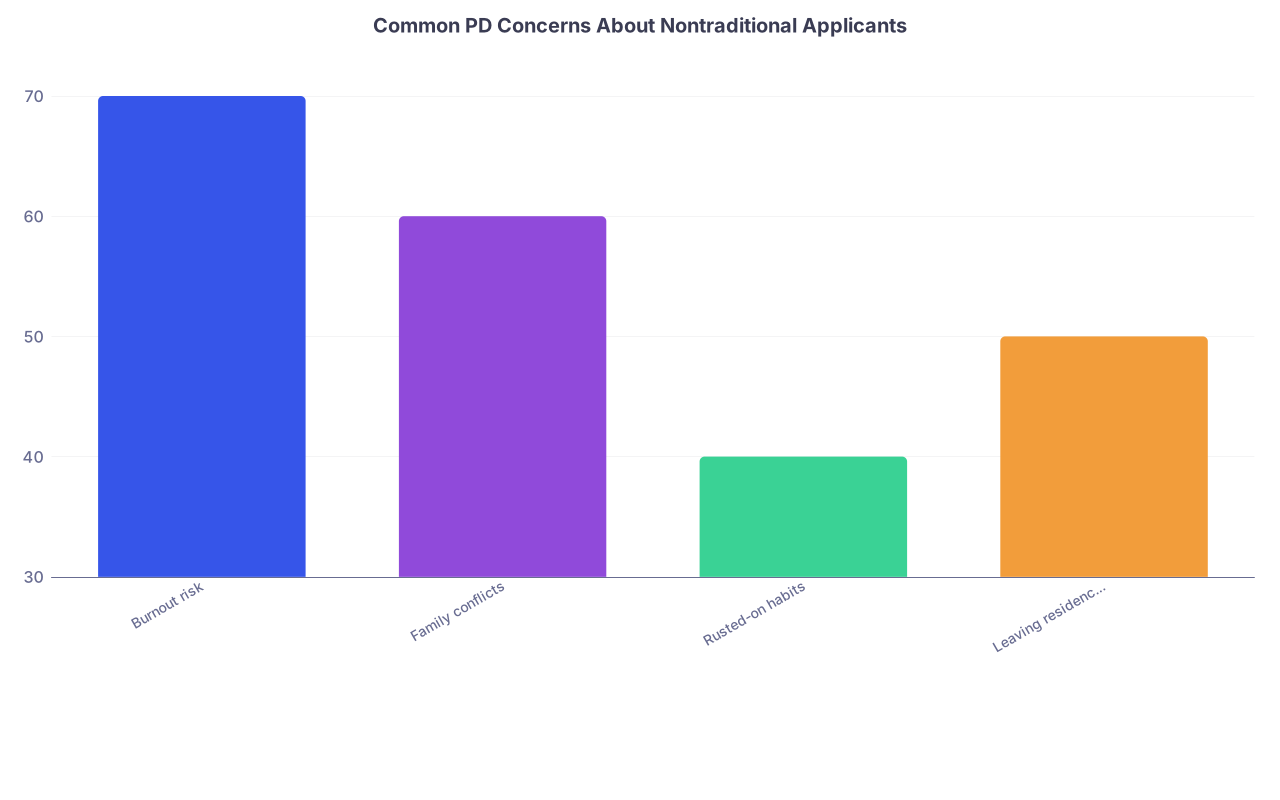
| Category | Value |
|---|---|
| Burnout risk | 70 |
| Family conflicts | 60 |
| Rusted-on habits | 40 |
| Leaving residency early | 50 |
I’ve heard variations of the same comments from PDs and APDs about older / second-career applicants:
- “Will they handle 80-hour weeks with kids at home?”
- “Are they too set in their ways to adapt to our system?”
- “If this doesn’t match their fantasy, will they just walk away?”
You do not need to say “I promise I won’t quit.” That’s weird. But you can indirectly answer those concerns:
Show real-world time and stress management.
Example: juggling work, classes, kids, and eventually rotations.Show adaptability.
Example: starting med school after being a senior professional and still thriving as a beginner.Show track record of finishing hard things.
Long projects, previous training programs, military service, long-term volunteer commitments.
One tight paragraph can carry a lot of weight here.
Step 6: Plug Your Story Into a Concrete Outline
Let’s turn all this into something you can actually write.
Here’s a working outline tailored for a mid- or late-career switcher:
Paragraph 1 – Hook anchored in the present, not childhood.
Start with a clinical moment from 3rd/4th year or sub-I that shows you functioning now, then briefly contrast with your “prior life.”
“At 3 a.m., I was double-checking an insulin drip rate on a DKA patient when my senior asked if I had ever managed a crisis this late at night before. I thought back to the years I spent running overnight production lines in a factory where a miscalculation meant serious injury instead of hypoglycemia.”
You’re on the wards, not playing nostalgia games.
Paragraph 2 – Former career snapshot.
Job, responsibilities, one or two transferable skills.
Paragraph 3 – The pivot: when and why you chose medicine.
Concrete steps you took after deciding.
Paragraphs 4–5 – Medical school and specialty.
Show growth, show fit, show “this is not a fantasy version of the field.”
Paragraph 6 – What your former career gives your residency class.
Leadership, maturity, calm under pressure, etc.
Paragraph 7 – Forward-looking closing.
Where you see yourself in this specialty, grounded in reality.
You can adjust the number of paragraphs, but do not lose that progression.
Step 7: Edit Out the “Young Applicant Voice”

You’re not 21. You shouldn’t sound like you are.
Things to strip from your draft:
- “Ever since I was a child…”
- “I have always dreamed of becoming a physician.”
- Overuse of “passion,” “calling,” “privilege” without specifics.
- Vague, breathy lines like “Medicine uniquely combines science and service.”
Replace with:
- Concrete, adult language about work, responsibility, systems, outcomes.
- Phrases like “I have learned,” “I have been responsible for,” “I have led,” “I have failed and corrected.”
Your readers are attendings. Many of them started straight through and frankly respect people who’ve done hard things outside medicine—if those people do not grovel or overcompensate.
Sound like a colleague in training. Not like a college applicant.
Step 8: Use Your Former Career Without Being Owned by It
Last point: your prior life is an asset, not your identity forever.
Do not build your entire medical persona around “the engineer,” “the teacher,” “the nurse who became a doctor.” That gets old fast, for you and for everyone else.
Use that experience to:
- Build credibility (you’ve done real work).
- Signal maturity.
- Offer concrete skills.
Then move on. You’re a physician-in-training now.
Your Next Step Today
Open your current personal statement draft—or a blank document if you have not started—and do this:
Highlight or write every sentence that mentions your former career.
For each one, ask:
- Does this sentence clearly support how I will function as a resident in this specialty?
- Could I cut this and still understand why I’m applying and what I offer?
If the answer to #1 is no, or #2 is yes, delete or rewrite it.
You’re not writing a eulogy for your old job. You’re writing a clear, forward-facing story: former career to resident—on purpose, with receipts.