Is a joke in your residency personal statement going to make you stand out—or get read aloud in a committee meeting for the wrong reasons?
Let me be blunt: nearly everything you think you know about “using humor to be memorable” in personal statements is based on vibes, folklore, and that one classmate who “totally matched at MGH with a super funny essay.”
You are not hearing from the people whose jokes bombed and got their statements quietly mocked in the workroom. I have.
Let’s strip away the mythology and look at what actually happens when humor shows up in residency personal statements—what PD surveys, selection committee behavior, and real-world outcomes suggest. Not the advice you wish were true. The stuff that is.
What Program Directors Actually Care About (And Where Humor Fits)
First, reality check. Humor is not on the scoring rubric.
We actually have decent data on what residency program directors care about. The big NRMP Program Director Surveys (2018, 2020, 2022) ask PDs to rate the importance of various application components.
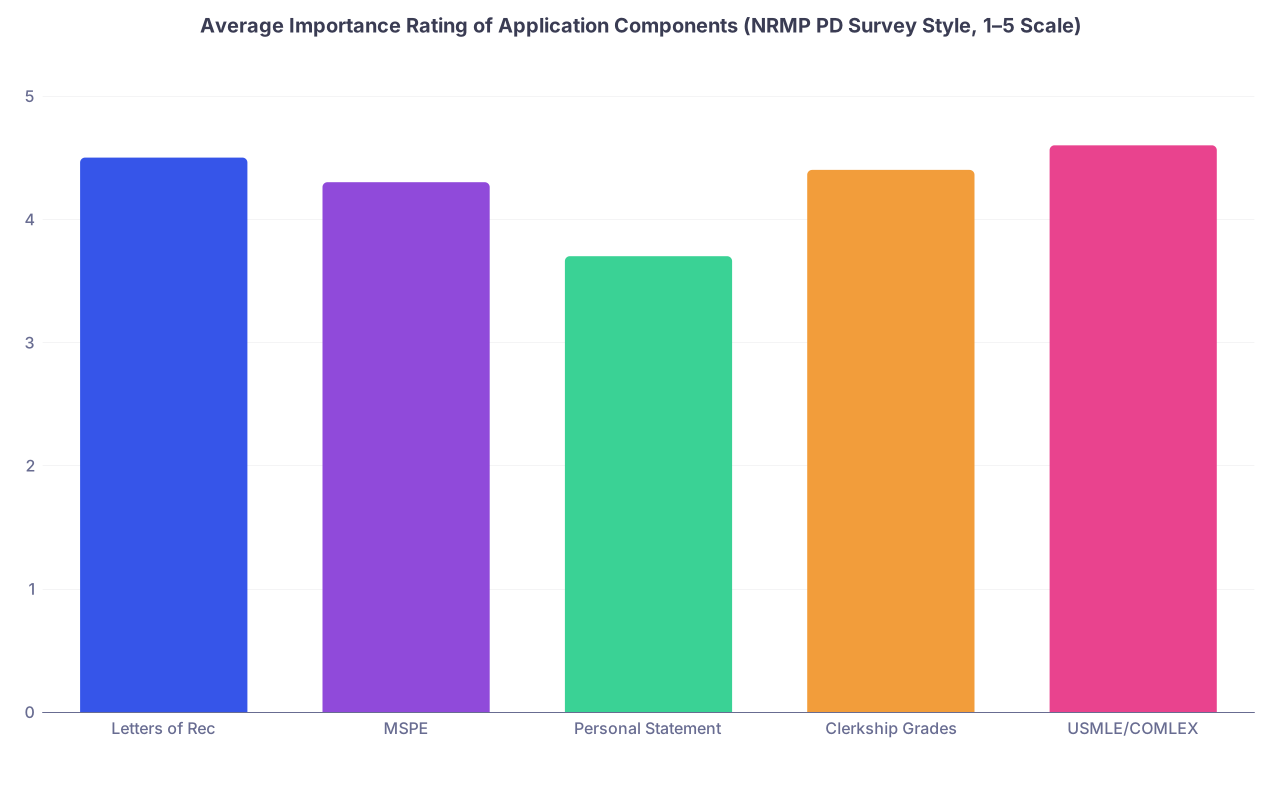
| Category | Value |
|---|---|
| Letters of Rec | 4.5 |
| MSPE | 4.3 |
| Personal Statement | 3.7 |
| Clerkship Grades | 4.4 |
| USMLE/COMLEX | 4.6 |
The personal statement is middle-of-the-pack important. Not irrelevant, but not your savior. No one is saying, “Well their Step score is weak, but that joke in paragraph three… we must rank them to match.”
The “use humor to stand out” crowd imagines a PD carefully savoring every sentence. That’s fantasy. Here’s what I’ve actually seen in multiple programs (IM, EM, and peds in particular):
- Personal statements mostly skimmed, not deeply read
- Often used to:
- Confirm you’re not bizarre, unprofessional, or a poor communicator
- Clarify major red flags or atypical paths
- Check specialty commitment and basic fit
- Occasionally remembered if:
- Exceptionally clear and mature
- Exceptionally weird or cringey
Guess which bucket most “funny” attempts fall into.
The core function of the personal statement is risk assessment, not entertainment. Comedy is inherently risky. That’s your starting point.
Myth #1: “Humor Makes You Memorable—in a Good Way”
This one is popular because it’s half true. Humor does increase memorability. But not always in the direction you want.
Think about how committees actually talk:
- “Is this the guy who wrote about wanting to be the ‘LeBron James of neurology’? Yeah, no.”
- “She opened with a fake ‘code blue’ scene that turned out to be about her latte machine. Hard pass.”
People remember the outliers—for better or for worse. Problem is, the downside is larger than the upside.
There are three big risks with humor:
Tone mismatch
The residency selection environment is serious and time-pressured. A joke that feels cute to you can feel flippant to a tired PD reading at 11:30 p.m. between service and email.Cultural/context mismatch
You don’t know who’s reading. Age, background, specialty culture—all affect what lands. Dark humor that kills on night float often dies in a dean’s office.Competence bleed-over
This is the one most applicants underestimate. If your humor misses, it doesn’t just label you “not funny.” It risks labeling you:- immature
- lacking judgment
- not self-aware
And those are death in selection.
So yes, they might remember you. The question is: what exactly do you want them to remember?
What the Evidence and Experience Actually Suggest
We don’t have randomized controlled trials where one group uses jokes and another doesn’t, then we follow match rates. But we do have:
- Large PD surveys on what’s valued
- Qualitative research on selection committee behavior
- Pattern recognition from people who’ve read hundreds or thousands of statements
When you put those together, some clear patterns emerge.
1. The “No-Humor Rule” Is Mostly About Risk Management
I’ve sat with attendings and PDs who say, “Just tell them no jokes. At all.” That sounds overcautious until you see what crosses their desks:
- Forced metaphors extended way too long (“Medicine is like a symphony and I am the conductor…”)
- Sarcastic lines about “surviving” third-year that come off as bitter, not funny
- Self-deprecating bits that edge uncomfortably toward insecurity or lack of resilience
When PDs say “don’t use humor,” they’re not banning all levity. They’re telling you: the average applicant is bad at calibrating tone on paper, and the downside is high. So they’d rather eliminate the category.
And yes—on average, they’re right.
2. Committees React More Strongly to Bad Humor Than to No Humor
I’ve never heard: “We should rank this person lower; their statement was too straightforward and sincere.”
I have heard:
- “That opening was… strange.”
- “I couldn’t tell if they were being sarcastic or serious.”
- “That joke about their ‘pathology addiction’ was just odd.”
Neutral statements don’t move the needle much. Problematic ones absolutely can, especially when there’s already doubt about maturity, professionalism, or fit.
3. Specialty Culture Matters More Than People Admit
Humor plays very differently in different fields. You know this if you’ve even mildly paid attention on rotations.
| Specialty | Humor Risk Level | Comment |
|---|---|---|
| Emergency Med | Medium | Light, dry humor sometimes tolerated |
| Internal Med | Medium-High | Conservative; subtle only |
| Pediatrics | Medium | Warmth > jokes; cute can turn cloying |
| Surgery | High | Very little tolerance for cuteness |
| Psychiatry | High | Overly quirky = potential concern |
| Radiology | Medium | Dry, minimal; still professional |
Is this table perfect? No. But it matches what I’ve seen in PD and APD conversations. The more a specialty prizes gravitas, stoicism, or high-stakes decision-making, the less patience there is for “look how witty I am” writing.
You’re not writing to your co-interns. You’re writing to people who think about liability, reliability, and professionalism all day.
Where Humor Can Work (And What It Looks Like)
Here’s the part everyone skips: there is a version of “humor” that does often work. It is not:
- obvious punchlines
- long extended jokes
- memes or pop culture references
- self-deprecation that borders on self-doubt
It’s closer to lightness than to comedy.
Characteristics of humor that usually lands:
Incidental, not central
The statement still functions perfectly well if the line is removed. The humor is seasoning, not the main dish.Self-aware but not self-destructive
A brief, grounded acknowledgment of your own neuroses, paired with evidence that you manage them.Anchored to real insight
The “funny” line reveals something real about how you think, relate, or grew. It’s not there just to show that you can be clever.
Here’s the difference.
Bad attempt:
“Like any good future surgeon, I enjoy sharp objects, late nights, and being in charge.”
I’ve seen similar lines. They don’t land. You think you’re being tongue-in-cheek; they see stereotypes, ego, and poor judgment.
Better version of lightness:
“By the end of my sub-internship, my co-residents had learned two things about me: I will always show up early, and I will always triple-check the consent form.”
Is that “humor”? Barely. But it has a faint wink of personality, it’s grounded in behavior, and it reads as conscientious, not clownish. That’s the target.
Concrete Examples: What Crosses the Line vs. What Adds Warmth
Let’s go through some anonymized, adapted examples I’ve actually seen or discussed with selection committees.
Example 1: Forced Joke Opening
Version A (Real-world bad):
“The first time I saved a life, it wasn’t in the hospital. It was reviving my dying houseplant with an IV drip of Miracle-Gro.”
Everyone in the room rolled their eyes. It’s cutesy, forces a fake “twist,” and undersells the seriousness of clinical work.
Version B (Neutral, better):
“I did not go into medicine for a single dramatic moment. I went into medicine because I kept noticing, again and again, that I felt most like myself in the middle of hard problems with real consequences.”
No joke. Still human. Much harder to make fun of in the workroom.
Example 2: Self-Deprecation Gone Wrong
Version A:
“I was never the smartest student in the room, but I made up for it with stubbornness and caffeine.”
You think that sounds humble. They wonder if you’re signaling chronic underperformance and poor coping.
Version B:
“I do not learn fastest when I first see something—I learn best when I see it again on call at 3 a.m., and then take five minutes the next day to close the loop.”
Still acknowledges limitation. But frames it as a learning style with a built-in solution, not a weakness papered over with a joke.
Example 3: Specialty “Humor” That Backfires
Version A, radiology applicant:
“I’ve always preferred talking to images instead of people, which is why radiology felt like home.”
Every radiologist on the committee: “We talk to people constantly. Also, red flag for team fit.”
Version B:
“Radiology appealed to me because I like being the person others call with hard questions. I enjoy the quiet focus of image interpretation, but I like even more that it feeds back into real-time decisions for patients I will never meet.”
No humor. But it humanizes you more than a forced joke.
So Should You Use Humor At All?
Here’s my honest answer after reading and editing hundreds of personal statements and sitting in on discussions where statements get dissected:
- If you’re asking, “How can I make this funnier?” you’re already on the wrong track.
- If you’re asking, “Can I keep this one slightly wry line that feels natural to me?” the answer is: probably yes, if it survives three tests:
Test 1: The “Read Aloud to a PD” Test
Imagine your least warm attending reading that sentence out loud in a conference room. Would you cringe? If yes, delete it.
Test 2: The “Remove It” Test
Cut the line. Does the statement still work? If it relies on the joke, the structure is wrong.
Test 3: The “Trait Signal” Test
What trait does this line actually signal? Not what you intend—what a cynical reader could reasonably infer.
- Signals that generally help: humility, insight, resilience, reliability, kindness.
- Signals that hurt: bitterness, flippancy, One-Man-Show energy, insecurity.
If the humor doesn’t clearly enhance the positive trait signal, it’s not earning its risk.
What to Focus on Instead of Chasing “Funny”
People chase humor when they don’t know what else to use to “stand out.” That’s the deeper problem.
You don’t stand out because you happened to be clever in 650 words. You stand out because you present a coherent, believable pattern of who you are and how you work.
Things that work better than humor, by a long shot:
- Clean, precise writing without fluff
- One or two specific clinical moments that changed how you think, not how you felt vaguely inspired
- Concrete behaviors: what you did on the team, what you changed, what you learned the hard way
- A clear, grounded understanding of your specialty—warts included
- Emotional maturity: you can discuss failure, conflict, or frustration without self-pity or melodrama
If you can write with clarity and restraint, you will already stand out more than most applicants. The bar for personal statements is lower than you think.
When Humor Is a Red Flag
There are a few patterns where any attempt at humor is basically a neon sign for immaturity:
- You’re addressing a remediation, leave of absence, or professionalism issue
- You had a major score drop, gap, or failure you’re explaining
- You’ve switched specialties or had a tortured path and are trying to “lighten it up”
Do not be cute here. Ever. Selection committees are scanning those paragraphs for accountability, not charm.
I’ve seen statements where someone tried to joke about a Step failure or a professionalism citation. Those comments stick. And not in your favor.
The Bottom Line: What the Data and Experience Really Say
You want a rule? Here it is.
- The personal statement’s job is to show judgment, maturity, and fit—not to audition your stand-up routine.
- Humor increases risk much more than it increases benefit. Most applicants are better off erring on the side of clarity and warmth, not cleverness.
- The very small amount of “humor” that works looks more like gentle lightness and self-awareness than like “being funny.” If you’re unsure which side you’re on, you’re probably on the wrong one.