

What actually happens to your job security when the dean changes, your division loses money, or RVUs tank—are you really “safer” in academics than in private practice?
Let me be blunt: academic contracts feel safer. They’re usually not as safe as people think. And some private practice deals, if structured right, are actually more secure and more lucrative.
You’re not choosing between “safe vs risky.” You’re choosing between two different sets of risks. If you don’t see those clearly, you’re the one who pays when the music stops.
Let’s break it down.
The Myth of Safety: Why Academic Contracts Feel Safer
Here’s why everyone says academics is safer:
- Big institution, big name, long history
- HR department, legal team, standardized contracts
- Predictable base salary, often tied to salary scales
- Benefits that look solid: retirement match, health, CME, PTO
Compared with a 5-partner group in a rented office with a fax machine from 2008, the university feels like a fortress.
But here’s what I’ve seen happen in academic centers:
- Division “restructuring” and people quietly pushed out
- Non-renewal of fixed-term contracts with 90 days’ notice
- Base + incentive models that never actually pay the incentive
- Tenure tracks that are basically a mirage for clinicians
- “We’re changing the compensation plan next year” (every year)
“Safe” in academics usually means:
- You’re less likely to wake up to a locked door and a bankrupt practice.
- You’re more likely to be slowly squeezed—more work, flat pay, non-renewal instead of outright firing.
Different kind of risk. Not necessarily lower.
Core Differences: Academic vs Private Practice Contract Risk
Here’s the comparison you actually care about.
| Factor | Academic Employment | Private Practice Employment |
|---|---|---|
| Job security | Moderate, depends on funding | Variable, depends on business |
| Income upside | Limited, capped | High if practice is healthy |
| Term & renewal | Often 1–3 year renewable | Often at-will or shorter term |
| Performance pressure | RVUs + academic output | RVUs/collections heavy |
| Termination protections | Policy-driven, some process | Highly contract-dependent |
The real question isn’t “Which is safer?”
It’s: “Which risks am I taking, and am I being paid properly for them?”
Let’s go deeper into the actual clauses that matter.
How Academic Contracts Actually Work (And Where They Bite You)
Most academic physician contracts share a few themes:
- Fixed term (often 1–3 years), with or without automatic renewal
- “Faculty appointment” language that sounds grand but is mostly symbolic for job security
- Compensation tied to rank, department policies, and sometimes RVUs or bonus structure
- Termination with and without cause, usually referencing institutional policies
Here’s where people get burned in academics.
1. Term length and non-renewal
You might think: “I have a 3-year contract, so I’m good for 3 years.”
Not exactly. Read the fine print:
- Does the institution have the right to non-renew with 90 or 180 days’ notice?
- Is there language like “subject to continued funding, clinical need, and satisfactory performance”?
I’ve seen perfectly competent assistant professors told in February that their June 30 contract simply won’t be renewed. No firing. No cause. Just “we’re going in a different direction” or “budget constraints.”
Safer than a private group folding? Maybe. But it’s still abrupt unemployment.
2. “Subject to department policy” trap
A classic academic clause:
“Compensation and duties are subject to applicable School of Medicine and Department policies, as may be amended from time to time.”
Translation: they can change the rules mid-game.
- Today: 70% clinical, 30% research, reasonable RVU expectations.
- Next year: new chair, new policy—now 90% clinical, new RVU targets, “temporary” suspension of incentive pay.
They don’t need to re-sign your contract to make that happen. You already agreed to follow department policies.
In private practice, major comp changes usually require some explicit amendment or at least a frank partner talk. In academics, it can just appear in an email.
3. Termination “for cause” vs “without cause”
For cause typically includes:
- Loss/restriction of license or DEA
- Exclusion from Medicare/Medicaid
- Professional misconduct, breach of contract, etc.
Without cause is the quiet killer. Most academic contracts allow:
Either party may terminate this Agreement without cause upon X days’ written notice.
X is often 60–180 days. That’s not job security. That’s a notice period.
If an academic lawyer tells you, “We never use that,” ignore it. You negotiate based on the written risk, not verbal reassurances.
4. Tenure and titles: mostly irrelevant to you
Unless you are true research faculty and actually on a tenure track with explicit written protections, tenure language is more branding than security.
“Assistant Professor of Clinical Medicine” sounds impressive.
From a contract standpoint, it usually means nothing beyond your pay range and committee eligibility.
Private Practice: Risky… Unless It’s Not
Private practice gets painted as the wild west: no rules, no safety, all RVUs and drama.
Sometimes that’s accurate. I’ve seen:
- “Eat what you kill” offers right out of fellowship with no base.
- Practices that hide financials and fudge collection numbers.
- Buy-in promises that never become real equity.
But I’ve also seen private deals that are objectively safer than academic ones, because they:
- Guarantee a higher base for 2–3 years
- Have clear, written pathways to partnership with defined terms
- Spell out call, clinic, and surgery time explicitly
- Include reasonable non-compete language or none at all
The key with private practice: the contract is everything. There’s no giant institution to fall back on. If it’s not written, it doesn’t exist.
The 5 Clauses That Actually Determine “Safety”
Forget the name on the letterhead. If you want to know how safe a contract is—academic or private—look at these five things.
1. Term and renewal
You want:
- A defined term (e.g., 2–3 years)
- Automatic renewal unless either side gives written notice
- Reasonable notice period for non-renewal (ideally 180 days)
Red flag language:
- “At-will employment” with no real term
- “Either party may choose not to renew upon 30–60 days’ notice”
Academic jobs often beat private practice on formal term length. But if they pair that with an easy non-renewal clause, the advantage shrinks.
2. Termination without cause
This is the real “safety” metric.
Better:
- 180+ days notice for no-cause termination
- Some severance (even 1–3 months) if they terminate you without cause
- Limits on termination timing (e.g., not mid-academic year unless severe issues)
Worse:
- 60 or 90 days’ notice, no severance, any time, for any reason
- “Mutual agreement” language that lets them pressure you to resign instead of firing
Academic contracts often give you a bit more notice than private ones. But I’ve seen private groups agree to 6–12 months of notice or a severance formula. Academics almost never negotiate severance up front—though you can try.
3. Compensation structure and volatility
“Safe” income means:
- Clearly defined base salary
- Transparent bonus formula that you can model with your expected volume
- No black-box department “discretion” language
Watch for:
- Academic pay plans based on “available funds” or “productivity thresholds” that are vague
- Private practice formulas that are all collections-based without guaranteed minimums in year 1–2
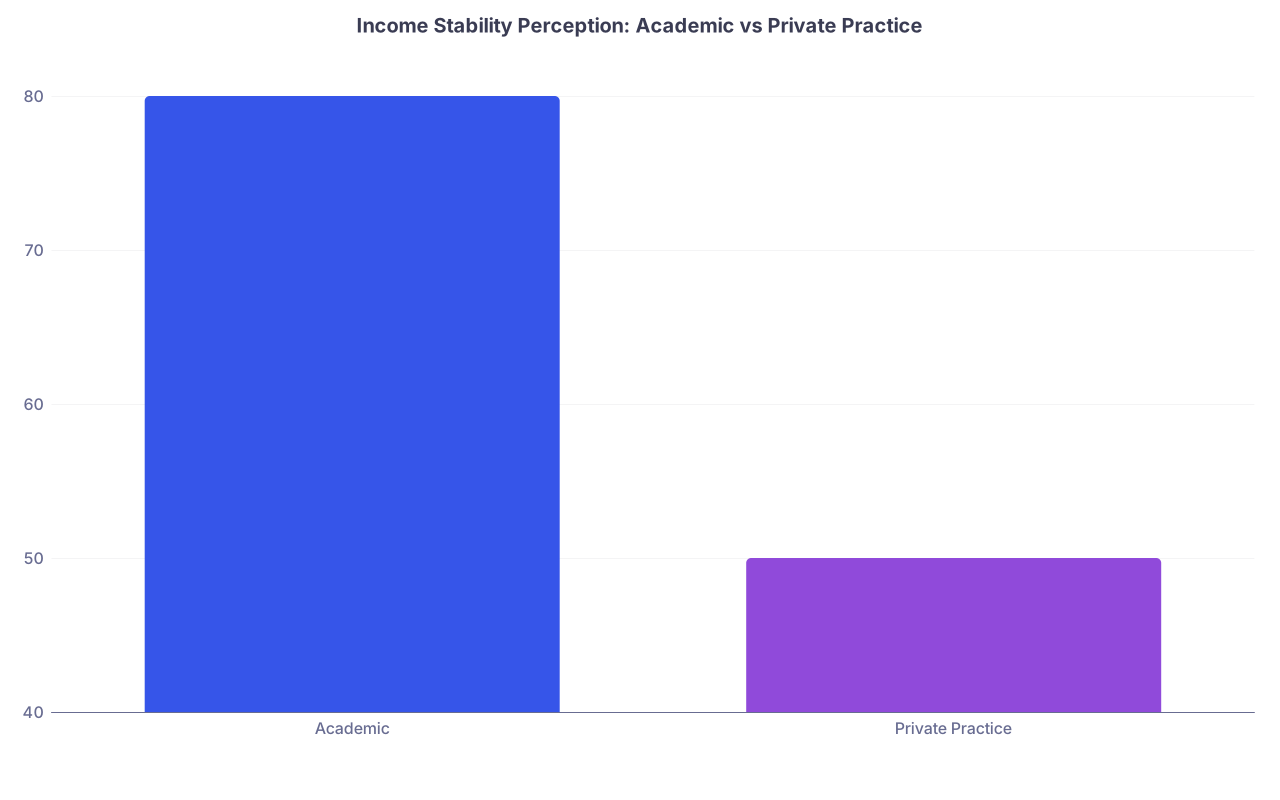
| Category | Value |
|---|---|
| Academic | 80 |
| Private Practice | 50 |
(That’s perception. Reality is more nuanced.)
4. Non-compete and restrictive covenants
This is where private practice is usually more dangerous.
Academic centers:
- Often have weak or no non-competes, or they’re geographically broad but not aggressively enforced.
- Sometimes rely more on non-solicitation (don’t poach patients/staff) than true non-competes.
Private practice:
- Frequently uses tight non-competes that can block you from working within 10–25 miles for 1–2 years.
- May attach them to any termination, even if they fire you without cause.
A strong non-compete with a short notice period = real risk. That combination can force you to move cities or sit out of work.
If you’re comparing “safety,” a harsh non-compete in private practice can absolutely make academics safer, even with lower pay.
5. Call, work hours, and role creep
Job safety isn’t just “Do I get fired?” It’s also “Do I get slowly crushed?”
In academics:
- Call often increases over time as faculty leave and aren’t replaced quickly.
- “Protected time” shrinks, especially for junior faculty.
- Extra committees and teaching get added informally.
In private practice:
- Call is tied to covering the group’s obligations. Lose a partner, everyone works more.
- Admin roles are fewer, but business meetings and practice politics can add burden.
You want your contract—academic or private—to state:
- Expected clinical hours or sessions
- Call frequency and any compensation for call
- Whether protected time is guaranteed, conditional, or just “aspirational”
A Simple Framework: Which Is Safer For You?
Use this three-part filter instead of labels.

| Step | Description |
|---|---|
| Step 1 | Job Offer |
| Step 2 | Higher risk |
| Step 3 | Relatively safer |
| Step 4 | Non-compete harsh? |
| Step 5 | Notice period for no cause? |
| Step 6 | Income volatility high? |
Ask yourself for each offer:
- If they fire me without cause, how long do I get paid and how hard is it to find another job locally?
- If the compensation model changes, can they unilaterally do that and is there any floor?
- If something goes wrong, will this contract let me keep working in this city?
Academics often win on #3 (weaker non-competes).
Private practice can win on #1 and #2 if negotiated well.
Practical Negotiation Moves (Academic vs Private)
You’re not just analyzing risk; you can change it with the right asks.

For academic offers, focus on:
Notice for non-renewal and no-cause termination:
“Can we increase the no-cause termination notice to 180 days?”Clarity of duties and protected time:
“Let’s specify that X% of my FTE will be protected for research/teaching in the contract.”Compensation transparency:
“Can you attach the current compensation plan and confirm changes will be communicated 90 days prior to implementation?”
You probably won’t change the institution’s fundamental template, but you can sometimes tweak notice, duties, and documentation.
For private practice offers, focus on:
Non-compete radius and duration:
“Let’s narrow this to 10 miles and 12 months, and exclude terminations without cause.”Guaranteed base period:
“I’d like a 2-year guaranteed base with clear productivity expectations before moving to pure production.”Partnership track in writing:
“Can we spell out the buy-in formula, target timeline, and what metrics determine eligibility?”
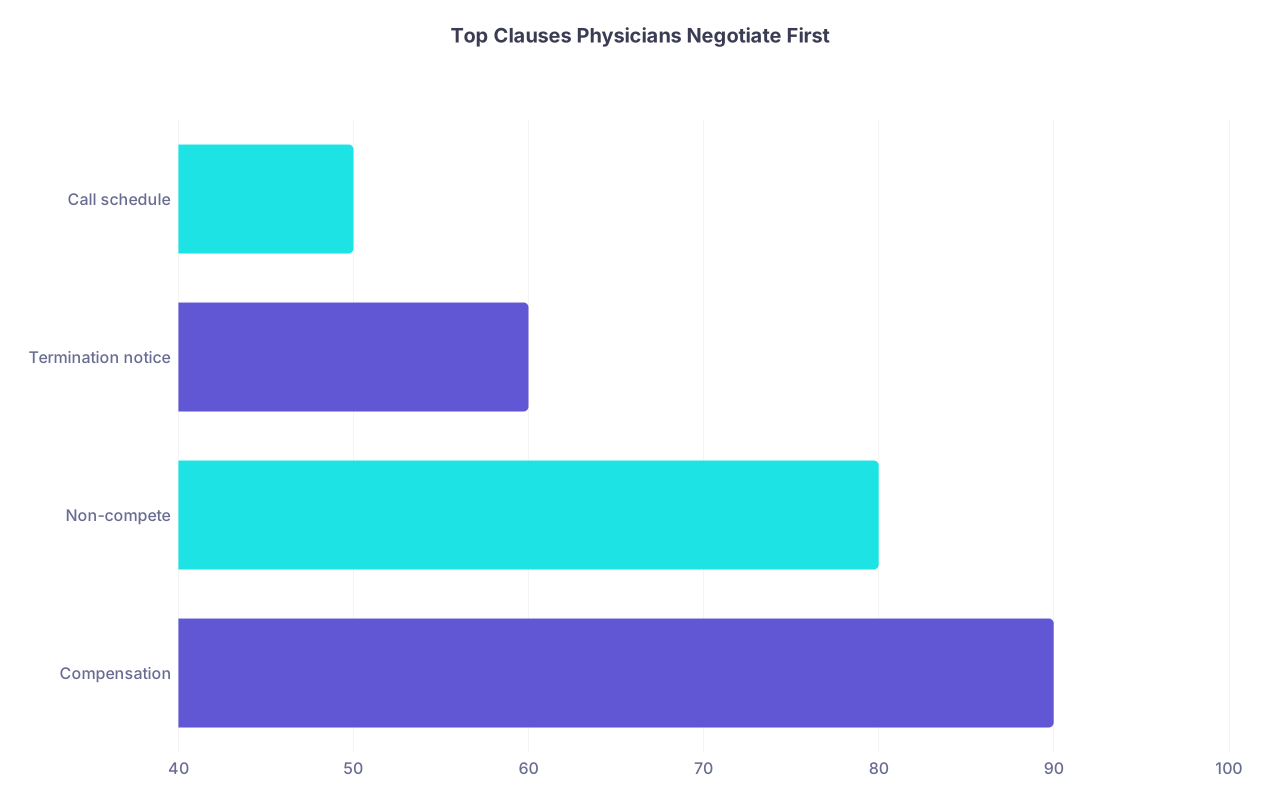
| Category | Value |
|---|---|
| Compensation | 90 |
| Non-compete | 80 |
| Termination notice | 60 |
| Call schedule | 50 |
Don’t just accept “we don’t change contracts” at face value. Sometimes they don’t, often they do. Especially for key recruits.
When Academic Is Clearly Safer
There are scenarios where I’d say yes, academics is genuinely the safer choice:
- You’re in a saturated market with few other employers and the private practice has a brutal non-compete.
- The academic center offers a long notice period (180+ days) and the private group is at-will or 30-day notice.
- The academic job has a stable base and the private job is 100% collections-based from day one.
- You care a lot about long-term visa support (J-1, H-1B); big institutions are more reliable here.

When a Private Practice Deal Can Be Safer
Yes, really.
If the private practice:
- Has transparent financials and lets you see actual numbers
- Offers 6–12 months’ notice or some severance for no-cause termination
- Has a reasonable or no non-compete
- Writes out a clear path to partnership with defined buy-in and governance rights
…and the academic offer gives you:
- 90-day no-cause termination
- Vague “subject to policy” comp language
- Heavy RVU requirements and minimal bonus
Then the “big, safe institution” is giving you less actual protection than the small group.
Quick Reality Check: What You Should Actually Do
Three things:
- Stop assuming “academic = safe, private = risky.” That’s lazy thinking.
- Have every contract—academic or private—reviewed by a physician-focused contract attorney. Not your cousin who does divorces.
- Evaluate offers based on:
- Term + notice
- Termination without cause
- Non-compete strength
- Compensation volatility

You’re not choosing “safety” vs “money.” You’re choosing which risks you’re comfortable carrying, and what you’re being paid to carry them.
FAQs
1. Are academic physician contracts usually negotiable?
Less than private practice, but not zero. Base salary bands are often rigid, and benefits are standardized. But you can sometimes negotiate:
- Start date
- Protected time (research, admin, teaching)
- Clinical location or scope
- Signing bonus or relocation support
- Termination notice length
It’s always worth asking, as long as you’re reasonable and specific.
2. Does an academic title (Assistant/Associate Professor) give me job security?
Not by itself. Your title mostly affects:
- Pay scale band
- Eligibility for promotion and certain committees/grants
Job security still comes from your employment agreement and institutional policies. Unless you have true tenure with explicit written protections (rare for clinicians), the title doesn’t keep you from being non-renewed.
3. Is an at-will private practice job automatically worse than an academic contract?
Not automatically. At-will just means either side can terminate without cause. If that at-will relationship is paired with:
- No or weak non-compete
- Strong income while employed
- A high-demand specialty and good local job market
…it can be perfectly acceptable. The danger is at-will + strong non-compete + short notice. That combo is rough.
4. How much notice should I push for in a no-cause termination clause?
Aim for at least 120–180 days. In academics, 180 days is a reasonable ask. In private practice, 90–120 is common, but some groups will agree to more, especially in hard-to-recruit specialties. The more restrictive your non-compete or the thinner your local job market, the more notice matters.
5. Are RVU-based academic jobs less safe than straight-salary academic jobs?
They’re less predictable. If the RVU target is aggressive or the bonus formula is vague, your “expected” income may never materialize. Straight-salary academic roles with modest productivity expectations tend to feel safer day-to-day, even if the top-line income is lower. Always ask to see what current faculty at your rank and specialty actually earned last year.
6. What’s the one contract red flag that should make me walk away?
A strong non-compete (large radius, long duration) that applies even if they terminate you without cause—and they refuse to modify it. That clause can control your geography, your family’s stability, and your leverage. If they won’t budge on a clearly abusive restriction, believe them. They’ll be rigid when things go bad too.
Key takeaways:
- Academic contracts feel safer but often rely on short notice and policy-driven changes rather than true protections.
- A well-written private practice contract can be safer than an academic one if you tame the non-compete and secure reasonable notice and compensation.
- Stop judging jobs by labels. Read the clauses on term, termination, non-compete, and pay—that’s where your actual safety lives.


