

Most new attending physicians accept too short of a guaranteed salary—usually because they don’t understand what it’s actually protecting them from.
You’re not just negotiating a number. You’re negotiating how long your training wheels stay on while you learn how to function as a full-fledged attending in a real-world practice.
Here’s the answer you’re looking for, and then we’ll break it down by specialty, setting, and risk.
The Short Answer: 2–3 Years for Most, But That’s Not the Whole Story
For a first job right out of residency or fellowship:
In most employed positions (hospital-employed, large multispecialty group, academic-affiliated):
You should push for a guaranteed base salary of at least 2 years, and 3 years is better if they’ll give it.In high-RVU, procedure-heavy, or new-market positions (cardiology, surgery, GI, EM groups transitioning to productivity, new outpatient clinics):
3 years of guarantee is ideal or at least 2 years with a soft landing (floor guarantee or phased ramp-down).In pure academic roles where compensation is less production-driven:
2 years of stability is usually sufficient, but watch the fine print on “incentive” or “variable” components.
If you’re early-career and they’re only offering 1 year of guarantee with an immediate jump to pure productivity afterward, that’s a red flag. Not always a dealbreaker, but absolutely a “slow down and scrutinize everything” moment.
What a Guaranteed Salary Really Does (And Why 1 Year Often Isn’t Enough)
A guaranteed salary isn’t a “gift.” It’s a risk-sharing tool.
You’re accepting:
- A new market where you might not have a built-in referral base
- Being unknown to local PCPs or surgeons
- Uncertain patient volumes
- Learning a new EMR and practice flow
- Delays in insurance credentialing that can wreck your billables for months
The employer is accepting:
- Paying you more than you might generate in billings during your ramp-up period
- Betting that your productivity will grow and ultimately exceed that guarantee
The guarantee is there to let you ramp up without losing sleep over every empty slot for the first year or two. That ramp-up almost never finishes cleanly at month 12.
I’ve seen:
- PCPs taking 18–24 months to build a full panel
- Specialists needing 2–3 years before the referral machine really hums
- Academic-private hybrids where clinics start half-empty for the first year and a half because scheduling, marketing, and internal referrals lag behind the rosy recruiting pitch
That’s why a single year of guarantee is often designed around the employer’s risk, not your reality.
How Long Should Your Guaranteed Salary Last? Use This Framework
You don’t negotiate in a vacuum. You match the guarantee length to how long it will realistically take you to hit your productivity stride.
Use this simple decision framework.

| Step | Description |
|---|---|
| Step 1 | New Attending Job |
| Step 2 | 2 Year Guarantee Typical |
| Step 3 | Target 3 Year Guarantee |
| Step 4 | Target 2 Year Guarantee |
| Step 5 | 2 to 3 Year Guarantee |
| Step 6 | 2 Year Minimum |
| Step 7 | Practice Type |
| Step 8 | Ramp Complexity |
| Step 9 | Buy In or Track? |
Now I’ll translate that into specifics.
1. Primary Care (FM, IM, Pediatrics, Outpatient)
Typical pattern:
- Panel growth is slow but steady
- Revenue per patient is relatively low compared to procedural specialties
- A lot depends on how aggressively the system markets you and how many PCPs are already overloaded
Recommended:
- 2 years minimum guaranteed salary
- 3 years strongly preferred if practice is new, in a saturated market, or they admit “you’ll be building from near-zero”
2. Hospital-Based Specialties (Hospitalist, Intensivist, Anesthesia, EM)
Here you’re less dependent on referrals and more on shift volume and group structure.
If:
- You’re working fixed shifts
- Pay is shift-based or day-rate based
- Volumes are already high
Then 1–2 years might actually be fine because your “productivity” is basically guaranteed by the shift schedule.
But if:
- You’re transitioning to some RVU or collections-based compensation
- There’s an unstable contract with the hospital
- Volume is volatile (e.g., small ED, new service line)
Then push for 2 years of defined compensation before any major variable/production risk.
3. Procedural and Surgical Specialties (Cards, GI, Ortho, General Surgery, ENT, etc.)
You’re highly dependent on:
- Referrals (PCPs, ERs, other specialists)
- OR block time or lab time
- Hospital politics
- Competition in the same service area
These factors can take years to stabilize.
Recommended:
- 3-year guarantee is ideal
- If they won’t budge off 2 years:
- Try to negotiate a productivity floor in year 3
- Or a phased plan (e.g., year 3 is base + RVU bonus, not pure eat-what-you-kill)
Typical Guarantee Lengths by Job Type (What’s “Normal”?)
Here’s what I commonly see in first-attending offers:
| Job Type | Typical Guarantee | What You Should Target |
|---|---|---|
| Hospital-employed PCP | 1–2 years | 2–3 years |
| Hospital-employed specialist | 1–2 years | 2–3 years |
| Academic (clinical track) | 2 years | 2 years (plus clarity) |
| Private group, no buy-in | 1 year or none | 2 years |
| Private group, partnership | 1–2 years | 2–3 years |
If your offer is shorter than the “Typical Guarantee” column, that’s a warning sign.
If it’s in the “Typical” but below “What You Should Target,” then you have room to negotiate.
Red Flags and Contract Tricks Around Guarantees
The number of years is only half the story. How the guarantee is structured can quietly shift all the risk back onto you.
Watch for these:
1. Income Guarantee With Recoupment
Classic trap. The contract says:
- “Your income is guaranteed at $300,000 in year one based on a loan from the hospital repaid from your future earnings.”
Translation:
- They’ll front you money as a “loan.”
- If you don’t generate enough revenue, they expect you to pay it back, often via reduced future earnings or even cash if you leave early.
If the word “promissory note,” “loan,” or “forgivable loan” appears in your compensation structure, get it reviewed by a physician contract attorney. Fast.
In a true salary guarantee:
- You get paid the base.
- You don’t owe back the difference if collections don’t keep up.
2. Tiny Print: “Productivity Adjustment Starting Month 13”
Some contracts quietly shift you to RVU or collections-based pay after only 12 months, regardless of what the recruiter verbally promised.
You’ll see language like:
- “Compensation may be adjusted to reflect productivity after the first 12 months…”
- “Employer reserves the right to convert to RVU-based compensation after year one…”
That’s not a locked guarantee. That’s an option for them to pull the rug whenever they want.
You want:
- Clear, unequivocal language:
“Base salary of $X, payable for 24 months, not subject to productivity adjustment during this period.”
3. Non-Renewal Right Before Productivity Takes Off
Another subtle game: 2-year guarantee, 3-year initial term, but they give themselves an easy out at the end of year two, just when you’re about to become profitable.
If the contract says:
- “Either party may elect not to renew at the end of year two without cause…”
Then they can:
- Use you for two years of subsidized call and coverage
- Dump you right as your volume matures
- Replace you with someone cheaper
You want:
- Either the guarantee and term aligned (e.g., 3-year term, 3-year guarantee)
- Or at least a relocation repayment or some disincentive for them to play games at the moment you become valuable.
How to Actually Negotiate More Years of Guarantee
You’re not asking, “Can you just be nicer?” You’re making a business case.
Here’s how to frame it:
Use realistic ramp-up expectations
“Given that building a patient panel in this community and establishing referral patterns will realistically take 18–24 months, I’d like the guarantee to cover that ramp period.”Tie it to their own projections
If they showed you growth curves or volume projections:- “Your projections show full productivity by year 3. To align incentives, I’d like the guaranteed base to extend through at least the second year, ideally the third, while I work toward those numbers.”
Offer trade-offs
If they push back hard:- “If you can’t extend the full guarantee to three years, could we structure year three as a base plus RVU bonus with a minimum floor so I’m not exposed to major downside if referrals take longer?”
Know their incentives
- Hospitals and large systems: often more flexible with guarantee duration, less flexible with raw base numbers
- Private groups: less likely to extend multi-year pure guarantees, but may agree to floors or phased plans, especially if there’s partnership in play
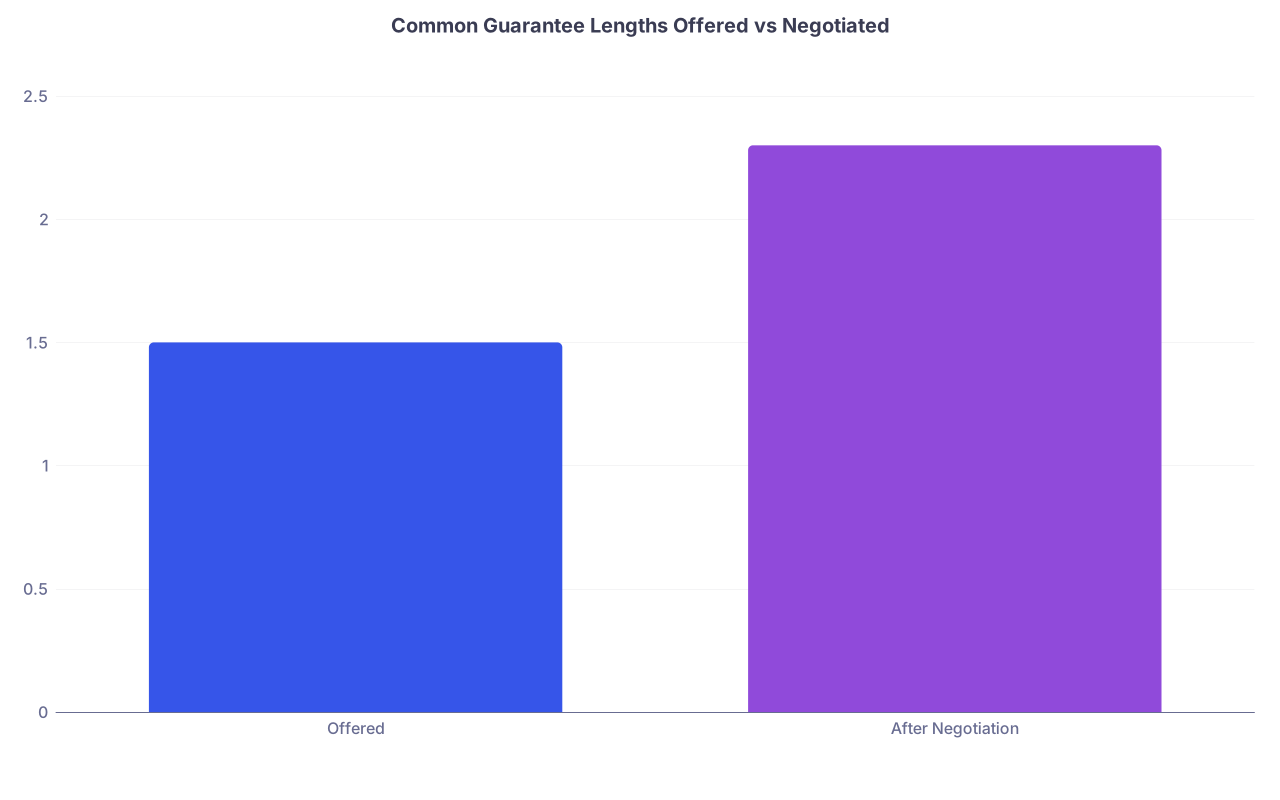
| Category | Value |
|---|---|
| Offered | 1.5 |
| After Negotiation | 2.3 |
How Long Until You’re Safe Without a Guarantee?
“Safe” means you can pay loans, live your life, and not panic every time census dips.
Rule of thumb by setting:
Stable hospital-employed, strong demand, full schedule from day one:
You might be fine after 12–18 months. But why eat that risk if they’ll extend?New market, new clinic, building from scratch:
You’re often not truly stable until 24–36 months.Procedural specialist in a competitive area:
2 years is bare minimum. 3+ years is much more realistic.

What If They Absolutely Won’t Extend the Guarantee?
Then you stop asking, “Can I live with this?” and start asking, “What safeguards do I need?”
If they insist on a shorter guarantee:
Get brutally honest about volume
- Who will refer to you by name?
- How many providers are actually going to send you patients?
- How quickly did the last doc in your position ramp up?
Ask for data
- Historical RVUs for prior physicians in the role
- Current wait times for that specialty
- How many new patients per month they realistically expect you to see
Shore up other parts of the deal
- Signing bonus and moving allowance (to build your financial cushion)
- Clear out-clause without punitive penalties if the job is financially unsustainable
- Shorter non-compete or smaller restricted radius
Absolutely get a physician contract lawyer
Do not “DIY” a short guarantee, high-risk compensation model. You will miss something.

| Step | Description |
|---|---|
| Step 1 | Short Guarantee |
| Step 2 | Request Volume Data |
| Step 3 | Negotiate Bonus and Relocation |
| Step 4 | Limit Non Compete |
| Step 5 | Get Contract Reviewed |
Example Scenarios: What Makes Sense?
| Scenario | Reasonable Guarantee |
|---|---|
| FM in busy suburban system clinic | 2–3 years |
| Hospitalist with fixed shifts | 1–2 years |
| New GI hire, building ref base from zero | 3 years |
| Academic IM with clinics + teaching | 2 years |
| Private ortho group with partnership | 2–3 years |

Quick Summary: What You Should Walk Away With
- For most first jobs, you should push for a 2–3 year guaranteed base salary. One year is often not enough time for your practice to truly stabilize.
- The structure matters as much as the duration. Avoid recoupment “loans,” hidden early productivity adjustments, and non-renewal traps that undercut your guarantee.
- Match guarantee length to real-world ramp-up time. The more your income depends on referrals, procedures, or a new market, the longer your guarantee should last.
FAQ (Exactly 5 Questions)
1. Is a 1-year guaranteed salary ever acceptable for a new attending?
Yes, but only in lower-risk situations—like hospitalist or intensivist jobs with fixed shift pay and strong existing volume. Even then, you should understand exactly what your compensation model becomes on day 366 and make sure you’re not exposed to massive downside.
2. Does a longer guarantee mean I’m getting underpaid compared to pure productivity?
Sometimes, but not always. A guarantee is a hedge. You might earn slightly less than a rock-star producer under a pure RVU plan, but far more than someone whose volume ramps more slowly. As a new attending, stability is usually worth trading a bit of theoretical upside.
3. What’s the difference between a salary guarantee and an income guarantee with a loan?
A true salary guarantee is just that—the employer pays you the stated amount, period. An “income guarantee” tied to a promissory note means they front you money that you’re expected to “earn back” through future production or even pay back if you leave. They are not the same thing, and the second one is much riskier.
4. How do I know if my specialty’s ramp-up really needs 3 years?
Ask directly: How long did it take the last physician in this role to hit target RVUs? What’s their current RVU or collections? What are the current wait times? If they can’t provide data or dodge specifics, assume ramp-up may be slower than advertised and lean toward wanting a longer guarantee.
5. If I can’t get a longer guarantee, what’s the next best thing to negotiate?
Push for: a minimum compensation floor after the guarantee period, detailed written production formula, better signing bonus/relocation to pad your finances, and more favorable terms around termination and non-compete. And get a physician contract attorney to review everything before you sign.


