

The fear of picking the wrong contract structure ruins more careers than a “bad” offer does.
Not the money. Not the location. That one decision about how you’re paid—base plus RVUs, straight salary, partnership track, 1099 vs W2—can keep you up at 2 a.m. staring at a ceiling you don’t even own yet, asking: “What if I screw this up?”
Let’s go right into your nightmare scenario: you’ve done the impossible, finished residency or fellowship, and now you somehow have two offers. On paper, that should feel amazing. Instead, you’re stuck in this panicky loop:
- What if I pick the “safe” one and leave $100k/year on the table?
- What if I pick the “high upside” one and can’t hit the RVU targets?
- What if I sign the wrong structure and get trapped for three years?
- What if everyone else is making way more and I only realize after it’s too late?
You’re not crazy for worrying about this. The system almost guarantees you’ll feel clueless the first time you do this, while the people across the table negotiate these contracts all day.
Let’s unpack this in a way that keeps you from spiraling and gives you a way to choose without destroying your sanity.
First Brutal Truth: There’s No Perfect Contract, Only Better Fit
Here’s the part nobody tells you when you’re PGY-3, exhausted, and scrolling through job boards during night float:
You’re not choosing the “right” contract structure.
You’re choosing which set of problems you’d rather live with.
One offer might be:
- Solid base salary, modest RVU bonus, W-2, employed by a hospital system.
- Predictable. Stable. Honestly, a little boring.
The other:
- Lower guaranteed base, big RVU upside, maybe some “partnership potential” after 2–3 years.
- Sexy on paper. Also riskier than your brain wants to admit.
Your anxiety is trying to find the path where you:
- make the most money,
- have the best lifestyle,
- never feel underpaid,
- and never have to explain a “mistake” to future employers.
That path doesn’t exist. I’ve never seen it. What does exist is:
- A contract that matches your current risk tolerance and life situation.
- A contract that gives you a clean exit if it’s not what you thought.
- A structure you understand well enough not to be exploited.
Your job isn’t to be perfect. It’s to avoid the landmines.
The Real Question: “What Happens If I’m Wrong?”
The scary part isn’t picking wrong.
It’s feeling stuck if you did.
So when you look at two offers, don’t just compare raw dollars. Ask:
“If this turns out to be the wrong structure for me, how painful and expensive is it to get out?”
This is where your anxiety is actually useful. You’re already thinking worst‑case. Good. Use it.
Look at these things like a paranoid lawyer in a white coat:
- Term length: Is this a one-year contract that auto-renews? Or a three-year term you can’t break without pain?
- Without-cause termination: Can you walk away with 60–90 days’ notice, no explanation, no penalties except maybe tail coverage?
- Non-compete: How wide? How long? Is it half the state, or a few miles from one clinic? Does it apply if they terminate you without cause?
- Tail insurance: If it’s claims-made malpractice, who pays tail if you leave? You, them, or split?
- Repayment clauses: Signing bonuses, relocation, stipends. Do you owe money back if you leave early? How is it prorated?
Here’s the thing almost no one tells you:
If the exit terms are reasonable, picking the “wrong” contract structure is annoying, not career-ending.
You’ll work there 1–3 years, learn a ton (about medicine and about what you actually want), and then move. That’s not failure. That’s normal.
Where people get destroyed is when they’re so focused on RVUs vs straight salary that they miss:
- a brutal non-compete that blocks half their metro area, or
- a repayment clause that sends them a $60k bill when they try to leave.
If you’re going to obsess about something, obsess about your escape hatch, not just your comp model.
Salary vs RVU vs “Eat What You Kill”: Which One Should You Fear?
Let me translate your current thoughts:
“What if I pick the stable one and I’m the idiot making $260k while my co-resident is at $450k?”
“And what if I pick the RVU-heavy one and can’t hit target and I end up at $180k and panic?”
Here’s a blunt breakdown, because fluffy explanations don’t help anyone at 3 a.m.
| Model | Risk Level | Predictability | Upside Potential |
|---|---|---|---|
| Straight Salary | Low | High | Low |
| Base + RVU | Medium | Medium | Medium–High |
| Pure RVU | High | Low–Medium | High |
| Partnership Track | High | Low–Medium | Very High |
Straight salary (or big base, tiny bonus)
This is the “sleep-at-night” option.
Good when:
- You’re paying off loans, moving, starting a family, or just plain burnt out.
- You don’t trust volume promises. (You shouldn’t.)
- You’re in your first job and want stability while you figure out what you even like.
Your fear: “I’m leaving money on the table.”
Reality: You’re buying stability as training wheels. That’s not stupid. It’s rational.
Base + RVU bonus
The classic hospital employed setup.
Good when:
- They can show you what current docs in your specialty actually earn.
- You’re in a decently busy area, not a dying satellite clinic in the middle of nowhere.
- RVU thresholds aren’t insane for a new grad.
Your fear: “What if I miss the RVU target and only make base?”
Reality: Look at the base alone and ask, “If I only get this, for the next 1–2 years, can I live my life and not panic?” If yes, the rest is upside.
Pure production / “eat what you kill”
This can be amazing. Or a complete bloodbath.
Good when:
- You’re joining a proven high-volume group with transparent data.
- You’ve seen actual numbers: what a new hire earned years 1–3.
- You’re comfortable working hard and tolerating income swings.
Your fear: “What if volume is terrible and I can’t pay bills?”
Reality: That’s a valid fear. As a first job, pure production is almost always too risky unless you really know the group or you’re in a clearly underserved area.
Partnership track
This one is often wrapped in vague promises:
“Work hard the first two years, then you’ll be a partner and your income doubles.”
Sometimes that’s true. Sometimes it’s straight-up fantasy.
Questions you should demand answers to:
- How many physicians made partner in the last 5 years, and how many did not?
- What do partners actually take home, not just “potential”?
- Is partnership guaranteed if you meet clear metrics, or is it “at the discretion of the partners”?
Your fear: “What if I grind for 3 years and they never make me partner?”
Reality: This happens a lot. That’s why exit terms and non-competes matter more than their “partner someday” speech.
Using Your Least Favorite Emotion (Anxiety) as Your Superpower
You’re already spiraling through worst-cases. So use that.
Instead of:
“What if I pick the wrong structure and my life is ruined?”
Ask, for each offer:
“If this is worse than I think, what exactly happens, step by step?”
Walk it through like a flowchart:

| Step | Description |
|---|---|
| Step 1 | Two Offers |
| Step 2 | Income if volume low |
| Step 3 | Exit cost and notice |
| Step 4 | Non-compete impact |
| Step 5 | Income if only base paid |
| Step 6 | Exit cost and notice |
| Step 7 | Non-compete impact |
| Step 8 | Can I pay bills? |
| Step 9 | Reasonable to leave in 1-2 years? |
| Step 10 | Can I work nearby after leaving? |
| Step 11 | Offer 1 Worst Case |
| Step 12 | Offer 2 Worst Case |
Do this on actual paper if you have to. For each offer:
Write: “If this goes badly, my realistic worst year looks like…”
Then add up: base (only), minimum bonus (or none), normal loan payments, normal living costs. Include the stuff you’re scared to look at: childcare, partner not working, etc.Then: “If I decide to leave after 12–24 months, here’s what I’d owe or lose…”
Tail coverage, repayment of relocation or sign-on, impact of non-compete.
You’ll notice something important:
For one of these offers, the worst-case will feel survivable. Annoying, maybe humbling, but survivable.
For the other, the worst-case might feel suffocating.
That’s your answer.
Not which one looks fancier on a spreadsheet.
Which one doesn’t destroy you if it’s not as advertised.
The Thing You’re Secretly Afraid Of: Looking Stupid
Most of the panic around “What if I pick the wrong structure?” isn’t about money. It’s shame.
“I don’t want to be the idiot who took the ‘security’ job when everyone else is bragging about RVU bonuses.”
“I don’t want to be the idiot who believed a partnership promise that never happened.”
You know what I’ve seen?
- People who took “safe” hospital jobs, realized they hated big systems, and switched to private groups a few years later—doing totally fine.
- People who chased insane RVU potential, burned out, moved, took a straight-salary academic job, and were happier making less.
- People who didn’t hit RVU targets early on, then slowly figured out efficiencies, referrals, clinic flow—and their income grew over time.
The only truly “stupid” move?
Signing something you don’t understand because you’re too embarrassed to ask questions or get a contract review.
You’re allowed to say:
- “Walk me through how this bonus is calculated using last year’s example.”
- “Show me the compensation of someone hired 2 years ago in my specialty.”
- “What happens if I only hit 60–70% of target year 1?”
- “How many people here have left in the last 3–5 years, and why?”
If they get weird, defensive, or vague when you ask?
That’s your answer. You don’t want to work there.
Concrete Moves So You Don’t Freeze
Let me make this practical, because anxiety without action is just torture.
Get both contracts reviewed. Not by your co-resident who “likes numbers.” By someone who does physician contracts all day—healthcare attorney or a reputable contract review service.
Translate both into a one-page summary you can understand:
- Year 1 guaranteed compensation (no assumptions, no “typical” volume).
- What you could make at realistic volume (not fantasy).
- Exit terms: notice, non-compete, tail, repayment.
Decide what you’re optimizing for in this first job:
- Maximum money
- Maximum flexibility/exit options
- Maximum stability and training wheels
You can’t optimize all three equally. Pick your top two.
Set a “minimum acceptable” for yourself:
- “If I make at least $X and I’m not trapped, I can live with it for 1–3 years.”
Anything that clearly falls below that? Out.
- “If I make at least $X and I’m not trapped, I can live with it for 1–3 years.”
Give yourself permission to treat this as a first job, not a life sentence. You’re allowed to pivot. Lots of doctors do. Quietly. No one announces their missteps at grand rounds.
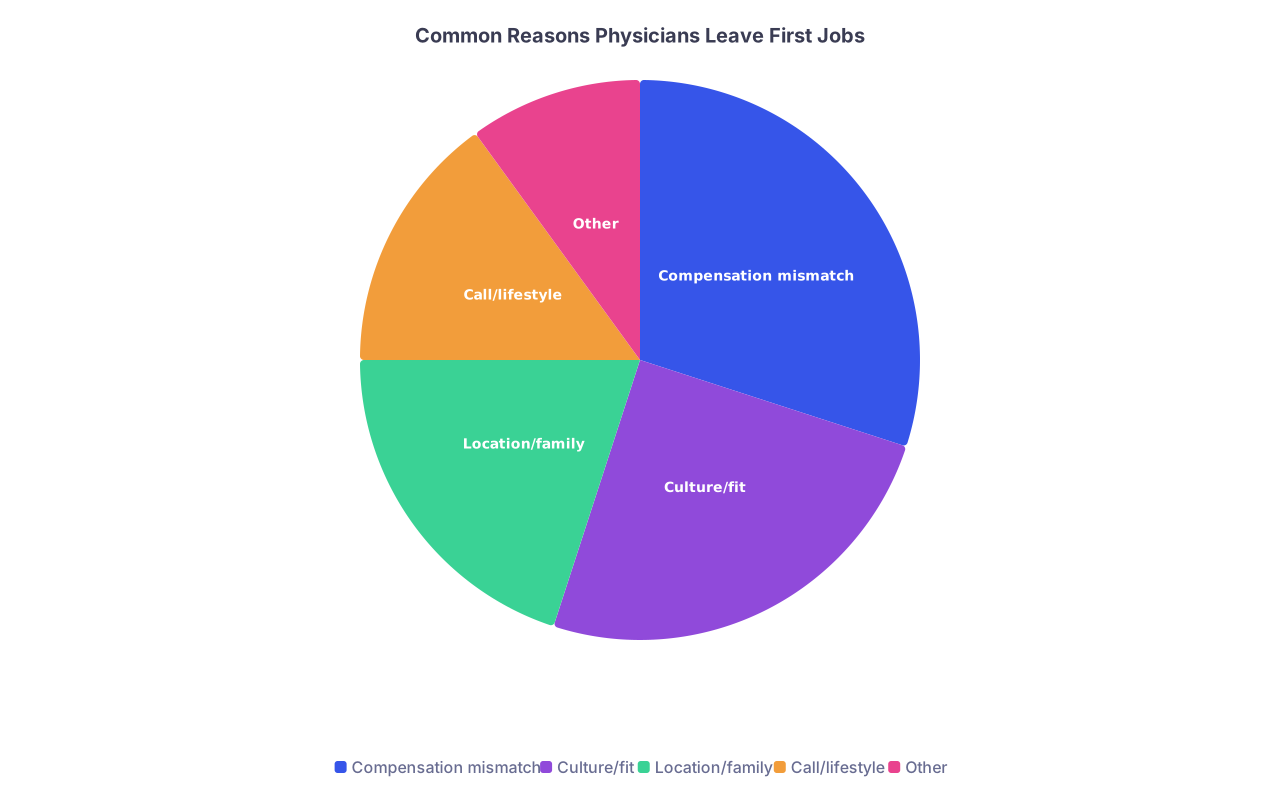
| Category | Value |
|---|---|
| Compensation mismatch | 30 |
| Culture/fit | 25 |
| Location/family | 20 |
| Call/lifestyle | 15 |
| Other | 10 |
See that? Most people leave not because they “picked the wrong comp structure,” but because the total package—money, culture, lifestyle—didn’t match what they thought.
The contract model is just one slice of the pie. Important, yes. But not the only thing.

FAQs – The Stuff You’re Too Stressed to Ask Out Loud
1. What if I pick the “safe” salary job and regret not choosing the higher‑upside RVU one?
Then you do what a lot of smart people do: you learn from a low-risk first job. You get experience, you figure out your true volume and preferences, and in 1–3 years you move to a structure with more upside if that still matters to you. You didn’t “waste” those years; you bought stability while you learned how this world works. That’s a fair trade.
2. What if I pick the RVU-heavy job and can’t hit my targets?
First, make sure the base alone is survivable before you even sign. If you end up not hitting targets, you’ll feel pressure, but you won’t be bankrupt. Then you have options: adjust clinic flow, ask for support, negotiate after year 1 with real data, or leave using your without-cause termination clause. You’re not shackled to them forever unless you signed something brutal like a huge non-compete and big repayment terms.
3. Does picking a “bad” first contract hurt my long-term career?
Almost never, unless there’s something really awful like a revoked license, glaring performance issues, or you bounce from job to job every few months. A 1–3-year first job where you decide, “This structure wasn’t for me” and then move on? That’s normal. Future employers care more about: Are you competent? Are you reasonable? Do you stay long enough to be useful? They don’t blacklist you because you didn’t love your first comp model.
4. How do I know if a non-compete is actually dangerous or just annoying?
Dangerous: huge radius (e.g., 25–50+ miles), multiple sites, multi-year duration, applies even if they terminate you without cause, and you have no realistic alternative employers outside that radius. Annoying: smaller radius (5–10 miles), shorter term (1 year), or limited to specific sites where you actually work. If a non-compete would force you to move your entire life to leave the job, that’s a red flag—especially if the comp structure is already high-risk.
5. Is it a red flag if a group won’t show real income numbers from current physicians?
Yes. Massive one. If they’re proud of their comp structure, they’ll happily show anonymized data: what new hires made in years 1–3, what partners actually take home, how bonuses actually paid out. If they dodge, hand-wave, or tell you, “It depends, but our docs do really well,” that usually means the reality doesn’t match the sales pitch. Believe that discomfort. It’s your brain trying to protect you.
Key points to walk away with:
- You’re not choosing perfection; you’re choosing which risks and tradeoffs you can live with for 1–3 years.
- The real disaster isn’t the “wrong” comp model—it’s a contract that traps you with brutal exit terms and a nasty non-compete.
- If you understand the worst-case for each offer and it’s survivable, you’re not making a catastrophic mistake. You’re making a professional decision with room to course-correct later.


