

The way most physicians sign RVU contracts is dangerous.
Not because RVUs are evil. Because nobody explains what happens when you don’t hit those RVU targets. And that’s exactly the nightmare scenario your brain keeps replaying at 3 a.m.
Let’s walk straight into the fear: what actually happens if you miss your RVU targets, and what you can do before you sign to protect yourself.
The RVU Panic: What’s At Stake If You Miss Targets?
Here’s the part nobody says out loud during the recruitment dinner:
If your income is tied to RVUs and you don’t hit your targets, there are only a few things that can realistically happen:
- You make less money than you thought.
- You get labeled as “low productivity” or “not a good fit.”
- Your contract doesn’t get renewed or you get quietly pushed out.
Not always. But I’ve watched some version of this play out more times than I’m comfortable with.
Sometimes it’s subtle. You’re six months in, your wRVUs are trending below target, and suddenly everyone is “concerned about clinic growth.” You’re getting meetings with your medical director about “panel development” and whispers like “we really expected more volume in this market.”
Meanwhile, you’re thinking: You control the schedule. You control the referral base. You control the marketing. How is this all on me?
That’s the core problem with RVU contracts: they put performance risk on you, but a lot of the factors that drive volume are controlled by the employer.
So when you ask, “What happens if I don’t hit my RVU targets?” what you’re really asking is: Am I going to be blamed and punished for things I don’t fully control?
You might be. Unless you protect yourself upfront.
How RVU Contracts Usually Work (And Where They Trap You)
You probably already know the basics, but I’ll keep it tight and focus on the parts that come back to bite people.
Most RVU-based contracts include some combo of:
- A base salary (maybe guaranteed for 1–3 years)
- A wRVU target per year
- A conversion factor (dollars per wRVU)
- Maybe a bonus if you exceed the target
- Sometimes a draw or guarantee that’s “reconciled” against productivity
The trap is hidden in how these interact when you’re under target.
Let me show you a basic structure that looks fine on paper but is quietly terrifying:
| Item | Example Value |
|---|---|
| Base salary (year 1) | $260,000 |
| Annual wRVU target | 5,500 |
| Conversion factor | $50 per wRVU |
| Expected productivity pay | 5,500 × $50 = $275,000 |
| Bonus | Paid for wRVUs > 5,500 |
On the surface this sounds good: solid base, clear target, upside for more work.
But now imagine 18 months in, your panel’s growing slowly, access is limited, and you’re on track for 4,200 wRVUs instead of 5,500.
Here’s where the anxiety goes nuclear.
Scenario 1: You Miss RVU Targets During a Guarantee Period
This is the “golden handcuff” phase. They often tell you:
“Don’t worry about RVUs the first year, your salary is guaranteed.”
What that secretly triggers in your brain: So if I’m behind by the time the guarantee ends, I’m dead?
Maybe. Maybe not. Depends what’s in the contract.
During the guarantee period, a few things might be happening:
- Pure guarantee: They pay you your salary no matter what, no reconciliation, no payback.
- Income guarantee with reconciliation: They track what you “should” have earned based on RVUs, and technically you’re accruing a deficit.
- Hybrid: Minimal reconciliation, but they “rebase” you later based on actual performance.
The worst shock I’ve seen: a doctor finishes a 2-year “guarantee,” then gets told their future salary will be based on their trailing RVUs. So their third-year offer suddenly drops by $40–$80k because “your productivity hasn’t supported the original base.”
No one said that part clearly during recruitment. Or they said it fast enough that it didn’t register.
So if you’re wondering, what happens if I’m under target during my guarantee? the realistic things are:
- Nothing happens yet… but your renewal/next contract is lower.
- You get painted as “underperforming” and now you’re on a short leash.
- In extreme cases: they don’t renew you at all.
To keep this from blowing up your life, you need crystal-clear answers before you sign on:
- Is the guarantee truly non-recoverable?
- Will my future base be tied to trailing RVUs?
- What happens if volume never matches the rosy projections?
Let me say this bluntly: “We’ll figure it out later” is not an answer. It’s a setup.
Scenario 2: After the Guarantee — When It Really Hurts
This is where the fear usually lives.
You’re past your initial guarantee. Your pay is now tied pretty directly to what you produce. And then you don’t hit the target.
The obvious consequence: your income drops. Sometimes sharply.
If your target is 5,500 wRVUs at $50 each, that’s $275,000. If you only hit 4,000, you’ve effectively “earned” $200,000. If 100% of your comp is productivity-based, that’s your pay.
If part of your pay is still base and part is RVU-based, you might see:
- No bonus (because you didn’t meet threshold)
- A “clawback” of advanced draws if they paid you assuming a higher RVU level
- A push at renewal to lower your base or put you on fully productivity-based pay
Now the scarier part: what this does to how they see you.
I’ve heard the exact phrases in admin meetings:
- “Dr. X just isn’t ramping up like we expected.”
- “We might need to rethink that FTE.”
- “Maybe this clinic doesn’t need full-time coverage.”
Low RVUs get turned into a character judgment. Slow. Not motivated. Poor fit. Even if the truth is: the schedule’s half blocked for hospital follow-ups, referrals are bottlenecked, and you’re stuck with 20-minute new patient slots.
Missing targets isn’t just a paycheck problem. It becomes a reputation problem inside the organization.
What Really Drives Whether You Hit RVU Targets
Here’s the part your anxious brain is correctly fixating on: you do not fully control your RVUs.
You control your work ethic, your efficiency, your documentation. But the system controls:
- How many patients can even get on your schedule
- The length of your slots
- Whether you’re doing new vs follow-up vs low-RVU admin work
- How much call you take (and whether that’s compensated)
- How referrals are routed between partners
- Whether they actually market you
- How much MA/nursing support you have
If you’re on 40-minute new patient slots with chronic trainwrecks and endless prior auths, you’re not going to hit the same RVUs as someone cranking through 15-minute bread-and-butter follow-ups all day.
Your fear isn’t irrational. It’s the system design.
So, if you’re going to sign an RVU contract, your #1 job is to shift some risk back off you and onto the people who actually control the inputs.
Protecting Yourself Upfront: Concrete Things to Negotiate
You can’t eliminate every risk. But you can make “I didn’t hit target” less catastrophic and more fixable.
Here’s what to push on before you sign:
1. Lower or Tiered RVU Targets Early On
Insist that ramp-up is real, not imaginary.
Year 1: Lower target (e.g., 60–70% of standard) Year 2: Intermediate Year 3: Full target
Also: make sure there are no hidden “penalties” during ramp. If they’ll track your RVUs but say you’re “protected,” get in writing that:
- Your base won’t be reduced mid-contract for low productivity.
- You won’t owe back any “deficit” when the contract ends.
2. Clear Language About What Happens If You Never Reach Target
Ask directly:
“What if, despite reasonable effort, I consistently land at 80% of target? What happens to my salary and my job?”
If they dodge, that’s a red flag.
Get specifics into the contract or at least in an addendum or email that references the contract:
- Will base be adjusted only by mutual agreement?
- Is non-renewal the only option? If so, what’s the notice period?
- Can targets be revisited if market conditions are different from projections?
You’re not being difficult. You’re preventing a future “We never promised that” conversation.
3. Protection Against Clawbacks
This one keeps people awake at night: What if I literally owe them money?
If they’re advancing you draws or guarantees against future RVU earnings, nail down:
- You won’t be personally liable to repay deficits if you leave or at reconciliation.
- At worst, future bonuses are offset until the deficit is gone.
- There’s no scenario where you cut them a check after working there.
If they refuse that, you need to think very hard about signing.
4. Operational Commitments in Writing
Everyone loves vague promises: “We’re really going to grow this market.”
You need numbers, not vibes.
Ask them to commit, in writing, to things like:
- Minimum clinic days per week
- Minimum number of slots per day
- Guaranteed block time in OR/procedure room (if relevant)
- Marketing/resource commitments for the first 1–2 years
- Referral pattern support (for example, being included in new patient routing)
You’re trying to build a case that if you miss targets, it’s not automatically a “you” problem.
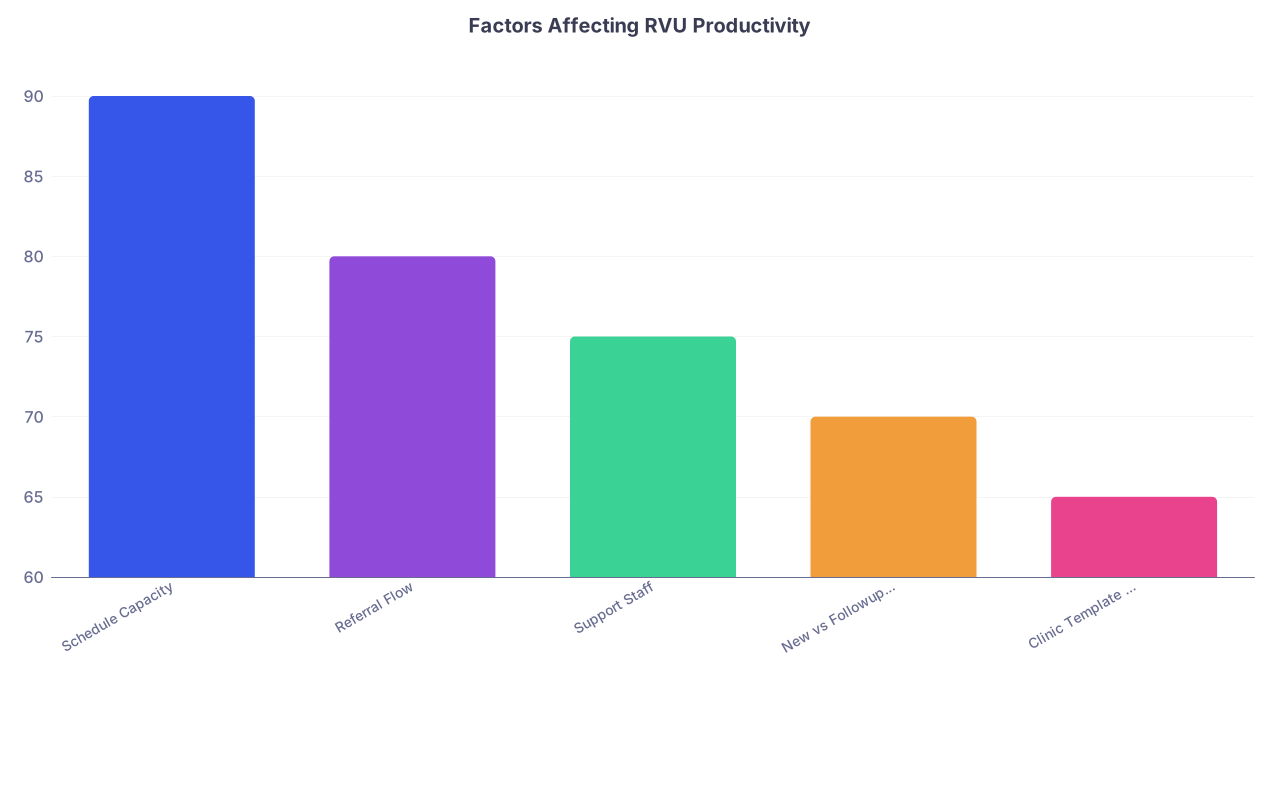
| Category | Value |
|---|---|
| Schedule Capacity | 90 |
| Referral Flow | 80 |
| Support Staff | 75 |
| New vs Followup Mix | 70 |
| Clinic Template Design | 65 |
Red Flags That Predict RVU Disappointment
There are some patterns that almost always end in “I didn’t hit my targets and now I’m screwed.”
Pay attention if you see:
- Targets based on “national MGMA 75th percentile” with no local volume analysis.
- They can’t tell you what current docs at your site are actually producing.
- “Everyone hits their targets” but nobody is willing to show anonymized productivity data.
- Heavy non-RVU work (teaching, admin, committee work) that isn’t compensated separately.
- You’re joining a clinic where multiple physicians left in the last 2–3 years.
If you’re already anxious, don’t gaslight yourself. That feeling is often your brain picking up on real structural risk, not just impostor syndrome.
What If I’m Already In the Job and Missing Targets?
Most of your fear might be: I’m already here. My RVUs are low. Now what?
First, breathe. This does not automatically mean you’re getting fired.
Three things to do fast:
Get the actual numbers.
Monthly RVU reports. By location. By CPT code. Compare against your contract target and your peers if possible. No more guessing.Document the barriers.
Not in a whiny way. In a factual way—limited slots, blocked templates, referrals being sent elsewhere, staffing shortages. Keep a running log.Ask for a formal review with a plan.
Frame it as: “My RVUs are significantly below target. I want to understand the drivers and create a realistic plan that works for both of us.”
During that meeting, push the conversation away from personal blame and toward systems:
- “If I’m expected to reach 5,500 RVUs, I’ll need X more patient slots per week or Y more procedure time.”
- “If I can’t get that, we may need to revisit the target or my comp model.”
If they’re reasonable, you might get:
- Adjusted expectations
- Better templates
- Marketing help
- Short-term income stabilization while changes are made
If they’re not reasonable, the writing is on the wall—and you should quietly start looking elsewhere before the contract expires.

| Step | Description |
|---|---|
| Step 1 | Notice RVUs below target |
| Step 2 | Request detailed RVU reports |
| Step 3 | Identify barriers and patterns |
| Step 4 | Meet with leadership |
| Step 5 | Adjust targets or operations |
| Step 6 | Quietly explore other jobs |
| Step 7 | Monitor progress 3-6 months |
| Step 8 | Exit on your terms |
Don’t Ignore the Psychological Toll
Let me just say this out loud: living month-to-month worried about whether you’re “earning your salary” in RVUs is brutal.
You start second-guessing every decision.
- “Should I squeeze in two more follow-ups instead of that complex new patient?”
- “If I spend the time to counsel this family properly, I’ll sink the schedule.”
- “If I say no to this extra clinic, will they think I’m lazy?”
You start feeling guilty for doing good medicine because you’re haunted by a dashboard.
This is why I’m a fan of some mix of:
- A real base salary that’s not absurdly low
- RVU incentives as upside, not survival
- A recognition that complex care doesn’t always generate pretty RVUs
If a system wants to hold you strictly to productivity, they should also own all the variables that drive that productivity—and they rarely do.
So yes, protect your finances. But also protect your sanity. Don’t agree to a setup where your entire self-worth lives or dies on a number you only partially control.

Bottom Line: What Actually Happens If You Miss RVU Targets?
Let’s answer the original question in plain language.
If you don’t hit your RVU targets, what happens depends entirely on:
- How your contract is written around guarantees, reconciliation, and renewal
- How your employer handles “underperforming” physicians culturally
- How much of your comp is base vs pure productivity
- Whether you can show that system issues, not just your effort, limited your volume
Worst realistic cases (if unprotected):
- Your pay drops drastically after the guarantee ends.
- You’re labeled a low performer and not renewed.
- You’re pressured into more volume at the cost of your sanity.
- In some setups, they try to claw back money.
Best realistic cases (if you protect yourself well):
- You have a stable base, with RVUs mainly affecting bonus.
- Early years have reduced targets and true guarantees.
- If volume isn’t there, you can renegotiate or exit cleanly.
- You have clear, fair expectations and actual support to meet them.
You can’t completely erase the fear. This stuff is risky. But you can go from “one bad year and I’m ruined” to “one bad year and I have options.”
And that’s all you really need.
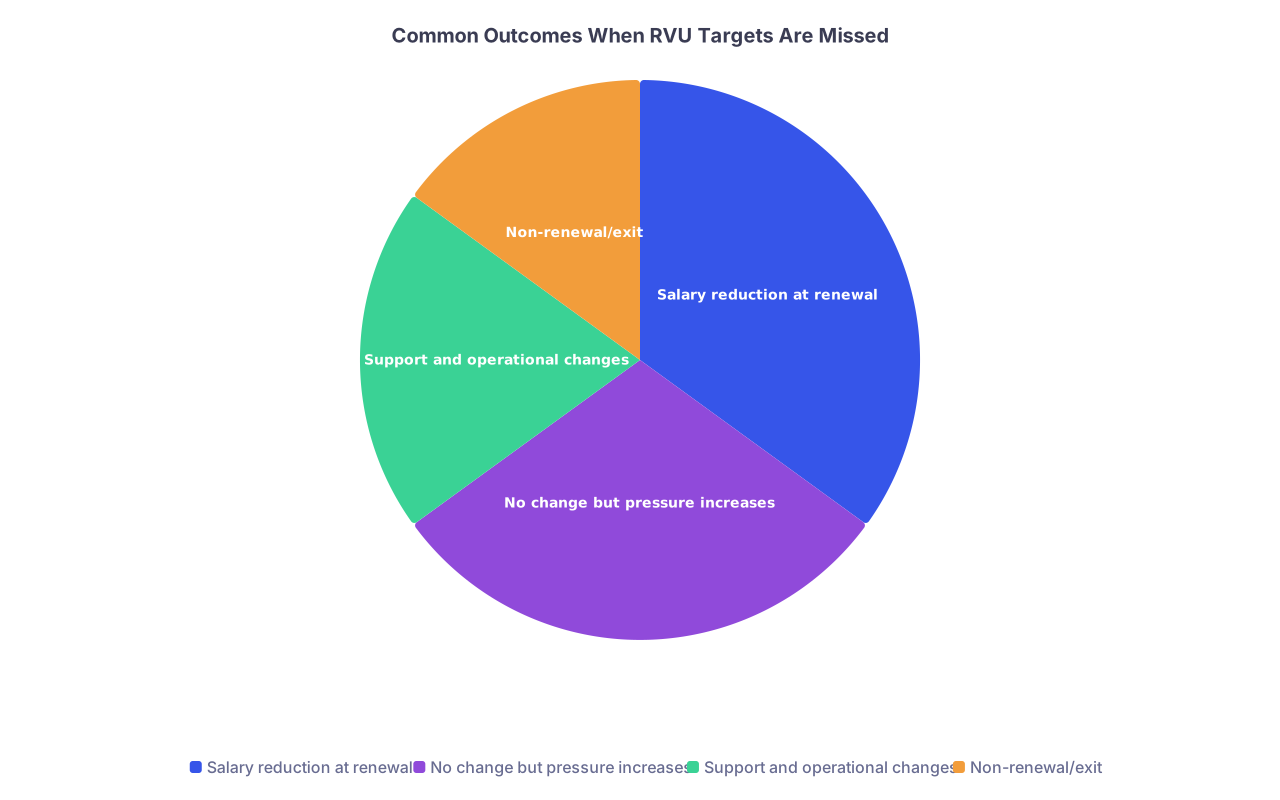
| Category | Value |
|---|---|
| Salary reduction at renewal | 35 |
| No change but pressure increases | 30 |
| Support and operational changes | 20 |
| Non-renewal/exit | 15 |

FAQ (Exactly 6 Questions)
1. Is it normal to not hit RVU targets in the first year?
Yes, and frankly it’s common. Ramp-up takes longer than recruiters pretend, especially in saturated markets or poorly managed clinics. That’s why you need clearly reduced targets or true guarantees written into the first 1–2 years. If they’re expecting full MGMA 75th percentile production six months after you start from zero… that’s fantasy.
2. Can they really make me pay back money if I don’t hit my RVUs?
They can if the contract explicitly allows it and you sign it. Some “income guarantee” structures technically create a repayable deficit. That’s why you want language clarifying that any shortfall is not personally repayable and is, at worst, offset by future incentive pay. If a contract says you owe them cash out of pocket, that’s a massive red flag.
3. How do I know if an RVU target is realistic for my specialty?
Ask for actual anonymized data from current physicians in your group, your site, and your schedule setup. MGMA medians are not enough. If everyone locally is producing 4,000–4,500 wRVUs and they’re setting your target at 6,000 with the same template, that’s not aspirational, that’s delusional. Also, ask what percentage of similar hires hit target in the first 2–3 years.
4. What if my RVUs are low because I’m doing a lot of teaching or admin work?
Then those duties need separate, explicit compensation or RVU credits. Don’t accept the “we really value teaching” speech without numbers behind it. If 20–30% of your time is spent on non-RVU tasks, your targets should be reduced accordingly or you should have a separate stipend. Otherwise, they’re double-dipping: your time and your paycheck.
5. Is it safer to avoid RVU contracts altogether?
Sometimes, but even “salary-only” jobs often have hidden productivity expectations. RVU models aren’t inherently bad; they’re just dangerous when lopsided. If you can find a solid base salary with modest, truly bonus-style RVU incentives and realistic targets, that can actually feel fine. The nightmare scenario is pure productivity, high targets, and no operational control.
6. How do I bring up these concerns without looking lazy or unmotivated?
Frame everything around alignment and realism, not fear. For example: “I want to make sure expectations are aligned so I can succeed long term. Can we look at local productivity data and define ramp-up targets we both think are achievable?” That doesn’t make you look lazy; it makes you look like someone who understands business and doesn’t want a mismatch leading to resentment later.
Years from now, you won’t remember the exact RVU numbers that scared you. You’ll remember whether you signed blindly—or whether you made sure the people measuring you also shared the risk they were so eager to place on your shoulders.


