

Most new physicians are more scared of contract negotiation than their first night on call. That’s backwards.
You can manage a crashing patient, but the idea of saying, “Can we talk about the compensation structure?” makes your stomach flip. I’ve watched brand‑new attendings confidently run codes… then whisper to me, “If I push back, they’ll just rescind the offer, right?”
Let me be blunt: rescinding an offer because you asked reasonable questions or tried to negotiate is extremely rare, and when it does happen, it’s usually a giant red flag you just dodged.
You’re not crazy for being scared though. You feel like all the power is on their side: they’ve got the job, the lawyers, the HR department, the recruitment firm. You’ve got… your student loans and a vague memory of a “Negotiations” slide from some noon conference that you definitely didn’t attend because you were post‑call.
So let’s talk about how to push back without losing the offer, and also what it really means if you do.
Why You’re So Afraid (And Why That Fear Lies to You)
You’ve probably got one or more of these running in the background of your brain:
- “I matched late, my CV isn’t amazing, they’re doing me a favor by even offering this.”
- “Everyone keeps saying jobs are tightening. I can’t risk pissing them off.”
- “I don’t understand half this contract; if I ask questions, I’ll look dumb.”
- “They’ll think I’m greedy. Or difficult. Or not a ‘team player’.”
I’ve heard recruiters literally say to residents: “This is a standard contract; our doctors don’t really negotiate.” Translation: “We hope you’re too scared and tired to ask for anything.”
Here’s the part you probably don’t believe but need to hear anyway:
You are expensive to recruit. They did not send that offer for fun. They have sunk real time and money into finding you.
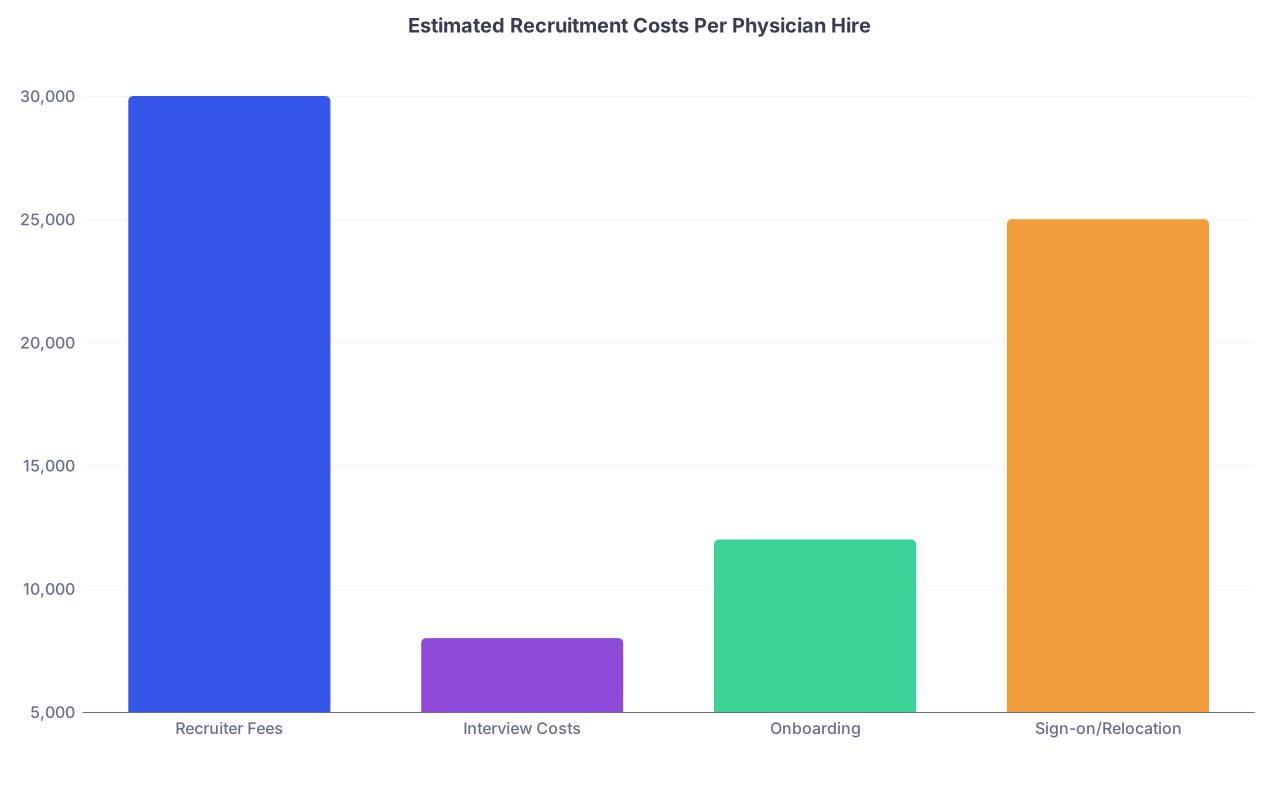
| Category | Value |
|---|---|
| Recruiter Fees | 30000 |
| Interview Costs | 8000 |
| Onboarding | 12000 |
| Sign-on/Relocation | 25000 |
Even for a modest community job, it’s not weird for a system to spend $50k–$75k getting you in the door. If they’re at the point of sending you a contract, they want you. They are not eager to throw that away because you asked about call pay.
Does that mean you can demand $150k more and a private scribe army? No. There’s a line. But reasonable questions and moderate pushes? That’s normal. Good programs expect it from adult professionals.
Here’s the real worst‑case scenario that actually happens: you’re so afraid of losing the offer that you don’t negotiate anything, you sign as is, and six months later you realize you locked yourself into a toxic, underpaid, overworked situation with a restrictive covenant that handcuffs you to a city you already hate.
That’s way worse than making someone in HR mildly annoyed for a week.
What “Pushing Back” Actually Sounds Like (So You Don’t Freak Out)
In your head, “negotiation” probably looks like TV: confrontation, ultimatums, “take it or leave it.” That’s not what you’re doing.
You’re doing calm, boring, adult conversation. Half the “negotiation” is tone.
Here’s the frame that keeps you safe:
- You’re appreciative: “I’m really excited about this opportunity.”
- You’re specific: “There are a few contract details I’d like to discuss.”
- You’re collaborative: “Is there room to adjust X?”
You’re not accusing, demanding, or dramatic.
Let’s turn your worst fears into actual sentences you can use.
You’re worried: “If I ask about salary, I’ll look ungrateful.”
Say something like:
“Thank you again for the offer. I’ve reviewed the contract and I’m very interested. I did have a couple questions about compensation and productivity expectations so I can understand how this would look in practice. Is now a good time to go through those?”
You’re worried: “If I question the non‑compete, they’ll think I’m planning to leave.”
Try:
“I hope this is a long‑term fit, but I do have some concerns about the scope of the non‑compete. A 30‑mile, two‑year restriction feels pretty broad. Is there any flexibility to narrow either the radius or the duration?”
You’re worried: “They’ll think I’m difficult if I ask for changes.”
Use:
“Most of the contract looks straightforward to me. There are just two areas I’d love to revisit: call compensation and the termination notice period. If we can find middle ground on those, I’d feel very comfortable signing.”
See the pattern? Interested, calm, specific. You’re not an angry customer at the pharmacy. You’re a professional working out terms with other professionals.
How Far Can You Push Before You Really Risk the Offer?
Here’s the line everyone wants: “Say this exact number of things and you’re safe.” Reality is messier, but there are some patterns.
Recruiters and administrators expect negotiation on:
- Base salary or starting guarantee
- Sign‑on bonus
- Relocation assistance
- Call responsibilities and call pay
- Schedule (clinic vs. OR vs. admin time)
- Start date
- Non‑compete radius / duration
- CME money and time
- Tail coverage responsibilities
If you’re asking about those, in a normal tone, you’re in safe territory.
Where you creep towards “we might walk away” land:
- You keep saying you’re “not sure” you even want to be in that city or at that type of practice
- You demand changes on almost every line of the contract
- You escalate emotionally (“This is insulting,” “No serious physician would accept this”)
- You blow off timelines and are non‑responsive for weeks while they’re trying to fill a spot starting July 1
- You keep “shopping” their offer publicly and letting it get back to them
Even then, most institutions don’t yank the offer immediately. They nudge. They say things like, “We really don’t have room to move on these items.” Or, “We understand if this isn’t the right fit.”
You’ll feel the cooling.
And here’s the thing you really don’t want to hear but need to: if a single round of measured, well‑framed negotiation makes them hostile, you just learned something important about how it will feel to work there when you ask for staffing, safer call schedules, or protected time in the future.
They’re showing you their culture.

The Step‑By‑Step Way to Push Back (Without Spiraling)
Your brain probably wants a script. So here’s a pretty practical flow I’ve watched dozens of anxious residents use without blowing anything up.
1. Get the contract reviewed by someone who knows this world
Not your dad’s estate attorney. Not your friend who “does law, I think.” Someone who actually reviews physician contracts: healthcare attorney, physician contract review service, or faculty who regularly helps residents with this and knows the norms in your specialty and region.
Ask them to circle 3–5 priority items, not 25 minor tweaks. You can’t die on every hill.
2. Make a short list of your non‑negotiables and your “it’d be nice” items
Your anxiety will try to treat every clause like life or death. It’s not.
You might decide:
- Non‑negotiable: tail coverage, non‑compete so harsh you can’t work anywhere nearby, insane call burden
- Strong preferences: salary range, bonus structure, protected time, schedule
- Nice to have: extra CME dollars, a bit more relocation, signing bonus bump
You won’t get everything. You probably don’t even want to try for everything; that’s how you feel like an enemy across a table instead of a future colleague shaping a job.
3. Ask for a call instead of sending a giant angry email
Email is where people misread tone, panic, and forward threads up the chain.
You can email to request the call. Something like:
“Thanks again for sending the contract. I’ve gone through it in detail and I’m very interested in the position. I had a few questions and potential adjustments I wanted to run by you. Would you have 20–30 minutes for a call this week?”
Then make a simple outline for yourself so you don’t word‑vomit.
4. Lead with enthusiasm, then ask clear, bounded questions
You start with: “I’m excited. I want this to work.” That’s your anchor.
Then go one item at a time:
“First, about base salary. I see the offer is $240,000 with RVU bonus after year one. From my conversations and MGMA data for similar positions in this region, I was hoping for something closer to $260,000, especially given the call expectations. Is there room to move the base in that direction?”
Notice what you’re doing:
- You’re not apologizing for asking
- You’re not threatening to walk
- You’re giving a rationale, not just “I want more”
Repeat that format for 2–4 key issues. Not 17.
5. Stop talking after you ask
This is excruciating if you’re anxious. You ask, they pause, you rush in to soften it.
Fight that urge.
Say your piece. Then shut up. Let them react. Silence is their problem, not yours.
They might say:
- “Let me take that back to the compensation committee.”
- “We don’t have room to move the base, but we might be able to adjust the sign‑on.”
- “We can’t change the system‑wide non‑compete template, but we can add a carve‑out.”
All of that is still progress.
6. Expect some “no” and some “we’ll see”
You’re not negotiating until someone says no to something. That’s how you know you’ve found the edges of the box.
Your goal isn’t to get every single change you want. Your goal is to move from “This scares me” to “This is acceptable and I understand it.”
If they say no to your top‑priority item (like narrowing the non‑compete), that’s a serious data point. You may decide it’s still worth it. Or not.

| Step | Description |
|---|---|
| Step 1 | Receive Offer |
| Step 2 | Get Contract Reviewed |
| Step 3 | Identify Top Issues |
| Step 4 | Request Call |
| Step 5 | Discuss Changes |
| Step 6 | Sign Contract |
| Step 7 | Reassess Fit |
| Step 8 | Walk Away |
| Step 9 | Deal Breakers Fixed? |
| Step 10 | Accept As Is? |
What Actually Gets Rescinded (And What You Learn From It)
You want the horror stories. “My friend asked for $10k more and they pulled the offer.” Those circulate like urban legends.
I have seen offers pulled. Here’s what was usually going on behind the scenes:
- The group was already on the fence about the candidate (weak references, mismatch in culture), and the negotiation was just the excuse.
- The system got a clearly stronger candidate in the same narrow timeframe.
- The candidate was openly shopping offers, slow‑responding, missing deadlines, making everyone nervous they’d never actually sign.
- The candidate was rude or combative: accusing the group of exploitation, putting demands in writing in a way that made legal/HR nervous.
An anxious, polite new attending asking about tail coverage and a slight salary bump? That does not get you blackballed.
Here’s the ugly twist: If they do rescind just because you dared to question the sacred non‑compete or ask for call compensation that doesn’t violate basic labor law… it hurts like hell, but long‑term, that’s a win. They just saved you from signing your life to people who punish basic self‑advocacy.
You want to work somewhere that’s relieved you know your value, not threatened by it.

Quick Reality Check: You’re Not Being “Greedy”
The system will happily let you believe you’re selfish for asking.
You just trained for a decade. You have hundreds of thousands of dollars of debt. You are taking on massive responsibility, risk, and burnout potential. Asking to be paid fairly and not locked out of your profession isn’t greed. It’s baseline self‑preservation.
Let’s be concrete. For many specialties, the first written offer is not the ceiling. I’ve watched:
- A hospitalist move a base from $240k to $260k plus better nights differential
- A neurologist get their sign‑on doubled from $10k to $20k
- An OB/GYN narrow a 30‑mile, 2‑year non‑compete to 10 miles, 1 year
- An EM doc get tail coverage added when the first draft shoved it entirely onto them
All without anyone losing an offer.
| Term | Typical Movement Range |
|---|---|
| Base Salary | 5–10% up |
| Sign-on Bonus | 25–100% up |
| Non-compete Radius | 10–20 miles narrowed |
| Non-compete Length | 6–12 months reduced |
| CME Allowance | +$1k–$3k per year |
Are there hyper‑competitive markets and specialties where there’s less room? Absolutely. But most of the time, there’s something they can move. Your job is just to ask like a grown adult, then make a decision based on the answer.
What to Tell Yourself the Night Before You Negotiate
You’ll probably lie awake rehearsing every sentence, imagining them sighing into the phone and saying, “You know what, never mind, we’re withdrawing the offer.”
So here’s the script I want in your head instead:
- “They chose me. They want me. This conversation is normal.”
- “If they punish me for asking basic questions, they’re not my people.”
- “I’m not begging; I’m collaborating on terms.”
- “It’s better to lose a bad fit than sign a bad contract.”
You don’t have to become some shark. You don’t have to enjoy this. You just have to be willing to feel mildly uncomfortable for an hour in order to protect the next 2–3 years (or more) of your life.
If you can run a code, you can say, “Can we talk about the RVU threshold?”
The Short Version You Can Tape to Your Laptop
- Asking questions and making reasonable requests does not, by itself, make offers vanish. If it does, that’s a bright red warning sign about the job.
- Go in prepared: have 2–4 priorities, get expert eyes on your contract, and negotiate on the phone with a calm, collaborative tone.
- Your goal isn’t to “win” everything; it’s to understand the deal, fix the real problems, and make sure you’re not signing away your future out of fear.


