

The biggest mistake new attendings make after signing is thinking the hard part is over. It is not. The clock just started on a brutal, deadline-heavy race: licensing, credentialing, payer enrollment, and hitting those bonus conditions you negotiated.
You do not get paid for “almost credentialed.” You get paid when you are licensed, privileged, enrolled, and actually seeing billable patients. Your post-signing timeline decides whether that happens on time or three months late while you burn through savings.
Here is how to run that clock like a professional.
Overview: Your Post‑Signing Countdown (Months 0–6)
At this point you should zoom out and see the whole race.
Assume this typical scenario:
- You sign your contract in March
- Your start date is September 1
- Your contract has:
- A start-date signing bonus (paid on first day of work)
- A productivity bonus based on RVUs or collections
- Relocation repayment tied to a 2–3 year commitment
From contract signing to stable paychecks is usually 4–6 months of paperwork and waiting.
Here is the rough global timeline:
| Phase | Timeframe After Signing | Key Goal |
|---|---|---|
| Gather documents | Week 1–2 | Be "application ready" |
| State license finalizing | Month 0–3 | Active medical license |
| Hospital credentialing | Month 1–4 | Privileges approved |
| Payer enrollment | Month 2–6 | In-network, can bill |
| First full paycheck | Month 2–3 after start | Collections begin flowing |
At this point you should:
- Print or save your contract.
- Highlight:
- Start date
- Bonus conditions and payment dates
- Any “must be completed by” licensing/credentialing language
- Non-compete trigger dates tied to “start of employment” or “end of employment”
Now we go in detail—month by month and then week by week.
Month 0: Week‑by‑Week After You Sign
You just signed. This is where most people relax. You do not.
Week 0–1: Lock In Your Master Timeline
At this point you should:
Schedule a 30–45 minute call with HR / Medical Staff Office
- Ask explicitly:
- “What is the latest date I need my license active for my start date to hold?”
- “When do you submit credentialing files to the Medical Executive Committee?”
- “When do you begin payer enrollment?”
- Get names and direct emails of:
- Medical Staff Coordinator
- Credentialing Specialist
- Recruiter / HR contact
- Ask explicitly:
Build one master calendar (Google Calendar, Notion, a legal pad with dates—just choose something and stick with it):
- Put your start date in bold.
- Backward-plan:
- License must be active 90 days before start (aggressive but realistic standard).
- Hospital privileges complete 60 days before start.
- Payer enrollment applications submitted 90–120 days before start.
Create a document packet (this is where people “lose” weeks):
- Updated CV with exact month/year for all employment and training
- Copies of:
- Medical school diploma
- Residency/fellowship certificate(s)
- USMLE/COMLEX score reports
- DEA certificate (if you have it / will transfer it)
- Driver’s license + passport
- List of:
- 3–5 references with emails and phone numbers
- All past employers and training sites with addresses and dates
- Malpractice carriers, policy numbers, and any claims history
Throw all this into a cloud folder labeled “Licensing & Credentialing – [Your Name].”
Week 1–2: State Medical License in Motion
At this point you should start or finalize your state medical license if it is not already active.
- Go to the state board website for your new job’s state.
- Download:
- Initial licensure or endorsement application
- Checklist of required verifications
- Start these immediately (they are slow):
- Verifications from:
- Medical school
- Residency / fellowships
- USMLE/COMLEX
- Previous state licenses
- Fingerprinting / background check
- Verifications from:
If you wait for HR to “remind” you, you will lose 4–6 weeks.
Ask your new employer directly:
- “Do you pay for licensure fees, DEA, and controlled substance registration?”
- “Do you have a preferred licensing service vendor?”
If they do and they pay for it, use it. They are faster than you.
Week 2–4: Credentialing Applications Out the Door
Now the licensing gears are turning in the background. Shift to hospital and payer paperwork.
At this point you should:
Complete hospital medical staff application the same week you receive it.
- Do not sit on it. I have watched brilliant new attendings delay this 3 weeks and then cry when their start date gets pushed.
- Respond to every question about:
- Past investigations
- Gaps in training
- Leaves of absence
Be honest and concise. Silence or half-answers cause delays.
Sign release forms for:
- NPDB (National Practitioner Data Bank)
- Background check
- Malpractice claims history
Clarify privilege scope:
- Make sure your requested clinical privileges match:
- Your actual skills
- What your contract expects (eg, general GI vs advanced endoscopy)
- If you over-request, they may ask for extra documentation and delay approval.
- Make sure your requested clinical privileges match:
Ask credentialing:
- “What is the next Medical Executive Committee meeting date?”
- “When is the final Board approval before my start date?”
Put those dates on your calendar. Those are the real gates.
Months 1–3 Before Start Date: Monthly Milestones
Now assume your start date is still roughly 3 months away. The next phase is all about tracking and pressure.
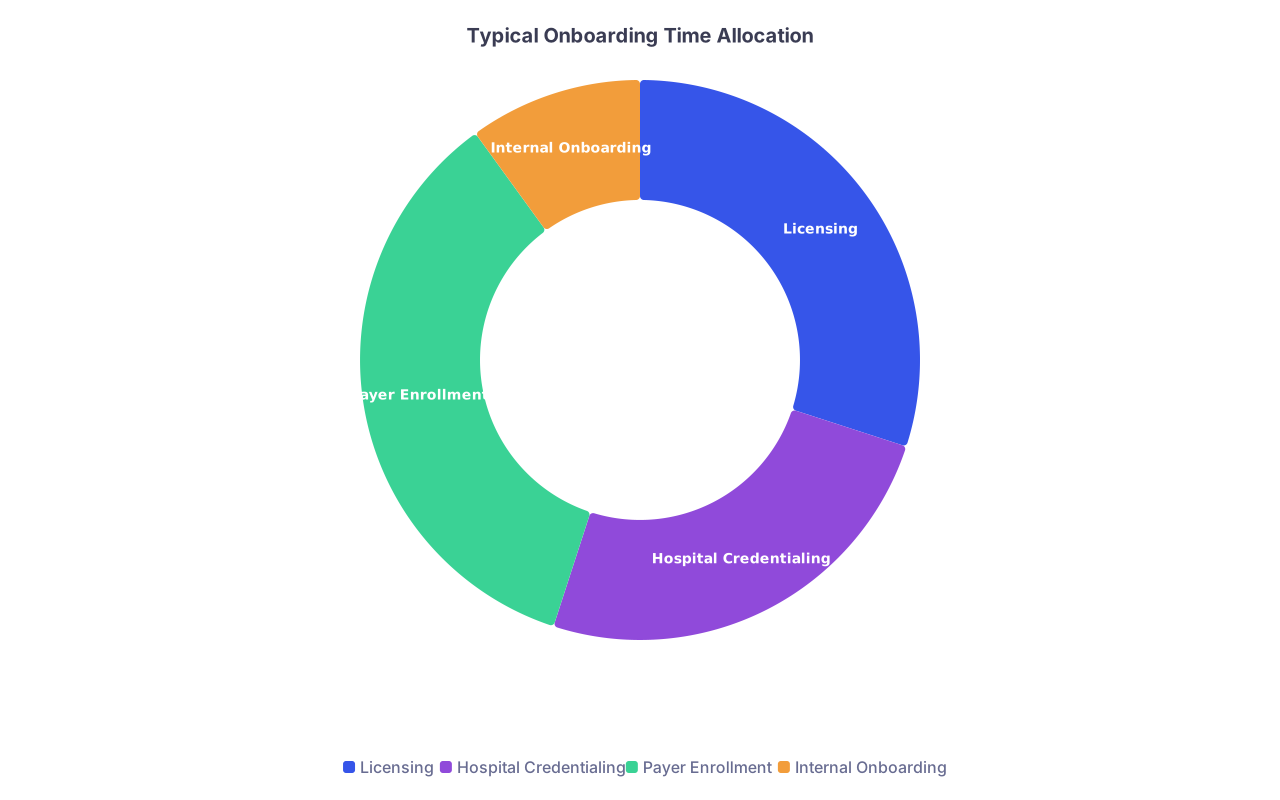
| Category | Value |
|---|---|
| Licensing | 30 |
| Hospital Credentialing | 25 |
| Payer Enrollment | 35 |
| Internal Onboarding | 10 |
Month −3 (About 90 Days Before Start)
At this point you should confirm your state license status.
- Check the state board portal weekly.
- If verifications are missing, nudge:
- GME office
- USMLE
- Previous states
A 5‑minute email now can prevent a 4‑week delay.
With your license nearly done or already issued:
Confirm hospital credentialing file is complete
- Ask: “Is anything outstanding on my file—references, verifications, explanations?”
- Respond to any extra questions within 24 hours.
Launch payer enrollment (if the group practices privately or you are not purely hospital employed):
- Common payers:
- Medicare
- Medicaid
- Major commercial plans (BCBS, Aetna, Cigna, UHC, etc.)
- Confirm:
- “Which payers does the practice need me enrolled with before I can bill?”
- “Will I be billing under a group NPI only, or also as an individual?”
- Common payers:
If you wait until 30 days before start for payer enrollment, you will be working but not collectible. Translation: you look busy, but your bonus clock is not ticking.
Month −2 (About 60 Days Before Start)
Two things need to be converging now:
- Hospital privileges approval
- Payer applications submitted
At this point you should:
Confirm Medical Executive Committee date your file will be reviewed
- If your file misses this meeting, your start date may slip.
- Ask bluntly: “Am I on track for privileges before my start date? Is there any risk?”
Check payer enrollment submission status
- Ask for a list:
- Payer
- Date application submitted
- Any returned or pending items
- Keep your own copy. You want to know, in 6 months, which payer is still hanging.
- Ask for a list:
Review your contract’s bonus language in detail
You are now 60 days out. At this point you should know:
- Signing bonus:
- Is it:
- Paid on start date?
- Paid on signing?
- Paid after proof of relocation?
- Is it:
- Productivity bonus metrics:
- RVUs, collections, or patient encounters?
- Measurement period (quarterly, annual, or guarantee period)?
- Are there “ramp up” protections?
- Repayment / clawback:
- If you leave before 1, 2, or 3 years, how much do you owe back?
- Is it prorated by months worked?
Write these down in plain English. Future you will thank you.
Month −1 (30 Days Before Start)
This is your risk checkpoint.
At this point you should:
Verify license is fully active
- Not “pending.”
- Not “pending additional review.”
- Actual active status on board website. Screenshot it.
Verify hospital privileges
- You want a written confirmation:
- “Your privileges have been approved effective [date].”
- If they are not approved:
- Ask: “What is the specific issue? What can I provide today to resolve it?”
- You want a written confirmation:
Ask for an onboarding schedule
- EHR training
- Orientation days
- Clinic templates
- Call schedule
Protect your start date bonus
- If your contract states: “Bonus paid upon commencement of employment,” confirm:
- Payroll date when it will actually hit
- Whether you must complete I‑9 / HR onboarding first
- Clarify tax withholding so you do not get surprised by how much disappears.
- If your contract states: “Bonus paid upon commencement of employment,” confirm:
Start Month: Week‑by‑Week Around Day One
Now the calendar hits your start month. This is where bonuses, base pay, and reality collide.
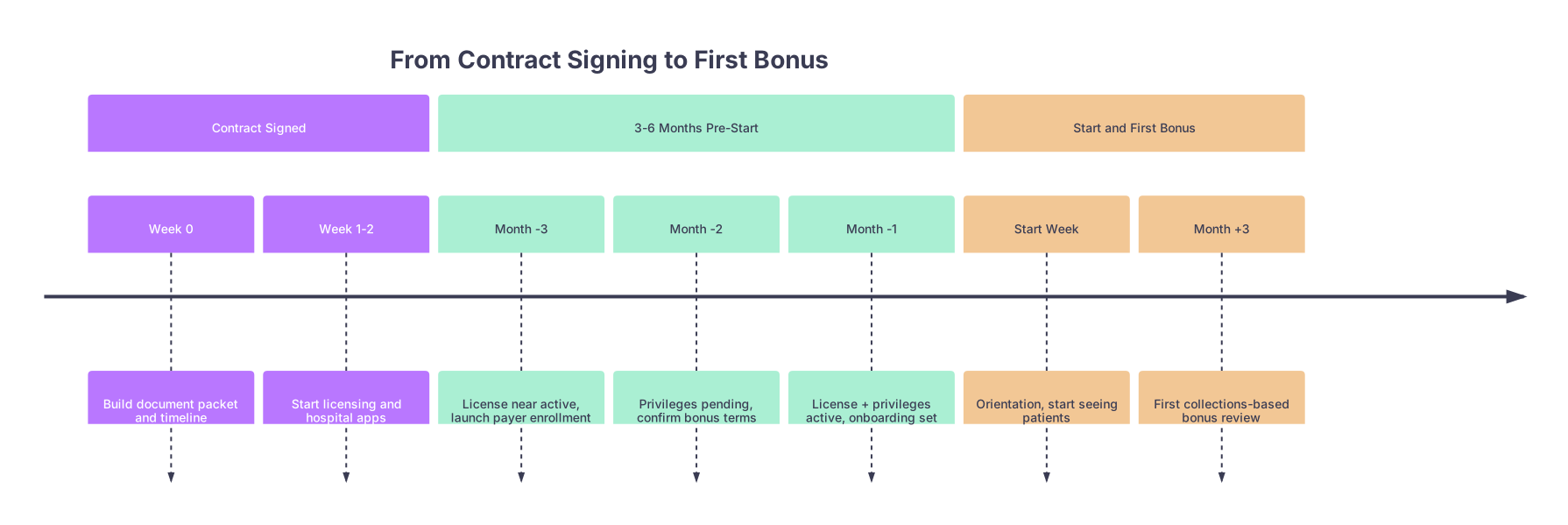
| Period | Event |
|---|---|
| Contract Signed - Week 0 | Build document packet and timeline |
| Contract Signed - Week 1-2 | Start licensing and hospital apps |
| 3-6 Months Pre-Start - Month -3 | License near active, launch payer enrollment |
| 3-6 Months Pre-Start - Month -2 | Privileges pending, confirm bonus terms |
| 3-6 Months Pre-Start - Month -1 | License + privileges active, onboarding set |
| Start and First Bonus - Start Week | Orientation, start seeing patients |
| Start and First Bonus - Month +3 | First collections-based bonus review |
Week −1 to Start Date
At this point you should:
- Confirm:
- DEA status updated to new state (or new DEA obtained)
- State controlled substance registration (if required) is issued
- Get:
- EHR login
- Ordering privileges (labs, imaging, meds)
If any of these are missing, you will technically be “started” but functionally useless.
Week 1: Start Date and Initial Bonus Triggers
On day one and that first week:
Complete HR onboarding immediately
- I‑9, direct deposit, benefits selections.
- Some employers do not release bonuses until these steps are recorded as complete.
Confirm signing/relocation bonus in writing
- Send a short email to HR/payroll:
- “Per my contract, my signing/relocation bonus is scheduled to be paid upon commencement of employment. Can you confirm the expected payroll date?”
- Save the reply.
- Send a short email to HR/payroll:
Start tracking RVUs or encounters from day one
- Ask:
- “How do I see my RVU or collections reports?”
- “Who sends them and how often?”
- If your bonus is RVU-based, you want to see how the system counts them.
- Ask:
Week 2–4: Early Productivity and Cash Flow Reality
Salary will arrive on schedule. Bonus? That will lag.
At this point you should:
Check how quickly charges are being dropped and coded
- Ask your manager:
- “From visit date to claim submission, what is the average lag?”
- Long lag = delayed collections = delayed productivity bonus.
- Ask your manager:
Verify payer enrollment is connecting
- For each major insurer:
- Are your claims being paid under your name/NPI?
- Or are they being held/denied as “provider not enrolled”?
- If denials occur:
- Send them to the credentialing/enrollment contact immediately.
- For each major insurer:
Update your personal cash-flow plan
- Remember: collections-based bonuses usually lag 60–90 days behind encounters.
- Plan like you will not see a real productivity bonus for the first 3–6 months.
Months 1–6 After Start: Hitting Bonus Deadlines
This is where new attendings either hit their negotiated numbers—or miss them quietly because they never built a timeline around them.
Month 1–3: Ensure Eligibility and Avoid Technical Disqualifiers
At this point you should re-open your contract and look for landmines:
- Are there thresholds for bonuses?
- Minimum RVUs before any bonus triggers
- Minimum number of clinic sessions or call shifts
- Are there exclusions?
- No bonus if you are on probation
- No bonus if you did not complete certain mandatory trainings
Then:
Confirm first review date
- “When is my first productivity/quality bonus review period?”
- “Which months of data will it include?”
- “Who calculates it?”
Match reality to the formula
- If your contract says:
- “Bonus of $X per RVU above 4800 RVUs annually”
Break it down:- ~400 RVUs per month
- ~100 RVUs per week (in a 4-week month)
- “Bonus of $X per RVU above 4800 RVUs annually”
- Look at:
- Your actual monthly RVU reports
- Visit volume and payer mix
- If your contract says:
If you are way off pace by Month 2, you need to adjust clinic templates, referral streams, or procedures now. Not at Month 10.
Month 3–4: First Bonus Calculations
By now, payer enrollment should be functioning, and your first bonus period may be reviewed.
At this point you should:
Request the calculation in writing
- “Can you send me the detailed calculation for my bonus this period?”
- Check:
- RVU counts
- Conversion factors
- Any excluded codes or patients
Challenge obvious errors—professionally and quickly
- Missing sessions
- Misclassified procedures
- Wrong time window
I have seen several attendings recover five figures in underpayments simply because they asked for a breakdown and compared it to their own records.
- Confirm payment date
- “Our policy is to pay bonuses within X days after calculation.”
Put that date in your calendar.
- “Our policy is to pay bonuses within X days after calculation.”
Month 5–6: Revisit Long-Term Traps (Clawbacks & Non-Competes)
Six months in, you are probably out of survival mode. This is exactly when you should revisit the ugly parts of your contract.
At this point you should:
Calculate your current clawback exposure
- If your signing bonus was $40,000 with 3‑year commitment:
- At 6 months, you have “earned” 1/6.
- You still owe back about $33,333 if you walk away now (assuming straight-line proration).
- Know that number. It affects how you negotiate any changes.
- If your signing bonus was $40,000 with 3‑year commitment:
Re-read non-compete language with real geography in mind
- Now that you know:
- Where your patients come from
- Where competing practices sit
You can see how restrictive your clause actually is.
- Now that you know:
Start a “contract changes I want next time” list
- Earlier bonus triggers
- Clearer payer enrollment responsibilities and deadlines
- Paid administrative time for onboarding / credentialing
You are not renegotiating yet. You are just documenting reality while it is fresh.
Quick Reference: Key Deadlines You Cannot Miss
Here is the distilled version. Print it, tape it next to your laptop.
| Time From Signing | You Should Have Completed |
|---|---|
| Week 1 | Document packet + licensing apps started |
| Week 2–4 | Hospital credentialing app fully submitted |
| Month 2–3 pre-start | License active or near-active; payer apps started |
| Month 1 pre-start | Privileges approved; onboarding schedule in hand |
| Start week | HR done; bonus payment date confirmed |
| Month 1–2 post-start | Payer enrollment verified with paid claims |
| Month 3–4 post-start | First bonus calculation reviewed |
| Month 6 post-start | Clawback exposure and non-compete re-checked |
What To Do Today
Do not just “remember” this. Systems beat memory.
Today, before you close this tab:
- Open your contract.
- Identify your start date and all bonus clauses.
- Then create a single-page timeline with three sections:
- Licensing and credentialing dates
- Payer enrollment milestones
- Bonus trigger and payment dates
If you cannot see all three on one page, you are flying blind.


