

It’s March. You just got the call: “We’re thrilled to offer you the position.”
Starting salary looks good. Sign-on bonus looks better. You scroll through the contract, your eyes half-glazed, until you hit a section titled: Restrictive Covenants.
Two paragraphs. A few lines about “Non-Competition” and “Non-Solicitation.”
Your recruiter says, “It’s standard. Everyone signs this.”
Let me tell you what really happens behind that language.
The non-compete in your contract is not just a legal paragraph. It’s a control mechanism. Medical directors, CMOs, and corporate leadership use it—very intentionally—to keep you in line, suppress turnover, and make sure you think twice before walking away.
And they’re a lot more strategic about it than you think.
The Real Purpose of Non-Competes (It’s Not What They Tell You)
Publicly, they’ll say:
“We need non-competes to protect our investment in you and maintain continuity of care.”
Internally, in those closed-door leadership meetings, the language is different. I’ve sat in those rooms. The conversation sounds more like:
- “We cannot afford to have cardiology lose another doc to that private group down the street.”
- “Make sure the radius covers the entire metro area. I do not want them walking across the street to our competitors.”
- “If these people knew how weak this clause really is in court, half of them would walk.”
The actual goals of non-competes for administrators:
Reduce your bargaining power.
If leaving means uprooting your whole life, moving your kids, and finding new schools, you are much less likely to push for higher pay or better hours.Lock in revenue streams.
Your RVUs, referrals, and downstream imaging/surgery dollars are predictable once you’re stable. They are not eager to see you replicate that across town.Control physician behavior.
Want to push back on schedule changes? Want to stop taking 1:3 call? They know you’ll think about the non-compete before you escalate.Deter competitors from poaching.
A heavy non-compete makes you a less attractive target for competing groups who don’t want legal headaches.
Nobody is drafting these clauses “just because it’s standard.” They’re engineered. Often by lawyers whose only mission is: make it as restrictive as the market will tolerate.
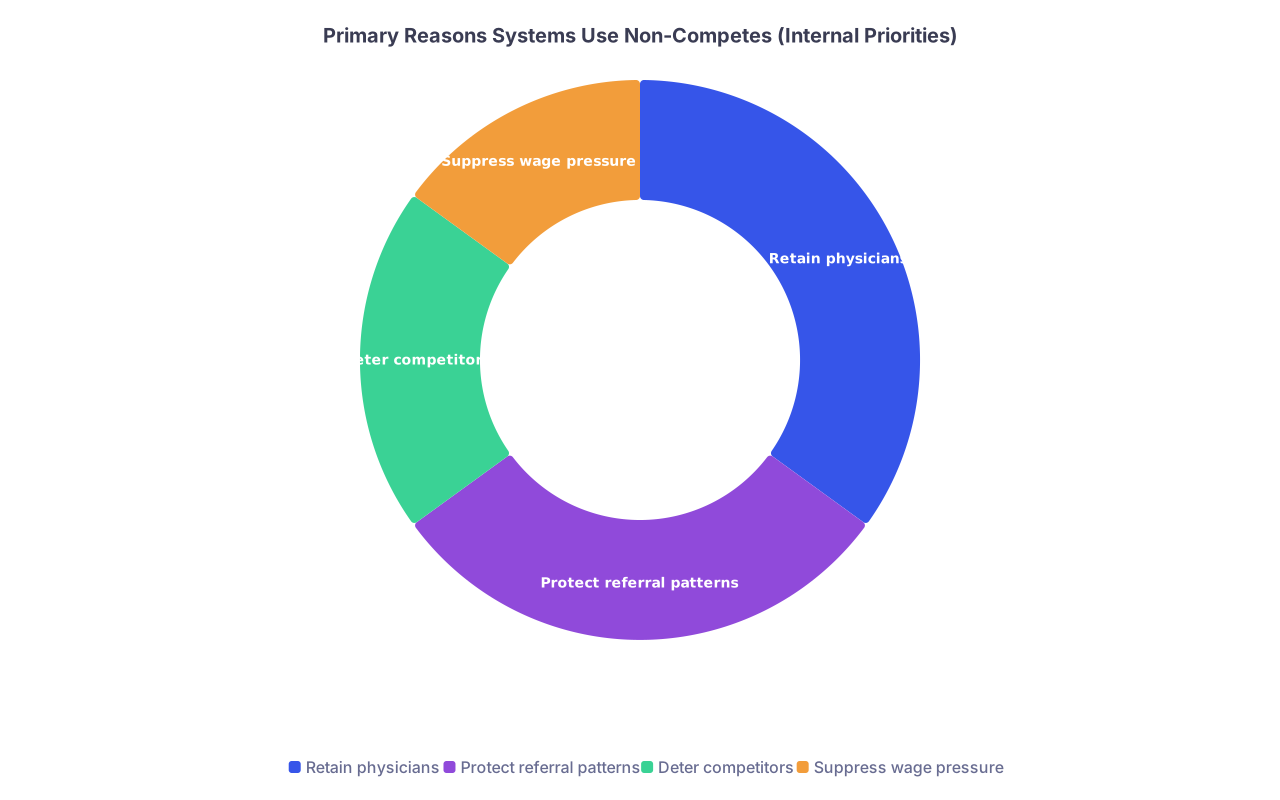
| Category | Value |
|---|---|
| Retain physicians | 35 |
| Protect referral patterns | 30 |
| Deter competitors | 20 |
| Suppress wage pressure | 15 |
How Medical Directors Quietly Weaponize Non-Competes
Here’s the part they never put in writing.
Non-competes are most useful to them before they ever send you a letter from legal. Ninety percent of the power is psychological.
1. The “Soft Reminder” Strategy
You start complaining about the call schedule. You raise concerns about unsafe staffing. You ask for compensation aligned with MGMA data.
Suddenly, the tone shifts.
You hear things like:
- “Just so you’re aware, the non-compete is pretty tight in this market.”
- “Our legal team has always enforced these; people don’t really leave to local competitors.”
- “We’ve had physicians try to go down the road and it did not end well for them.”
Translate that. What they’re really saying:
“You are trapped. Negotiate within the cage.”
Most of the time, they never actually want to go to court. They just want you nervous enough that you stay where you are and stop pushing too hard.
2. The “Silent Blackout Zone”
In bigger metros, leadership and legal deliberately design overlapping radii to create a de facto blackout zone.
You’ll see language like:
“Within a radius of 20 miles from any facility, clinic, or outpatient center owned, leased, or operated by Employer…”
Not just the main hospital. Every satellite office. Every urgent care with their logo. The imaging center you’ve never set foot in. They map it strategically, and the net effect is: you cannot practice in the entire region without risking a fight.
I’ve seen a 10-mile clause in a city where the system owned locations in every direction. Functionally, it was a regional ban. On paper, 10 miles looks reasonable. In practice, it means: move or switch careers.
3. The “We Enforce These” Myth
You’ll be told:
- “We’ve always enforced these non-competes.”
- “Our attorneys are very aggressive about this.”
- “I’d hate to see you go through that.”
A lot of the time, this is bluff. Litigation is expensive; local judges sometimes hate physician non-competes. But they only need you to believe it.
What you don’t see: the number of cases they quietly let go because the physician had:
- A lawyer who knew the local case law
- Documentation that the employer breached first (unpaid bonuses, major scope changes)
- A competing offer that didn’t exactly violate the defined “scope” of practice
They’ll trumpet the one case they won and stay silent about the five they settled or walked away from.
The Anatomy of a Control Clause: What They Slip In
Let’s tear open the non-compete language and show you where the real landmines are.

1. Overbroad Geographic Radius
If you’re in a dense urban area, any radius over 10–15 miles is usually designed to shut down your local options.
Common trick: tying the radius to any facility of the employer rather than your primary worksite. That’s how a “10-mile” clause becomes a metro-wide blockade.
2. Excessive Time Period
Twelve months is common. Eighteen is aggressive. Twenty-four is a straight-up intimidation tactic in many states, even if it’s not enforceable.
Remember: even if a judge later cuts it down, the threat of two years out of practice in your city is enough to keep many physicians chained.
3. Vague Scope of Practice
Bad:
“…may not practice medicine within…”
Worse:
“…may not provide healthcare services of any kind…”
They intentionally keep it broad so if you try to say, “I’m not doing interventional anymore, I’m just doing clinic,” they can still threaten you.
Sophisticated systems define your specialty broadly: not “interventional cardiology,” but “cardiology, including invasive and noninvasive services.”
4. Non-Solicit Hidden as Non-Compete
They’ll bury in the same section:
- You may not “solicit” or “treat” former patients
- You may not recruit staff to come with you
- You may not contact referral sources
In practice, they use non-solicits to cripple your ability to rebuild even if your non-compete gets weakened. You can technically practice… with no patients, no staff, and no referral network.
How Recruiting and Medical Directors Coordinate Behind the Scenes
You think you’re negotiating with a friendly recruiter and a supportive medical director. What you don’t see is the email thread running behind your back.
Recruiter to medical director:
“Candidate is pushing back on non-compete. Wants to limit to 5 miles from primary clinic only. Thoughts?”
Medical director to legal:
“We can’t narrow this too much; we’ve already lost two docs to the private group next door. Need enough teeth to block that path.”
Legal to recruiter:
“Offer a small concession in time (18 months down to 12) but keep the radius and scope. Do not set a precedent of limiting to one location.”
What you hear:
“We brought this to legal. They’re being generous going to 12 months. Unfortunately, we can’t change the facilities language. This is really the best we can do for you.”
The conversation you don’t hear:
Medical director saying, “If we let them out of the metro, every future hire will ask for the same.”
They are not thinking about your career. They are thinking about policy precedent and system leverage.
| What You Hear | What It Usually Means |
|---|---|
| "This is standard for our contracts." | "We wrote it this way to maximize control." |
| "We always enforce our non-competes." | "We sometimes enforce them; we always threaten." |
| "Legal will not approve that change." | "We do not want to open the door for others." |
| "We have to protect our investment in you." | "We have to protect our revenue from losing you." |
| "Other physicians here have signed the same thing." | "They signed it because they felt trapped too." |
How Smart Physicians Push Back (Quietly and Effectively)
You are not powerless. But you have to stop acting like a grateful trainee and start acting like a professional with leverage.
1. Attack All Three Axes: Time, Radius, Scope
Weak negotiation:
“Can you remove the non-compete?”
They’ll say no, and they’ll be right. Most systems will not remove it outright.
Strong negotiation:
- Time: “I can agree to a non-compete, but 12 months should be the maximum. Eighteen or twenty-four is excessive.”
- Radius: “The radius has to be measured from my primary practice location only, not every facility the system owns.”
- Scope: “The restriction should only apply to [your exact subspecialty] and only in employed roles, not independent consults or telemedicine.”
You don’t always get all three. But every cut you make shrinks the cage.
2. Tie It to Something They Want
You get more traction when you connect the change to their goals.
Examples:
- “If call is going to be 1:3 and includes two hospitals, the non-compete must be limited to my primary hospital location. Otherwise, I’m shouldering disproportionate risk.”
- “If you want me to build your new clinic on the north side, I need language allowing me to stay in this city if the clinic fails or closes.”
In other words:
“If you want me to carry risk for you, you cannot also fully control my exit.”
3. Use State Law as a Lever (Without Getting Academic)
You don’t walk into their office quoting statutes. But your attorney should arm you with simple talking points.
For example:
In states where physician non-competes are heavily disfavored or banned, you say:
“Given the current state environment, I want this language revised to reflect that any restriction will be reasonable and consistent with applicable law, with an explicit carve-out if state law changes.”Where courts routinely narrow non-competes, you say:
“This looks overbroad compared to what local courts generally enforce. Let’s write something that would actually be considered reasonable if ever reviewed.”
You’re signaling: I know this game, and I have counsel.
How Non-Competes Shape Your Life After You Sign
The most dangerous effect of a non-compete isn’t when you’re leaving. It’s how it distorts your decisions while you’re still there.
You will:
- Put up with toxic colleagues longer than you should.
- Accept creeping workload increases.
- Swallow “temporary” pay changes that never go away.
- Stay in a city that’s burning you out because you feel boxed in.
I’ve watched good physicians stay in miserable jobs two, three years longer than they needed to, because they had a kid in high school, a spouse with a local career, parents nearby. The threat of relocation is the silent leash.
That is the real value of your non-compete to them.
Not the courtroom. Your hesitation.

| Step | Description |
|---|---|
| Step 1 | Sign Contract |
| Step 2 | Settle into Job |
| Step 3 | Non-Compete Dormant |
| Step 4 | Consider Leaving |
| Step 5 | Review Non-Compete |
| Step 6 | Stay and Tolerate More |
| Step 7 | Consult Attorney |
| Step 8 | Negotiate Exit Carefully |
| Step 9 | Relocate or Change Path |
| Step 10 | Happy with Role |
| Step 11 | Family and Location Ties |
| Step 12 | Viable Local Options |
What They Really Fear (And How That Helps You Negotiate)
Let’s flip sides for a second. What actually scares medical directors and CMOs?
Public physician exodus.
If you leave and then others follow, especially to a visible competitor, it reflects directly on leadership. Their bosses start asking questions.Bad press or legal drama.
The last thing a big system wants is the local paper running “Hospital Sues Doctor for Working Across Town.” They like to threaten lawsuits, not be seen actually swinging.Being the outlier in the market.
If competing systems start loosening non-competes and they do not, they become less attractive. Recruiters already know which employers have a bad reputation.
You can use this.
When you negotiate, you are not just one doc. You are potentially a precedent. If they think pushing you too hard will create noise—publicly, legally, or internally—you suddenly have leverage.
This is why a well-connected attorney with local experience is worth every penny. They know:
- Which systems actually sued
- Which judges hate these cases
- Which clauses have quietly been softened for others
I’ve seen non-competes reduced or effectively neutered simply because the physician’s attorney made it clear they were fully prepared to fight—and to make it loud.
What To Do If You’re Already Trapped
If you’re reading this and thinking, “That’s me. I already signed,” here’s the ugly truth and the path forward.
No, you probably won’t get them to tear up your non-compete just because you changed your mind. But you have more options than staying miserable forever.
Get a copy of your exact contract and read the details.
Many physicians are operating off a vague memory of “I can’t practice within 50 miles.” Then we look at the actual language and find carve-outs, narrower definitions, or conditions that trigger the clause.Talk to a local physician contract attorney, not your buddy the real estate lawyer.
You need someone who knows your state’s pattern with physician non-competes. They’ll know what’s “scary-sounding” versus what actually holds up.Look for employer breaches.
If they’ve changed your comp model without agreement, failed to pay bonuses, forced major schedule changes beyond contract language—you may have arguments that they breached first, which weakens their position.Negotiate your exit instead of sneaking out.
Quietly approach leadership with a proposal:- You’ll give them longer notice.
- You’ll help recruit your replacement.
- You’ll agree to a modified, more reasonable restriction.
Systems will sometimes relax the non-compete in exchange for an orderly, non-disruptive departure. Especially if they’re worried about optics or gaps in coverage.
The Bottom Line: Non-Competes Are About Power, Not “Protection”
You are not naive. Do not let them treat you like you are.
Non-competes in physician contracts are not primarily about:
- “Protecting training investment”
- “Ensuring continuity of care”
- “Maintaining quality”
They are about power asymmetry. Keeping the organization flexible and you rigid. Making it easy to replace you and hard for you to replace them.
Once you understand that, the whole deal looks different.
You start asking:
- What is the true cost of this job if I cannot work in this city for a year after?
- What am I trading for this sign-on bonus?
- How much control over my own future am I willing to sell?
And more importantly:
You stop treating the non-compete as “boilerplate” and start treating it as a core compensation term—because it is.
With that mindset, you’ll negotiate harder, walk away more often, and avoid a lot of the traps your colleagues are quietly stuck in right now, too embarrassed to admit it.
With these truths on the table, you’re better prepared for the reality of post-residency contracts. Next step is learning how to structure the entire deal—comp, call, bonuses, tail coverage—so the job works for your life, not just your CV. But that’s a story for another day.


