

The worst contract problem physicians have is not signing a bad deal. It is leaving one without a plan.
If you are exiting a bad contract, the calendar is your most powerful negotiation tool. Not your emotion. Not a dramatic speech. Your timeline.
Below is a practical, time-based guide for physicians leaving an employed position after residency or early in their attending career. Notice periods, tail coverage, restrictive covenants, patient handoffs, income gaps—the whole messy package—organized into what you should do month by month, then week by week, then day by day.
Big Picture: Your Exit Timeline at a Glance
Before details, you need the frame. Most physician contracts require 60–180 days’ notice for “without cause” termination. Your safe planning window is usually 6 months.
At this point you should assume:
- You are under a written employment agreement, not at‑will.
- You have:
- A notice clause (often 60–90 days).
- A non‑compete and/or non‑solicit.
- Professional liability and tail language.
- Repayment clauses (sign‑on bonus, relocation, loan assistance).
| Practice Type | Common Notice Period |
|---|---|
| Hospital-employed | 90–180 days |
| Large multispecialty | 90 days |
| Private group | 60–90 days |
| Academic | 90–180 days |
| Locums agencies | 14–30 days |
Your goal: Align three timelines so they do not wreck your life:
- Legal timeline – notice, end date, non‑compete, repayment.
- Clinical timeline – safe patient and panel transition.
- Financial timeline – income continuity, benefits, and malpractice tail.
Now let’s walk it chronologically.
6–4 Months Before Your Intended Last Day: Quiet Recon and Strategy
At this point you should not be announcing anything. You are gathering data and building options.
Step 1 – Pull and dissect your contract (Week 1–2)
Take out the actual signed copy. Not the draft. The one with your signature.
Find and highlight, physically:
- Term and termination section
- Notice period for “without cause” termination
- For‑cause termination triggers
- Non‑compete / restrictive covenant
- Non‑solicitation (patients, staff, referral sources)
- Malpractice coverage (claims‑made vs occurrence, tail coverage responsibility)
- Repayment obligations:
- Sign‑on bonus
- Relocation allowance
- Loan repayment
- Training/tuition assistance
At this point you should create a one‑page summary. Date, quote, and page number each critical clause. This is what you hand your attorney later.
Step 2 – Map the legal constraints (Week 2–3)
Now translate those clauses into real calendar constraints:
- Minimum notice days
- Whether your non‑compete geographically blocks your realistic next job
- Whether there is a “repayment if you leave within X years” window you are still in
- How long your restrictive covenant runs (1 year, 2 years, more)

| Category | Value |
|---|---|
| Notice (days) | 90 |
| Non-compete (months) | 24 |
| Repayment Window (months) | 36 |
If the contract is aggressive—long non‑compete, broad geography, large clawback—you do not guess. You get legal help.
Step 3 – Hire a physician contract attorney (By Week 4)
By the end of the first month, you should have:
- A physician‑savvy employment attorney (not your cousin who does real estate).
- A scheduled review of:
- Enforceability of non‑compete in your state.
- Options to negotiate exit terms.
- Strategies to avoid “for cause” accusations (productivity, professionalism, etc.).
You are buying two things: risk assessment and leverage. Often, I see physicians discover that their non‑compete is partially or completely unenforceable. That immediately changes your timeline options.
Step 4 – Start your job search quietly (Weeks 3–8)
You do not resign before you have a realistic next step. At this point you should:
- Refresh your CV.
- Contact recruiters you trust (hospital systems, specialty‑specific agencies).
- Clarify your non‑compete when speaking to them. Be explicit:
- “I have a 15‑mile non‑compete around my current primary practice site for 18 months.”
- Favor roles that:
- Respect your notice needs.
- Fall outside non‑compete geography OR are in settings exempt under your state law (e.g., academic, VA, FQHC in some states).
Rough hiring timelines post‑residency are often 3–6 months from first contact to first day. You need to line that up with your notice period.
3 Months Before Your Last Day: Lock the Dates, Shape the Exit
Assuming a 90‑day notice, this is the most critical pivot point. You move from “thinking about leaving” to “committing to a date.”
Step 5 – Align start date of new position (Weeks 9–10)
Before you give notice, you should have:
- A verbal offer or written offer letter for the new job.
- A target start date that:
- Is at least 1–2 weeks after your contract end date to avoid overlap issues.
- Accounts for credentialing and licensing delays.
If the new employer is pushing an aggressive start that conflicts with your notice, push back. A solid employer will respect that you honor your current contract. It signals professionalism.
Step 6 – Final legal check and strategy (Week 10–11)
Sit down again (phone or video is fine) with your attorney and go through:
- Your proposed final work date.
- When written notice must be received to satisfy the clause.
- How you will deliver notice (certified mail, hand‑delivery with acknowledgment, email if contract allows).
Clarify with your attorney:
- Whether you should offer to help recruit or onboard your replacement (this can soften the stance on non‑compete or repayment).
- Whether there is any strategic timing to avoid crossing a new repayment “anniversary” (e.g., bonus forgiveness after 2 years).
90–60 Days Before: Give Notice and Control the Narrative
Here is where most physicians either earn respect or burn bridges. The difference is preparation.
Step 7 – Draft a precise resignation letter (Week 11–12)
Your letter should be boring, clear, and contract‑aligned. Not a therapy session.
Core elements:
- Your name and role.
- A clear statement invoking the correct termination clause:
- “I am providing notice of my resignation under Section X, ‘Without Cause Termination.’”
- Final working date, calculated according to your notice period.
- A sentence expressing willingness to assist in transition.
No complaints. No accusations. Those belong in separate conversations, if at all.
Step 8 – Deliver notice correctly (Day 0 of Notice)
On the day you start your notice clock:
- Deliver the letter according to contract terms:
- If it requires certified mail, use it and keep proof.
- If it allows email, still consider a paper copy with acknowledgment.
- Notify:
- Your direct supervisor or medical director (conversation first, then letter).
- HR or practice administrator, as specified in the contract.
At this point you should keep:
- A copy of your signed letter.
- Receipts/tracking confirming delivery.
- Written acknowledgment of your last day.
Weeks 1–4 of Notice: Stabilize Patient Care and Protect Your Reputation
This first month after notice is fragile. People watch you closely. This is where you make or break references for the next decade.
Step 9 – Agree on a transition plan (Week 1–2 of Notice)
Within the first two weeks of giving notice, you should meet with leadership about:
- Clinic templates and scheduling:
- How far out you will book new patients.
- When new referrals should start shifting to other clinicians.
- Inpatient / call coverage:
- Adjust call schedules to avoid you holding call on or after your final week, if possible.
- Patient communication:
- Who notifies patients?
- What can you say about your departure?
- Will there be a standard script?
You want this in a short written summary (even email) so there are no disputes later.
Step 10 – Clarify malpractice and tail (Week 2–3 of Notice)
You do not want to be learning about tail coverage on your last day.
At this point, you should:
- Ask HR/administration:
- Is your current policy occurrence or claims‑made?
- If claims‑made, who pays for tail under the contract?
- When will tail be bound, and how long will it cover?
- Cross‑check answers against your contract with your attorney.
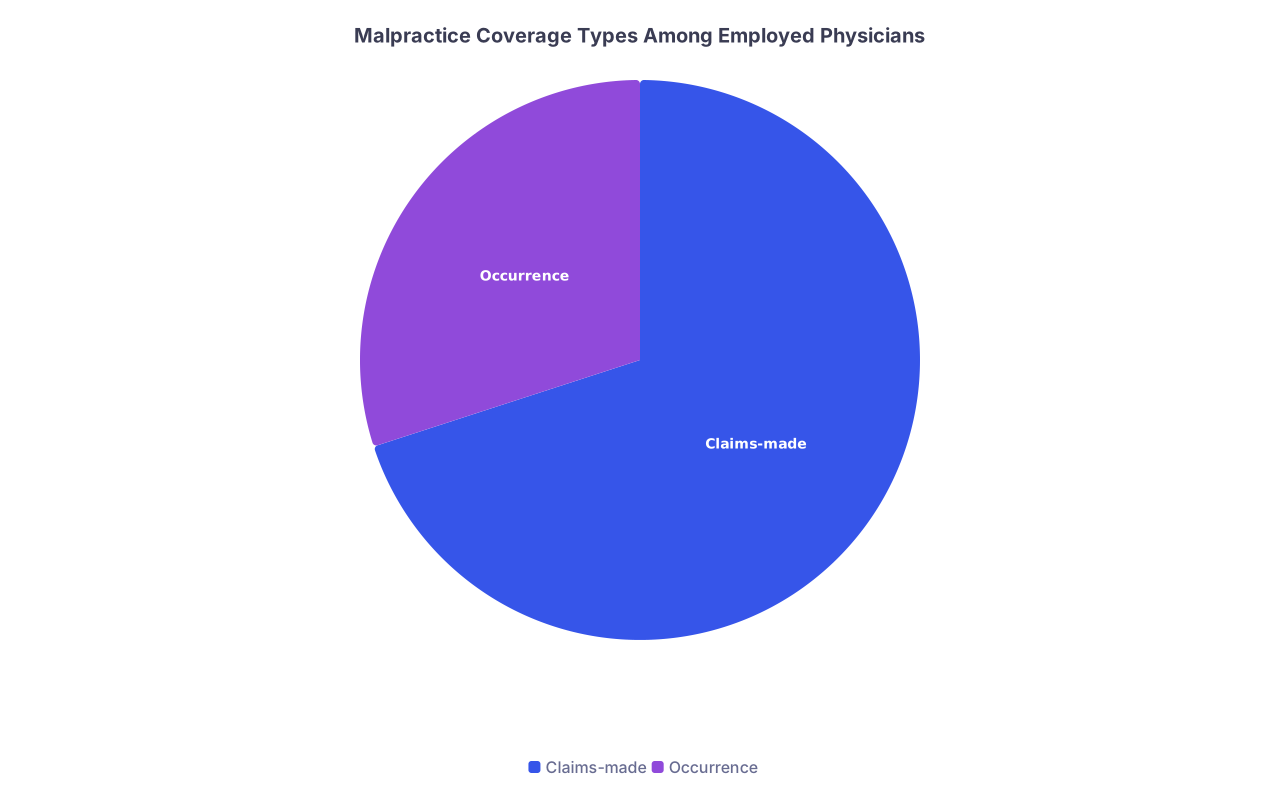
| Category | Value |
|---|---|
| Claims-made | 70 |
| Occurrence | 30 |
If you must buy your own tail, start getting quotes now, not 3 days before you leave.
Step 11 – Start patient handoffs in a structured way (Week 3–4 of Notice)
Clinically, at this point you should:
- Identify high‑risk and complex patients (oncology, anticoagulation, chronic pain, pregnancy, etc.).
- Prioritize:
- Early follow‑ups before you leave.
- Clear documentation of plans and contingency options.
- Direct handoffs to specific colleagues for critical cases.
Your last month is not the time to reduce documentation quality. Administrations get jumpy when exiting physicians leave sparse notes. That is exactly when people invent “for cause” narratives.
60–30 Days Before: Money, Logistics, and Non‑Compete Reality
You are halfway through your notice. This is where you lock down finances and post‑employment restrictions.
Step 12 – Settle repayment obligations (Weeks 5–8 of Notice)
By now you should know exactly what they think you owe.
You should receive in writing:
- Any sign‑on, relocation, or bonus clawback amounts.
- Any training or loan repayment reimbursement you must make.
- Timing of the repayment (lump sum vs payroll deduction from final checks).
If the number is large, your attorney may negotiate:
- Reduction or waiver, especially if:
- They are breaching other parts of the contract.
- You are leaving due to documented unsafe conditions.
- Payment plan over several months.
Do not ignore this. Employers send these to collections.
Step 13 – Verify PTO and last paycheck details (Weeks 5–7)
Ask HR directly:
- Is unused PTO paid out? Many hospital systems do. Some do not.
- When will your last paycheck be issued?
- How are RVU/bonus payments handled after departure?
You want everything in writing, ideally an exit summary via email.
30–7 Days Before: Tighten Clinical Transitions and Reputation Management
Now you are entering your last month. Every interaction is memorable. People remember your final weeks.
Step 14 – Stop booking new long‑term patients (Around Day −30)
At this point you should:
- Block your schedule for new long‑term patients after a specific cutoff date.
- Limit yourself, if possible, to:
- Follow‑ups that you can reasonably resolve or hand off.
- Acute visits that can be transitioned smoothly.
For surgical or procedural specialties:
- Set a hard stop date for new elective cases where post‑op follow‑up would extend well beyond your last day.
- Coordinate:
- Which partner will see your post‑ops.
- How patients are told about this ahead of time.
Step 15 – Manage professional references and future credibility (Day −30 to −14)
You are not just leaving a job. You are leaving a reputation trail.
During this window:
- Identify 2–3 colleagues who can serve as future references:
- A department chair.
- A senior partner.
- A nurse manager or lead APP who respects your work.
- Ask them explicitly:
- “Would you be comfortable serving as a reference for me going forward?”
Even if the system itself is toxic, individual people can still vouch for your clinical performance.
Final Week: Exit Execution Checklist
This is where chaos happens if you do not plan. So you plan.
Step 16 – Administrative and clinical cleanup (Day −7 to −2)
In your last week, at this point you should:
- Close every chart you can.
- Sign all orders and review results.
- Finalize dictations and operative notes.
- Double‑check there are no outstanding peer reviews or incident reports sitting unanswered.
On the admin side:
- Confirm tail coverage binding date and documentation.
- Confirm return of:
- Hospital ID badge
- Keys
- Company devices
- Export copies of:
- CME certificates
- Non‑clinical evaluations you might want (if policy allows)
- Contact info for colleagues and mentors (not patient lists—huge legal line there)
Step 17 – Final patient communication (Varies by setting, often Day −7 to −1)
Follow whatever script or policy the practice has for patient notification.
Common options:
- System‑generated letter on practice letterhead explaining you are leaving and who will assume care.
- MyChart/inbox message template.
Be careful about:
- Giving out personal contact info.
- Inviting patients to follow you if your contract has non‑solicit language. That is how lawsuits start.
You can usually say: “The practice will help arrange continued care” and leave it at that.
Last Day and First 30 Days After: Close the Loop and Protect Yourself
The day you walk out is not the end of your exit timeline. You still have financial and legal tails.
Step 18 – Exit interview and final documentation (Last Day)
If there is an exit interview:
- Keep it factual, not emotional.
- Focus on:
- Patient safety issues.
- Systemic problems, not personal attacks.
- Assume anything you say could be relayed up the chain, possibly to credentialing committees.
Before you leave the building:
- Get written confirmation of:
- Last working day (should match your notice letter).
- That you voluntarily resigned.
- Ask for a generic letter confirming dates of employment and role, to use later for credentialing.
Step 19 – First week after leaving: Verify the financials (Week +1)
Once you are out:
- Check:
- Final paycheck amount.
- Payout of unused PTO (if applicable).
- Any unexpected deductions.
- Confirm:
- Health insurance end date.
- COBRA options, if there is a gap before your next job benefits begin.
Store all pay stubs and the final statement somewhere you can find it during future credentialing.
Step 20 – First month post‑exit: Non‑compete and credentialing vigilance (Weeks +2 to +4)
As you start or prepare to start your new job:
- Ensure:
- Your new practice location, telemedicine footprint, and marketing do not violate non‑compete parameters as currently interpreted by your attorney.
- Watch for:
- Any “problem physician” narratives from your previous employer during credentialing.
- Requests from new hospitals for former employer evaluations.
If something looks off—like a suddenly hostile reference—loop your attorney in quickly. It is easier to correct early.
Compressed Timeline: If You Must Leave Fast
Sometimes the situation is bad enough that 6 months of planning is impossible. Unsafe staffing, harassment, unpaid wages. I have seen physicians walk out with minimal notice and still be fine, but you do not do this casually.
If you are in this scenario:
- At this point you should call an attorney first, before HR, before anyone.
- Ask:
- Whether the employer’s breach allows immediate “for cause” resignation.
- How to document the unsafe or illegal conditions.
- How to minimize damage from not honoring the notice period.
Expect:
- More risk of:
- Non‑compete enforcement attempts.
- Negative references.
- But sometimes, staying is worse for your license and sanity than leaving cleanly.
Sample 90‑Day Exit Timeline
To pull this together, here is a simple 90‑day notice countdown, assuming you have already done the 1–3 months of prep.
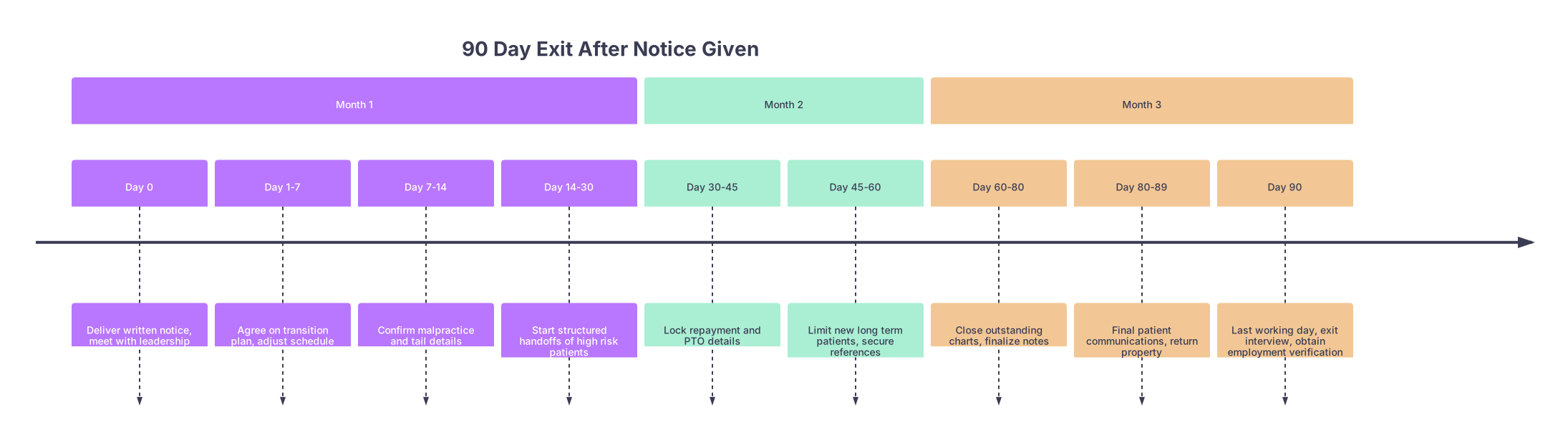
| Period | Event |
|---|---|
| Month 1 - Day 0 | Deliver written notice, meet with leadership |
| Month 1 - Day 1-7 | Agree on transition plan, adjust schedule |
| Month 1 - Day 7-14 | Confirm malpractice and tail details |
| Month 1 - Day 14-30 | Start structured handoffs of high risk patients |
| Month 2 - Day 30-45 | Lock repayment and PTO details |
| Month 2 - Day 45-60 | Limit new long term patients, secure references |
| Month 3 - Day 60-80 | Close outstanding charts, finalize notes |
| Month 3 - Day 80-89 | Final patient communications, return property |
| Month 3 - Day 90 | Last working day, exit interview, obtain employment verification |
Open your contract today and find the termination and notice section. Identify the exact number of days and how notice must be delivered. Write that number and method at the top of a blank page titled “Exit Timeline.” That is your anchor. Everything else flows from there.


