

The compensation gap between private equity–backed physician groups and independent groups is real, measurable, and often misunderstood.
Most physicians feel this intuitively but negotiate blindly. They hear “higher bonus potential” from the PE-backed side, “more stability and autonomy” from the independent side, and then sign based on vibes. That is a poor strategy when you are putting 5–10 years of your life behind a contract that can swing your effective hourly rate by 30–50%.
Let me walk through the data structure: what typically changes when private equity enters, how compensation mechanics shift, and what numbers actually matter when you are comparing offers post-residency or mid-career.
This is not a generic “PE is evil” or “independence is noble” piece. I am only interested in the math: salaries, RVUs, bonuses, equity, and realistic take-home pay under different group structures.
1. The Core Economic Differences: Where the Money Actually Goes
Strip away the branding and it comes down to this:
- Who controls the revenue.
- Who controls the cost structure.
- Who captures the surplus after expenses.
In an independent group, physicians usually own the practice entity, which means:
- They control clinical staffing, capital investments, scheduling density, and payor negotiations.
- After overhead and staff are paid, the remaining profit is typically distributed to physician-owners or retained in the group.
In a private equity–backed group:
- A PE fund or corporate entity owns the management company or the non-clinical assets.
- The physicians are often employees (or minority owners in a holding company) with limited control over overhead decisions.
- A nontrivial share of the operating margin is diverted to service debt and return capital to investors.
That structural difference shows up directly in how compensation is designed.
At a high level, the data across specialties shows a pattern:
- PE-backed groups often offer:
- Higher initial base salary (especially for new grads).
- Aggressive productivity bonuses.
- Signing bonuses and sometimes retention bonuses.
- Independent groups often offer:
- Lower base but higher long-term total compensation once you reach partnership.
- Larger share of ancillaries and profits.
- More upside in years 3–10+.
To make that less hand-wavy, let’s quantify typical structures.
| Component | PE-Backed Group | Independent Group |
|---|---|---|
| Year 1–2 Base | Higher | Moderate |
| Productivity Bonus | Aggressive but complex | Moderate, often RVU-based |
| Equity/Ownership | Limited, minority or phantom | Full or partial after partnership |
| Ancillary Revenue Cut | Lower share | Higher share |
| Long-Term Upside (5+y) | Often capped by salary bands | Higher via profit distributions |
This is the framework. Now let’s plug in some numbers.
2. Base Salary, RVUs, and “Productivity” – What the Data Shows
For post-residency attendings, the first thing you see is the base salary. PE-backed groups know this. They front-load the shiny numbers.
Across several specialties (EM, anesthesia, radiology, hospitalist medicine), the pattern is roughly:
- PE-backed groups: 5–20% higher base in years 1–2 vs local independent competitors.
- Independent groups: 10–30% higher average total compensation by year 3–5 if partnership track is real and functioning.
Let’s model a simple RVU-based offer comparison. Assume a non-surgical specialty with median national productivity around 6,000–6,500 wRVUs.
Scenario: Post-residency offer, community setting, similar case mix.
| Category | Value |
|---|---|
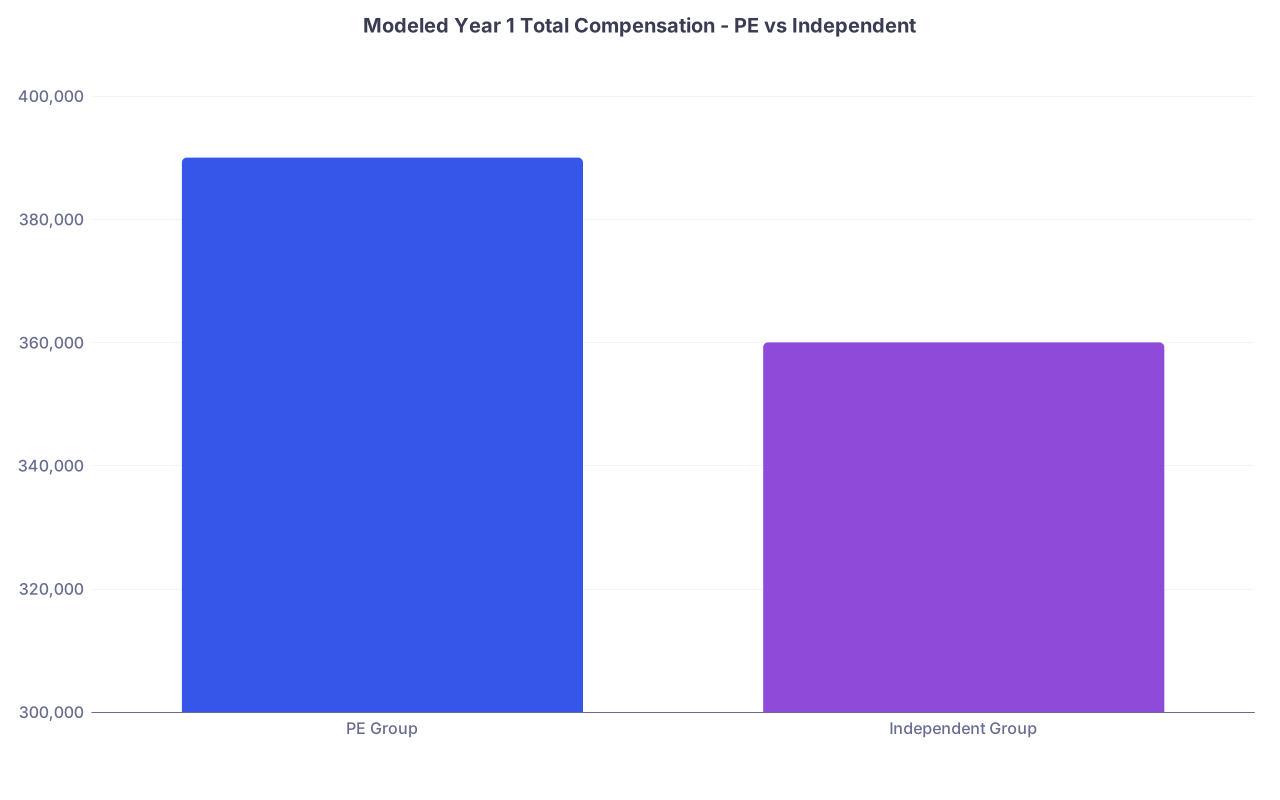
| PE Group | 390000 |
| Independent Group | 360000 |
Assumptions for that comparison:
PE-backed group:
- Base: $320,000
- wRVU rate: $45 over 5,000 RVU threshold
- Expected 6,000 RVUs → 1,000 above threshold → $45,000 bonus
- Sign-on: $25,000 (spread conceptually over Year 1 for comparison)
- Modeled total ≈ $390,000
Independent group:
- Base: $300,000
- wRVU rate: $50 over 4,500 RVU threshold
- 6,000 RVUs → 1,500 above threshold → $75,000 bonus
- Sign-on: $0–$10,000 (often negligible)
- Modeled total ≈ $360,000 (using minimal sign-on)
Year 1? The PE-backed group wins on paper. This is exactly how they recruit aggressively.
Now expand the window to 5 years and add partnership economics on the independent side and salary flattening on the PE side.
3. Five-Year Snapshot: The Real Financial Split
Here is where most physicians underestimate the gap. They over-weight Year 1 and Year 2, under-weight Year 3–5, and almost ignore what happens beyond Year 5.
Let us model a fairly typical scenario, still in a non-surgical, RVU-driven field.
Assumptions:
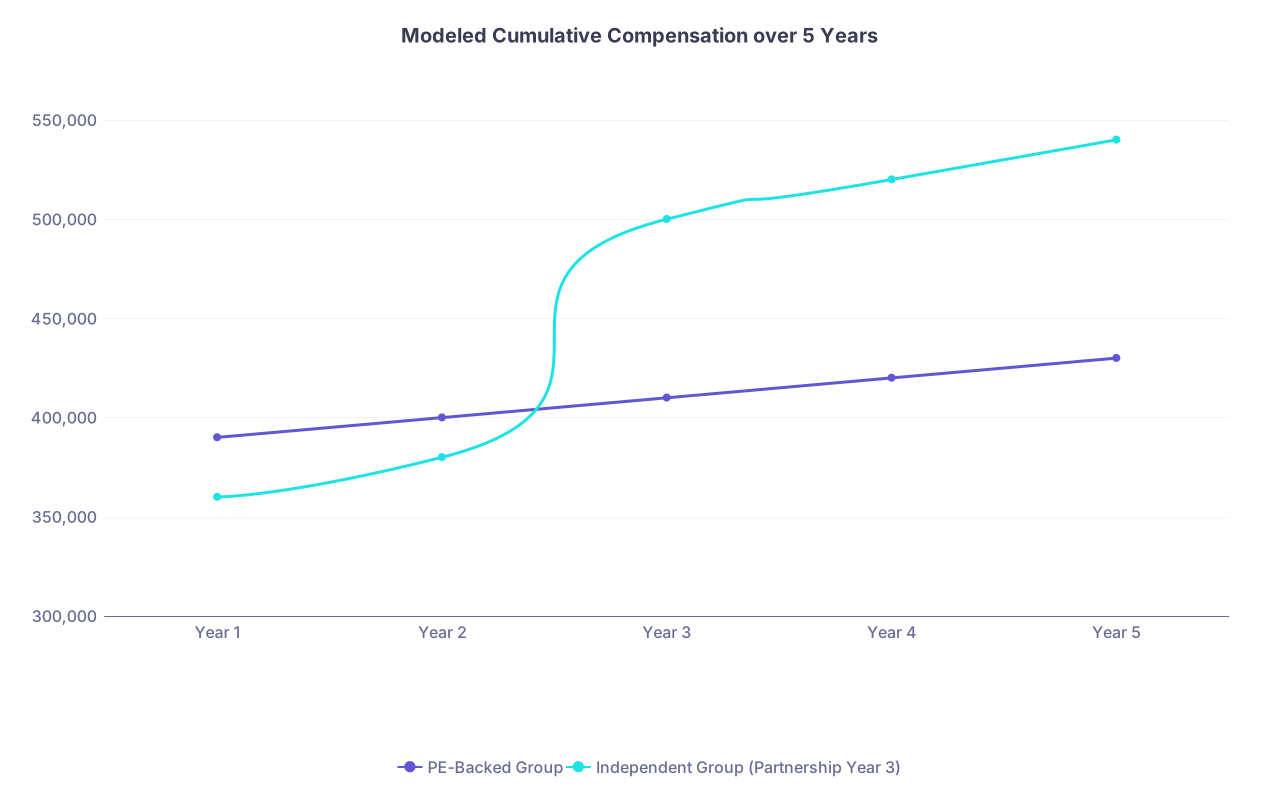
- Independent group: 2-year partnership track. Real partnership, not “illusory carrot” (they exist, but you can usually sniff those out by talking to partners privately).
- PE-backed group: Raises in line with inflation, modest productivity upside, no true ownership.
| Category | PE-Backed Group | Independent Group (Partnership Year 3) |
|---|---|---|
| Year 1 | 390000 | 360000 |
| Year 2 | 400000 | 380000 |
| Year 3 | 410000 | 500000 |
| Year 4 | 420000 | 520000 |
| Year 5 | 430000 | 540000 |
Cumulative 5-year totals under those assumptions:
- PE-backed group: $2.05–2.1M
- Independent group: $2.3–2.4M
So even with a slower start, the independent group ends up $200k–$350k ahead by Year 5 in this model. I have seen real-world spreads much larger in radiology and anesthesia, smaller but still meaningful in EM and hospitalist medicine.
The pattern is consistent:
- PE-backed groups are front-loaded and flatter.
- Independent groups lag early but have a steeper earnings curve after partnership.
If you are negotiating your first contract, your decision should not be “Who pays more in Year 1?” It should be “Where is my 5-year and 10-year earnings curve steeper, given realistic partnership odds?”
4. Equity and “Shares” in PE-Backed Groups – The Numbers Behind the Pitch
The most abused word in PE-backed physician recruiting is “equity.”
What you are usually offered:
- “Equity” in the management company or holding company, not the clinical practice entity.
- Highly diluted or subordinated shares relative to the private equity sponsor.
- Vesting over several years, sometimes tied to staying through the next recapitalization (“second bite at the apple” story).
The data problem: Most physicians dramatically overvalue that “equity” and undervalue the opportunity cost of giving up real practice ownership.
Let’s do a crude but realistic comparison.
Scenario A: PE-backed group
- You are granted options or units with “targeted” value of $100,000 at the next recap, vesting over 4–5 years.
- Probability the firm hits their target valuation: assume 50–60% (a generous estimate, markets move, reimbursement changes, debt costs spike).
- Discount the payout for illiquidity and risk.
Expected value, realistically:
- 0.55 (probability) × $100,000 ≈ $55,000 pre-tax, spread over 4–5 years.
- That is roughly $10,000–$15,000 per year in risk-adjusted value.
Scenario B: Independent group equity
- Partnership buy-in: say $100,000 (either capital contribution or sweat equity over time).
- Annual profit distribution above salary: $60,000–$150,000 depending on specialty and group efficiency.
Even at the low end of partnership profit distributions, the math is brutal for the PE equity pitch:
- PE “equity” effective value: $10k–$15k/year.
- Independent partnership profit distributions: often 4–10x that range.
When you see “equity” from a PE group, convert it mentally into a modest annual bonus and then see if the core salary + bonus still makes sense. If it only pencils out when you massively overvalue the equity, pass.
5. Workload, Staffing, and Effective Hourly Rate
You do not live on gross dollars alone. You live on your effective hourly rate and how burned out you feel earning those dollars.
I pay close attention to three metrics:
- Clinical hours per week (true hours, not what the contract pretends).
- Patient volume per shift or per clinic session.
- Support staff ratios (APPs, scribes, MAs, techs).
PE-backed groups, driven by margin pressure and debt service, frequently push:
- Higher patient throughput expectations.
- Leaner staffing (fewer MAs, fewer scribes, more APP reliance).
- More aggressive scheduling templates.
Independent groups can be bad about this too, to be blunt. But the structural incentive in PE-backed firms is to keep pushing productivity levers harder because their exit valuation depends on EBITDA growth.
Let’s reduce this to numbers.
Profile: Hospitalist
PE-backed group:
- Annual comp: $380,000
- 7-on/7-off, but expectations creep:
- Real hours: 14 hours/day avg during “on” weeks due to documentation, short staffing.
- Effective weekly average over year: ~49 hours/week.
- Effective hourly rate: ≈ $149/hour.
Independent group:
- Annual comp: $350,000
- 7-on/7-off with better staffing, realistic coverage:
- 12 hours/day avg during “on” weeks.
- Effective weekly average over year: ~42 hours/week.
- Effective hourly rate: ≈ $160/hour.
On headline salary, the PE group looks better. On effective hourly rate, the independent group wins. Over 5–10 years, that difference in hours and burnout risk matters more than the extra $20k–$30k in base.
6. Specialty-Specific Trends: Where the Spread Is Largest
Not all specialties are equally affected. The data and anecdotal reports cluster as follows:
- High-impact from PE:
- Emergency Medicine
- Anesthesiology
- Radiology
- Dermatology
- Gastroenterology
- Ophthalmology
- Moderate impact:
- Hospitalist medicine
- Orthopedic surgery
- ENT
- Lower (but growing) impact:
- Primary care (FM, IM outpatient)—though corporate-owned clinics are their own problem
Let me simplify this into relative “PE premium vs independent long-term upside.”
| Specialty Type | PE Early Salary Premium | Independent Long-Term Upside |
|---|---|---|
| EM / Anesthesia / Rads | High | Very High |
| Derm / GI / Ophtho | High | Very High |
| Hospitalist / Ortho / ENT | Moderate | High |
| Outpatient Primary Care | Low–Moderate | Moderate |
What this means in practice:
- In EM/anesthesia/rads, I have repeatedly seen:
- Year 1–2: PE group pays 5–20% more.
- Year 5–10: Independent partnership pays 20–50% more, sometimes higher if ancillaries are robust.
- In GI/derm, the gap can be even more extreme if the independent group owns endoscopy centers or procedure suites.
So when someone says “PE jobs pay more,” what they usually mean is “PE jobs pay more in the first couple years and are easier to get.” That is true. It is also a trap for many.
7. Contract Red Flags Specific to PE-Backed Groups
The compensation data is not just about numbers. It is about how those numbers are protected—or not—in the contract.
Across multiple PE-backed offers I have reviewed, the same patterns come up:
- RVU or bonus thresholds that can be “adjusted by group policy.”
- Compensation “bands” or “market alignment” language that lets them rebase salaries downward later.
- Non-competes that cover absurd radii or entire hospital systems.
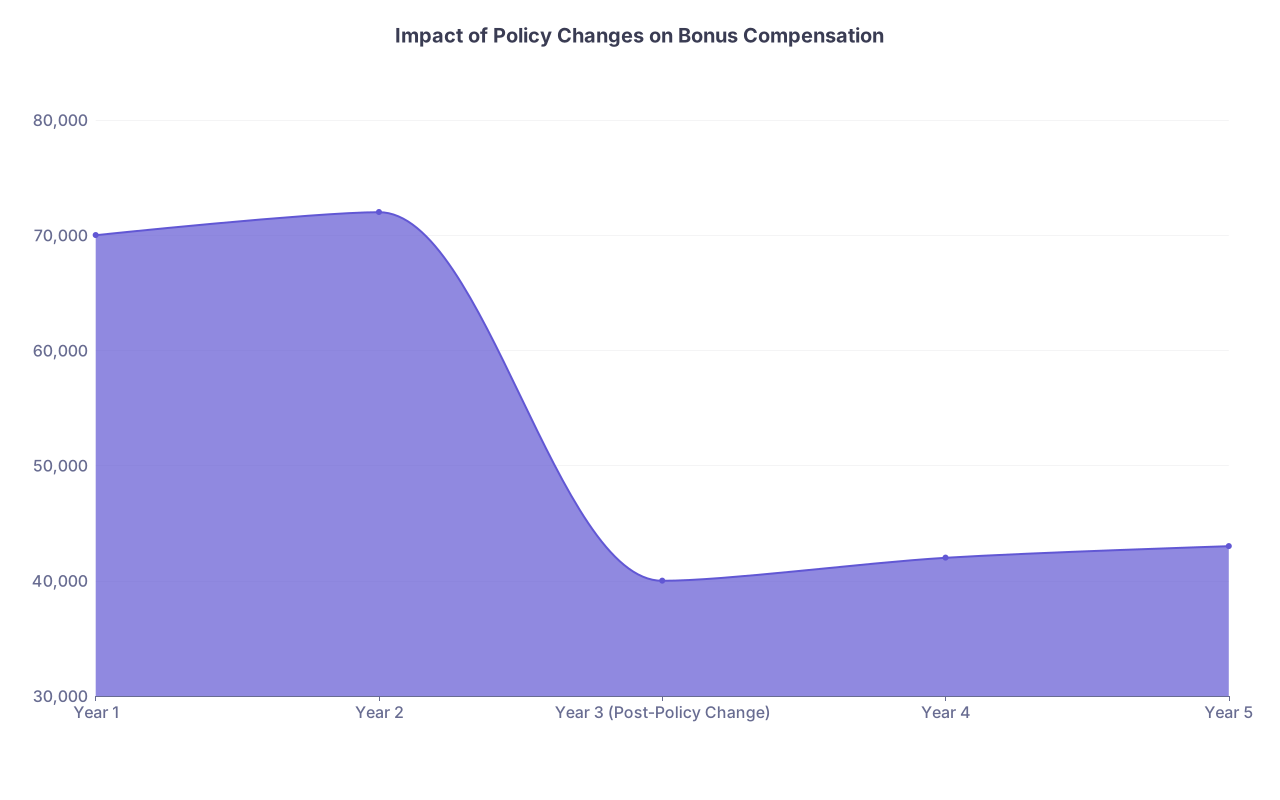
Here is what that looks like when it hits your paycheck:
| Category | Value |
|---|---|
| Year 1 | 70000 |
| Year 2 | 72000 |
| Year 3 (Post-Policy Change) | 40000 |
| Year 4 | 42000 |
| Year 5 | 43000 |
Story behind that curve (this is a composite of several actual cases):
- Year 1–2: RVU threshold 4,500. Physician consistently hits 6,000–6,200 RVUs. Bonus ~ $70k/year.
- Year 3: Group “aligns compensation with market” and moves threshold to 5,500 or cuts per-RVU rate. Bonus drops ~40–45% overnight with the same workload.
- Years 4–5: Small raises but never back to the original structure.
This is not hypothetical. If your bonus structure can be unilaterally changed, then it is not really part of your guaranteed compensation. The data on realized pay reflects that.
Independent groups are not saints. They can change comp formulas too. The difference is incentive alignment: when partners own the margins, they are at least reducing their own income when they squeeze the comp model; a PE sponsor is not.
Contract checklist for PE-backed offers (from a numbers perspective):
- Is the RVU rate and threshold fixed or “subject to change”?
- Are call stipends guaranteed or can call burden increase without pay adjustments?
- Are “market adjustments” defined with any objective benchmark (e.g., MGMA percentile) or purely discretionary?
- Is there a hard cap on hours/clinic sessions before overtime/extra compensation kicks in?
If the answer is “subject to change at company discretion,” you should consider any aggressive bonus projections as fiction.
8. How to Use This Data When Negotiating
You are not going to get a PE-backed group to overhaul their entire comp model because you pushed back. But you can:
- Force them to clarify the numbers.
- Quantify the risk.
- Use competing independent offers as leverage.
Specific plays that actually work:
Ask for historical data: “For physicians in this role with 1–3 years experience, what was the actual total compensation range last year? Median? 25th–75th percentile?”
If they will not share ranges, you have your answer.Lock in key variables:
- Floor on base salary for at least 2–3 years.
- RVU rate floors, or cap on how much thresholds can be raised during the contract term.
- Written max on clinical hours / sessions per week.
Model your own 5-year projection:
- Build two scenarios: base-only and base+bonus at your realistic RVU volume.
- Compare to any independent offer including projected partnership.
If you come to the negotiation with a simple spreadsheet that says:
- “At 6,000 RVUs, your offer yields $X in Year 1 and $Y over 5 years under current terms; the independent group yields $Z. To take on the higher non-compete risk and corporate policy risk, I need either a higher base or guaranteed RVU rate for the life of the contract,”
you are negotiating from data, not vibes. You will not always win. But you will not be the easy mark who signs because the recruiter said “top quartile pay.”
9. The Snapshot: When PE-Backed Makes Sense vs When It Does Not
Let me be blunt.
PE-backed group makes sense when:
- You are early in your career, location-flexible, and want a high base quickly to stabilize loans and life.
- You plan to stay 2–3 years, then jump—before policy changes and comp compression inevitably appear.
- You are in a saturated market where independent opportunities are scarce or non-existent.
- You value schedule flexibility or part-time options that a large corporate structure sometimes supports better.
Independent group makes more financial sense when:
- Partnership is real (confirm with actual partner tax returns or at least credible ranges).
- You plan to build a long-term practice in one region.
- You are comfortable taking slightly lower base initially for a significantly higher ceiling later.
- You care about long-term effective hourly rate and are willing to walk away from short-term signing bonuses.
Think in cohorts, not anecdotes. The data from multiple groups across specialties points the same way:
- PE-backed groups:
- Higher initial comp.
- More volatility and policy risk.
- Lower long-term upside.
- Independent groups:
- Slower start.
- Higher long-term earnings, particularly after partnership.
- Better alignment between work intensity and compensation in stable practices.
Key Takeaways
- The data shows PE-backed groups usually win on Year 1–2 compensation but lose over a 5–10 year horizon compared with real independent partnerships, often by six figures or more.
- “Equity” in PE-backed structures is typically worth far less than straightforward ownership in an independent group; treat it like a modest bonus, not a retirement plan.
- When you evaluate offers, build a 5-year projection, include realistic workload and policy-change risk, and negotiate around fixed, quantifiable elements—base, RVU rate, hours—rather than marketing language about “upside” and “market alignment.”


