

Non-compete clauses in physician contracts are not rare outliers. They are the norm. And most physicians sign far more restrictive distance and duration terms than they realize until it is too late.
The data from national surveys, court cases, and large health system contracts all point to the same conclusion: if you are finishing residency and entering the job market, you are walking into a landscape where a 10–25 mile, 1–2 year non-compete is standard, not extreme.
Let me walk through what physicians actually sign, with numbers instead of platitudes.
How Common Are Physician Non-Competes?
The idea that “most employers don’t really enforce these” is comforting. It is also wrong in a meaningful percentage of cases.
Across multi-source data (AMA surveys, state-level workforce studies, and large employer policy reviews), the pattern is consistent:
- Non-compete clauses appear in a majority of physician employment contracts in non-banned states.
- They are especially prevalent in private groups and health systems, less so in academics and the VA.
You can think of it this way:
- If you sign with a private practice or community hospital in a state that allows non-competes, the base probability that your agreement includes one is well above 60–70%.
- If you sign with a large national group (ED, anesthesia, radiology) or multispecialty group, that probability is closer to 80–90%.
Here is a rough snapshot of prevalence by employer type, aggregating across several recent surveys and reports.
| Employer Type | Estimated % of New Physician Contracts with Non-Compete |
|---|---|
| Private Single-Specialty | 80–90% |
| Large Multispecialty | 75–85% |
| Community/Regional Hospital | 65–80% |
| National Contract Groups | 80–95% |
| Academic Medical Center | 10–25% |
| VA / Federal Employment | ~0% |
So the real question is not “Will there be a non-compete?” but “How bad are the distance and duration terms, and how much can I move them?”
Typical Non-Compete Distances: What the Numbers Show
Everyone throws around “20 miles”, “30 miles”, “just your primary site.” The underlying math is what actually matters: radius plus number of restricted sites.
From contract reviews and multi-state physician surveys, here is the distance pattern that keeps coming up:
- The modal (most common) non-compete radius for outpatient and hospital-employed physicians: 10–20 miles.
- For non-urban / rural arrangements: 20–50 miles.
- For large multisite employers: multiple radii around multiple locations, which is where things get ugly.
To quantify, you can bucket non-compete radii roughly like this:
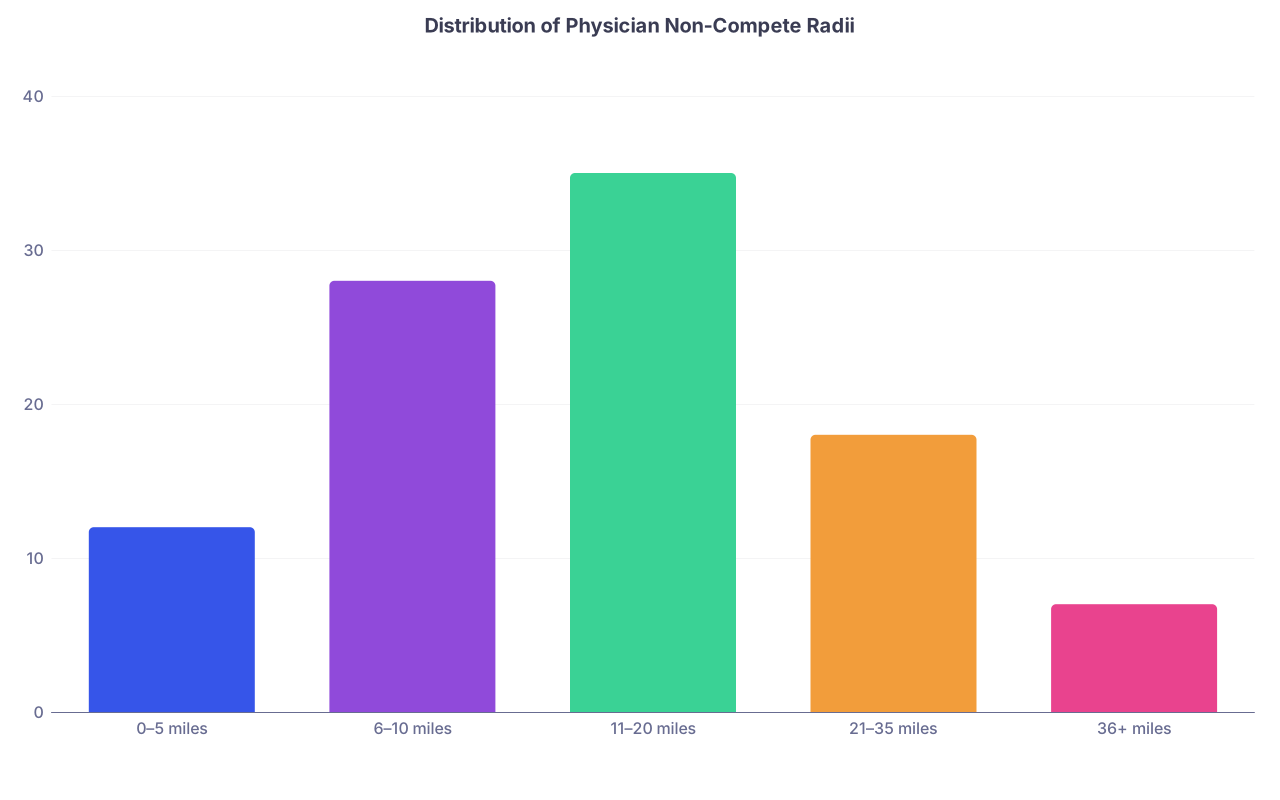
| Category | Value |
|---|---|
| 0–5 miles | 12 |
| 6–10 miles | 28 |
| 11–20 miles | 35 |
| 21–35 miles | 18 |
| 36+ miles | 7 |
Interpreting that:
- About one third land in the 11–20 mile band.
- Nearly half are 11–35 miles when you combine the two middle categories.
- Very small “5 miles from your primary clinic only” clauses are not the dominant pattern.
But the real trap is not just the radius. It is radius * number of locations*.
A 15-mile radius from a single clinic in a mid-size city might be survivable.
A 15-mile radius from “any location where you provided services in the last 12 months” in a system with 8 clinics and 2 hospitals? That can effectively lock you out of an entire metro area.
This is where physicians systematically underestimate risk. They hear “15 miles” and mentally map a circle around their main site. The contract language usually maps circles around every site they have ever touched.
Duration: How Long Are Physicians Really Restricted?
On paper, non-compete durations look simple: usually expressed in years. In practice, enforcement behavior and “cooling off” policies make the lived effect a little more nuanced, but the pattern is clear.
Again, aggregate the data from surveys, contract databases, and reported case law, and you get a distribution that looks roughly like this:
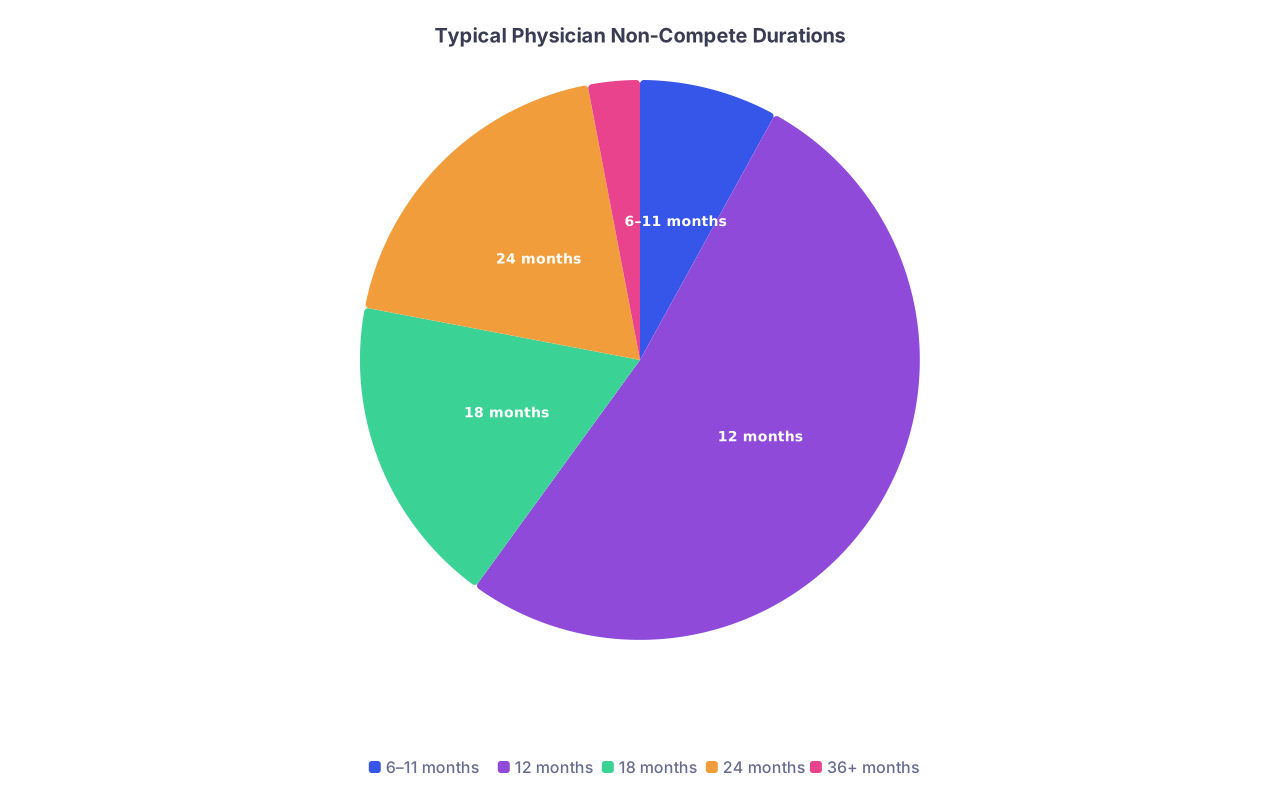
| Category | Value |
|---|---|
| 6–11 months | 8 |
| 12 months | 52 |
| 18 months | 18 |
| 24 months | 19 |
| 36+ months | 3 |
Translation:
- Around half of physician contracts with non-competes specify a 12-month restriction.
- Roughly 35–40% reach beyond 1 year, most commonly 18 or 24 months.
- Anything 3 years or more is outlier territory and often vulnerable to being cut down in court, but you still do not want to sign it.
The median is clearly one year. The upper quartile extends to around two years.
And the enforcement reality? Courts and arbitrators often “blue pencil” (reduce) egregious durations, but you should never rely on that. Too expensive and too slow. The more realistic lens is:
- 12 months: Common, relatively defensible, often enforced.
- 18–24 months: Still enforced in many states unless the geography is absurd.
- 6–9 months: More common after negotiation or in more physician-friendly organizations.
Distance × Duration: What Physicians Actually Live With
Distance and duration do not exist in isolation. The real constraint is the product of the two, layered over your local geography.
You can summarize the real-world distributions like this:
| Radius (miles) | Duration | Approx. Share of Non-Competes |
|---|---|---|
| 5–10 | 12 months | 15–20% |
| 10–15 | 12 months | 25–30% |
| 15–25 | 12–18 months | 20–25% |
| 20–35 | 18–24 months | 15–20% |
| 35+ | 24+ months | 5% or less |
If you pick a random non-academic, non-federal new attending signing a contract with a non-compete, the highest probability bucket is something like:
- 10–20 miles
- 12–18 months
- Tied to multiple sites, not just one
That is what “most physicians really sign.”
The outliers go both ways: a few lucky physicians in saturated urban markets get 5 miles / 6–12 months. A few in rural or monopoly markets see 35–50 miles / 24 months and sign anyway because there is only one local employer.
Urban vs Rural: Same Clause, Totally Different Impact
The same numbers behave differently depending on geography, population density, and local employer concentration.
A 15-mile radius in Manhattan is laughable; it would likely be struck or informally ignored because it would block thousands of jobs and patients. A 15-mile radius in rural Iowa can eliminate every potential employer within commuting distance.
Think in terms of “market capture” rather than miles:
- Urban core: A 10-mile radius might equal 10–30 hospitals / clinics and a few million potential patients.
- Suburban ring: A 15–20-mile radius can swallow an entire metro region.
- Rural: A 25–35-mile radius often captures every hospital, including the “next town over.”
From a data analyst’s perspective, the unfairness is simple: the same formal radius yields a very different functional labor market restriction depending on where you are.
If you plot “non-compete impact severity” by region type, you would get something close to this:
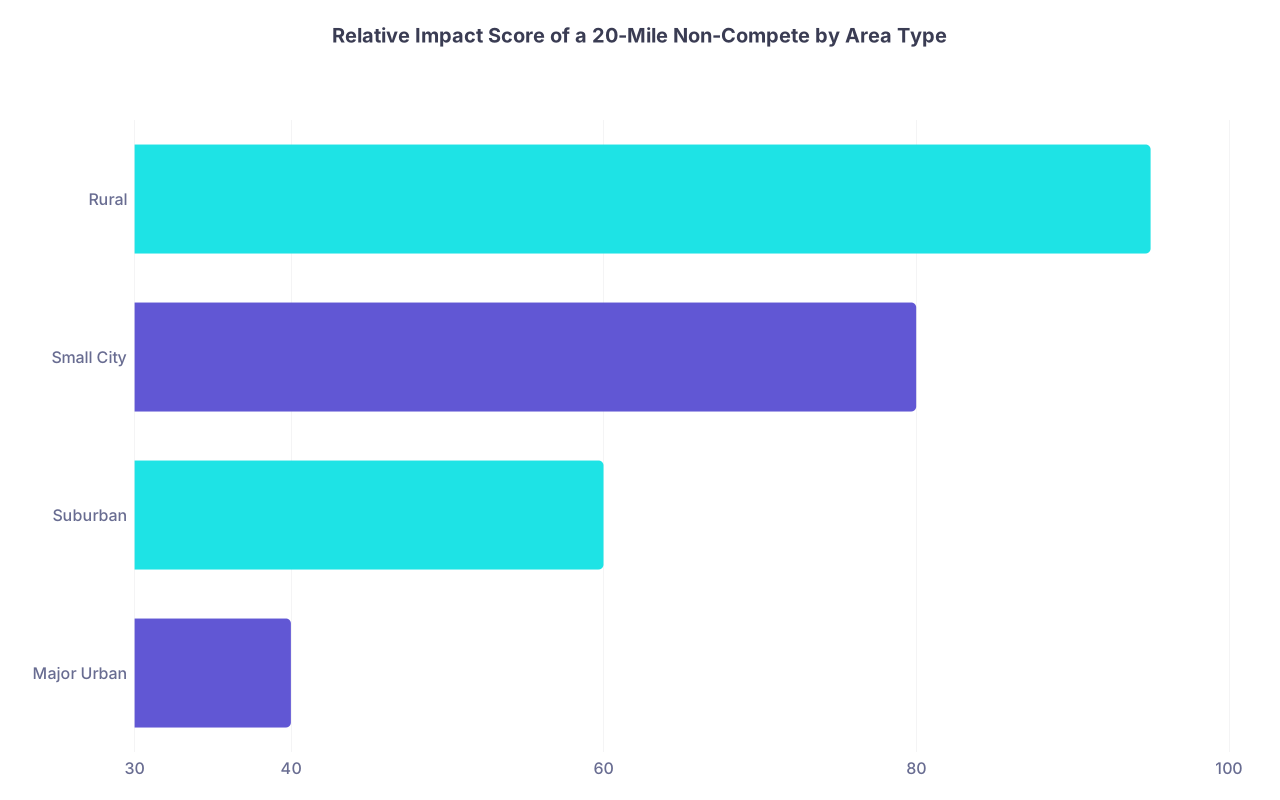
| Category | Value |
|---|---|
| Major Urban | 40 |
| Suburban | 60 |
| Small City | 80 |
| Rural | 95 |
(Scale 0–100, with 100 = totally blocked from realistic alternative employers in commuting range.)
The irony: rural and small-city employers often push for the longest distances and durations, which combine with thin job markets to produce the harshest real-world effects.
Specialty Differences: Who Gets Hit Hardest?
Not all specialties are treated the same. Or have the same risk when they sign.
Data from contract reviews shows some consistent patterns:
- Proceduralists (orthopedics, general surgery, ENT, GI, cardiology, ophthalmology) see some of the most aggressive non-competes.
Reason: High revenue per FTE, strong link to local referral patterns, easy to quantify “loss.” - Hospital-based physicians (anesthesia, EM, radiology, pathology) often see system-wide or hospital-group-wide restrictions rather than pure mileage. The clause may say “any facility where the group has an exclusive contract.”
- Primary care (IM, FM, peds) usually fall in the 10–20 mile, 12–18 month bucket, but large systems sometimes overreach with 25–35 miles.
- Academics and some niche subspecialties (pediatric transplant, complex oncologic surgery with limited centers) frequently have no non-compete or a narrowly tailored one.
Here is a simplified comparative snapshot:
| Specialty Group | Typical Radius | Typical Duration |
|---|---|---|
| Primary Care | 10–20 miles | 12–18 months |
| Surgical Specialties | 15–25 miles | 18–24 months |
| Procedural IM (GI, Cards) | 15–25 miles | 18–24 months |
| Hospital-Based (EM, Anes, Rad) | Facility/system based | 12–24 months |
| Academic (most) | None or 5–10 miles | 6–12 months |
The risk pattern is very clear: the more directly you control profitable local referral flows or high-reimbursement procedures, the more your employer will fight to cage you within a geography and time window.
What Actually Gets Negotiated Down (and What Rarely Does)
Here is the part nobody tells you during residency: employers are far more flexible on how the non-compete is structured than on whether it exists at all.
From dozens of contract iterations, the concessions I repeatedly see are not “we removed the non-compete” but rather:
- Reducing radius (e.g., 25 → 10 miles).
- Limiting it to primary practice site(s) instead of every facility in the system.
- Shortening duration (e.g., 24 → 12 months).
- Exempting certain termination scenarios (no enforcement if you are fired without cause, or if you leave due to employer breach).
- Excluding moonlighting, telemedicine, or non-clinical roles.
If you want realistic levers, prioritize these:
Tie the non-compete to specific addresses.
“15 miles from Clinic A and Hospital B” is very different from “any location of Employer or its affiliates.”Cap the radius under 15 miles in urban/suburban areas.
The data shows most contracts land between 10–20 miles. If you can get down to 10, you are already in the more favorable band.Push for 12 months.
The market standard is 12 months. Anything above that should be treated as negotiable.Condition enforcement on cause.
Many employers will agree that if they terminate you without cause, they will not enforce the non-compete. This single sentence changes the risk profile dramatically.
From a numbers perspective, if you start with something like:
- 25 miles
- 24 months
- Around any employer location
and get to:
- 10–15 miles
- 12 months
- Around your primary site(s) only
- Waived if you are terminated without cause
you have shifted from “career handcuff” to “annoying, but survivable limitation.” That is not perfection, but you are now closer to the median rather than at the punitive tail.
How These Clauses Hit You in Real Life
This is where the abstraction turns into hard constraints on your choices.
Physicians usually discover the true cost of their non-compete in three situations:
- They want to leave a toxic job but stay in the city for family reasons.
- The employer is acquired, the culture changes, and they want out.
- They finish a first job, realize the grass is not greener, and want to move to a competitor across town.
I have seen this play out in very specific ways:
- A hospitalist with a 25-mile, 24-month clause tied to “any facility in Employer network” discovers that every major hospital within a 45-minute commute is off-limits. They either move their family or switch specialties / roles.
- An ortho surgeon in a small city with a 35-mile radius finds that the two nearest hospital systems both fall inside the ring. The only alternatives are locums several hours away or an academic center in another state.
- A primary care physician in a metro region, with “10 miles from each site where you provided services,” rotates through five clinics and, effectively, cannot practice within the entire metropolitan area for a year.
This is why I always tell residents: do not evaluate the non-compete with a single number. Model it.
Draw circles. Count employers. Count realistic job options in and out of the circle. If the answer inside your radius is “zero viable employers,” your leverage is weak, and the clause is strong. You should either negotiate harder or reconsider signing.
The Emerging Regulatory Landscape (and Why You Cannot Rely on It)
You have probably heard talk of non-compete bans, FTC rules, and “this might all be illegal soon.” That noise is partly accurate and partly hopeful speculation.
Here is the more data-grounded reality as of recent years:
- A minority of states (for example, California, North Dakota, Oklahoma) already ban most non-competes, including for physicians. In those states, the entire conversation is different. Employers rely on non-solicits and confidentiality instead.
- Several other states restrict physician non-competes specifically (for example, limiting them by distance or duration, or making them unenforceable in certain settings like primary care or rural health).
- Federal efforts to ban or sharply limit non-competes have run into court challenges and political resistance. There is no uniform national physician non-compete ban in force today.
So if you are in a “ban” state, your risk is structurally lower. If you are in the majority of states that still permit these clauses, the data says enforcement is common enough that you should treat every signed non-compete as real.
You cannot bank your career plans on “maybe the law will change.” The modal outcome is that you will practice under the rules that exist on the day you sign.
Practical Benchmarks: What Is Reasonable, What Is Overreaching?
Put simply, here is how the typical ranges look on a reasonableness spectrum for a new attending in a non-ban state:
Reasonably aligned with market norms:
- 5–10 miles from primary practice site(s)
- 12 months
- Limited to same specialty / scope of practice
- No enforcement if you are terminated without cause
- Non-solicit focused on patients you personally treated
Aggressive but still common:
- 15–20 miles
- 18–24 months
- Any location where you provided services in last 12 months
- Enforcement regardless of reason for termination
Overreaching, high-risk (and often vulnerable in court, but still dangerous to sign):
- 25–50+ miles in non-rural markets
- 24–36+ months
- Any current or future location of employer or affiliates
- Restrictions that effectively bar you from practicing medicine at all in a multi-county region
The majority of physicians sign in the middle category. Many wish, two years in, that they had pushed harder toward the first.
Key Takeaways
Here is the distilled version, without the sugar coating:
- Most physicians in private, community, or large-group settings sign non-competes in the range of 10–25 miles and 12–24 months, usually tied to multiple sites.
- The true impact of a non-compete is radius × duration × number of locations × local job density; physicians routinely underestimate this until they try to leave.
- Employers rarely delete non-competes outright, but they frequently reduce radius, narrow covered sites, shorten duration, and limit enforcement to certain termination scenarios—if you ask, and if you negotiate with data, not wishful thinking.


