
You’re sitting in a hospital Starbucks, new-attending offer packet open, a draft pitch deck in one tab and your research protocol in another. The salary looks solid, but then you hit the section labeled “outside activities” and your stomach drops. If you sign this as written, your startup idea and half your research life are basically dead on arrival.
If that’s you, or you know it will be you in 6–12 months, this is the playbook you should have had before you opened that PDF.
1. Get Honest About Your Real Plans First
Before you care about contract language, you need clarity on what you’re actually trying to protect. Because the right terms for “I write occasional UpToDate chapters” are very different from “I’m building the next AI radiology company.”
Ask yourself, and answer in writing (for you, not them):
What exactly is the side thing?
- Clinical startup? (telemedicine, app, device)
- Non-clinical startup? (software, consulting, education)
- Traditional academic research?
- Industry collaborations (pharma, device, data science)?
- Content/brand: YouTube, Substack, TikTok, consulting?
How big could it realistically get?
- Just “beer money” and CV lines?
- Possible 6–7 figure equity outcome?
- Something you might want to go full-time on in 2–3 years?
How much time will it need at its peak?
- 3–4 hours/week on nights/weekends?
- 10–15 hours/week?
- Could it require weekdays / travel / conferences not directly tied to your employer?
You do not need to tell the employer all of this in detail. But you need it top of mind so you know where to push and where you can compromise.
Here’s the key mindset:
You are not “hiding” a side hustle. You are designing a contract that lets you do legitimate outside professional work without getting fired or sued for it later.
2. The Four Contract Clauses That Can Quietly Kill Your Side Projects
There are four sections that matter more than anything else if you care about research or startups:
- Moonlighting / outside activities
- Intellectual property (IP) and “work made for hire”
- Non-compete / non-solicitation
- Confidentiality and use of employer resources
If you don’t read anything else closely, read those. Twice.
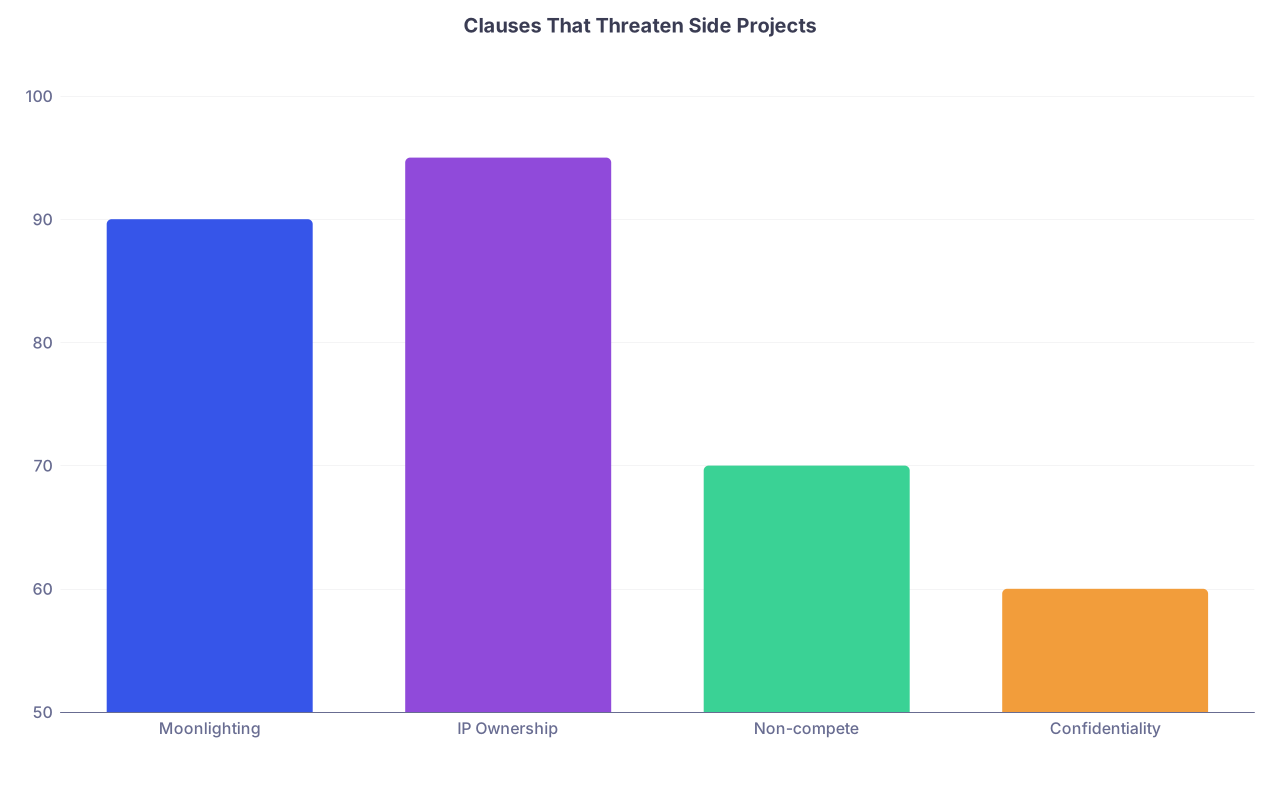
| Category | Value |
|---|---|
| Moonlighting | 90 |
| IP Ownership | 95 |
| Non-compete | 70 |
| Confidentiality | 60 |
2.1 Moonlighting / Outside Activities
Red-flag wording looks like:
- “Employee shall devote full time and attention to Employer and shall not engage in any other professional activities, compensated or uncompensated, without prior written consent of Employer.”
- “Outside activities are prohibited unless expressly approved by Employer in its sole discretion.”
That “sole discretion” phrase is a trap. It means they can say no for any reason, at any time, and you have no recourse.
You want language more like:
- “Physician may engage in other professional activities, including teaching, research, consulting, and business ventures, provided such activities:
- (a) do not materially interfere with Physician’s duties hereunder,
- (b) do not compete with Employer’s clinical services,
- (c) are conducted substantially on Physician’s own time and without use of Employer resources.”
That clause is your oxygen. Without it, every talk, advisory board, consulting contract, and startup call is technically a policy violation.
2.2 Intellectual Property and “Work Made for Hire”
Most physicians do not realize how aggressive some hospital IP policies are until it’s too late.
Bad version:
- “All ideas, inventions, discoveries, developments, software, writings, or other works created by Physician during the term of employment shall be considered work made for hire and shall be the exclusive property of Employer.”
That “during the term” + “all ideas” combo? That includes your startup you work on at 11 p.m. at home that has nothing to do with the hospital. I’ve seen lawyers for big systems lean on that language when a physician later raises money.
You want something segmented and narrower, for example:
“Employer shall own intellectual property:
- (a) created within the scope of Physician’s employment duties; or
- (b) developed using Employer facilities, funding, confidential information, or staff support.
Physician shall own intellectual property developed:
- (c) entirely on Physician’s own time;
- (d) without use of Employer resources or confidential information; and
- (e) that does not relate to Employer’s business or anticipated research programs.”
That’s closer to “side-gig safe.”
2.3 Non-Compete / Non-Solicitation
Non-competes matter not just for where you can practice, but for what kind of startup you can build.
Watch for language like:
- “Employee shall not, during employment and for two (2) years thereafter, engage in any business that competes, directly or indirectly, with Employer.”
- “Compete” defined broadly as “any healthcare or health-related services.”
That second one nukes almost any digital health startup.
You want constraints narrowed by:
- Geography
- Service line
- Patient population
- Delivery mode
Good direction:
- “Competing business” means provision of in-person clinical services within 10 miles of Employer’s primary facility in [specific specialties]. Non-clinical businesses such as software, consulting, and education that do not directly deliver clinical care to patients in that area are excluded.”
Magic phrase: “Non-clinical businesses such as software, consulting, and education are excluded.” Push hard for that if you’re even remotely startup-minded.
2.4 Confidentiality / Use of Employer Resources
You need clarity that:
- Your startup will not piggyback on employer patient data or systems.
- Your research can flow between institutions legally.
- Your side project communication is kept separate.
Typical safe language:
- You agree not to use employer PHI, trade secrets, or proprietary data in outside work.
- You will not use employer equipment, staff time, or brand for private ventures.
That’s fine. Honestly, that’s how you want to run it anyway.
What you do not want is language that says, in effect, “Anything related to healthcare that touches your brain is ours.” Overly broad “confidential information” definitions can bleed right into your startup.
3. The Conversation Strategy: How to Raise This Without Looking “Disloyal”
You’re probably worried about this part. You do not want to be the new grad who shows up at HR saying, “Hey, I’m trying to protect my startup exit; can we edit section 12.3?”
Here’s how to play it.
Step 1: Normalize it
You frame this as professional standard practice, not a weird one-off request.
Example email line:
“I do some academic and consulting work outside of my clinical duties, and I want to be sure the contract language supports standard outside professional activities (research, speaking, advisory work) as long as they don’t interfere with my responsibilities here.”
No mention of “big startup” yet. Just “academic and consulting work” and “standard outside activities.”
Step 2: Anchor on Research and Education
Most institutions are comfortable with research, speaking, and modest consulting. Use that.
In a call:
“I’m planning to stay active with research and some advisory work in my subspecialty. I want to make sure the outside activities and IP language doesn’t unintentionally capture, say, a guideline committee or an industry advisory board that I do on weekends.”
You’re not saying: “I’m launching a for-profit competitor.”
You’re saying: “I’m a serious academic physician; let’s not handcuff that.”
Step 3: Separate Clinical Time from Everything Else
Employers care about two things above all: clinical volume and reputation.
Reassure them explicitly:
“My clinical work and access will be my priority. I’m just looking for clear, written acknowledgment that on my own time, not using hospital resources, I can continue to build my academic and consulting profile.”
If you sound like you’ll protect their RVUs and not embarrass them publicly, most groups are more flexible than you think.

| Step | Description |
|---|---|
| Step 1 | Review Contract |
| Step 2 | Identify Problem Clauses |
| Step 3 | Clarify Your Side Plans |
| Step 4 | Propose Specific Edits |
| Step 5 | Finalize Contract |
| Step 6 | Refine and Negotiate |
| Step 7 | Decide to Walk or Accept Risk |
| Step 8 | Employer Response |
4. Concrete Language: Edits You Can Actually Propose
Let’s get specific. If you see common bad clauses, here’s how to push back.
4.1 Outside Activities / Moonlighting
Problem clause:
“Physician shall not engage in any other professional activities, compensated or uncompensated, without prior written consent of Employer, which may be granted or withheld in Employer’s sole discretion.”
Proposed revision:
“Physician may engage in other professional activities, including but not limited to teaching, research, consulting, expert witnessing, and business ventures, provided such activities:
(i) do not materially interfere with Physician’s duties and responsibilities to Employer;
(ii) do not compete with the clinical services provided by Employer; and
(iii) are conducted substantially on Physician’s own time and without material use of Employer resources.
Employer’s consent shall not be unreasonably withheld for such activities.”
Key additions:
- Explicit list (teaching, research, consulting, business ventures)
- “Materially interfere” (gives you some room)
- “Not unreasonably withheld” (limits arbitrary vetoes)
4.2 IP Ownership
Problem clause:
“All inventions, discoveries, improvements, software, writings, and other works created by Physician during the term of employment shall be the sole property of Employer.”
Proposed revision:
“Employer shall own intellectual property conceived or reduced to practice:
(a) within the scope of Physician’s employment duties for Employer; or
(b) using Employer’s facilities, funds, confidential information, or personnel.
Physician shall own intellectual property:
(c) developed entirely on Physician’s own time;
(d) without use of Employer’s facilities, funds, confidential information, or personnel; and
(e) that does not relate directly to Employer’s existing or planned clinical services or sponsored research programs, as disclosed in writing to Physician.”
If you’re really startup-oriented, you can add:
“Non-clinical software tools or educational content created by Physician without Employer resources shall be deemed Physician-owned intellectual property.”
That one line has saved more than one future founder.
4.3 Non-Compete Narrowing
Problem clause:
“Employee shall not, during employment and for two (2) years thereafter, engage in any business that competes, directly or indirectly, with Employer.”
Proposed revision:
“Employee shall not, during employment and for one (1) year thereafter, provide in-person clinical services in [specialty] within a [10]-mile radius of Employer’s primary facility.
Non-clinical work, including consulting, software development, education, and research activities, that does not involve direct provision of clinical care to patients in this restricted area shall not be deemed competitive.”
You may not get everything. But if you can carve out “non-clinical work” explicitly, your startup life becomes much safer.
| Clause Type | Risky Version Key Phrase | Safer Version Key Phrase |
|---|---|---|
| Outside Work | "sole discretion" / "prohibited" | "may engage in... not materially interfere" |
| IP Ownership | "all ideas during employment" | "within scope of duties / using employer resources" |
| Non-Compete | "any business that competes directly or indirectly" | "in-person clinical services within X miles" |
| Non-Clinical Work | Not addressed | "non-clinical work... shall not be deemed competitive" |
| Consent Standard | "may be withheld for any reason" | "consent shall not be unreasonably withheld" |
5. Special Case: Academic vs Private Practice vs Big Health System
Where you work matters for how hard to push and where.
5.1 Academic Medical Centers
Pros:
- They like research. They like grants. They like prestige.
- They often have formal IP policies and tech transfer offices.
Cons:
- Those tech transfer offices want a cut of your ideas.
- Their default is: “If it even smells like research or innovation, it’s ours.”
If you’re planning industry collaborations or startups:
- Ask directly for the university IP policy in writing.
- Ask whether they use a standard “inventor share” model (e.g., 30–40% after expenses).
- Clarify what counts as “university resources” (lab space? your brain? your nights?).
Your negotiation often shifts from “ownership” to “percentage and freedom to commercialize.”
5.2 Private Practice Groups
Pros:
- Usually care most about clinical revenue, not your app idea.
- Often more flexible with outside consulting and startups if it doesn’t distract you.
Cons:
- Contracts may be sloppier. Broad language thrown in by a generic lawyer.
Here, your job is to:
- Tighten vague “all ideas” clauses.
- Add explicit carve-outs for non-clinical businesses and consulting.
- Get a simple, readable outside activities clause you can actually comply with.
5.3 Big Health Systems
Pros:
- They’ve seen this before. They probably have some policy precedent.
- If they have innovation centers, they might even like that you’re entrepreneurial.
Cons:
- Bureaucratic. “We never change that clause” is a common line.
- Legal is there to protect the system, not your future cap table.
Strategy:
- Use “standard physician practice” language: research, speaking, guidelines, occasional consulting.
- Ask if they have a standard exception/waiver template for outside activities.
- If they absolutely refuse to narrow IP or non-compete language, be honest with yourself about whether this is the right home for a founder type.
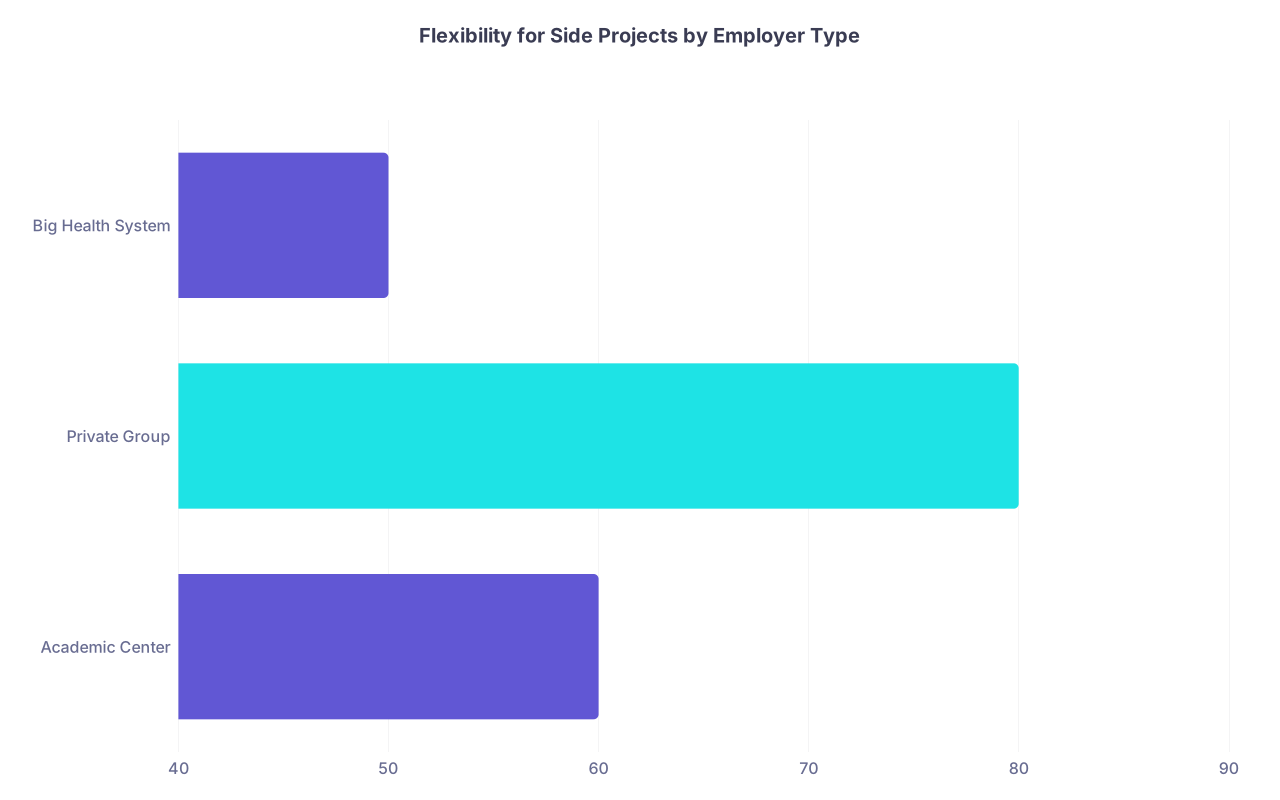
| Category | Value |
|---|---|
| Academic Center | 60 |
| Private Group | 80 |
| Big Health System | 50 |
6. Guardrails You Should Set for Yourself (Even With a Good Contract)
A contract that technically allows side gigs doesn’t mean you should be reckless. There are a few personal rules that keep you safe:
Never use employer PHI, ever.
Not for demos, decks, prototypes, or “internal testing.” Use synthetic or publicly available datasets.Keep your devices and accounts separate.
Use your own laptop, personal email, and personal cloud storage for startup/research not tied to the institution. Don’t mix Epic screenshots and pitch deck slides.Be honest about time.
If your startup starts creeping into clinic time, you’re in breach whether or not anyone notices. When it grows, renegotiate FTE rather than lying to yourself and them.Document major outside agreements.
If you sign a big consulting or advisory contract, keep it in a folder. If you ever get asked by your employer what you’re doing, you want to show you took it seriously, not that you’ve got a mess.Don’t surprise your chair or group leader.
You don’t have to overshare, but if you’re giving a high-profile talk, raising a seed round, or launching a product with your name on it, a short heads-up email can prevent a lot of drama.

7. When to Walk Away
Sometimes the answer is: this job is wrong for the version of you that builds things.
Hard lines that should make you seriously consider walking:
- They refuse any carve-out for non-clinical work in the non-compete.
- They insist all IP you create “during the term” is theirs, no matter what.
- They prohibit all outside work except with case-by-case approval and no “not unreasonably withheld” language.
- They react defensively or suspiciously when you calmly ask to protect normal academic and consulting activity.
You don’t need to light the bridge on fire. A simple:
“I appreciate the offer. Given my long-term plans to stay active in research and innovation, I’m looking for a structure that allows more flexibility for outside professional work. I don’t think we’re aligned on that right now.”
You’ll feel like you’re throwing away a sure thing. You’re not. You’re trading one job for the ability to actually build the bigger thing you say you care about.

8. Quick Checklist Before You Sign Anything
Run through this list with your contract in one hand and a highlighter in the other:
Outside activities:
- Do you have explicit permission for research, teaching, consulting, and business ventures as long as they don’t interfere?
- Is employer consent required, and if so, is it “not unreasonably withheld”?
IP:
- Is ownership tied to scope of duties + use of employer resources, not your entire life during employment?
- Are non-clinical tools/content you build on your own time clearly yours?
Non-compete:
- Is it limited in geography and clinical scope?
- Are non-clinical ventures explicitly carved out?
Confidentiality:
- Is “confidential information” defined narrowly enough that your general medical knowledge and generic know-how aren’t locked up?
- Are you comfortable you can comply while still doing your side work?
If more than two of those are “no,” you either negotiate harder or accept that this job will be hostile soil for your research/startup life.

FAQ (Exactly 5 Questions)
1. Should I tell the employer explicitly that I’m starting a company?
You do not need to show them your pitch deck or cap table. You do need to make sure the contract language is compatible with “outside consulting and business ventures on my own time that don’t interfere with clinical work.” If your startup will use their data, staff, or branding, then yes, you must explicitly involve them. If it’s completely separate and protected by clean contract language, a general disclosure about “ongoing consulting and innovation work” is usually enough.
2. Can my hospital actually claim ownership of a startup I built at home?
If you signed a contract that says “all ideas or inventions during employment are ours,” yes, they can at least make a credible legal threat. And credible threats are enough to scare investors. That’s why narrowing IP language before you sign is non-negotiable if you have serious entrepreneurial ambitions. Once the contract is signed and the company is valuable, you’ve lost your leverage.
3. What if they say, “We never change that clause”?
That’s often more habit than law. You can respond with: “I understand this is your standard language. Given my plans for continued academic/consulting work, I’d like to see if we can tailor it slightly so I can comply in good faith.” If they absolutely will not budge on IP, outside work, or non-compete carve-outs, accept that you’re choosing a “pure clinician” path in that role. Or walk. But don’t fantasize that they’ll ignore those clauses later if things go well for you.
4. Do I really need a lawyer for this?
If you care about side-gig safety for anything beyond minor speaking fees, yes, you should get a physician contract lawyer to look at it. Not your cousin who “does real estate.” Someone who’s seen hospital systems go after physician IP and understands standard carve-outs. The few hundred to couple thousand dollars you pay now is nothing compared to losing equity or getting stuck in a career box you can’t get out of.
5. What if my side project grows and starts conflicting with my job later?
Then you renegotiate—formally. That might mean reducing FTE, switching to a different role, or explicitly structuring an agreement between your employer and your company (e.g., pilot site, consulting contract). Do not quietly let your startup time cannibalize your clinical time and hope nobody notices. That’s how you end up terminated “for cause,” which then poisons your next job, your reputation, and sometimes your startup fundraising.
Open your offer letter right now and search for “outside,” “inventions,” and “non-compete.” If you can’t clearly see where your research and startup life fits without permission every step of the way, that’s your signal: fix the contract before you sign, or you’ll be negotiating with your future on the line instead of a Word document.