

The default way hospitals “do” part‑time is terrible for you unless you structure it yourself.
If you want 0.8 FTE or part‑time, you cannot just say “I want 4 days a week” and hope they’ll make it fair. They will not. You have to dictate the math: hours, benefits, and call.
Let me lay this out like you’re about to walk into an actual negotiation. Because you are.
Step 1: Decide Exactly What You Want Before You Talk Numbers
“Part‑time” means nothing. 0.8 FTE means nothing. Schedules and money mean something.
Sit down and define your non‑negotiables on paper first:
Clinical time:
- How many clinic/OR/coverage days per week?
- What time do you want to leave?
- Any hard constraints (pickup at 4:30 three days a week, no Fridays, etc.)?
Call:
- Are you willing to take call at all?
- If yes, how often vs full‑time colleagues?
- In‑house vs home call? Weekend vs weekday?
Income floor:
- Minimum annual pay that makes it worth working at all.
- Minimum RVU/production target you’re willing to sign your name under.
Benefits:
- Do you need health insurance through them or via spouse/marketplace?
- Retirement match worth it only above a certain % FTE?
- CME, malpractice, disability—what must be included?
Most physicians get railroaded because they walk in saying, “I’d like part‑time” instead of, “Here’s the 0.8 FTE structure I’m proposing: 4 clinic days, no scheduled Fridays, 80% of base, proportional call, full benefits.”
Write it out as if you’re drafting the schedule section of a contract. Then you’re reacting to specifics, not vague vibes.
Step 2: Understand How FTE, Pay, and Benefits Usually Tie Together
You need to know their default rules before you bend them.
Here’s how many employers typically structure FTE:
| FTE Level | Typical Schedule | Pay Basis | Benefits Eligibility |
|---|---|---|---|
| 1.0 FTE | 5 days or full call | 100% salary/RVUs | Full benefits |
| 0.8–0.9 | 4 days or reduced hrs | 80–90% of salary | Often full benefits |
| 0.6–0.79 | 3 days | 60–79% of salary | Partial or scaled benefits |
| 0.5 | 2–3 long days | 50% of salary | Sometimes health, limited other |
| <0.5 | 1–2 days | Hourly/prorated | Usually no benefits |
None of this is universal. But it’s common enough that HR will try to plug you into one of these boxes.
Your job is to:
- Get as high a benefits tier as possible for the lowest FTE you can live with.
- Force them to spell out exactly how FTE affects: salary, bonus/RVUs, vacation, CME, retirement, malpractice, call.
Ask for their physician FTE policy in writing before signing. If they “don’t have one,” that’s code for “we’ll wing it and you’ll lose.” Make them define it in the contract.
Step 3: Choosing Your 0.8 FTE Structure (The Real Schedules)
“0.8 FTE” can mean radically different lives. You have to anchor it.
Here are three common 0.8 setups and how they actually feel:
Four full days, no Fridays (or fixed day off)
- 4 clinic/OR days, 1 day off every week.
- Pay: ~80% of base, proportional RVU target.
- Call: typically 80% share—but they’ll try to make it 100% if you don’t say no.
- Lifestyle: Best if you want predictable weekly structure, one fully protected personal day.
Four shorter days + reduced call
- E.g., Mon–Thu 8–3 instead of 8–5/6.
- Pay: Could still be 0.8 if you’re producing, but some places will call this 0.9 FTE.
- Call: You push harder to reduce call since total hours/week down.
- Lifestyle: Good if your real issue is late days, not total days.
Three very long days + some call (often 0.6–0.8 FTE range)
- E.g., 3 x 10–12 hr days, no work the other days.
- Pay: Can be 0.6–0.8 FTE, depending on volume.
- Call: Usually still some weekend call; weekdays might be exempted if coverage allows.
- Lifestyle: Brutal on working days, amazing on days off. Works well when you have a partner with opposite schedule or childcare jiu‑jitsu needs.
If you’re aiming for 0.8 FTE, the cleanest option most groups understand: 4 days/week, 80% of full‑time salary, full benefits.
Spell it out in your ask:
“I’m proposing 0.8 FTE defined as 4 clinical days per week, no Friday clinic, with salary and RVU targets at 80% of full‑time and call proportional to 0.8 FTE.”
That’s a coherent offer. They can say yes, no, or counter with something intelligible.
Step 4: Do Not Let Them Stick You With 100% Call
This is where part‑time physicians get quietly destroyed.
The almost universal administrative instinct:
“Fine, we’ll pay you 0.8, but you’ll still be in the full call pool because it’s hard to schedule otherwise.”
If you let that stand, you’re just subsidizing the group’s coverage problems with your sanity.
You want one of these structures instead:
Proportional call
- If full‑time takes 1:6 call, you at 0.8 FTE should be 0.8 x that load.
- Real math: if 6 full‑time docs cover 1:6, and you’re 0.8, they should treat you like 0.8 of a doc in the call schedule calculation.
- Example line for contract:
“Physician shall participate in call at a rate of 0.8 of full‑time call obligation, with specific call frequency to be mutually agreed upon and updated annually.”
Reduced call with explicit offset
- You take less call than proportional, but accept slightly lower pay or more clinic time as trade.
- Works well if you hate nights/weekends but don’t mind more weekday hours.
No call, clean and simple
- Better for specialties where call is brutal (OB, neurosurg) and your life stage can’t support it.
- You must understand: this hits your value to the group. You probably won’t be near market comp, and you might get passed over for certain jobs. That’s fine if you’re choosing it intentionally.
Whatever you do: do not leave call vague.
Bad language:
“Physician will participate equitably in call coverage as determined by the group.”
That’s a trap. “Equitable” is useless when you’re 0.8. Insist on either proportional or “to be negotiated, but not to exceed X nights/week or Y weekends/year without written consent.”
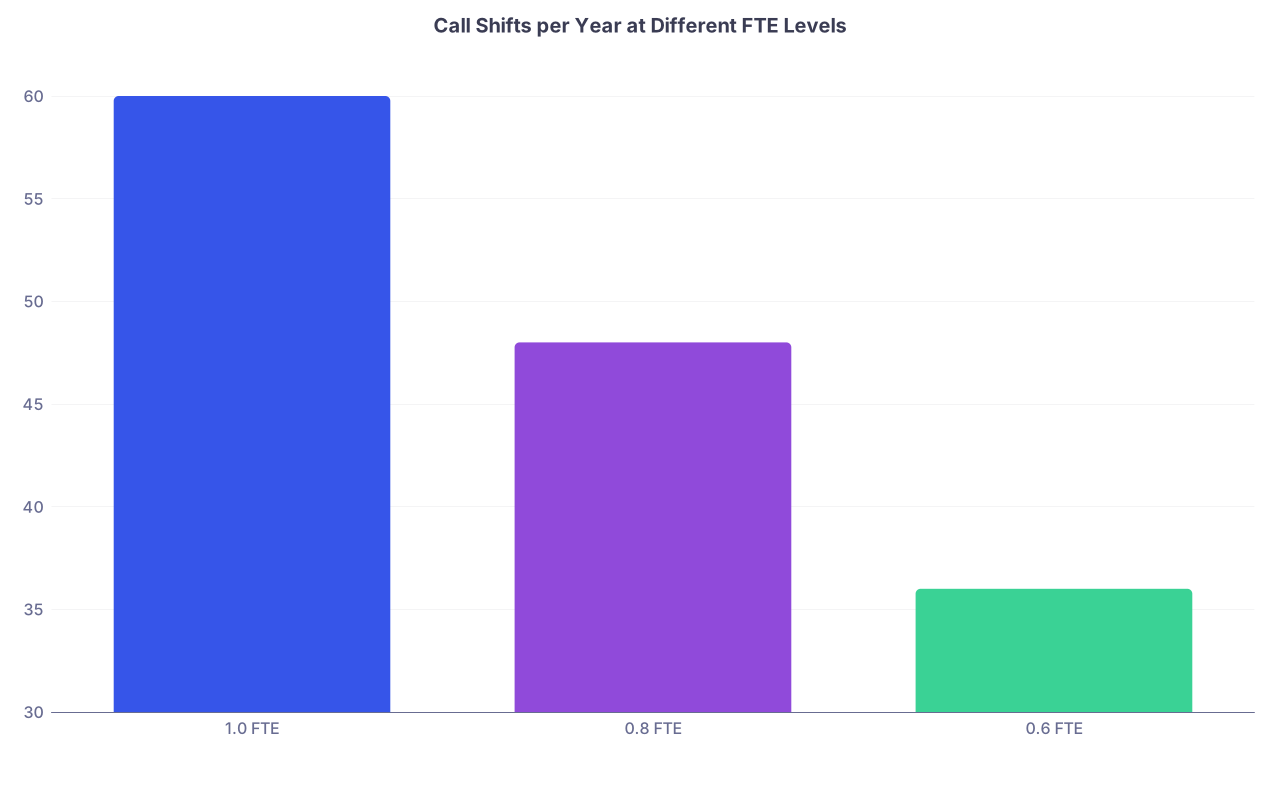
To make the math more concrete:
| Category | Value |
|---|---|
| 1.0 FTE | 60 |
| 0.8 FTE | 48 |
| 0.6 FTE | 36 |
(Assuming full‑time takes 60 call shifts per year.)
You want your call roughly following that shape, not flat at 60 for everyone.
Step 5: Benefits—Where 0.8 FTE Can Actually Be a Sweet Spot
If you negotiate correctly, 0.8 FTE is often the “best of both worlds” point: you keep full benefits and buy back time.
Questions to ask before you ever say “0.8 FTE” out loud:
At what FTE do I qualify for:
- Health insurance?
- Full retirement match?
- CME funds and days?
- Paid time off (and how is it accrued for part‑time)?
- Short and long‑term disability?
- Life insurance?
Is malpractice coverage (including tail, if applicable) fully covered at 0.8 FTE?
Many systems give full benefits at 0.8 or even 0.75 FTE. If they do, 0.8 is fantastic: you get almost all of full‑time’s economic package at 80% of the hours.
If they try the usual trick—“benefits are the same cost to us, so we’ll have to charge you a higher premium at 0.8”—push back. Your FTE status affects their payroll tax, retirement match, and sometimes productivity expectations. You’re not just an “expense burden.”
Phrase it like this:
“Given that I’m close to full‑time and still providing continuity and call, I’d like to maintain full benefits eligibility at 0.8 FTE. Many systems do this at 0.75 and up. Is there flexibility here?”
If they say “policy is policy,” ask to see the policy. Sometimes the recruiter or department chair is just guessing and HR quietly has more leeway than they admit.
Step 6: Structuring Pay and RVUs So You Don’t Get Punished
The next big landmine: they cut your FTE, but leave your productivity targets and comp structure essentially unchanged.
You want three things:
Base salary scaled to FTE.
- If full‑time base is $280K, 0.8 FTE should be $224K. Clean.
- Do not accept some random number well below proportional “because part‑time is hard on the schedule.”
RVU/bonus thresholds scaled to FTE.
- If full‑time needs 5,000 RVUs to hit bonus, your 0.8 FTE threshold should be 4,000.
- Same for quality or citizenship metrics that unlock bonus pools.
No “minimum FTE productivity” trick language.
- Watch for: “Regardless of FTE status, physician is expected to meet minimum panel size/RVU targets established for full‑time clinicians.”
- That’s nonsense. Cross it out.
If they say, “But our overhead is the same,” you counter with: “Then let’s adjust how many clinic sessions I cover or build in some admin/project work that justifies the overhead. I’m not signing a contract where my FTE is 0.8 but my targets are 1.0.”
You can even explicitly define expected sessions per week:
“0.8 FTE is defined as 8 half‑day clinic sessions per week, with RVU targets and base compensation set at 80% of full‑time expectations.”
This pins everything down: days, expectations, and pay.
Step 7: Guard Your Schedule in Writing
Verbal promises about “We’ll try to keep your day off free” are worthless.
You want concrete language around:
Your standard weekly schedule:
- “Physician’s regular schedule will be 4 clinical days per week, Monday–Thursday, with Friday unscheduled clinic time, except by mutual written agreement.”
Use of your “off” day:
- Clarify whether they can assign meetings/admin on your off day. If you care, say no.
- Or compromise: “Up to X days per quarter for mandatory meetings.”
Late clinics:
- If you need to be out by 4:30, explicitly set the last patient time.
- “Last scheduled patient at or before 3:30pm” is more enforceable than “clinic ends at 4pm.”

| Step | Description |
|---|---|
| Step 1 | Define personal needs |
| Step 2 | Choose days per week |
| Step 3 | Decide on call tolerance |
| Step 4 | Check employer FTE policy |
| Step 5 | Draft preferred schedule |
| Step 6 | Negotiate contract language |
| Step 7 | Sign only when specifics match |
If they push back with “we need flexibility,” fine—give them limited flexibility with guardrails. Example:
“Group may adjust clinic days up to 4 times per year for operational needs, with at least 60 days’ notice and no change to overall FTE or day‑off count.”
That’s reasonable. “We can change your days whenever” is not.
Step 8: How to Actually Ask for 0.8 FTE Without Killing the Offer
Timing matters.
If you lead with “I only want 0.8” before they feel your value, weaker groups will just move on. You want them to see you as the solution to a problem before you introduce your terms.
Sequence that tends to work:
Initial interview:
Focus on fit, clinical strengths, enthusiasm for the practice. Get them bought into you first.When they indicate serious interest (post‑second interview / pre‑offer):
Say something like:“One structural thing that’s important to me long‑term is working at about 0.8 FTE for family reasons. I’ve been very productive in that structure previously. Is this something your group has done before or is open to discussing?”
Once they say “Yes, we can discuss that”:
Then drop your specific proposal: days, call, pay proportionality.
If they flinch hard—“We only do 1.0 FTE, no exceptions”—you have a decision. Either:
- Walk and stop wasting time, or
- Ask about starting at 1.0 with a guaranteed written review and option to drop to 0.8 by a specific date.
Get that in writing:
“Physician may elect to reduce FTE to 0.8 effective on or after Month/Year, with salary, RVU targets, PTO, and call obligations adjusted proportionally, subject to 90 days’ notice.”
If they won’t even put that in the contract, they don’t really intend to support part‑time later. Believe what the contract says, not what the chair says over coffee.
Step 9: Special Cases by Setting
Academic vs private vs hospital‑employed all play differently.

Academic jobs
- Pros: More precedent for part‑time, especially for parents or dual‑career couples.
- Cons: Pay is already lower. 0.8 of academic pay can get tight fast.
Watch for:
- Hidden expectations: “0.5 clinical, 0.3 research, 0.2 admin” at 0.8 FTE can quietly become “we expect you to do 1.0 FTE of research anyway.”
- Tenure/promotion clocks: clarify how part‑time affects these formally.
Private practice
- Pros: More flexible—if you bring revenue, they care less about your FTE label.
- Cons: Benefits may be weaker or vanish below 1.0 FTE.
You want:
- Clear partnership track rules at part‑time. Can you become partner at 0.8? At what buy‑in and distribution?
- Definition of overhead and shared costs if you’re not full‑time.
Hospital‑employed
- Pros: Often standardized benefits and clear FTE bands. 0.8 can keep full benefits.
- Cons: Bureaucracy. “Policy” walls you run into.
Get the HR policy document. Match your contract to it. When they say “we can’t,” ask who can.
Step 10: Red Flags That Tell You to Walk
I’ve seen these kill careers:
“We don’t really use FTE; everyone just pitches in.”
Translation: you’ll be full‑time in everything but name and pay.“We’ll start you full‑time and discuss 0.8 later, no need to write it down.”
No. If it’s not written, it’s fantasy.“Benefits stay the same cost to us, so you’ll pay the full premium at 0.8.”
Run the numbers. That can shred your real net pay.“Part‑time physicians take full call; that’s just how we do it.”
Unless they’re offering something huge in exchange (and they rarely are), this is exploitative.
If your gut says, “They don’t actually respect part‑time as a legitimate choice,” believe that. You can’t out‑work a bad structure.
Quick Reality Check With Some Numbers
Let’s put some rough math to two sample options for the same job (family med, hospital‑employed, Midwest):
| Item | 1.0 FTE | 0.8 FTE Structured Well |
|---|---|---|
| Base Salary | $260,000 | $208,000 (80%) |
| Call Shifts/Year | 60 | 48 |
| Health/Retire | Full benefits | Full benefits |
| Workdays/Week | 5 | 4 |
| RVU Target | 4,800 | 3,840 (80%) |
Now compare to bad 0.8 FTE:
- Base: $200,000 (below 80%).
- Call: 60 shifts (same as full‑time).
- Benefits: same employee premium as full‑time, but 20% less employer retirement match.
- RVU target: still 4,800 “because coverage.”
That’s not part‑time. That’s just being underpaid.
FAQs
1. Should I start full‑time and cut back later, or insist on 0.8 FTE from the start?
If you absolutely know you can’t tolerate full‑time with call, don’t lie to yourself or them—negotiate 0.8 from the start.
If you’re unsure and the group is otherwise excellent, you can accept 1.0 but only if the contract explicitly gives you the right to move to 0.8 by a certain date with defined pay, call, and benefit changes. No “we’ll revisit.” Written, concrete language or walk.
2. Is it realistic to get full benefits at 0.8 FTE?
Yes, very. Many hospital systems and large groups already do this. The more they rely on standardized HR policies, the more likely 0.75–0.8 is the benefits cutoff. In private practice, it’s less common, but you can sometimes trade slightly lower salary or increased call for maintained benefits. Always ask directly where the benefits FTE threshold is and if exceptions are ever made.
3. How do I respond if they say, “Part‑time is hard for us to schedule”?
Acknowledge the problem, then give them a solution:
“I get that. That’s why I’m proposing a clean structure: 4 predictable clinic days, proportional call, and stable FTE so you can hire around it. This is not a temporary thing—I’ll be very consistent. Let’s structure it so it works for both the group and for my family.”
If they still resist, it usually means they just don’t want to deal with non‑standard arrangements. That’s a culture problem, not a scheduling problem.
4. Can I still make partner if I’m 0.8 FTE?
Sometimes yes, but you must force the conversation. Ask:
- “Is partnership available at 0.8 FTE?”
- “Is buy‑in the same or scaled?”
- “Will my profit share be 80% of a full partner’s, or structured differently?”
Get this in writing or at least in a partnership policy document. If they dodge, assume you’re being placed in permanent second‑class status and decide if that’s acceptable to you.
5. How do I know if 0.8 FTE is financially viable for me?
Do brutal, honest math. Write down your fixed expenses (mortgage, loans, childcare), then your desired savings rate. Use realistic post‑tax numbers for both 1.0 and 0.8 scenarios. Consider the value of benefits and the cost of hiring help (childcare, housecleaning, etc.) when you’re more full‑time. Many physicians discover that 0.8 with full benefits and less burnout is actually a better life than 1.0 with marginally more money but no time.
Open the draft contract—or the job posting you’re looking at—right now and write, in plain English, how you want your 0.8 FTE to look: days, call, pay, and benefits. If you can’t describe it clearly to yourself, you’re not ready to negotiate it with them yet.


