

It’s late January. You just finished a week of nights, you’re behind on dictations, and your inbox has two emails staring at you:
- Offer #1: Big hospital system. Solid brand name. Lower base but promises “great earning potential.”
- Offer #2: Private group. Higher base, more call, fuzzy partnership track language.
Both want an answer “within 7–10 days.” Your PD says “that system is stable, don’t overthink it.” Your co-fellow says, “You’d be insane not to push them against each other, they need you.”
You’re sitting there thinking:
How do I use one offer to improve the other…
Without looking like a jerk, blowing up both, or getting locked into a bad deal?
This is the situation. Let’s walk straight into it.
Step 1: Get Your House in Order Before You Leverage Anything
Before you start “using” offers, you need clarity. Otherwise you’re just flailing.
First, turn both offers into something you can actually compare. Hand-wavy “great culture” doesn’t help when you’re on your third night in a row two years from now.
Make a simple table or spreadsheet. At minimum, compare:
| Item | Offer A | Offer B |
|---|---|---|
| Base Salary (Year 1) | ||
| Bonus / RVU Rate | ||
| Call Schedule | ||
| PTO / CME Days | ||
| Non-Compete Distance | ||
| Term / Notice Period |
Now, answer three questions for yourself, in writing:
- If I had to sign one today, which would I pick and why?
- What are the 3–5 things that must improve for me to say yes to each offer?
- What is my real walk-away point? Not theoretical. Real. “If they can’t fix X, I’m out.”
If you cannot answer those, you are not ready to leverage anything. You’ll get pushed around.
Then, be clear on your priorities. Early-career physicians often underestimate:
- The weight of call and nights
- The pain of a long non-compete when things go bad
- The impact of wRVU thresholds that are unrealistic
And they overestimate:
- “Prestige” of a nameplate
- “Future partnership upside” that’s not written anywhere
- “You’ll easily hit 10,000 RVUs” claims with zero data
You need a ranked list: What actually matters more to you — money, location, schedule, academic time, autonomy, partnership, specific niche (e.g., advanced endoscopy, structural cardiology), etc. That ranking will drive what you try to leverage.
Step 2: Tighten Your Timeline and Control the Clock
Each employer will give you some artificial timeline: “We’d love a decision by next Friday” or “Our committee meets on the 28th.”
You cannot leverage well if their clocks don’t line up.
Your job is to:
- Know your internal deadline (when you really need this done for your own sanity, boards, visa, family).
- Bring their timelines closer together without lying.
Sample email to Offer A (if B just came in and is attractive):
Thank you again for the offer. I remain very interested in the position. I want to be transparent that I’ve received another offer with a similar timeline. To make the best decision, I’ll need the full contract for review and approximately 10–14 days to discuss it with counsel and my family.
Is that acceptable on your end?
Two things you do not do:
- Do NOT say “I’ll have an answer by tomorrow” when you will not.
- Do NOT let one contract sit untouched for 3 weeks and then panic.
Get both full contract drafts as fast as possible. Do not negotiate off a vague “offer letter” if you can avoid it. The poison usually lives in the actual contract: non-compete, termination, call, RVU thresholds.
Step 3: Decide Your Leverage Strategy: Silent, Light, or Full-Court Press
There are three basic ways to use a competing offer. You need to pick your lane based on how much you like the job and how competitive your field/market is.
Strategy A: Silent Leverage (Use B for confidence, not for conversation)
You don’t explicitly mention the other offer. You just:
- Feel less desperate, which changes your tone and backbone.
- Ask clearly for what you want: “This base is significantly below what I’m seeing elsewhere; I’d like to see $X.”
- Are ready to walk if they say no.
This works when:
- You’re not that attached to the job.
- You’re in a strong specialty or underserved market (psych, heme/onc in rural, EM in some regions, etc.).
- You don’t like games.
Strategy B: Light Leverage (Acknowledge there’s competition, but no details)
You subtly bring in the existence of another offer, without sending contracts or playing numbers too hard.
You say things like:
I’m enthusiastic about this role and can see myself here long term. I do have another offer with a higher starting salary and a less restrictive non-compete. If we can get closer on those pieces, I’d be comfortable moving forward with you.
You’re giving them direction without turning it into an auction. Often this is enough. Especially if they’re actually motivated.
Strategy C: Full-Court Press (Deliberate, specific, and somewhat aggressive)
You explicitly use the numbers and terms from one offer to move the other.
For example:
I have an offer from [Regional Medical Group] for $325,000 base, a 15k sign-on, and no non-compete. I’d prefer to join your team based on fit and location, but I do need to be reasonably aligned. Is there room to adjust base salary, sign-on, or the non-compete language to be more competitive?
You do this when:
- One job is clearly your top choice.
- The other offer is objectively stronger in key areas.
- Your specialty or local market gives you decent bargaining power.
- You’re okay if they say “no” and you go with the other job.
Notice what you’re not doing: You’re not lying. Fabricating phantom offers is how physicians burn reputations fast. Hospital recruiters talk. Locally, people absolutely compare notes.
Step 4: What To Actually Ask For When Leveraging
You do not go to war over everything. Pick 3–5 high-yield items and hammer those. Use the competing offer strategically on the parts that matter.
Here are the big negotiation levers and how a second offer helps:
1. Base Salary / Guarantee
If Offer B pays you $40k more base than Offer A, you use that.
Concrete script:
I’m excited about this role, but I’m struggling with the compensation piece. I have another offer at $340,000 base. I would strongly prefer your group for long-term fit.
If we could get the guaranteed base closer to $330,000 (or improve sign-on/loan repayment to offset the gap), I’d be comfortable committing.
You’re not asking them to magically match the highest possible number. You’re asking them to narrow the gap or compensate another way.
2. Bonus / RVU Structure
One offer might have:
- Lower base but generous wRVU rate and realistic thresholds
versus - Higher base and laughable wRVU expectations you’ll never hit
Use the better structure to challenge the weaker one. Ask:
- For written historical data: average RVUs produced by new hires, how many actually hit bonus.
- To adjust wRVU thresholds in year 1–2, or delay them.
Example:
The other offer I have sets a lower threshold in the first year to account for ramp-up time. Would you consider lowering the year 1 RVU target or tiering it so a portion of bonus triggers at a more achievable level?
3. Non-Compete and Restrictions
If one offer has no non-compete and the other has “25 miles from any system facility,” you absolutely leverage that.
You say:
One of my other offers does not include a non-compete, which gives me some security if things do not work out. Your current language would essentially lock me out of the entire metro area.
Could we either remove the non-compete or narrow it to my primary practice site with a smaller radius and a shorter duration (for example, 10 miles for 12 months)?
Here, the competing offer proves this is not “impossible” industry-wide nonsense. Others in the same region are doing it.
4. Call / Schedule / FTE Level
Maybe Offer B is 1.0 FTE but reasonable call, while Offer A is “0.8 FTE” on paper but with brutal call burdens.
You use that to say:
The other option I’m considering has a more balanced call schedule, which is important to me starting out. I’d like to understand whether there’s flexibility here — for example, a cap on in-house nights per month or additional compensation after a certain number of calls.
You’re putting the competing offer in the background as a sanity check: “Other people treat this as negotiable.”
5. Sign-On Bonus / Loan Repayment / Relocation
These are relatively easy for many employers to move, especially large systems.
If Offer B has:
- $30k sign-on
- $50k loan repayment spread over 3 years
Use it:
One of my other offers includes a more robust sign-on and loan repayment package. If base salary is hard to move, is there room to improve the sign-on or add a structured loan repayment amount over the first few years?
They may not match exactly. Often they will find something: extra relocation, CME, retention bonuses.
Step 5: Exactly How to Say It (Without Sounding Like a Bidding War Idiot)
There’s a way to talk about competing offers that signals maturity instead of desperation.
Use these rules:
- Always lead with fit and genuine reasons you like them.
- Then give them concrete issues that are holding you back.
- Then show how another offer solves those issues.
- Then ask directly if they can move closer.
Here’s a tight, realistic script for a phone call with your preferred job (Offer A), after you’ve received a better comp package from Offer B:
I wanted to check in now that I’ve had both contracts in front of me. I’ll be direct — I see myself fitting better with your team long term. I like the clinical mix and how you’ve described the group culture.
The challenge is compensation and the non-compete. My other offer is at $360,000 base with a smaller non-compete radius and no restriction on moonlighting. That’s a meaningful gap.
If there’s room to improve the base closer to $340,000 and narrow the non-compete to my primary site with a shorter duration, I’d feel comfortable choosing you.
Is there any flexibility there, or is this essentially your final structure?
Then you shut up. Let them talk.
You want them to either:
- Come back with something improved, or
- Tell you honestly, “We can’t do that” so you stop wasting time.
Step 6: What Not to Do (The Ways People Blow This)
Let me be blunt. I’ve watched all of these happen:
Lying about offers.
“I have an offer at $400k” when you don’t. Recruiters call each other. If they smell lies, you’re done. And your reputation in that city will take a hit before you even arrive.Sending one offer’s full contract to another employer.
You can share broad numbers. Do not email over someone else’s confidential document. That is how you look unprofessional fast.Playing endless ping-pong.
“Group A just raised by 10k, can you beat that?” followed by “Group B, they beat you, now your turn.” This screams immaturity. Negotiate with each once, maybe twice. Then pick.Acting offended when they won’t match everything.
They might truly have hard caps: RVU conversion factors set system-wide, base salary ranges with HR constraints. Take the “no” as data and decide, instead of trying to brute-force.Letting your ego drive it.
“My co-fellow got 350, I demand 360.” Who cares. Look at: How hard will you work? What’s your call? What’s the non-compete? You’re not trying to win a contest; you’re trying to build a life you can stand.
Step 7: How Hard to Push, Specialty by Specialty
Your leverage is not the same in rural family med vs. Manhattan derm.
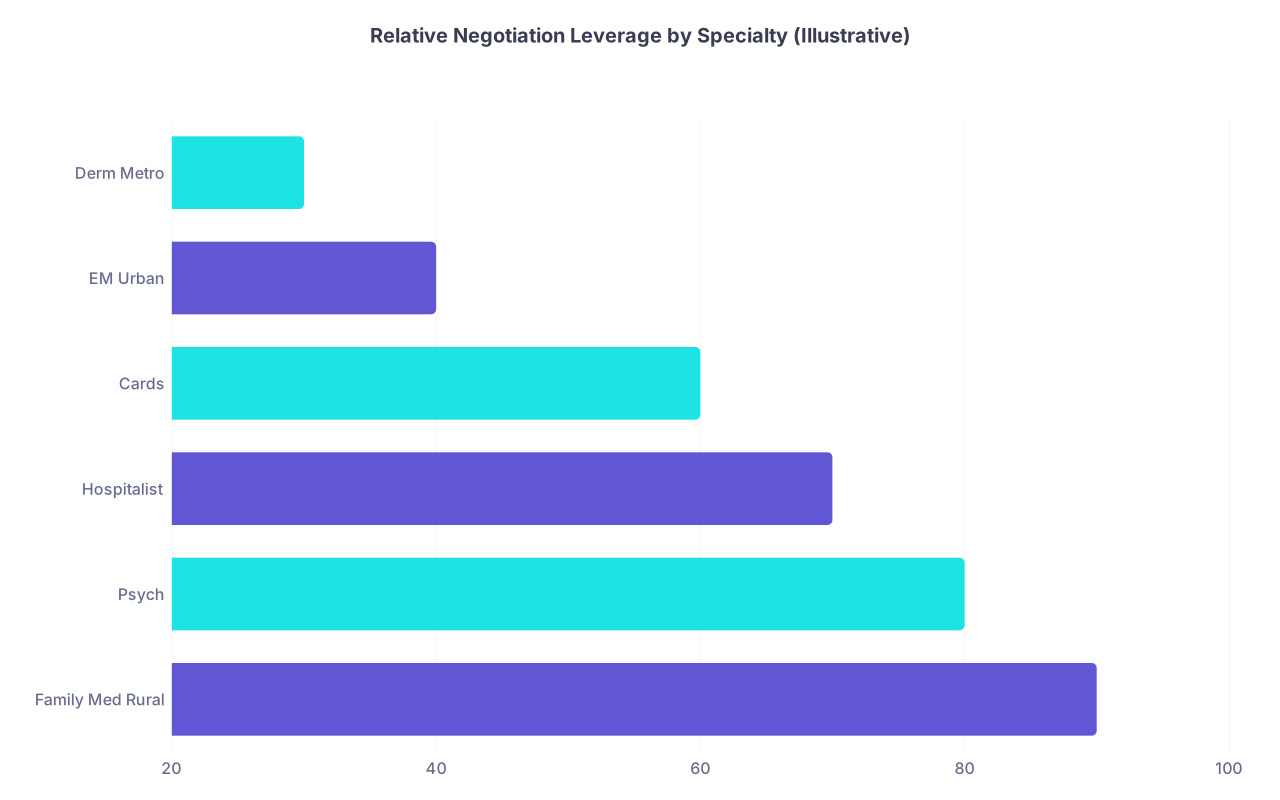
| Category | Value |
|---|---|
| Family Med Rural | 90 |
| Psych | 80 |
| Hospitalist | 70 |
| Cards | 60 |
| EM Urban | 40 |
| Derm Metro | 30 |
This is a rough feel, not gospel. But the point stands: If you’re in a high-need area or specialty, you can push more on:
- Compensation
- Non-compete
- Call burden
If you’re going for an insanely competitive metro subspecialty job, your leverage is more limited. There, the second offer buys you confidence and some tweaks, not a total rewrite.
Step 8: Use a Contract Review Strategically (Not Just Legally)
If you can stomach the cost, get a physician contract lawyer or experienced advisor involved. Not so they can send angry letters. So they can:
- Decode the non-compete, termination, and RVU structure.
- Tell you what’s “normal” in that region / specialty.
- Help you prioritize what to push for.
You can then legitimately say to the employer:
I had my contract reviewed and a few areas worry me — specifically the termination clause and non-compete. Another offer I have is less restrictive here, and my counsel suggested I ask if there’s any room to adjust those provisions.
This takes it from “picky new grad” to “reasonable professional following advice.”
Step 9: Know When to Stop and Decide
At some point, the back-and-forth has to end. The worst thing you can do is drag this on for weeks because you’re afraid to choose.
Signs you’re at decision time:
- You’ve gotten at least one revision from each side.
- You understand the comp structure, call, and non-compete clearly.
- Further changes would be marginal (another 5k here, one extra CME day there).
Now ask yourself:
- If the money were identical, which job would I pick?
- Is the worse culture/location worth the extra money? Or vice versa?
- Which job makes Future Me — post-call, with a sick kid at home — less miserable?
And then you decide. Not your PD. Not your co-fellow. You.
When you accept, close the loop with the other side like an adult:
Thank you again for the offer and for working with me throughout this process. I’ve decided to accept another position that aligns better with my personal and family priorities at this time.
I appreciated the opportunity to learn more about your group and hope our paths cross again.
No explanations about exact numbers. No apologizing for wanting what you want.
Step 10: Psychological Side — Not Getting Intimidated
A few things you’ll likely hear from recruiters, chairs, or practice leaders:
“We never negotiate.”
Translation: “We prefer you not ask.” Often untrue. Ask once anyway. If the door is really closed, they’ll show you.“Our other new hires signed this as is.”
Maybe. Maybe not. Irrelevant. Your situation, loans, and leverage are not theirs.“This is standard for our system.”
Sometimes partially true. But “standard” still gets tweaked all the time — sign-ons, RVU thresholds, non-compete radius.
You’re not being difficult by negotiating. You’re acting like a professional with a doctorate and a 3–7 year training path behind you. The recruiter negotiates for a living. So does the admin across the table. Respectful pushback is normal.
A Simple Process Map: From Two Offers to Final Choice

| Step | Description |
|---|---|
| Step 1 | Receive Offer A |
| Step 2 | Receive Offer B |
| Step 3 | Compare key terms |
| Step 4 | Plan asks for A |
| Step 5 | Plan asks for B |
| Step 6 | Use B as leverage with A |
| Step 7 | Use A as leverage with B |
| Step 8 | Revised A offer |
| Step 9 | Revised B offer |
| Step 10 | Sign A and decline B |
| Step 11 | Sign B and decline A |
| Step 12 | Choose preferred job |
| Step 13 | Accept A or B? |
You’re not trying to create a multi-month chess game. This is a short sequence: get info, clarify preferences, negotiate once or twice, and choose.
One Last Piece: Think Two Jobs Ahead
You might feel like this is “the job.” It’s probably not. It’s your first attending job. The one that sets your trajectory and either burns you out or builds your skills.
So when you’re leveraging offers, look beyond Day 1:
- Which job gives you a network you actually want?
- Which one leaves you trapped by a non-compete if things sour?
- Which one respects your time now, which usually predicts how they’ll treat you later?
If both offers disappeared tomorrow, you’d still be a physician with a valuable skill set. Act like it.
With two contracts in your inbox, you’re not at their mercy — you’re at a fork in the road. Use the second offer to improve the first, or to walk away confidently when they will not budge.
Get your asks clear, push once or twice with specifics, stay honest, then choose the imperfect but best option for your real life, not your ego.
Once you sign, your focus shifts: onboarding, building your practice, and making sure this job works for you in the first year. That’s a whole different situation — and one worth handling just as deliberately.


