

You just got the offer you thought you wanted. Big academic or large group job. Title looks good. Salary is… fine but not great. And the contract says “0.1 FTE for teaching and academic activities” with no RVU credit and no explicit protection.
Translation: you are about to do a ton of unpaid teaching on nights and weekends while your partners out-earn you.
You want real protected time for teaching. You also want to be at the top of the salary range, not the martyr who “loves education” and quietly subsidizes everyone else.
Here is how you fix that. Step by step.
Step 1: Get Clear On What You Actually Want
Most physicians walk into these negotiations fuzzy. “Some teaching time” and “a competitive salary” are not negotiable items. They are vibes.
You need numbers.
Define your teaching package in concrete terms
Decide your ideal and your minimum acceptable package before you talk to anyone:
Time
- What percent FTE protected? (e.g., 10%, 20%, 30%)
- How many half-days or sessions per week?
- Will it be blocked (e.g., every Thursday PM) or scattered?
Scope of teaching
Spell out what you are actually doing:- Precepting residents
- Medical student clerkship teaching
- Developing curriculum
- Simulation sessions
- Evaluations and remediation time
- Program or clerkship leadership
Compensation principle
Decide your non-negotiable rule:- Either:
- “Protected teaching time is paid at the same effective hourly rate as my clinical time.”
- Or:
- “Base salary remains in the top band for my specialty and region, and teaching is compensated via stipend / admin pay / separate track.”
- Either:
Write this down. Literally.

Step 2: Understand How Your Employer Actually Pays You
If you do not understand the economic engine, you will negotiate blind. The admin will win. They always do when the other side does not know the math.
Find out your compensation model
You are usually dealing with one of these:
- Pure RVU model – Base + RVU bonus; teaching generates $0 RVUs.
- Blended – Base salary tied to FTE plus RVU/collections bonus above a threshold.
- Straight salary with expectations – Academic/hospital-employed. “Competitive” but with hidden productivity expectations.
Get specific numbers, not vague statements.
Ask directly:
- “What is the expected annual wRVU target for a 1.0 FTE clinician in this role?”
- “How is teaching time accounted for in meeting that target?”
- “Does the department receive GME or UME funding that supports faculty teaching effort?”
You want to know:
- The RVU target for full-time.
- The $ per RVU they are using.
- Whether teaching RVUs or “educational RVUs” exist. (Many places do this now. If they do not, you can propose them.)
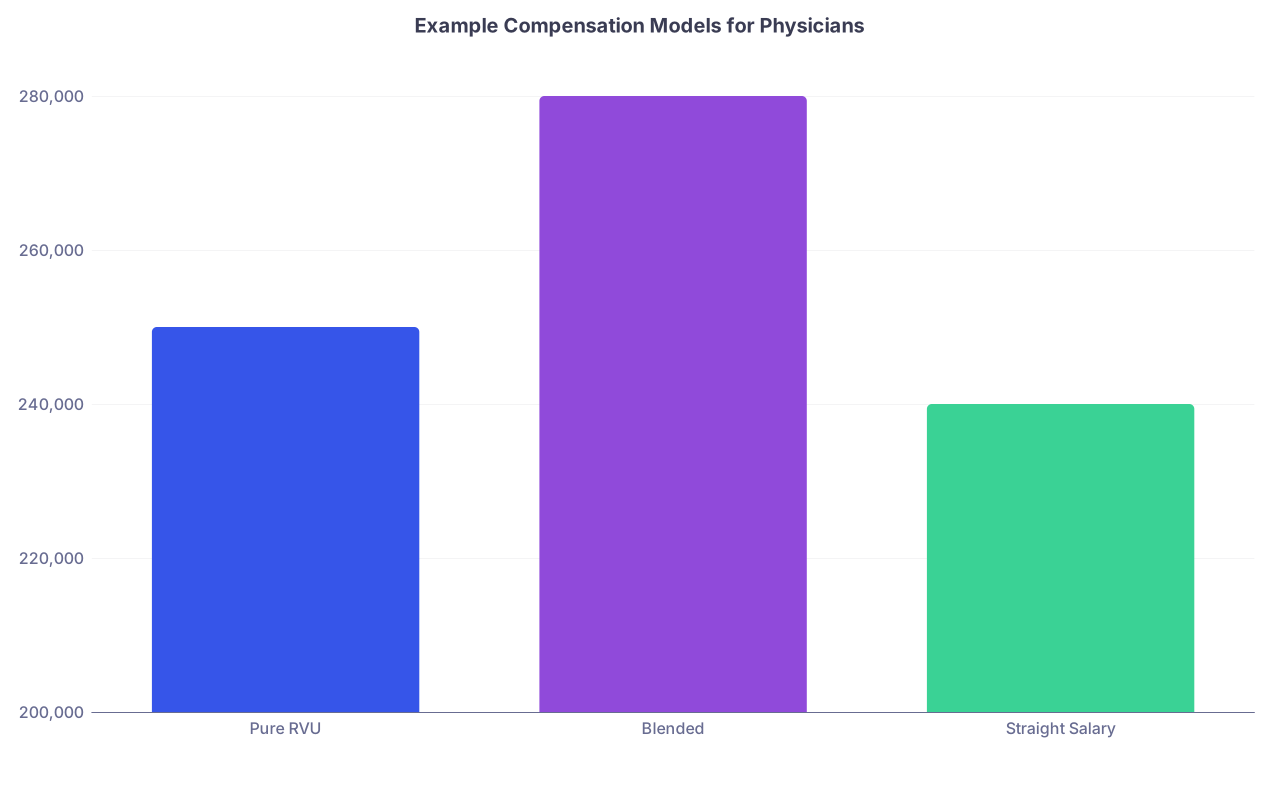
| Category | Value |
|---|---|
| Pure RVU | 250000 |
| Blended | 280000 |
| Straight Salary | 240000 |
Now you can see the game: teaching time either needs to:
- Reduce your RVU target proportionally
- Or be compensated with a stipend / separate pay bucket
- Or both
Step 3: Convert Teaching Time Into Money (So You Can Argue Like an Adult)
Administrators speak three languages: RVUs, FTE, and budget. Not “I love teaching.”
You will argue for protected time and top salary by turning teaching into numbers.
Example: How to do the math
Say:
- Typical full clinical FTE in your specialty: 7,000 wRVUs/year
- Compensation rate: $50 per wRVU
- Target base compensation: $350,000
That matches: 7,000 x $50 = $350,000.
You want 20% protected time for teaching. That is one full day per week:
- Clinical FTE: 0.8
- New RVU target should be: 0.8 × 7,000 = 5,600 wRVUs
If they leave the target at 7,000, they are asking you to produce 1.0 FTE output in 0.8 FTE time. Hard no.
Now tie this to dollars:
- Value of that 20% time in clinical RVUs = 1,400 wRVUs
- Dollar equivalent = 1,400 × $50 = $70,000
That is the financial “cost” to them of letting you teach one day per week instead of seeing patients.
Your negotiation job is to secure one of three outcomes:
Reduced RVU target + same base salary
- 5,600 target, still $350k base.
- Department “eats” the $70k loss but recovers some via GME/UME funding and institutional missions.
Same RVU target + separate teaching compensation
- 7,000 RVU target stays.
- You still do 0.8 FTE clinical plus 0.2 FTE teaching but:
- Teaching paid as an additional $70k stipend / admin pay / “educator track” supplement.
- Now your total package is $420k, which often pushes you to top-of-market.
Hybrid
- Slightly reduced RVU target (say 6,200).
- Teaching stipend for part of the difference ($40k, for example).
You are not begging. You are proposing a mathematically coherent package.
Step 4: Build Your Leverage Before You Ask
You only get top salary and protected time when you are hard to replace. That is the uncomfortable truth.
So you need leverage. Before you start asking for anything big.
Ways to build leverage
Competing offers
You do not need five. You need one solid alternative with numbers in writing.
Even a strong community job with high pay and minimal teaching can be useful as a foil.Clear value-add as an educator
Show you are not just “interested in teaching” but strategically important:- Evidence of teaching awards
- High trainee eval scores
- Curriculum development experience
- Fellowship in medical education
- Running boot camps, OSCEs, simulation, etc.
Tie your role to accreditation / program strength
If the residency needs a dedicated site director, rotation director, or scholarly mentor for ACGME compliance, that is leverage.
Programs get nervous about citations. You can make yourself the solution.Understanding local pain points
Example: The IM program is getting crushed by low in-training exam scores. You walk in with a concrete plan: dedicated board review time, simulation, and data tracking. You are not “a teacher.” You are risk reduction.
Everything in your ask will land better if framed as:
“I am part of how this institution keeps its residency strong, recruits trainees, and avoids citations.”
Not:
“I just really love teaching.”
Step 5: How to Actually Ask – The Script
Time to sit down with the chair / chief / admin.
You need to come in calm, structured, and clearly prepared. Here is a framing that works.
Opening
“I appreciate the offer. I am excited about the mix of clinical work and teaching here. I want to make sure the structure of the role sets us both up for success long term.”
Then go straight to the two key pillars:
- Protected time clarity
- Compensation parity
Protected time ask
“I want to be explicit about the teaching component. Based on the expectations we have discussed—precepting, curriculum, evaluations, and potential leadership—I am looking for 20% protected time. That is one day per week, scheduled and blocked, not just an ‘assumed’ carve-out.”
Pause. Let them react.
If they balk with “we cannot really block time,” respond:
“For this kind of role to work and to hit the educational outcomes you want, the time has to be structurally protected. What has worked best for me is [e.g., every Thursday afternoon completely off the schedule]. I am open to different days, but it does need to be built into the template.”
You are setting a baseline: protected time is not theoretical.
Compensation + RVU alignment
Now you tie it to their own math.
“For a full-time clinician here, the RVU target is about 7,000. With 20% of my effort dedicated to teaching, it makes sense for my clinical target to be 80% of that—around 5,600. I want my base compensation to remain in the top range for the department, not discounted for teaching, so I would like to see the 0.8 clinical FTE structured so that the RVU target is adjusted accordingly.”
You did not ask for a “raise.” You asked for internal consistency.
Then, if you want to push toward top salary, add:
“Given the additional responsibilities for education leadership, I would also like to talk about an education stipend or an educator-track supplement, so that my total compensation remains at the top of the departmental range.”
You are calmly tying educational work to senior-level pay.
Step 6: Anticipate Their Pushback and Pre-Build Your Counter
They will not just say “sure.” If they do, you under-asked.
Here are the most common objections and how to handle them.
Objection 1: “Everyone teaches here; we do not pay extra.”
Translation: We have been getting free labor for years and prefer to keep it that way.
Response:
“I understand that teaching is part of the culture, and I am fully on board with that. What we are talking about here is not informal hallway teaching. This is structured, recurring protected time with defined responsibilities that support accreditation and recruitment. That level of responsibility is usually treated as a formal component of FTE with either:
- Reduced RVU expectations,
- A defined stipend,
- Or both.
That is how it remains sustainable long term.”
You are differentiating yourself from casual precepting.
Objection 2: “We cannot lower your RVU target; that is department policy.”
Do not accept “policy” as the end of the story. Policies get bent for people they want to keep.
Response:
“If the target has to stay at 7,000 on paper, then we should treat the teaching effort as additive and compensate for it separately. Based on the value of that time clinically, that would be roughly a $70,000 education stipend for the 20% effort.”
You push them to choose: adjust RVUs or pay a stipend. They cannot pretend there is no cost.
| Option | RVU Target | Teaching Pay Handling |
|---|---|---|
| Adjust target only | 5,600 | No extra stipend |
| Stipend only | 7,000 | Annual educator stipend |
| Hybrid | 6,200 | Smaller stipend + reduction |
Objection 3: “We do not have budget for stipends.”
Response:
“Then the simplest way is to align my RVU expectations with my clinical FTE. If I am 0.8 clinical and 0.2 teaching, the target should reflect 0.8 FTE. Otherwise, we are asking one person to meet full-time clinical metrics while also leading education, which is not realistic.”
You bring it back to fairness and feasibility.
Step 7: Get Every Detail in Writing
Verbal promises disappear the second your chair changes jobs. Or the CMO gets “more focused on productivity.”
Anything not on paper is optional. You are not optional.
You want explicit contract or offer letter language that covers:
FTE breakdown
- “Physician will be employed at 1.0 FTE, comprised of 0.8 FTE clinical effort and 0.2 FTE dedicated to teaching and educational leadership.”
Protected time structure
- “Teaching effort will include one half-day per week of protected non-clinical time, scheduled as [e.g., Thursday afternoons] and not assigned clinical duties except in emergent circumstances.”
RVU or workload expectations
- “Clinical RVU expectation will be prorated to 0.8 clinical FTE, with an annual target of 5,600 wRVUs.”
Compensation language
- Either:
- “Base salary of $350,000 is inclusive of both clinical and teaching duties, with RVU expectations adjusted for 0.8 clinical FTE.”
- Or:
- “Base salary of $350,000 for 0.8 clinical FTE plus an annual education stipend of $70,000 for 0.2 FTE teaching responsibilities.”
- Either:
Teaching responsibilities
- Bulleted list in an addendum:
- Resident precepting X half-days/month
- Curriculum development
- Evaluations and mentoring
- Specific leadership roles (e.g., Associate Program Director)
- Bulleted list in an addendum:
Review / renegotiation point
- “Teaching FTE and associated compensation will be reviewed after 12 months and adjusted based on scope of responsibilities and institutional needs.”
This is not overkill. This is how you avoid getting quietly converted back to 1.0 clinical FTE with the same “expectations” for teaching on top.
Step 8: Use Titles and Roles Strategically
You want more than “attending who likes teaching.” Titles create structure and justify money.
Examples:
- Associate Program Director
- Site Director for [hospital or clinic]
- Director of Medical Student Education for [department]
- Clerkship Director
- Simulation Director
Each of those can carry:
- Defined FTE for education/admin
- A stipend line in the budget
- More leverage when asking for top-of-band salary
When possible, attach your protected time to a named role tied to accreditation or required program functions.
You say this:
“Given the responsibilities we are describing, this aligns well with an Associate Program Director-level role. APDs typically have at least 20% protected time. I would like my contract to reflect that title, 0.2 FTE for that work, and salary in the upper tier for that level.”
Now you are arguing from norms, not preferences.
Step 9: Benchmark Your “Top Salary” Ask
You cannot credibly ask for “top salary” if you have no idea what that is.
Use:
- MGMA
- AAMC for academics
- Specialty societies’ compensation surveys
- Informal intel from fellows, recent grads, and people at similar institutions
You are aiming for:
- At or above 75th percentile for your specialty and region for your total package (clinical + teaching).
Then phrase it this way:
“I want my total compensation, including the teaching component, to be at least in the 75th percentile for my specialty at my stage, given the additional leadership responsibilities. From what I have seen of MGMA/AAMC data, that would put us in the $X–Y range. With the base and education stipend structured as we discussed, we are in that zone.”
You anchor high, backed by data.
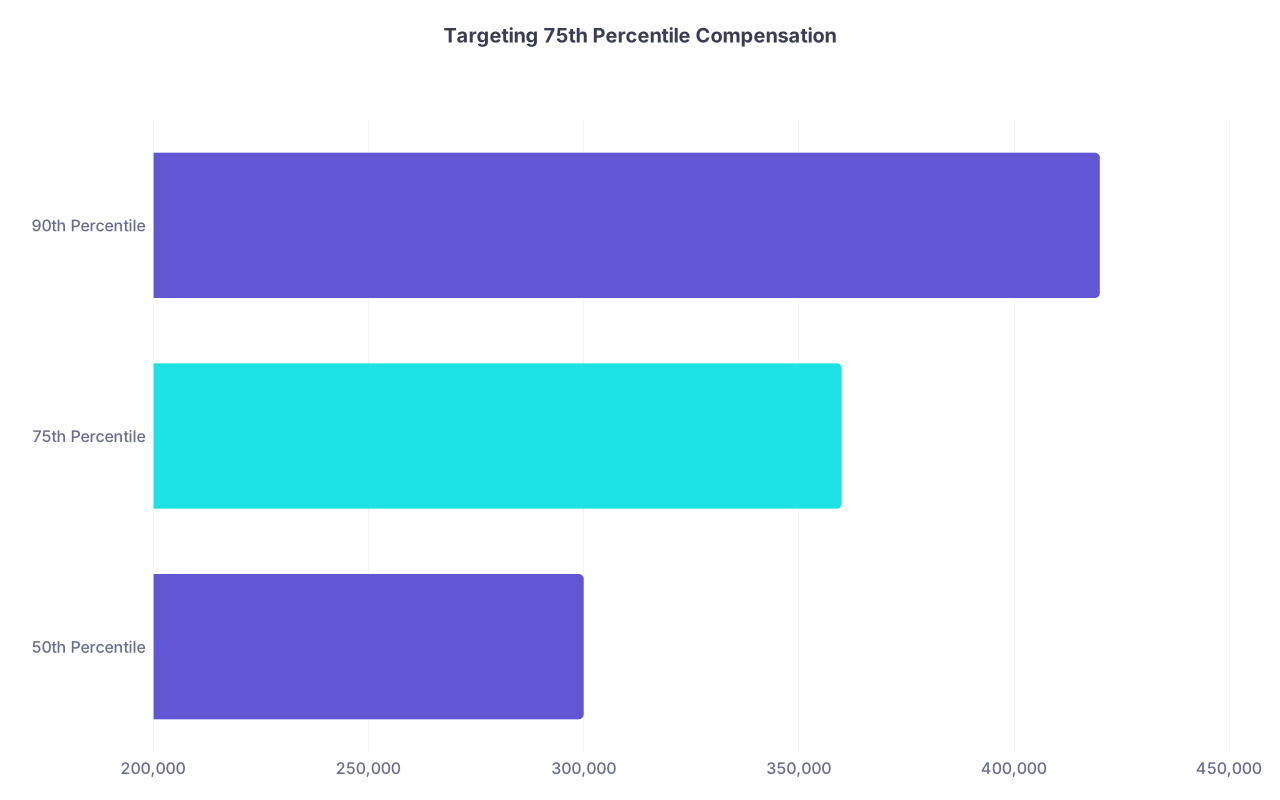
| Category | Value |
|---|---|
| 50th Percentile | 300000 |
| 75th Percentile | 360000 |
| 90th Percentile | 420000 |
Step 10: Decide Your Walk-Away Point
Final piece. You need to know when “no” is the right answer.
Because this will happen:
- They “love your vision” but will not put protected time in writing.
- They offer bottom-third salary with a fuzzy promise of “future adjustments.”
- They refuse to adjust RVU expectations and tell you “everyone manages.”
That is when you decide: is this who you want controlling your time and income?
Be explicit with yourself:
- Minimum protected time you accept (e.g., 10% or 0.1 FTE)
- Minimum dollar figure (e.g., no less than $X total comp)
- Non-negotiables (e.g., written reduction in RVU target proportional to clinical FTE)
If they cannot meet your floor, you politely walk.
Because here is the reality: if a department will not respect your time and value before you start, they will not suddenly respect it later.
Two Common Case Scenarios
Case 1: Large academic hospital, IM hospitalist
Offer:
- $260k base, 1.0 FTE, 7-on/7-off schedule
- “Significant teaching with residents”
- No formal protected time
Your ask:
- 0.8 clinical FTE (fewer shifts / sessions)
- 0.2 FTE as Associate Program Director:
- Protected admin/education days
- Adjusted RVUs or separate stipend
- Target total: $320–340k
You structure:
- $260k for 0.8 clinical FTE with prorated RVUs
- $60k APD stipend
- Written protected time for education days, plus specific APD duties
If they say: “We will do APD title but no stipend or protected time; salary stays at $260k,” you have your answer.
Case 2: Big private group with residents rotating through
Offer:
- $450k+ pure RVU model
- Residency rotates through your group, but teaching is not paid
- They dangle “informal teaching opportunities”
Your move:
- Either:
- Accept the high-pay, high-clinical job and do only limited, informal teaching. No “extra duties.” No free curriculum work.
- Or:
- Propose:
- 0.9 clinical FTE
- 0.1 FTE education director for the group with residents
- $45–50k stipend, fixed
- Protected half-day/week, no patients
- Propose:
The mistake is to take that 450k job and then slowly accumulate unpaid teaching/admin until your actual hourly rate drops to academic money without academic protections.
FAQ (Exactly 2 Questions)
1. What if my dream institution says they “never” give protected time for junior faculty?
Then you believe them. And you assume that is not changing for you. In that case, you either:
- Take the job with eyes open, prioritizing the brand name or location and consciously limiting your teaching/time donation.
- Or you walk and find a place that treats educational work as real work.
Do not sign on and hope culture will magically shift around you. It will not.
2. Can I negotiate for protected time and salary upgrades after I have already started the job?
Yes, but it is harder. You need:
- A documented track record: teaching evaluations, projects completed, leadership you have already informally assumed.
- Clear data that your current RVUs or workload are incompatible with your actual mix of teaching and clinical time.
- A concrete proposal for a restructured role with FTE breakdown, RVU targets, and compensation that align.
You frame it as: “Here is what I am actually doing, here is the misalignment, and here is a sustainable structure that keeps me here long term.”
You still push for written protected time, RVU adjustments, and compensation at or near the top of your local range.
Key Points to Take With You
- Convert teaching into concrete FTE, RVUs, and dollars before you negotiate.
- Tie your ask to specific roles (APD, clerkship director) and institutional needs, not just your personal interest.
- Lock in protected time, RVU expectations, and compensation structure in writing, or be ready to walk.


