

Most physicians either leave six figures on the table or torch relationships because they do not know how to write one email. The counteroffer email.
You can fix that in an afternoon.
What you are trying to do is simple, but not easy:
- Protect long‑term relationships.
- Signal professionalism and collegiality.
- Still push hard enough that you do not end up underpaid and boxed into bad terms.
This is a writing problem as much as a negotiation problem. So I am going to give you the exact words, the structure, and when to send what.
Use this as your playbook.
Core Rules Before You Send Anything
If you ignore these, even the best template will not save you.
Do not counter by phone first.
Talk on the phone to build rapport, but put all key numbers and terms in writing. “Per our conversation…” protects you.Lead with appreciation, not entitlement.
Your first paragraph either calms them or puts them on defense. You want calm.Counter on the full package, not just salary.
Salary, signing bonus, RVU rate, call pay, tail coverage, non‑compete, schedule. The whole thing. Otherwise you end up playing whack‑a‑mole.Ask. Do not argue.
You are not a plaintiff’s attorney in this email. You are a future colleague trying to solve a problem: “How do we make this work for both of us?”Use ranges and options.
Give them two or three paths to “yes” so they still feel like they are choosing.Never send when angry or exhausted.
Draft when annoyed if you must. Edit and send when calm.
Quick Anatomy of a Strong Counter Email
Keep this structure in your head. Every template below follows it:
- Subject line – clear, not dramatic.
- Appreciation + enthusiasm.
- Brief recap of what you like about the offer.
- Calm outline of what needs to change (2–5 bullets).
- Specific, reasonable asks with numbers.
- Reassurance you want to make it work.
- Clear next step (call / revised draft).
Template 1: Initial Counter to a Solid but Under-Market Offer
Use this when the offer is decent, you genuinely like the group, but key numbers are 10–25% below market or competing offers.
When to send: After you have the offer letter or draft contract in hand.
Subject: Offer for [Specialty] Position – Follow‑Up and Proposal
Dr. [Last Name] / [Ms. Last Name],
Thank you again for sending the offer and for the time you and the team have spent with me. I appreciate the transparency throughout the process and I remain very interested in joining [Group / Hospital Name].
There are many aspects of the offer that align well with what I am looking for, especially:
- The collegial culture I saw during my site visit.
- The commitment to [specific program: e.g., “growing the stroke program” or “building outpatient cardiology capacity”].
- The support for [teaching / research / quality projects] which is important to me long term.
After reviewing the proposal and comparing it with current benchmarks and my other options, there are a few areas where I would like to explore adjustments to see if we can get closer to market and to a package that works on both sides:
Base compensation: The proposed base of $[X] is below what I am seeing for similar positions in [region] (typically in the $[A]–$[B] range for my specialty and call burden).
→ Would you be able to consider a base in the range of $[target low]–$[target high]?Signing bonus / relocation: Given the move from [current city] and the costs associated with relocation and licensure, I was hoping for a combined package closer to $[amount] (currently at $[current offer]). I would be open to some of this being structured as a forgivable loan if that is easier on your end.
Non‑compete: The current 20‑mile, 2‑year non‑compete feels broad for this market. Would you be open to either (1) reducing the duration to 1 year, (2) narrowing the radius to 10 miles, or (3) limiting it to facilities where I actively practice?
I am enthusiastic about the possibility of joining [Group Name] and believe we could build a strong, long‑term relationship. If we can come closer on these points, I would be comfortable moving forward quickly.
Happy to discuss by phone if that is easier. Thank you again for your time and consideration.
Best regards,
[Your Full Name, MD]
[Specialty]
[Phone]
Why this works
- Respectful but not passive.
- You anchor with market data without attaching a PDF or sounding like a consultant.
- You give options on the non‑compete rather than “this must be removed.”
Template 2: Hard Counter When You Have a Stronger Offer Elsewhere
This is when you actually have leverage. Another offer in hand. Higher pay. Better terms. You want Group A but not at a $70,000 pay cut.
Use it to pressure without sounding like you are playing games.
Subject: Offer for [Specialty] Position – Interest and Competing Offer
Dr. [Last Name],
Thank you again for the offer and for all the time you and the team have invested in this process. I enjoyed meeting everyone and still consider [Group / Hospital] my first choice from a fit and career perspective.
I want to be transparent with you. I have received another written offer from [competing institution, general description only if needed – e.g., “a regional health system in [state]”] with significantly higher guaranteed compensation and a more limited non‑compete.
To be specific, that offer includes:
- Base salary of $[higher amount] for [first X years].
- Signing bonus of $[amount].
- Non‑compete limited to [radius] miles and [1] year.
I would strongly prefer to join [Group Name] if we can come closer financially. Based on my research and the other offer, would you be able to consider:
- Increasing the base salary to $[target] for the guarantee period; and/or
- Increasing the signing bonus to $[target]; and
- Narrowing the non‑compete to [radius] miles and [1] year.
I understand there are institutional constraints and I am not expecting you to match everything line by line. My goal is to find a package that makes joining [Group Name] feasible while recognizing the value I will bring to the practice.
I remain very interested in working together and would appreciate your thoughts on whether there is room to move in this direction.
Sincerely,
[Your Name, MD]
Key points
- You show your cards just enough. They know you are not bluffing.
- You still say “first choice.” That matters for people who worry about being the consolation prize.
- You signal flexibility: “I am not expecting you to match everything line by line.”
Template 3: Countering Specific Contract Landmines (Non‑compete, Tail, Call)
Sometimes the money is fine, but the legal or lifestyle terms are brutal. Extensive non‑compete, you pay your own tail, unlimited call.
Here is how to isolate the problem without blowing up the whole thing.
Subject: Offer for [Specialty] Position – Contract Terms
Dr. [Last Name],
Thank you for sharing the draft employment agreement. I have reviewed it carefully and discussed several sections with a healthcare attorney.
Overall, I remain very interested in the position and feel the role aligns well with my goals. There are a few specific contract terms I wanted to flag and see if there is flexibility to adjust. These are important to me from a risk and sustainability standpoint:
Professional liability tail coverage
As written, I would be responsible for purchasing my own tail coverage if I leave the group, which can be a significant cost for [specialty] in this region. Would the group be willing to:- Cover tail coverage if separation is due to non‑cause reasons (e.g., loss of hospital contract, reduction in force), or
- Split the cost on a pro‑rated basis depending on length of service?
Non‑compete
The current non‑compete is [X] miles for [Y] years and includes all locations where the group practices. From both a fairness and enforceability perspective, I would be more comfortable with:- A radius of [reduced miles] around the primary practice site(s) where I work, and
- A duration of [1 year].
Call coverage
The agreement does not specify a cap on call or compensation for additional call. For long‑term sustainability, I would like to either:- Include a maximum of [number] call nights / month on average, or
- Add language that call beyond that level is compensated at $[rate] per shift.
I want to be clear that I am enthusiastic about joining the team. Addressing these areas would make me much more comfortable committing to a long‑term arrangement.
Please let me know if there is room to adjust these provisions or if there are alternative structures you would consider.
Best regards,
[Your Name, MD]
Why this keeps bridges intact
You are not accusing them of bad faith. You are framing changes as risk management and sustainability. That language lands much better with admin and partners than “this is unfair.”
Template 4: Polite Decline With Door Left Wide Open
Sometimes the right move is to walk. But you want the option to come back in three years when administration changes, your kids are older, or the market shifts.
You decline now. You do not slam the door.
Subject: Offer for [Specialty] Position
Dr. [Last Name],
Thank you again for the opportunity to interview with [Group / Hospital] and for extending an offer. I truly appreciated the time you and the team spent with me and the chance to learn more about the group and the community.
After careful thought, I have decided to accept another position that is a better fit for my current family and career priorities. This was not an easy decision, because there is a lot I liked about [Group / Hospital], including [1–2 genuine positives – e.g., “the collegial culture” or “the strong support for teaching”].
I want to emphasize that my decision is not a reflection of any shortcomings on your end. The role you described is an excellent opportunity, and I am confident you will recruit someone who fits well with the team.
I hope we can stay in touch. I would welcome the chance to cross paths again professionally, whether through regional meetings, shared patients, or future opportunities.
Thank you again for your time and consideration.
Sincerely,
[Your Name, MD]
Optional variant: Declining specifically due to terms
If you want them to know exactly why, without turning it into a lecture:
After reviewing the final offer, the main factors driving my decision were the overall compensation structure and the breadth of the non‑compete. I respect that these terms reflect institutional policy, but they are not the right fit for me at this time.
That one sentence plants a seed. When they lose two more candidates over the same issues, sometimes policies change.
Template 5: “Let’s Talk First” – When the Offer is Way Off
Sometimes the offer is so off‑base that a line‑by‑line counter email is a waste. Example: $240k base for a procedural subspecialist in a high cost‑of‑living city, heavy call, you buy your own tail, 2‑year non‑compete across three counties.
In that case, set up a call, set parameters, then follow with a summary email.
Subject: Offer for [Specialty] Position – Request to Discuss
Dr. [Last Name],
Thank you for sending the offer for the [Specialty] position. I appreciate the time and effort that went into putting it together and remain interested in the possibility of joining the team.
After reading through the offer, I have several questions and concerns about the compensation structure and certain contract terms (specifically related to call expectations, non‑compete scope, and malpractice coverage). Rather than sending a long list of edits by email, I think it would be more productive to talk through these points together.
Would you have 20–30 minutes this week or early next week for a call? I want to understand what flexibility exists on your end and share what I would need to make this a realistic option.
Thank you again for the opportunity.
Best regards,
[Your Name, MD]
Follow‑up summary email after the call
This is where you lock in what you discussed and nudge them toward a revised offer.
Subject: Follow‑Up on Offer Discussion – [Your Name]
Dr. [Last Name],
Thank you for taking the time to speak with me earlier today about the offer. I appreciate your willingness to walk through the details and explore possible adjustments.
To summarize my understanding of where we landed:
- You will check on the possibility of increasing the base salary from $[current] to approximately $[target / range], potentially with a shorter guarantee period.
- There may be room to adjust the non‑compete to [revised scope / duration] focused on the primary practice location.
- The group is open to covering [tail insurance / a portion of tail] in certain circumstances, such as non‑cause termination.
- Call expectations would be [X] nights per month on average, with additional call paid at $[rate] per shift.
If this summary aligns with your understanding, I would be very interested in reviewing a revised offer reflecting these points.
Thank you again for your time and consideration.
Best regards,
[Your Name, MD]
Table: What to Push On vs. Let Go
| Term | Push Hard? | Comments |
|---|---|---|
| Base salary | Yes | Major driver of total comp |
| Signing bonus | Medium | Nice to have, often flexible |
| RVU rate / productivity | Yes | Big impact after guarantee |
| Non-compete scope | Yes | Affects future job options |
| Tail coverage | Yes | Can be a massive one-time cost |
| Relocation allowance | Medium | Often some wiggle room |
| CME / benefits | Low-Med | Improve if easy, not a dealbreaker |
How Hard Can You Push Without Burning Bridges?
You can push harder than most residents and fellows think. The bridge burns when:
- You change your story every week.
- You threaten or ultimatums (“match this or I walk”) too early.
- You drag things out for months while stringing people along.
Here is a simple frame:
Resident / new grad with one offer in a saturated market:
Push modestly. 5–10% base increase, tweak some terms. Do not die on the hill of a non‑compete if you plan to leave the state anyway.Fellow in a competitive specialty with two written offers:
Push hard on base, bonus, non‑compete, and call. You are in demand. Use it.Mid‑career doc in a niche field being actively recruited:
Push very hard. Base, RVU, schedule, administrative time, leadership titles, buy‑in terms. If you are revenue‑generating and rare, act like it.
Chart: Where Negotiations Usually Move
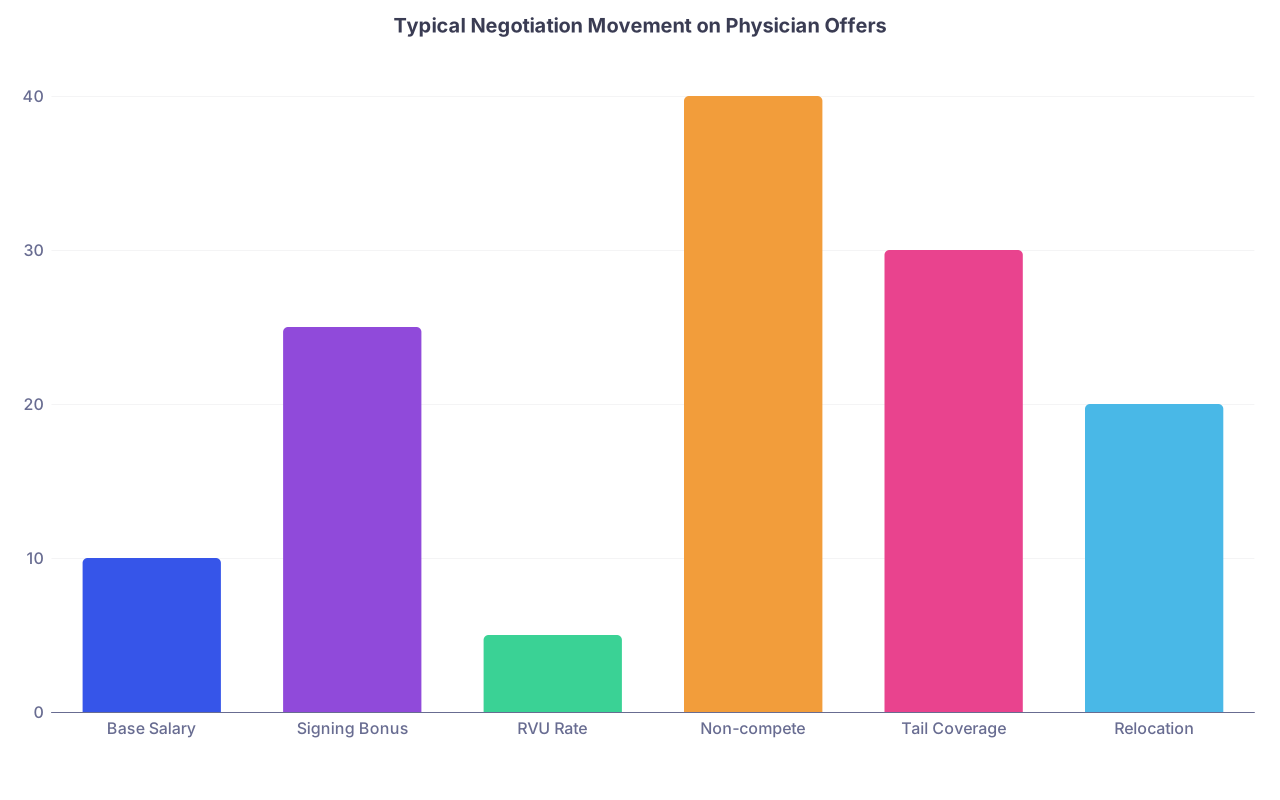
| Category | Value |
|---|---|
| Base Salary | 10 |
| Signing Bonus | 25 |
| RVU Rate | 5 |
| Non-compete | 40 |
| Tail Coverage | 30 |
| Relocation | 20 |
Interpreting this roughly:
- Non‑compete and tail are often more negotiable than people think, especially in private groups.
- RVU rate is sticky. You may get tweaks, but large jumps are rare without clear productivity backing.
Email Tone Mistakes That Kill Good Offers
A few ways physicians accidentally nuke relationships in one paragraph.
Sounding entitled.
“Given my training at [prestigious institution], I expect…”
Nobody cares. Market and value matter. Training is background, not a bargaining chip.Treating admin like enemies.
“This non‑compete is outrageous and completely unacceptable.”
It might be outrageous, but the person reading your email probably did not write it. Attack the policy, not the people.Oversharing your internal drama.
“My loans are huge and daycare is expensive, so I really need at least $X.”
The offer is about your market value to them, not your personal budget.Vagueness.
“I was hoping for something more competitive.”
Useless. Give numbers. Ranges. Concrete requests.Throwing legalese you do not understand.
Copy‑pasting your attorney’s redlines into an email without context just annoys people. Summarize the issues in plain English first.
If you have trouble with tone, draft the agitated version. Then strip out every accusation and every “you” blame statement. Replace with “the contract,” “the current offer,” “this structure.”
When to Bring in a Contract Attorney (and How to Reference Them in Email)
You should have a physician‑focused contract attorney for anything more complex than a straight W‑2 hospitalist job with standard terms.
Here is the line to avoid sounding adversarial:
“I have reviewed the draft with a healthcare attorney who works with physicians on employment agreements. We identified a few areas that are concerning from a risk perspective, and I wanted to see what flexibility exists on your side.”
You are not saying “my lawyer will sue you.” You are saying “I got professional advice and want to address risk.”
Timeline: Offer to Signed Contract
Use this as your sanity check so you do not drag things out or sign too fast.
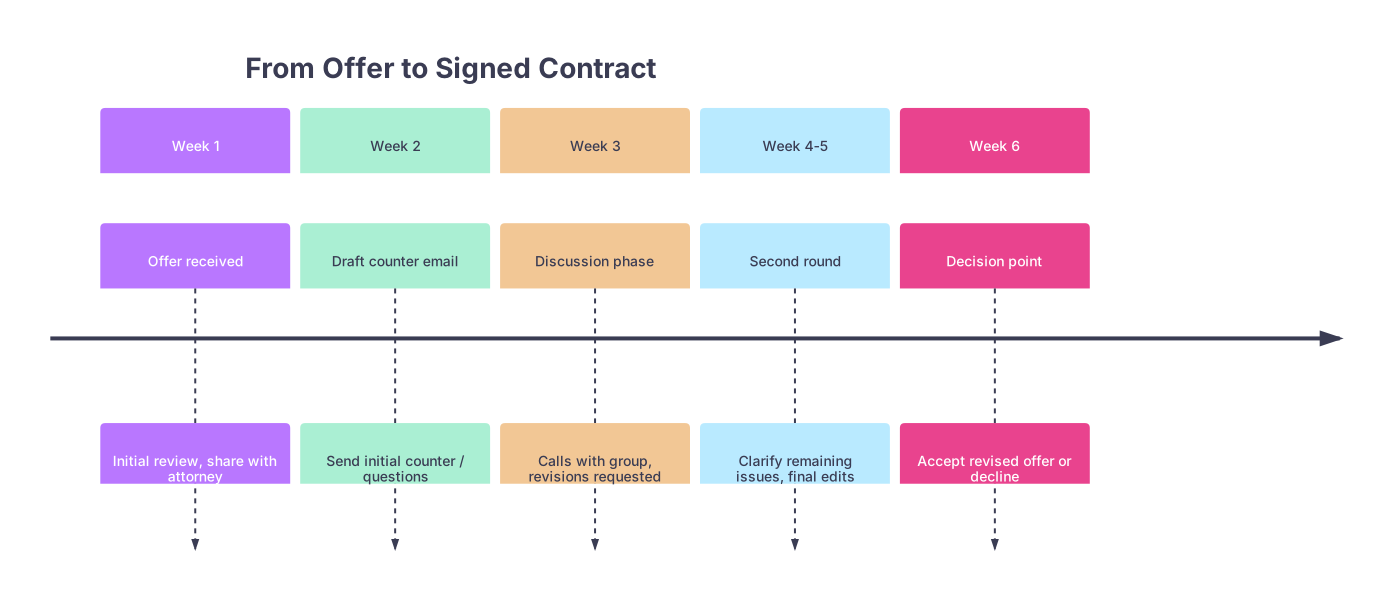
| Period | Event |
|---|---|
| Week 1 - Offer received | Initial review, share with attorney |
| Week 2 - Draft counter email | Send initial counter / questions |
| Week 3 - Discussion phase | Calls with group, revisions requested |
| Week 4-5 - Second round | Clarify remaining issues, final edits |
| Week 6 - Decision point | Accept revised offer or decline |
If this goes beyond 6–8 weeks without real movement, either:
- They are not serious about flexibility, or
- Their administrative process is broken.
Both are data points.
Dealing With “This Is Non‑Negotiable”
You will hear this. Often from someone who either:
- Does not actually have authority, or
- Has never seen anyone push back successfully.
Your response, in writing:
Thank you for clarifying. I understand if certain elements are tied to system‑wide policy. My main concern is [summarize: e.g., “the 2‑year, 30‑mile non‑compete” or “being solely responsible for tail coverage”].
If there truly is no flexibility on this point, I will need to think carefully about whether I can accept that level of risk. I appreciate your transparency.
Then you decide. Sometimes you walk. Sometimes you swallow one bad term because the rest of the package is exceptional and you can tolerate the risk. But you make that choice consciously, not because someone scared you with “policy.”
Final Words: Use Email to Signal the Physician You Plan to Be
How you handle this process tells them a lot:
- Are you clear and organized?
- Do you communicate like an adult or like a panicked intern?
- Can you advocate for yourself calmly?
You want to project: thoughtful, firm, collaborative. Future partner, not needy employee.
If you remember nothing else, keep these three points:
- Structure your counter emails: appreciation → specifics → concrete asks → reassurance.
- Fight hardest on the things you cannot fix later: non‑compete scope, tail coverage, compensation structure, call expectations.
- Protect relationships: state your needs clearly, keep the tone professional, and always leave the door open—even when you walk away.
Use the templates. Edit them to sound like you. Then send the email everyone else is too nervous to write.


