
The way most physicians “negotiate” tail coverage is wrong. They ask nicely, hope for the best, and then sign the contract that quietly sticks them with a five‑figure bill when they leave.
You need to stop doing that.
Tail coverage is a negotiable business term, not a favor. And you should be using the same concrete, sharp language that a healthcare attorney would use if they were sitting next to you.
Below is exactly how to do that—what to ask for, what to push back on, and the actual phrases you (or your lawyer) should be saying and emailing.
Step 1: Get Clear On What You Are Actually Negotiating
Tail coverage is not mysterious. It is a simple, expensive switch the employer wants to flip in your direction.
Claims‑made malpractice policy:
- Covers claims only if the claim is made while the policy is active.
- When you leave and that policy stops, any later claim from your time there is uncovered.
- Tail coverage fills that gap.
Occurrence malpractice policy:
- Covers you for incidents that occurred during the policy period, even after the policy ends.
- No tail needed.
So your first task is not to negotiate. It is to force clarity.
Here is how your attorney would start that clarification, in writing:
“Please confirm in writing: (1) Whether the malpractice coverage is occurrence‑based or claims‑made, and
(2) If claims‑made, the current carrier, limits, and whether the employer currently purchases tail coverage for departing physicians.”
You are not asking. You are documenting. Different energy entirely.
Once the answer comes back “claims‑made” (it usually does), the real game starts: Who pays for tail, under what conditions, and with what exceptions.
Step 2: Identify the Tail Allocation Pattern You Want
Most contracts fall into one of four patterns:
| Model | Who Pays Tail | Typical For |
|---|---|---|
| Employer Pays All | Employer | Highly competitive markets, hospital systems |
| Physician Pays All | Physician | Smaller private groups, rural jobs |
| Split (50/50 or Sliding) | Shared | Many medium groups, DSOs, multispecialty |
| Conditional | Depends on reason for departure | Larger groups / PE-backed practices |
If you do not pick a target model in your head, you will get whatever is easiest for them—which is usually “physician pays all.”
For a new attending, here is the priority list I recommend:
- Best: Employer pays 100% of tail, regardless of the reason for separation.
- Next best: Employer pays tail if they terminate you without cause or you leave for good cause; cost‑share otherwise.
- Minimum acceptable: Sliding scale cost‑share tied to years of service (e.g., 25/75 → 50/50 → 75/25 → 100% employer).
- Red flag: Physician pays 100% of tail in all circumstances, including employer breach. That needs to be attacked hard.
Now, the language.
Step 3: Baseline Language Your Attorney Would Push For
Let us start with what a strong, physician‑friendly clause actually looks like. This is the “ideal” version your lawyer aims for first:
“Professional Liability Insurance and Tail Coverage.
Employer shall, at its sole cost and expense, maintain professional liability insurance coverage for Physician with limits of not less than $1,000,000 per claim and $3,000,000 in the aggregate, on a claims‑made basis, covering Physician’s professional services on behalf of Employer.
Upon termination of this Agreement for any reason, Employer shall be solely responsible for procuring and paying for any extended reporting endorsement (‘tail coverage’) necessary to cover claims arising from Physician’s services rendered during the term of this Agreement.”
That is the clean version. No exceptions, no traps.
They will almost never agree to that right away. That is fine. You start there, then trade down intelligently.
Here is the exact email phrase you use to introduce that language:
“Given current market standards for post‑residency positions in this specialty, my expectation is that the employer will be responsible for tail coverage. I propose we insert the following clause…”
You are anchoring. You are also signaling that you are not guessing; you know what others are getting.
Step 4: Turn Their Bad Clause Into Your Negotiating Playground
Here is the kind of garbage I routinely see in physician contracts:
“Physician shall be solely responsible for purchasing and maintaining any extended reporting endorsement (tail coverage) upon termination of employment, regardless of the reason for termination.”
That line can cost you $30,000–$120,000 depending on specialty and region. For a new attending, that is devastating.
Your job is to break that sentence into parts you can negotiate.
Phrase Set #1: Push Back on “Physician Pays All”
Your response (out loud or in email) should sound like this:
“As drafted, the tail provision allocates 100% of the tail cost to the physician for all termination scenarios. That is not acceptable to me, particularly if the employer ends the relationship or breaches the agreement. I need to see this provision revised so that the employer bears responsibility in at least some termination scenarios.”
Then propose specific text:
“At a minimum, please revise to:
- Make the employer responsible for tail if the employer terminates without cause; and
- Make the employer responsible for tail if the physician terminates for good cause (for example, employer’s material breach).”
They may counter. Good. Now you are actually negotiating instead of being steamrolled.
Step 5: Concrete Clauses For Different Real‑World Scenarios
Let me walk through the exact language sets an attorney will cycle through depending on where you end up.
Scenario A: Employer Pays When They Pull the Plug (Without Cause)
Your lawyer would push for:
“Tail Coverage Allocation.
(a) If Employer terminates this Agreement without cause, Employer shall be solely responsible for procuring and paying for any required tail coverage.
(b) If Physician terminates this Agreement with at least ninety (90) days’ prior written notice and without good cause, Physician shall be responsible for fifty percent (50%) of the cost of such tail coverage, and Employer shall be responsible for the remaining fifty percent (50%).
(c) If Physician terminates this Agreement for good cause due to Employer’s material breach that remains uncured, Employer shall be solely responsible for the cost of tail coverage.”
This clause does three critical things:
- Protects you if they dump you.
- Protects you if they breach and force you out.
- Limits your exposure when you choose to leave voluntarily.
Here is the negotiation phrase you use:
“This allocation is more consistent with risk being shared proportionally. When the employer makes the decision to end the relationship or breaches the contract, the employer should not be able to shift that financial risk entirely to the physician.”
Scenario B: Sliding Scale Based on Years of Service
Sometimes they will not eat the whole tail. Fine. Then you attach it to longevity:
“Tail Coverage Cost Sharing.
The cost of any required tail coverage shall be allocated as follows based on Physician’s years of continuous service at the time of termination:
- Less than 1 year: Physician 100% / Employer 0%
- 1–2 years: Physician 50% / Employer 50%
- 2–3 years: Physician 25% / Employer 75%
- More than 3 years: Physician 0% / Employer 100%
Notwithstanding the above, if Employer terminates Physician without cause or if Physician terminates for good cause due to Employer’s material breach, Employer shall be solely responsible for tail coverage regardless of years of service.”
What you say to justify it:
“If I stay and build the practice for several years, I should not be penalized with a five‑figure tail bill when I eventually move. This structure rewards stability and aligns with what many of my colleagues are seeing.”
Scenario C: Employer Has a Nose Policy (Prior Acts Coverage)
Sometimes they will say: “We do nose coverage instead of tail.”
Good. That can work in your favor—if it is written correctly.
Your lawyer’s language for that:
“Prior Acts Coverage.
If Physician separates from Employer and commences employment with a subsequent employer that agrees to provide ‘prior acts’ coverage (nose coverage) that fully covers Physician’s professional services rendered for Employer, neither party shall be obligated to purchase tail coverage.
Employer agrees to reasonably cooperate with Physician and any subsequent employer to facilitate the placement of such prior acts coverage.”
Key phrase to say:
“If your standard practice is to handle this via prior acts coverage at the next employer, I need that explicitly stated so I am not left in limbo between policies.”
Step 6: Lock Down The “Good Cause” and “For Cause” Landmines
Where most physicians get burned is not the obvious clause. It is the interaction between tail coverage and the termination section.
Here is how:
- Contract says: If you are terminated “for cause,” you pay tail.
- Then they define “cause” so broadly that being one month behind on documentation counts.
- Result: they can fire you cheaply and send you a $50K tail bill on the way out.
Your attorney will do two things:
- Tighten the “for cause” definition; and
- Limit tail exposure even if “for cause” is triggered.
Language to tighten “for cause”:
“For Cause Termination – Physician.
‘For cause’ termination of Physician by Employer shall be limited to:
(i) Physician’s loss, suspension, or restriction of medical license or DEA registration;
(ii) Physician’s exclusion from participation in Medicare/Medicaid;
(iii) Physician’s conviction of a felony; or
(iv) Physician’s willful misconduct or gross negligence that materially harms Employer or patients.
Administrative issues such as chart completion, productivity thresholds, or disagreements regarding practice operations shall not constitute cause unless Physician has received written notice and a reasonable opportunity to cure (not less than thirty (30) days).”
Then, connect this to tail:
“Even in the event of a for cause termination under subsection (iv) above that is not cured, Physician’s obligation to contribute to tail coverage shall not exceed fifty percent (50%) of the tail premium.”
What you actually say to them:
“I am not going to accept a structure where an administrative disagreement can be labeled ‘for cause’ and used as a pretext to shift a massive tail bill to me. Cause needs to be narrowly defined and serious.”
Step 7: Get Numbers On The Table Before You Agree To Any Tail Split
Never agree to “Physician pays 50% of tail” without knowing 50% of what.
Real attorneys do this automatically. They ask for quotes.
Here is the exact phrase your attorney would use:
“Before we finalize any allocation of tail costs, please obtain from your carrier a written estimate of the current tail premium for a physician in this specialty, with your coverage limits, and share that estimate. I will not agree to a percentage allocation in the abstract.”
And then again, more blunt:
“I need to know whether we are talking about $15,000 or $80,000 before I sign a contract that could obligate me to that expense.”
If they resist sharing numbers, that is a data point: they know it is ugly.
Step 8: Protect Yourself in Common High‑Risk Situations
Let us talk about how tail coverage plays out in real career moves. Because this is where physicians get surprised.
Leaving After a Short First Job
You take your first job out of residency. It is a bad cultural fit. You leave after 10 months.
Standard “physician pays tail” clause? You just bought a full tail. The group shrugs.
How to protect yourself:
- Push hard for:
- Employer pays if they terminate without cause.
- Employer pays if you terminate for good cause.
- If they will not move, try:
- Cap your exposure for separations under 12 months (e.g., employer and physician split 50/50).
- Or a defined buyout cap: “Physician’s liability for tail shall not exceed $____.”
Your concrete language:
“This is my first attending position, and the risk of paying a full tail if the fit is not right in the first year is disproportionate. I need either a cost cap or a shared allocation if separation occurs within the first 12 months.”
Employer Merger, Sale, or Practice Closure
Contracts almost never protect you when ownership changes. That is a mistake.
Your attorney’s protective clause:
“Change in Control / Practice Closure.
In the event Employer is acquired, merges, ceases operations, or otherwise undergoes a change in control such that Physician’s employment is terminated or materially altered, Employer (or its successor) shall be solely responsible for any required tail coverage. Physician shall not bear any tail cost arising from a corporate transaction or practice closure initiated by Employer.”
Phrase you use:
“If the group sells to a hospital or private equity, I should not be blindsided with a tail bill because of a corporate decision I do not control.”
Step 9: Use Process And Timeline To Your Advantage
Most physicians negotiate in a panic two days before their desired start date. That is how you lose.
You should be doing this:
- Get the draft contract.
- Read only three sections first:
- Malpractice / Insurance
- Termination
- Restrictive covenants (non‑compete, etc.)
- Mark every tail‑related clause.
- Send a consolidated, calm email addressing all of it.
Here is the exact email template your attorney might send on your behalf (cleaned up, but you can use it):
“Thank you for the draft. I have a few items that need to be addressed before I can move forward. The most significant is malpractice tail coverage.
As drafted, the agreement places the entire tail burden on the physician in all scenarios. That allocation is not acceptable.
I propose the following revisions:
- Employer pays 100% of tail if Employer terminates without cause or if Physician terminates for good cause due to Employer breach.
- For voluntary resignation by Physician without good cause, a sliding cost‑share based on years of service, not to exceed 50% from Physician.
- Tail cost to be capped at a defined amount if separation occurs within the first 12 months.
I have attached specific redline language for your review. Once we resolve the malpractice section, I expect the remaining items can be finalized quickly.”
You are framing tail as the major issue. That forces them to deal with it, rather than quietly leaving it for last.
Step 10: Watch For These Red‑Flag Phrases And Fix Them
Here are the exact phrases in contracts that usually signal pain ahead—and what your attorney would reply with.
“Regardless of the reason for termination”
- Response:
“This phrase needs to be removed in the malpractice section. Tail allocation must differ when the employer initiates termination or breaches the agreement.”
- Response:
“Physician shall bear all costs associated with tail coverage”
- Response:
“I cannot accept language that assigns all tail costs to me. We need a shared or employer‑paid model in at least some scenarios, especially employer‑initiated termination.”
- Response:
“Cause shall include failure to meet productivity standards”
- Response:
“Productivity variances should not be grounds for ‘cause’ termination that triggers tail responsibility. At most, they should be addressed through a performance improvement process with an opportunity to cure.”
- Response:
No mention of tail at all
- Response:
“The agreement is silent on tail coverage, which is a major gap. We need explicit language on who is responsible for tail upon termination and under what conditions.”
- Response:
Step 11: Use Data And Market Reality To Back Your Ask
You will get resistance. Every group says, “This is our standard.”
Your counter should not be a complaint. It should be grounded.
Use concrete comparators from colleagues and recruiters:
“I am currently evaluating offers from [Hospital System A] and [Practice B]. Both include employer‑paid tail if the employer terminates without cause and shared cost arrangements in other scenarios. I am asking for something in that range—not an outlier.”
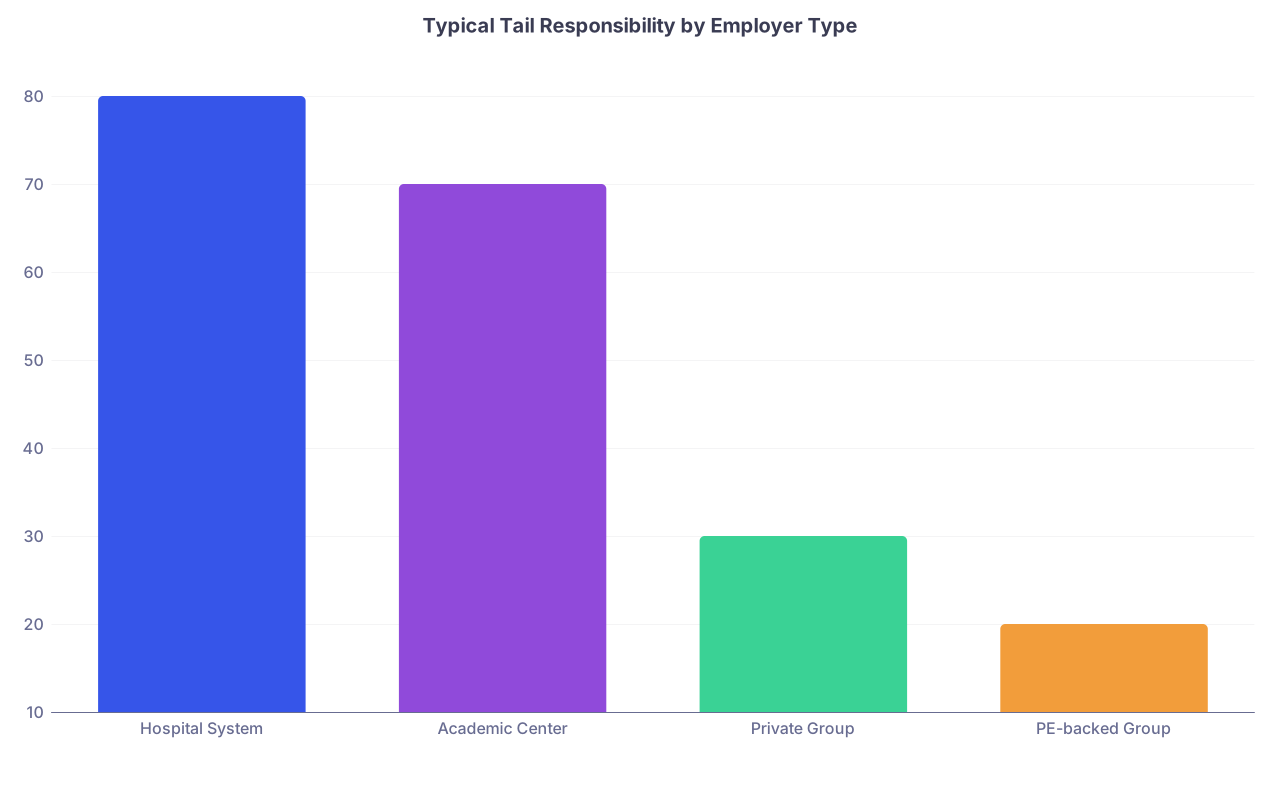
To make that more vivid, here is how tail responsibility often breaks down by employer type:
| Category | Value |
|---|---|
| Hospital System | 80 |
| Academic Center | 70 |
| Private Group | 30 |
| PE-backed Group | 20 |
(Values represent approximate % of offers where the employer pays all or most of tail in my experience—hospital systems and academics are far more generous than small or PE‑backed groups.)
That chart is not gospel. It is a reminder: you have more leverage with some employers than others. Use it.
Step 12: Understand What “No” Really Means And Decide Accordingly
Sometimes, after all of this, the employer holds the line:
- “We never pay tail.”
- “We have 20 applicants for your spot.”
- “Our partners all paid their own tail.”
Now you have a decision, not a negotiation problem.
What I tell physicians in that position:
- If the tail is likely under $15K and the rest of the deal is phenomenal (location, schedule, comp, no non‑compete), you might accept it and mentally treat tail as a signing cost.
- If the tail is more like $40K–$80K, you are looking at a stealth penalty for leaving. You need to treat that as part of your compensation package and compare accordingly.
A quick mental calibration tool:
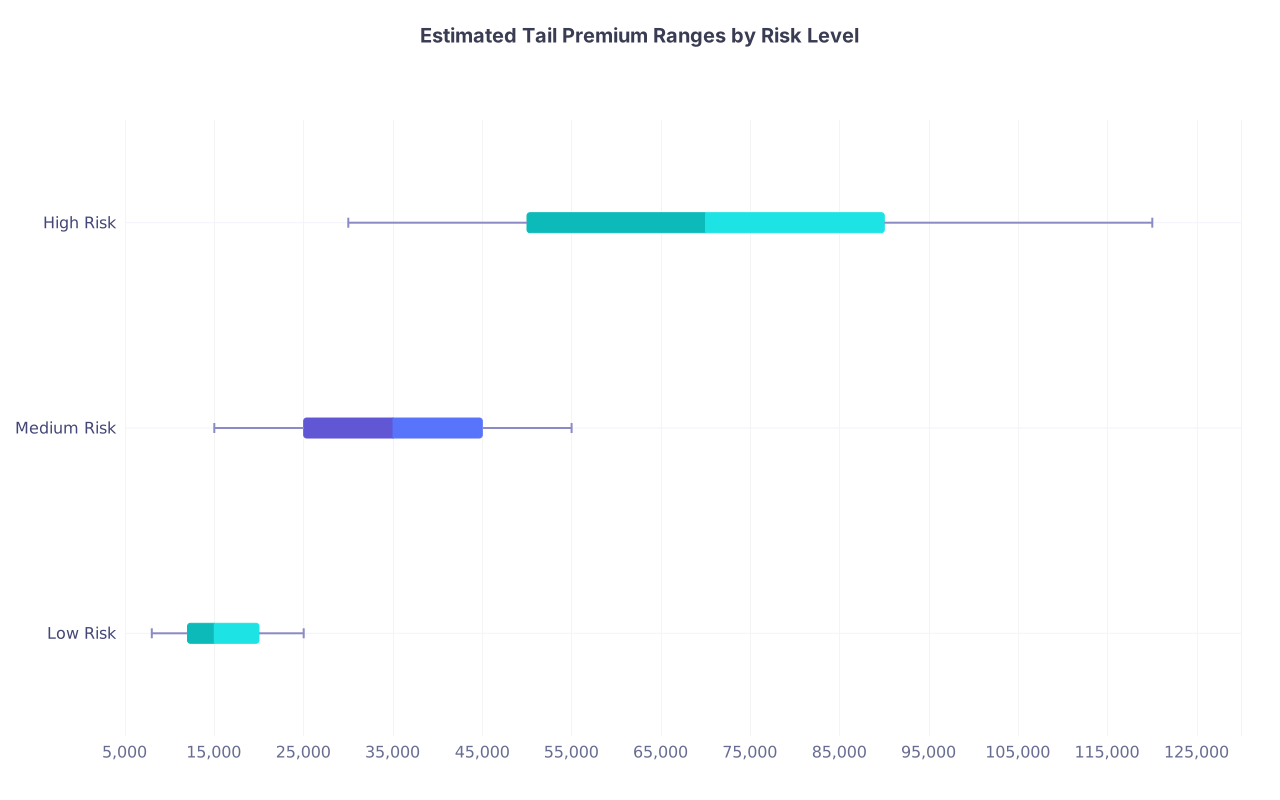
| Category | Min | Q1 | Median | Q3 | Max |
|---|---|---|---|---|---|
| Low Risk | 8000 | 12000 | 15000 | 20000 | 25000 |
| Medium Risk | 15000 | 25000 | 35000 | 45000 | 55000 |
| High Risk | 30000 | 50000 | 70000 | 90000 | 120000 |
If your specialty is medium to high risk and you are being asked to shoulder 100% tail with no exceptions, that is not a neutral clause. That is a serious financial bet on staying long‑term.
So ask yourself plainly: “Would I still take this job if they cut my effective total comp by $20K–$40K per year?” Because that is what the tail obligation can amount to when amortized over a short stint.
Step 13: How To Actually Talk About Tail Coverage In Real Conversations
Email is great. But you will also have phone or Zoom calls with leadership, where you must speak like a grown professional, not a scared new grad.
Here are ready‑made phrases you can literally read off your notes:
Opening the topic:
“I want to make sure we are aligned on malpractice coverage, especially tail responsibility, before we move too far forward. That is a major factor in my decision.”
Stating your standard:
“My baseline expectation is that if the employer chooses to end the relationship without cause, the employer is responsible for tail. Beyond that, I am open to reasonable cost‑sharing structures for voluntary departures.”
Pushing back on a hard “no”:
“I understand this has been your historical approach. At the same time, current market offers I am seeing as a graduating fellow include more balanced tail provisions. If there is no flexibility at all on this point, it makes it difficult for me to justify choosing this position over others.”
Framing it as risk allocation, not greed:
“I am not trying to nickel‑and‑dime the group. I am trying to avoid a misalignment where a single corporate decision or personality conflict could leave me personally liable for a very large tail bill.”
Have these lines written down. Use them. You will sound like someone who did not just “hope for the best” but actually understands the stakes.
To tie it together, a quick visual of when to raise what:
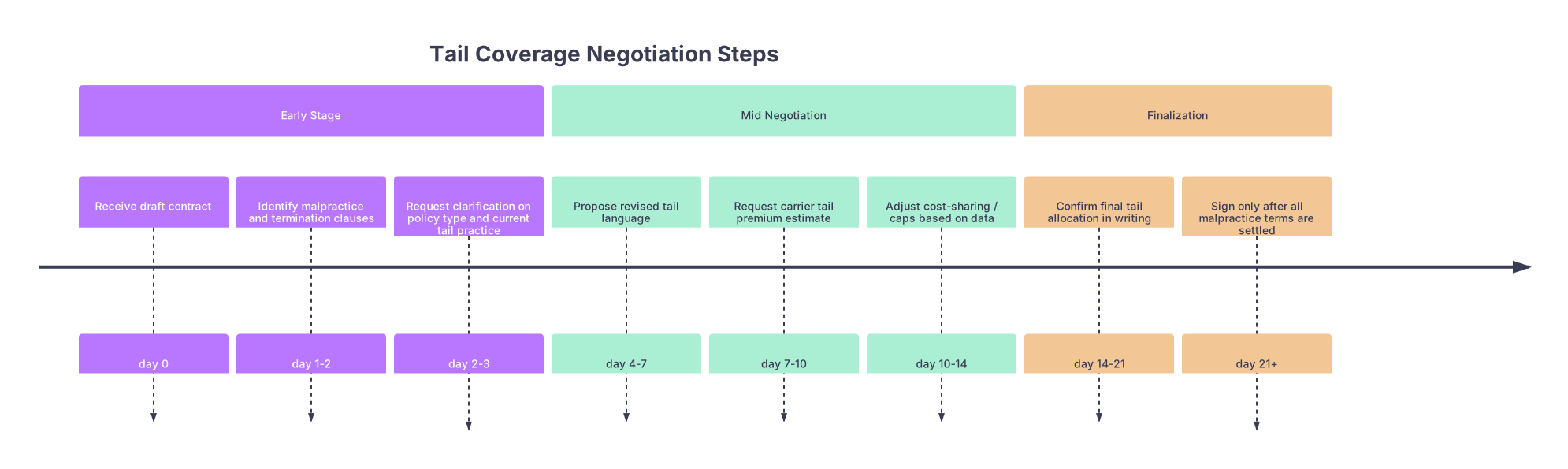
| Period | Event |
|---|---|
| Early Stage - Receive draft contract | day 0 |
| Early Stage - Identify malpractice and termination clauses | day 1-2 |
| Early Stage - Request clarification on policy type and current tail practice | day 2-3 |
| Mid Negotiation - Propose revised tail language | day 4-7 |
| Mid Negotiation - Request carrier tail premium estimate | day 7-10 |
| Mid Negotiation - Adjust cost-sharing / caps based on data | day 10-14 |
| Finalization - Confirm final tail allocation in writing | day 14-21 |
| Finalization - Sign only after all malpractice terms are settled | day 21+ |
Step 14: Do Not Forget To Document The Final Version
Verbal assurances are worthless when the claim hits three years later.
Your final checklist before signing:
Does the contract:
- Specify claims‑made vs occurrence?
- State coverage limits?
- Explicitly allocate tail responsibility by termination scenario?
- Define “for cause” narrowly?
- Provide cure periods for minor issues?
- Address mergers / closures?
Do you:
- Have a number (or range) for the tail premium?
- Understand what percentage of that you might owe in each realistic scenario?
- Have copies of all email exchanges about tail terms?
If any of those are “no,” you are signing blind.
Key Takeaways
- Tail coverage is a major financial term, not a footnote. Force clarity, attach actual dollar estimates, and never accept “physician pays all regardless of reason” without a fight.
- Use concrete, attorney‑grade phrases: tie tail responsibility to who initiates termination, define good cause and for cause tightly, and build in caps, sliding scales, or employer‑paid triggers.
- Treat tail allocation as part of total compensation. If they will not budge, decide with eyes open and compare that hidden liability to what other offers are giving you.