

The biggest regrets senior attendings have about their first contracts are the things they did not know were negotiable.
They all thought they were being “reasonable” and “grateful.” The hospital thought they were being cheap. Guess who won.
I’ve sat in on the meetings you never see—CMO talking to legal, practice owner griping to the recruiter, partner shareholders reviewing compensation reports. I’ve also listened to 50‑year‑old attendings swear they’d go back in time and shake their 32‑year‑old self by the shoulders before signing that first job.
Let me walk you through what they regret not adding. Because that’s where people get burned.
1. The One Number That Haunts People: Tail Coverage
Ask any senior attending what they wish they had negotiated in their first contract and this one comes up immediately: tail malpractice.
They didn’t understand it. They didn’t ask. They signed. Years later, they paid.
Here’s how it really plays out behind the scenes.
Hospitals and groups know new grads don’t grasp tail. I’ve heard practice managers literally say: “Don’t bring up tail unless they ask.” Because every year they lock someone into a role where leaving will cost that person $40–120k out of pocket.
Tail is not some abstract legal concept. It’s a bill. A giant, one-time bill. It comes due the moment you leave a claims‑made policy job and don’t have another insurer picking it up.
The common regret is simple: they did not have language that either:
- Required the employer to pay 100% of tail, or
- At least shared the cost, or
- Waived tail if terminated without cause or if the employer sold/merged/closed.
Instead, contracts said something like: “Physician shall be responsible for obtaining and paying for extended reporting endorsement (tail) upon termination for any reason.”
Here’s what that looked like in real life:
- Hospitalist, first job: $235k base, “claims‑made, malpractice paid.” Sounded fine.
Three years later, leaving a toxic group: $78,000 tail quote. No way to spread the payments.
They took out a personal loan.
That’s not theoretical. I’ve seen that exact bill.
If you take nothing else from this article, take this: you want tail coverage responsibility spelled out in black and white, and you want as little of it on you as possible, especially in your first contract.
At minimum, you want:
- Employer pays tail if they terminate you without cause
- Employer pays tail if they sell, merge, or close the practice
- Shared or employer‑paid tail after a certain period of continuous service (3–5 years)
And you do not sign until this is clarified. Senior attendings regret learning this lesson the hard way.
2. RVUs, “Productivity,” and the Trap of the Missing Definitions
Everyone thinks they’re going to understand their comp model. Most new attendings don’t even understand the vocabulary.
Here’s the quiet part: administrators count on that.
I’ve been in comp committee meetings where someone says, “The new grads won’t read past the base salary anyway.” They know you’re distracted by the $260k, $300k, $350k number on page one and exhausted from fellowship or residency.
The big regrets from attendings 10–20 years out? They never added:
- Clear written definitions of what counts as a billable wRVU
- A schedule of wRVU credit per CPT, attached to the contract
- A minimum base period before switching to pure or majority productivity
- A floor (guaranteed minimum) for at least 1–2 years
Without that, here’s what happens.
- You’re promised “$55 per wRVU after 6,000 wRVUs.”
- No one tells you that hospitalists in your group actually average 4,200 wRVUs.
- No one explains that procedures you thought you’d get credit for are billed globally by the group or hospital.
- Two years in, your production bonus is $0 and they comment on your “lower productivity.”
Senior attendings, especially in EM, anesthesia, radiology, and some surgical subspecialties, routinely regret not having:
- A written, fixed wRVU rate (not “subject to change by employer policy”)
- A guarantee that the RVU rate cannot be unilaterally reduced during the term
- Clear language about credit for shared visits, teaching, and non-billable work
You want the comp formula in the contract, not just in a policy manual that can be changed without your consent.
| Item | What Should Have Been Written In |
|---|---|
| wRVU dollar value | Fixed rate per term (e.g., $52) |
| Bonus threshold | Specific wRVU or revenue target |
| Call pay | Exact $ per shift / per call |
| Raise structure | % or amount per contract year |
| Academic stipends | Exact $ for teaching/admin |
If your contract just says “per employer compensation plan” without attaching that plan, you’re signing a blank check. For them.
3. Call Coverage: The Most Under‑Negotiated Pain Point
You know what people underestimate? Call.
In every debrief with mid‑career attendings I know, call is in their top three regrets. Not the existence of call. The terms.
You think, “Everyone does call, I can handle it.” Sure. Until you’re Q3, 1:4 weekends, covering three hospitals, and getting paid $0–$150 per night to be up from midnight to 4 AM.
What senior attendings wish they’d put in writing:
- Maximum call frequency (e.g., “No more than 1:6 weekday call and 1:6 weekend call without physician’s written consent and agreed compensation adjustment.”)
- Explicit separate payment for extra call beyond that baseline
- Clear rules for call redistribution if new hires join or partners leave
- A right to review and approve changes in call requirements during the contract term
What actually happened instead:
- Contracts said “Physician will participate in call as scheduled by the group.”
- The group lost two people. Recruitment lagged.
- Suddenly your Q6 became Q3, with no increase in comp.
- When you complained, leadership said, “Everyone’s pitching in right now. We’ll revisit next year.” They didn’t.
Call is a currency. Senior attendings regret not pricing it from day one.
If you’re hospital-employed:
- You want call pay itemized separately from base.
- You want weekend call, holiday call, and in‑house call differentially valued.
If you’re private‑practice headed toward partnership:
- You want transparency on how call is divided among partners vs non‑partners.
- You want to know if call decreases (or pay increases) after partnership and by how much.
Most of them never asked. They wish they had.
4. Non‑Competes That Quietly Boxed Them In
The number of attendings who feel “trapped” by their non‑compete after a few years is higher than you think. I’ve watched people stay in bad jobs purely because of the geography in one paragraph they barely read as a new grad.
Here’s the part you don’t see: local hospitals talk. Group leaders talk. They know exactly how non‑competes in the area are written and use that to control physician movement.
The regrets:
- Accepting a radius that made it impossible for their spouse to keep their job if they left
- Accepting a duration (2 years, sometimes 3) that effectively ended any realistic local options
- Not limiting the scope to the specific locations they actually worked at
- Not tying enforceability to who terminated whom (and why)
Senior attendings will tell you: they wish their first contract had said something like:
- “Non‑compete shall apply only to Hospital A and Clinic X locations where Physician provided services at least 50% of the time in the 12 months prior to termination.”
- “Non‑compete shall be null and void if Physician is terminated without cause or if employer materially breaches the agreement.”
Instead, their contracts said:
- “Physician shall not practice medicine within a 25‑mile radius of any facility owned, operated, or affiliated with Employer for a period of 24 months.”
Think “owned, operated, or affiliated” is harmless? I’ve seen that clause cover almost every hospital in a 2‑county area.
The non‑compete is not “standard.” It’s a tool. Senior attendings regret treating it like paperwork instead of a career‑defining term.
5. FTE Status, Protected Time, and the Lie of “We’ll Work It Out Later”
Here’s something young physicians chronically underestimate: how fast your 1.0 FTE turns into 1.2 FTE worth of work.
Not officially, of course. On paper you’re still “full‑time.” In reality you’re doing:
- Clinic
- Inpatient rounds
- Committee work
- Teaching
- Quality projects
- “Can you help with just one more thing?”
Senior attendings look back and wish they had done two things from the start:
- Defined what 1.0 FTE actually meant in concrete terms (clinic sessions, shifts, RVUs, hours)
- Put protected time in writing for non‑clinical duties
Without those, you get the classic bait‑and‑switch:
- Recruiter: “You’ll have 0.2 FTE for admin/research/teaching.”
- Contract: “Physician may be assigned administrative or academic duties as determined by Employer.”
- Six months in: you’re doing all the admin and teaching on evenings and weekends.
Protected time that’s not in writing is not protected. It’s a suggestion.
I’ve seen junior faculty at academic centers take on major roles—clerkship director, associate program director, QI lead—with “informal” promises of future support. Three years later, no RVU credit, no stipend, minimal promotion progress, total burnout.
They all say the same thing at 40: “I should have demanded my FTE and protected time be explicit in my first contract, when I actually had leverage as a new hire.”
6. Partnership Tracks and Private Practice Mirages
This one is brutal, especially in certain specialties: ortho, GI, cards, anesthesia, EM, radiology.
“Partnership in 2 years” is the most abused phrase in private practice recruiting.
What senior attendings regret isn’t joining private practice. Many love it. They regret not forcing the partnership track to be contractually real instead of aspirational.
Here’s what “partnership track” often means in a bad contract:
- You start as an employee at below‑market pay.
- You bust yourself for 2–3 years building their panel and revenue.
- At year 2, they say “We’re not bringing on new partners this year, the market’s uncertain.”
- Clock resets. Or the buy‑in number suddenly doubles.
I’ve seen young docs do the “2‑year” track for 6+ years. Still associates. Still at the mercy of the original partners.
They regret not insisting on:
- A written time frame: “Partner consideration after 24 months of full‑time employment.”
- Clear, objective criteria: RVU thresholds, citizenship expectations, quality metrics.
- A predetermined or formula‑based buy‑in, not “to be determined by the partners at that time.”
- Access to financials before signing and definitely before buy‑in (collections, overhead, payer mix).
The partners will call you “entitled” if you ask. Ignore that. That’s exactly what they said about the few people who did get these things in writing—and those are the ones who ended up with fair deals.
If the partnership track is real, they won’t be afraid to put it in ink.
7. Termination Clauses and the Missing Safety Net
Young attendings focus on the start of the job. Senior attendings obsess over the exit terms. Because they’ve lived through layoffs, mergers, leadership changes, hostile new CMOs.
The painful regrets come from signing contracts that allowed:
- Termination without cause with very short notice (30 days, sometimes even less)
- No severance whatsoever, even for no‑cause termination
- Employer ability to change location or primary duties without physician consent
You know what 90‑day notice with no severance looks like when a system decides to “restructure”? It’s panic. Kids mid‑school year. Mortgage. Aging parents nearby. And an HR email that reads like a utility bill.
Would those same physicians have skipped the job if they couldn’t get better terms? Maybe, maybe not. But they all say: “I should have pushed harder on termination language. It felt awkward to talk about leaving before I even started. I got burned for that.”
You want:
- At least 90 days’ notice for termination without cause, 120 is better
- Severance if they terminate without cause (even 1–3 months base is meaningful)
- Some control over unilateral changes in work site or role (“material change requires mutual written consent”)
Most new grads never even bring this up. Big mistake.
8. CME, Licensing, and the “Nickel‑and‑Diming” They Didn’t See Coming
This one sounds small until you add it up. Over a decade, it’s tens of thousands of dollars.
Here’s what senior attendings say they wish they’d locked in tight:
- Adequate CME allowance (not $1,500); $3,000–$5,000 is more realistic in many fields
- Paid time off specifically for CME, not “use your PTO”
- Reimbursement for license(s), DEA, board certification, required hospital fees
- Paid society dues for at least one major specialty organization
I’ve seen academic centers cover almost nothing and say, “Well, you can use your academic office funds.” Those funds are $0. Or they show up once and vanish with budget changes.
Year after year, you’re paying:
- State license renewals
- DEA renewal
- Specialty board maintenance
- Hospital staff dues, sometimes multiple facilities
- Required CME — and the conferences that matter aren’t cheap
Senior attendings regret that their first contracts didn’t separate:
- PTO for vacation
- PTO for sick time
- CME days
Instead, everything was lumped under “28 days PTO” and they effectively had to choose between staying current and seeing their family.
Ask for real numbers. In writing. Before you sign.
9. The Support You Don’t Think About Until You’re Drowning
The dirty secret: admin and clinical support is one of the biggest ways employers quietly shift cost and burnout onto physicians.
New grads rarely ask about it. Senior attendings know better, because they’ve lived through the bait‑and‑switch from “full support” to “do more with less.”
Common regrets:
- Not specifying MA:physician or RN:physician ratios
- Not clarifying who does prior auths, referrals, inbox triage
- Not limiting expected “uncompensated overtime” to clear boundaries
You can’t perfectly control staffing in a contract, but you can insist on expectations like:
- “Physician will have dedicated clinical support staff during all scheduled clinic sessions.”
- “Physician administrative duties (inbox, refills, messages) will be limited to X hours per week, with additional compensation or support if exceeded.”
That last one? I’ve only seen a handful of doctors ever get it in writing. And those doctors are much harder to abuse with endless inbox work at 10 PM.
10. The One Clause Almost No One Reads: “Employer Policies”
A quiet little clause that comes back to bite attendings 5–10 years in is some variation of:
“Physician agrees to abide by all Employer policies and procedures, as may be amended from time to time at Employer’s sole discretion. Compensation and duties may be adjusted in accordance with such policies.”
You skim over that. Everyone does.
Here’s what it actually means in practice: they can materially change your job and pay structure without renegotiating your contract, as long as they label it a “policy” change.
I’ve watched:
- Groups cut RVU rates and call pay under a “revised compensation policy”
- Admins add mandatory evenings/extended hours as a “patient access initiative”
- Health systems require extra committees or quality projects “per new performance expectations”
All without touching your contract. Because you already agreed to follow “all policies, as amended.”
Senior attendings regret not at least pushing for language that says:
- “Employer policies shall not materially change Physician compensation or primary duties without mutual written agreement.”
Will they always give it to you? No. But you’ll be surprised how often they’ll soften the language if you push.
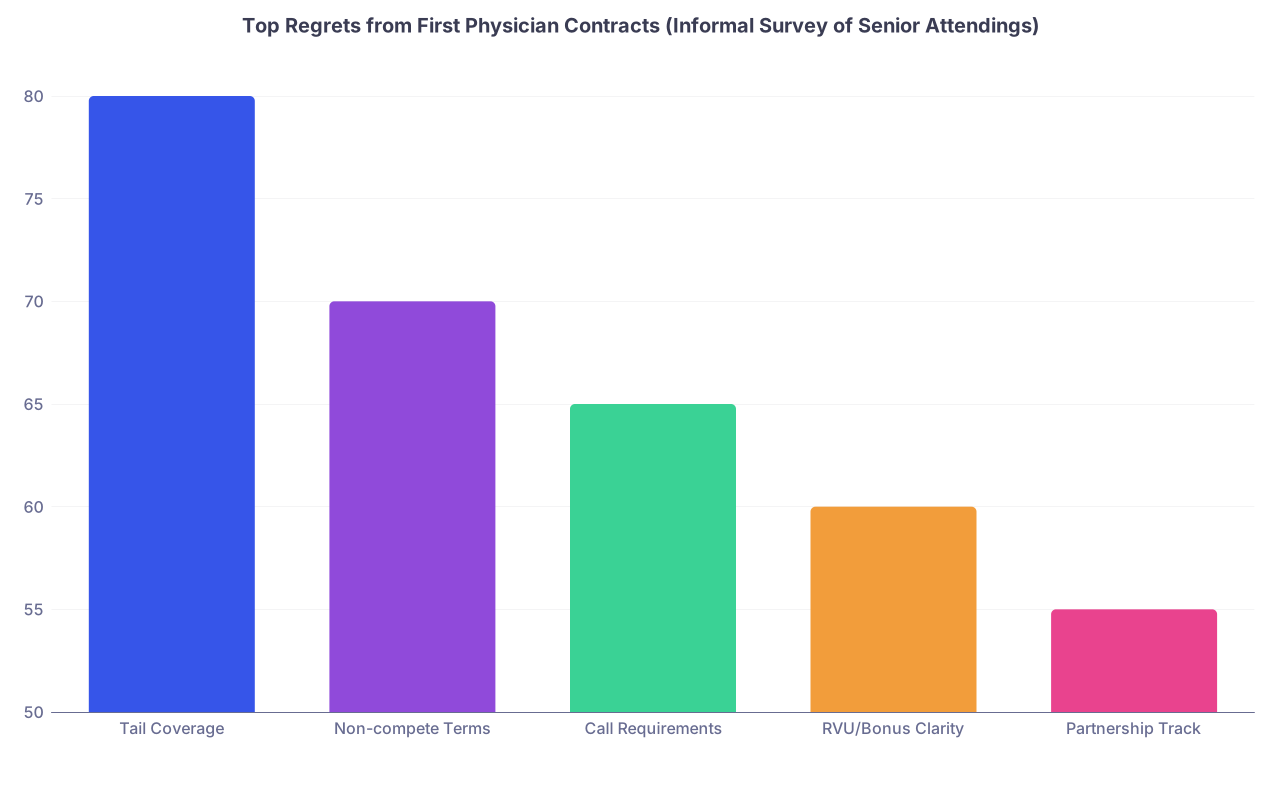
| Category | Value |
|---|---|
| Tail Coverage | 80 |
| Non-compete Terms | 70 |
| Call Requirements | 65 |
| RVU/Bonus Clarity | 60 |
| Partnership Track | 55 |
How These Regrets Show Up 10–15 Years Later
By mid‑career, the pattern is obvious. The attendings who were deliberate and demanding in their first contract usually:
- Changed jobs earlier and more strategically
- Built wealth faster (because they didn’t give away years of underpaid, over‑called work)
- Avoided feeling trapped in toxic environments
The ones who signed whatever was put in front of them out of fear or “gratitude” often:
- Stayed too long in bad jobs because of tail, non‑competes, or both
- Took financial hits when trying to leave
- Built their life (house, kids’ schools, spouse’s job) around a geographic box they didn’t realize they’d agreed to
I’ve watched both groups sit in the same physician lounge. The difference in their stress level is almost physical.
The irony: your first contract is usually when you have the most leverage. You’re new, in demand, relatively cheap for what you can generate, and the market is short on physicians. But psychologically, you feel the least powerful, so you negotiate the least.
That’s how these regrets are born.

| Step | Description |
|---|---|
| Step 1 | Residency or Fellowship |
| Step 2 | Offer Received |
| Step 3 | Signs Without Negotiating Key Terms |
| Step 4 | Early Practice - Honeymoon |
| Step 5 | Workload and Call Increase |
| Step 6 | Tries to Leave or Renegotiate |
| Step 7 | Financial Hit to Exit |
| Step 8 | Geographically Trapped |
| Step 9 | Stays in Bad Job Longer |
| Step 10 | Mid Career Regret |
| Step 11 | Contract Barriers |
FAQ: What Senior Attendings Ask Me to Tell You
1. “Is it realistic to get all of this in my first contract?”
No. You won’t get everything. And you do not need the “perfect” contract. But you should absolutely pick 3–5 high‑impact items—tail coverage, non‑compete scope, call terms, RVU clarity, exit terms—and push hard on those. Senior attendings don’t regret the things they asked for and didn’t get. They regret what they never brought up.
2. “Won’t I look difficult if I negotiate too much?”
Behind closed doors, the language is harsher: “naive” vs “savvy.” Admin and partners expect you to negotiate at least some things. They’re more worried when you sign everything with no questions—that’s the person they know they can load up with extra work later. A reasonable, well‑informed negotiation earns respect. Whining after you signed earns eye rolls.
3. “How do I know if a non‑compete or tail clause is a dealbreaker?”
Ask yourself two concrete questions:
- If this job turns toxic, can I afford to leave—financially and geographically?
- Do I have other realistic options if I walk away right now?
If the answer to both is “no,” the contract is chaining you to that employer. Many senior attendings wish they’d walked away from those deals early instead of “seeing how it goes.”
4. “What’s the single most important line to add if I can only get one real change?”
If I had to pick for you? Clear employer responsibility for tail coverage when they terminate you without cause or when they sell/merge/close. That one line has saved careers and prevented six‑figure hits. Non‑compete softening is next. Most of the other stuff you can live with for a few years. Tail and non‑compete can own you.
Here’s what you need to remember:
- The biggest regrets are almost always about missing language, not flashy salary numbers.
- Your first contract quietly sets the boundaries of your freedom for years—tail, non‑compete, call, exit terms.
- You have more leverage than you feel. Use it now, so you’re not one of the attendings telling the next generation, “I wish someone had warned me.”


