

The most dangerous RVU contracts are not the obviously bad ones. They are the ones that look generous until you run the math and realize you just signed up for burnout at a discount.
You are stepping out of residency into a market that increasingly weaponizes RVUs against physicians who do not know how these models really work. I have watched too many new attendings lock themselves into three‑year traps because they trusted HR slides and “our top earners make $700k+” anecdotes instead of demanding hard numbers.
Let’s make sure you are not next.
RVUs 101: The Trap Is Usually in the Details, Not the Concept
RVUs themselves are not the problem. The way they are used is the problem.
Very quick baseline so we can talk about the traps:
- wRVU (work RVU) – your actual clinical work. This is what almost every physician compensation model cares about.
- Total RVU – wRVU + practice expense + malpractice. This is not what you want your pay tied to.
- Conversion factor – dollars per wRVU (e.g., $50/wRVU).
In a clean model, you see something like:
- Base salary: $260,000
- wRVU target: 6,000/year
- wRVU rate: $50/wRVU above target
The toxicity comes when:
- The target is unrealistic relative to your FTE and support.
- The wRVU rate is quietly low.
- The “base” is a short‑term teaser that will vanish.
- The hospital manipulates how RVUs are counted.
If you do not know the benchmarks, you have no idea what is fair. Here is a quick sanity check:
| Specialty | Common Annual Target | Typical wRVU Rate ($/wRVU) |
|---|---|---|
| Outpatient IM | 4,500–6,000 | 45–60 |
| Hospitalist | 4,000–5,500 | 45–65 |
| General Surgery | 7,000–9,000 | 50–70 |
| Cards (non-int) | 7,000–9,000 | 50–80 |
| EM | RVUs/shift metric | 50–80 |
If your offer is dramatically outside these bands, your mistake might already be starting.
Red Flag #1: “Guaranteed” Salary That Quietly Converts to Pure RVU Hell
The most common trap: the sweet‑sounding “2‑year guaranteed salary” that morphs into a punishing RVU‑only model once you are settled, have moved your family, and your kids like their school.
Typical pattern:
- Year 1–2: “Base salary $300,000, no RVU pressure, just build your practice.”
- Year 3+: Salary disappears. You get:
- wRVU target 7,500
- $48/wRVU
- No floor. No guarantee. Collections risk shifted onto you.
On paper, they’ll say: “Most of our physicians hit 8,500 wRVUs; you will do great.”
In reality, half the group never touches target because:
- The call schedule is brutal and disruptive.
- You are covering three sites, constantly driving, zero efficiency.
- Support staff turnover is high; MA and RN holes crush your throughput.
- Clinics are under‑resourced: 1:1 MA, clunky EMR, chronic overbooking or underbooking.
The worst twist: some contracts demand repayment of “excess” salary if your wRVUs during the guarantee period do not justify what they paid you. That “guarantee” is actually a loan in disguise.
How to catch this before you sign
You should be asking, in writing:
- “What happens after the guarantee period ends? Show me the exact Year 3+ formula.”
- “Is there any clawback or repayment if I do not meet wRVU levels during the guarantee?”
- “What percentage of your physicians hired in the last 5 years are still here now?”
- “What is the median wRVU production for physicians in my specialty here during years 1, 2, 3?”
If they cannot or will not give you those numbers, you are walking into a black box by choice.
Red Flag #2: Unrealistic RVU Targets Disguised as ‘Average’
The second big trap: targets that are “based on MGMA” but somehow 10–20% above what other systems are using for the same specialty.
I have seen internal medicine offers like:
- Base: $260,000
- Target: 7,000 wRVUs
- Bonus only after 7,000 (e.g., $55/wRVU above target)
For a full‑time outpatient IM doc with average support, 7,000 wRVUs is borderline insane. That is afternoon‑clinic‑every‑day‑plus level work, with no margin for vacations, admin, or actual thinking.
This is often what happens when you normalize unsustainable productivity:
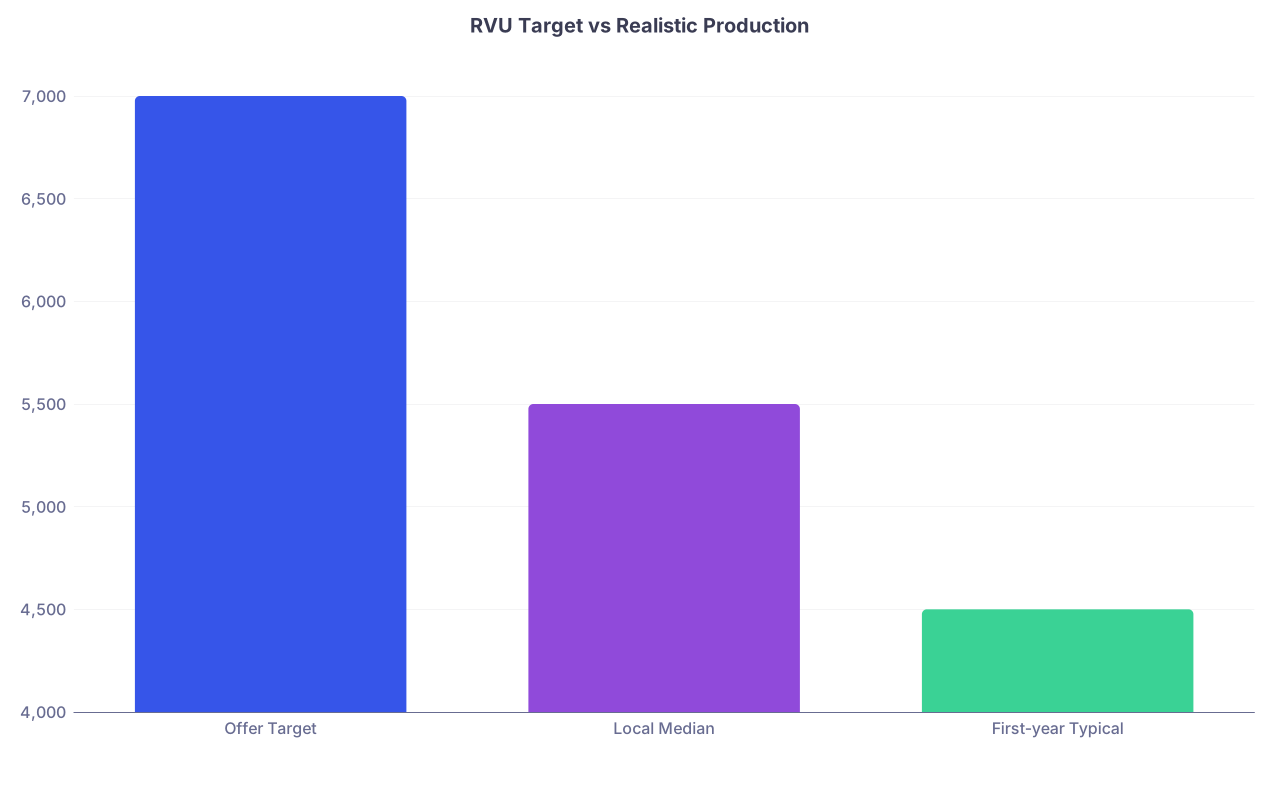
| Category | Value |
|---|---|
| Offer Target | 7000 |
| Local Median | 5500 |
| First-year Typical | 4500 |
That “MGMA‑based” language is usually misleading. They cherry‑pick 75th–90th percentile productivity then call it “average.” If your target is their 75th percentile but your pay is near national median, you are subsidizing their margin with your nights and weekends.
Concrete questions to force clarity
Ask them to put this in writing or email:
- “What are the annual wRVU targets for my specialty and FTE level?”
- “What are the actual median and 75th percentile wRVUs produced by your current physicians in this role?”
- “How many physicians in this role met or exceeded target last year? Out of how many total?”
- “How many clinic days per week and how many patients per day are you expecting to hit that target?”
If you are expected to:
- See 22–25+ complex patients per day
- Handle your own inbox, refills, documentation
- Take call
…and still be “average,” that is not a neutral contract. That is a churn model.
Red Flag #3: Low RVU Conversion Factor Paired with High Targets
Some groups try to look generous by setting “reasonable” targets… then quietly underpaying each RVU.
Example I saw for outpatient cards:
- Target: 7,500 wRVUs (reasonable for some settings)
- Rate: $40/wRVU
- “Top earners” allegedly make $650k
Run the math:
- Hit target: 7,500 x $40 = $300,000
- To get to $650k, you would need:
$650,000 / $40 = 16,250 wRVUs. That is absurd.
So either:
- They are lying about what “top earners” make, or
- Those “top earners” are working at a level that is not compatible with a sustainable life.
You need to triangulate:
- Target relative to FTE
- Expected patient volumes
- Actual rate per wRVU
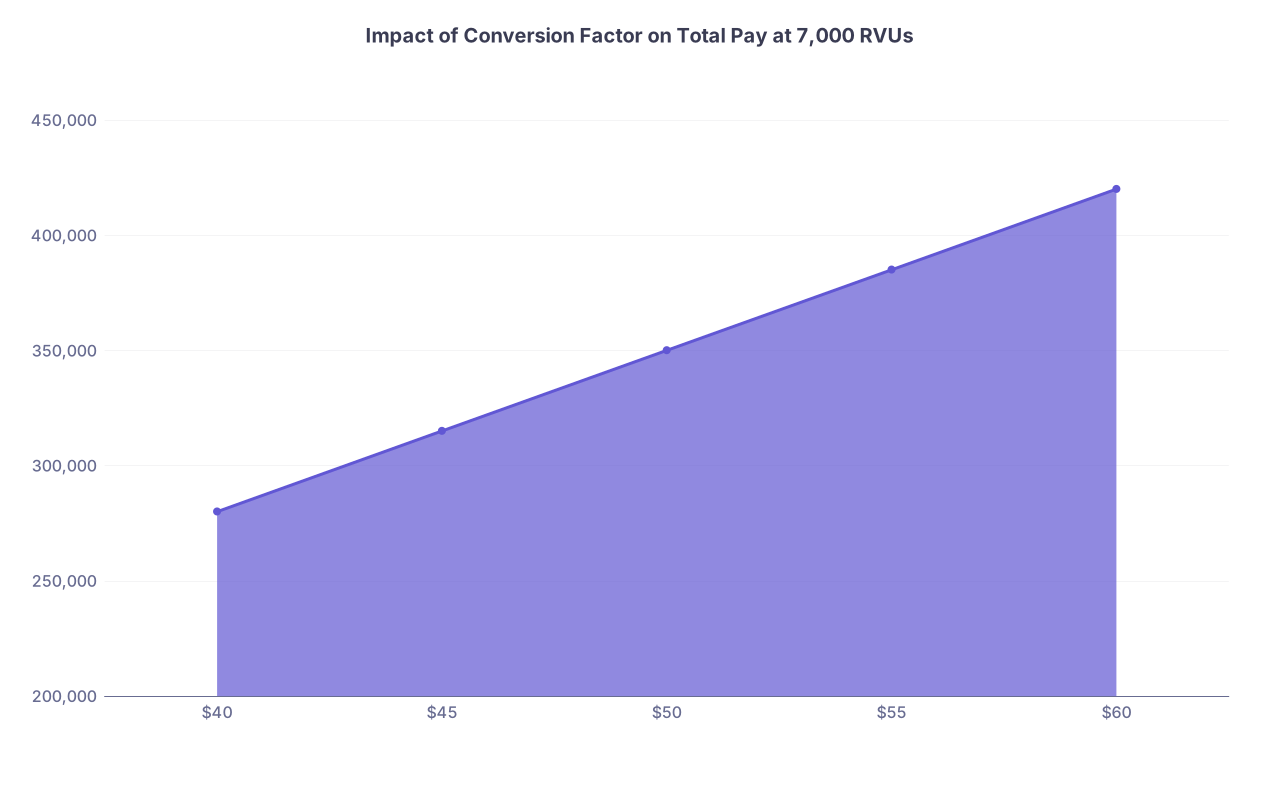
| Category | Value |
|---|---|
| $40 | 280000 |
| $45 | 315000 |
| $50 | 350000 |
| $55 | 385000 |
| $60 | 420000 |
That chart is the entire point: a $10 difference in conversion factor can mean a $70k difference at the same workload. Low rate + high target is a double hit.
Numbers you must demand
- “What is the exact wRVU conversion factor for my role after the guarantee?”
- “Is the conversion factor fixed for the life of the agreement? If not, who sets it and how often?”
- “Are there any thresholds or tiered rates (e.g., $45 for first 5,000, $60 after 8,000)? Put that in the contract, not just verbally.”
If the rate is materially below regional norms, do not let them compensate by “promising volume.” You cannot spend promises.
Red Flag #4: RVU Credit Games and Opaque ‘Adjustments’
Here is where it gets really sneaky.
The RVUs you think you are generating are not always the RVUs they are crediting to you. Some groups quietly:
- Exclude certain codes from RVU credit (e.g., nurse visits, phone visits, care management).
- Cap RVUs on certain visit types, even when you document appropriately.
- Split RVUs between multiple physicians in nontransparent ways.
- Use “team RVU pools” where your effort subsidizes other people.
You see this in contracts that say:
- “RVUs will be credited in accordance with employer’s compensation plan as amended from time to time.”
- Or: “RVU values and attribution will be determined solely by Employer policies.”
Translation: they can change the rules at any time without changing your contract.
I once watched an employed doc discover that half her hospital follow‑ups were being attributed to the hospitalist group, not her, because “that is how we do it in our system.” No one mentioned that during recruitment.
Protection strategies
You should insist on:
Specific RVU schedule reference
“wRVUs shall be calculated using the current year CMS Physician Fee Schedule wRVUs, without modification or reduction.”Fixed attribution rules in the contract, not just a policy document:
- Who gets credit for split/shared visits?
- Who gets credit for procedures done during hospitalizations?
- Are APP‑generated RVUs credited to you, shared, or kept by the hospital?
Right to audit:
A clause that you can review how RVUs are calculated and challenge errors quarterly.
If they balk at including specifics and say “we never have issues with that,” that is exactly when you should worry.
Red Flag #5: No Protection Against Non-Productivity Factors That Kill Your RVUs
A pure RVU model assumes a fantasy world where:
- Clinics run on time.
- Staff are stable and trained.
- The EMR does not crash.
- You never get pulled into unpaid admin meetings, committees, or teaching.
Reality is uglier. RVU models turn toxic when the system:
- Cuts MA/RN staffing but expects the same RVU production.
- Switches to a new EMR that slashes productivity for months (or permanently).
- Piles on non‑clinical duties without credit (medical directorship, QI projects, teaching).
Look at this typical time allocation for a new attending:
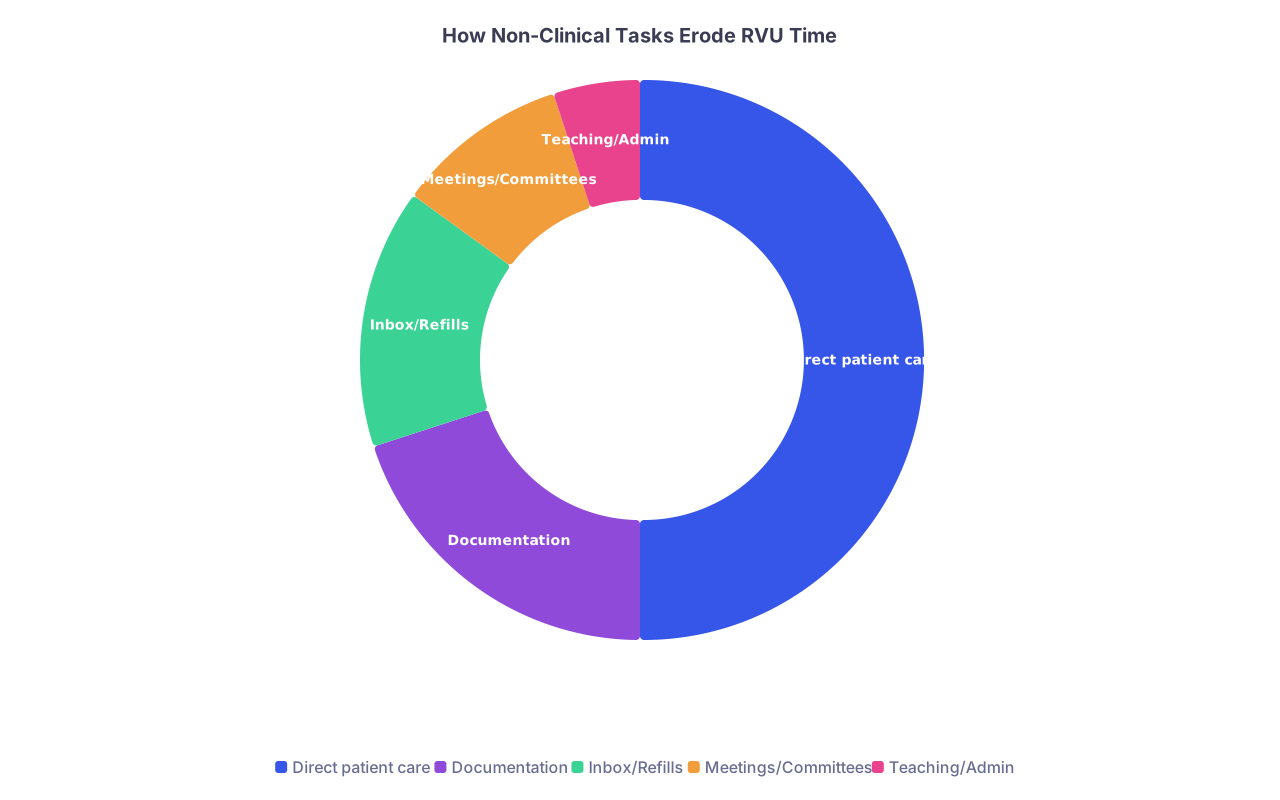
| Category | Value |
|---|---|
| Direct patient care | 50 |
| Documentation | 20 |
| Inbox/Refills | 15 |
| Meetings/Committees | 10 |
| Teaching/Admin | 5 |
You are paid only on that “direct patient care” slice. Everything else quietly eats your chance of hitting target.
Minimum protections you should negotiate
At least try to get:
Adjustment language:
“RVU targets will be proportionally adjusted downward for significant non‑clinical duties assigned by Employer (e.g., committee leadership, teaching, admin roles). Such duties and adjustments will be documented in writing.”FTE clarity:
1.0 FTE should be clearly defined in hours and clinical sessions. If you are 0.8 FTE, your target needs to be 0.8 of a full target, not “roughly the same.”Start‑up and transition grace period:
Lower targets or guarantees during EMR transition, practice opening, or major systemic changes.
If administration keeps saying “we will work with you” but refuses to put anything in writing, assume you will be held to the full target no matter what.
Red Flag #6: Toxic Blend of RVUs Plus Uncompensated Call
Another classic mistake: ignoring how call interacts with RVU expectations.
Red flag patterns:
- Heavy call (q3–q4) with no call pay and no RVU bump.
- Call that generates low RVUs but high workload (e.g., tons of phone management, low billing).
- “Home call” that turns into constant hospital trips and next‑day exhaustion, destroying clinic productivity.
So you are:
- Wiped out
- Slower in clinic
- Making mistakes
…and still expected to hit the same RVU target as the person in the next group who has light call and protected time.
What you need to know
Ask specifically:
- “How is call compensated? Flat stipend, per shift, or RVU generation only?”
- “Are there different RVU rates or bonuses for work done on nights/weekends/holidays?”
- “Is call built into the RVU target assumptions? Show me the math.”
If they say: “We do not pay separately for call; it is part of your salary,” then the base or RVU rate needs to be higher than comparable jobs that do not have that call burden. If it is not, you are giving free labor.
Red Flag #7: Lack of Transparent Data and ‘Trust Us’ Culture
This is the meta‑red flag that often predicts all the others.
You ask for:
- Median wRVU production
- Range of pay by FTE in your role
- Turnover history
- How many people have left in the last 3 years and why
…and you get:
- Vague answers
- “We do not usually share that.”
- Cherry‑picked examples (“Dr. X made $650k in his third year!”)
You should mentally translate “trust us” to “you will not like the numbers.”
Here is what a healthy vs toxic setup usually looks like:

Transparent groups:
- Hand you anonymized RVU and pay ranges for current faculty.
- Show you exactly how bonuses would have paid out last year for your role.
- Let you talk to several current physicians alone, without admin in the room.
Toxic groups:
- Rely on slogans and testimonials instead of spreadsheets.
- Emphasize “family culture” and “we’re like a family here” while dodging direct questions.
- Get defensive or annoyed when you persist.
If they will not share data before you sign, they definitely will not be generous after you sign.
How to Systematically Stress-Test an RVU Offer
Do not rely on your gut. Build a simple sanity check.
Here is a bare‑bones process:

| Step | Description |
|---|---|
| Step 1 | Receive Offer |
| Step 2 | Identify RVU Rate and Target |
| Step 3 | High risk - renegotiate or walk |
| Step 4 | Ask for production data |
| Step 5 | Model 3 scenarios |
| Step 6 | Negotiate protections |
| Step 7 | Contract review by attorney |
| Step 8 | Target reasonable? |
| Step 9 | Data transparent? |
| Step 10 | Comp fair vs market? |
When you “model 3 scenarios,” I mean:
- Conservative year (first year, slower ramp, more no‑shows, EMR learning curve)
- Expected year (steady full schedule)
- Stretch year (highest sustainable pace you would be willing to work)
Put rough numbers on:
- Patients/day
- Days/clinic per week
- Average RVUs per visit (they should tell you typical numbers)
- Expected vacations and CME time
Then compute likely annual wRVUs and apply their conversion factor to it.
If your expected year lands at or below median national comp for significantly above‑median work, that contract is already on the edge of abusive.
Practical Tactics When You Push Back
You are not powerless here. A few moves that work better than you think:
Anchor to data, not feelings.
“MGMA 50th percentile compensation for my specialty is X at Y wRVUs. Your target is Y+20%. To make this viable, I need either a lower target or a higher conversion factor.”Ask for tiered productivity instead of one high bar.
Example:- $45/wRVU from 0–5,000
- $55/wRVU from 5,001–7,000
- $65/wRVU >7,000
Negotiate the structure if not the rate.
- Add a floor guarantee for Years 3–4.
- Cap maximum RVU target increases per year (e.g., no more than 5–10%).
- Convert non‑clinical time into a reduced target, written into the contract.
Use other offers as leverage (without bluffing).
“Another system has offered a $55/wRVU rate with a 6,000 target and better staffing. I like your location more, but the gap is material. How close can you get?”
If they respond with disdain, guilt, or “you should be grateful for this opportunity,” consider that your preview of working there.
Quick Visual Checklist: Common RVU Traps

Here is what should make your internal alarms go off immediately:
- RVU model kicks in after a short “guarantee” with no ongoing floor.
- Targets clearly above regional norms with no supporting data.
- Low $/wRVU combined with high expectations and heavy call.
- Contract language that lets them change RVU values or attribution “per policy.”
- Refusal to share anonymized wRVU and pay data from current physicians.
- No adjustment for non‑clinical duties.
- No clear FTE definition or misaligned targets for less‑than‑full‑time.
- Hard multi‑year non‑compete that traps you in a bad structure.
If you see two or more of these in the same offer, that is not bad luck. That is design.
Do Not Ignore Your Exit Options
One last mistake: signing a toxic RVU contract and a suffocating non‑compete.
If the model goes sideways, you need an escape route. Watch for:
- Wide geographic non‑competes (30+ miles, whole county, whole health system).
- Long durations (more than 1–2 years).
- Applies to any clinical work, not just your subspecialty.
Combine that with a punishing RVU structure and you have voluntarily stepped into a cage. Fixing a bad compensation model is tough. Leaving one should at least be possible.
Get a physician contract attorney to review the document. Not your cousin who “does real estate.” Someone who has actually seen dozens of these and can say, “This is worse than average; here is where.”

Key Takeaways
Keep it simple:
- Do the math, not the wishful thinking. Targets, conversion factor, and realistic volume must line up. If the numbers only work in fantasy, walk.
- Demand transparency in writing. How RVUs are counted, what others actually produce, and how your comp will be calculated must be explicit—policies change, contracts bind.
- Protect your downside. Floors, adjusted targets for non‑clinical work, reasonable call compensation, and an escape route if it all goes bad are not luxuries. They are survival tools.
Do not be the attending who realizes in year three that you are working at 90th percentile effort for 40th percentile pay. Spot the toxic RVU structures before you ever pick up the pen.


