

You are not “saving money” by skipping a contract attorney. You are gambling a six‑figure pile of future income for a four‑figure fee today. And the house usually wins.
I have watched too many smart, competent physicians walk straight into lousy contracts because they believed one of three lies:
- “It is a standard contract.”
- “We give the same agreement to all our physicians.”
- “You can always renegotiate later.”
Those three sentences have quietly drained more physician wealth than any tax bracket.
Let me walk you through how that happens and how to avoid becoming another cautionary story.
The Most Expensive Myth: “It’s Just Boilerplate”
The single biggest mistake? Treating your first attending contract as routine paperwork, not a multi‑year financial engine.
Hospitals and large groups do not pay attorneys to write contracts for fun. Every clause is there for a reason. When you skip your own attorney, here is what actually happens:
- You sign a document drafted solely to protect the employer’s interests.
- You assume “industry standard” must mean “fair.”
- You focus on base salary and ignore the structurally expensive parts: RVU targets, tail coverage, call pay, termination terms, and restrictive covenants.
You know what I hear years later?
“I had no idea that number of RVUs was unrealistic.” “I did not realize I was effectively buying my job back if I left.” “I thought non‑competes were not really enforceable.”
That ignorance is not free. It is wildly expensive.
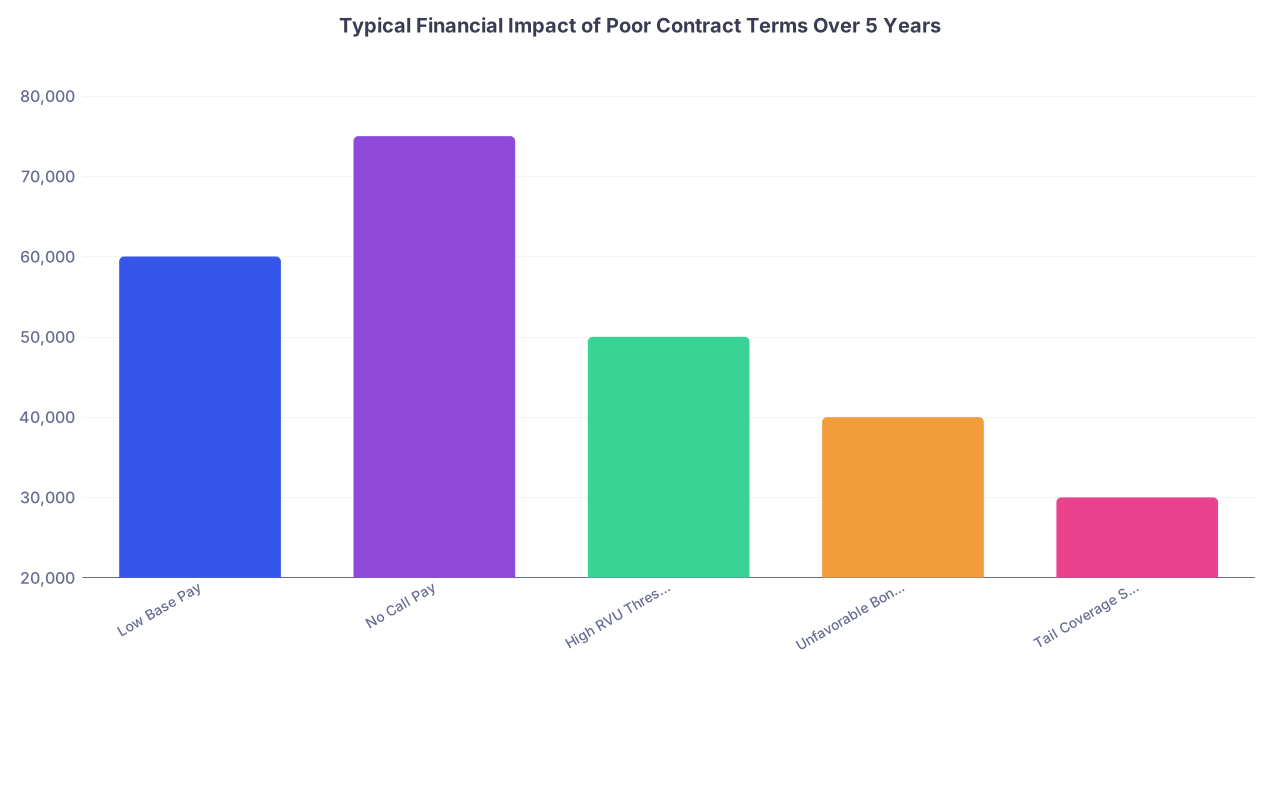
| Category | Value |
|---|---|
| Low Base Pay | 60000 |
| No Call Pay | 75000 |
| High RVU Thresholds | 50000 |
| Unfavorable Bonus Plan | 40000 |
| Tail Coverage Shifted to Physician | 30000 |
Those numbers are not theoretical. They are very reasonable estimates of what I have seen physicians lose over a five‑year span by signing “standard” contracts without review.
Where the Six‑Figure Losses Hide in Your Contract
The danger is not usually one gigantic, obvious problem. It is the accumulation of slightly bad terms that compound over time. Like interest, but in reverse.
Let us break down the usual culprits.
1. Base Salary That Looks “Fine” but Is Quietly Below Market
You compare your offer to what your co‑fellow got down the road and think, “Close enough.” Big mistake.
Without an attorney (or at least someone who actually lives in physician contract data), most new attendings:
- Underestimate their market value by 5–15%.
- Do not realize how geography, subspecialty, and call burden should move the number.
- Accept “mid‑percentile” pay that is actually low once the job demands are fully priced in.
Even a 10% underpayment on a $280,000 starting salary is $28,000 per year. Lock that in over 5 years with tiny raises and you are well into six‑figure territory.
| Scenario | Annual Base | 5-Year Total (No Raise) |
|---|---|---|
| Fair Market | $300,000 | $1,500,000 |
| 10% Underpaid | $270,000 | $1,350,000 |
| 15% Underpaid | $255,000 | $1,275,000 |
No attorney can magically force an employer to pay you top dollar. But a good one will:
- Recognize when you are being low‑balled.
- Push for adjustments or offsetting benefits.
- Document in writing what was actually agreed on (so it does not “disappear” later).
Skipping that review is essentially agreeing, in advance, to a lower lifetime earning curve.
2. RVU and Productivity Traps You Do Not See Coming
Here is a classic move: strong base pay for the first 1–2 years, then a sharp pivot to RVU‑based compensation. On paper, it looks generous.
Until you realize:
- RVU targets are set above what existing physicians are actually producing.
- Internal referral patterns mean you will never see the volume implied.
- The conversion factor (dollars per RVU) is below benchmark.
- The “guarantee” is really an advance you owe back or that suppresses future bonuses.
An attorney who has looked at hundreds of contracts will ask the unsexy but essential questions you are unlikely to think of:
- “Show us de‑identified productivity for physicians in this role over the last 2–3 years.”
- “Confirm in writing that there is no clawback of guaranteed salary if RVU targets are not met.”
- “Clarify whether RVUs for supervision, procedures, or midlevel collaboration are credited to the physician.”
You? You are being told, “Everyone meets the target, do not worry.” And you are busy with your in‑training exam or boards, so you sign.
That is how a contract that looked like $350,000/year becomes $240,000/year in reality. For many years.
The Two Silent Killers: Malpractice Tail and Restrictive Covenants
The single worst blowups I have seen did not come from base pay. They came from clauses new physicians skim or do not understand at all.
1. Malpractice Tail Coverage: The Surprise $40,000–$100,000 Bill
Ask any physician who got stuck paying their own tail coverage when they left a job. They remember the number.
With claims‑made malpractice policies, someone has to pay for “tail”—the coverage for claims filed after you leave. Your contract decides who that is.
Here is the pattern when no attorney is involved:
- The employer quietly assigns tail coverage to “departing physician” in the termination section.
- You assume “insurance is covered,” because someone vaguely said “we cover malpractice.”
- You leave in 3 years for a better opportunity and are handed a $60,000 invoice.
An attorney will:
- Go straight to the malpractice section and termination clauses.
- Push for employer‑paid tail, or at least a cost‑sharing formula.
- Add exceptions so you are not penalized if they terminate you without cause.
That one negotiated change can easily be worth more than the total you pay for attorney review in your entire career.
2. Non‑Competes and Restrictive Covenants: Losing Your Entire Local Market
The cockiest statement new attendings make: “Non‑competes are not enforceable anyway.”
This is dangerously wrong in many states, especially outside a few highly restrictive jurisdictions. I have watched this movie play out:
- A hospital contract has a 20–30 mile non‑compete for 1–2 years.
- It covers every location the system “owns or affiliates with”—not just where you work.
- You sign without legal review.
- Two years later, toxic work environment or leadership changes push you to leave.
- Your child is in school. Partner has a job locally. You cannot realistically move.
- You discover that every practice hiring in your specialty falls inside the restricted area.
Now you are trapped. Either:
- Stay in a bad job.
- Move and upend your family.
- Sit out of practice locally and lose income.
A physician contract attorney can:
- Shrink the radius.
- Limit the restriction to specific sites you actually work at.
- Narrow the scope (e.g., just your subspecialty).
- Add carve‑outs for employer breach, termination without cause, or failure to renew.
You likely will not get a perfect outcome. But you can almost always get something less catastrophic than the boilerplate language you are handed.
The “Trust Me” Problem: HR, Recruiters, and Verbal Promises
Let me be blunt. HR and recruiters are not your fiduciaries. Their job is to secure physicians on terms favorable to the organization and within their budget.
Red flags I hear constantly:
- “Oh, we do not usually change our contract.”
- “This is our standard for all physicians.”
- “We can work out the details later; this is just to get you on board.”
- “That is not enforceable; we never use that clause.”
An attorney does not accept any of that at face value. And you should not either.
Here is what tends to go wrong when you rely on verbal assurances:
- They promise protected clinic time for teaching → not in the contract → disappears in year 2.
- They say call will be “1 in 6, maybe better” → no schedule language in the contract → becomes 1 in 3.
- They mention a signing bonus not needing to be repaid → actual contract says full repayment if you leave before 3 years.
A good contract lawyer is annoying in exactly the way you need:
“Put that in writing.” “Define what ‘reasonable’ means here.” “Specify compensation for extra call.” “Clarify whether ‘productivity bonus’ is based on collections or billed charges.”
Is that adversarial? A little. Should you care? No. You are not joining a family; you are signing a commercial agreement that controls your income and mobility.
Why “I’ll Just Fix It Next Contract” Is Fantasy
Physicians love deferring conflict. I get it. Residency trains you to be accommodating and “a team player.”
So you tell yourself:
“I will sign now and renegotiate after I prove myself.” “They said they will revisit compensation in a year.” “I do not want to scare them off with an attorney.”
Here is the problem.
Once you are in the system:
- Your leverage often decreases, not increases. They know you are rooted in the community, your kids are in school, your partner has a job, and you are not likely to blow it all up over contract terms.
- Culture hardens. That “standard contract” is somehow even more untouchable once you have already signed something similar.
- You are busy. Full‑time clinical work plus call leaves very little bandwidth for strategic negotiation or job searches.
If you think negotiating while you still have outside offers is stressful, wait until you are trying to renegotiate from inside a single job with no alternative in hand.

| Step | Description |
|---|---|
| Step 1 | Interview Stage |
| Step 2 | Offer Received |
| Step 3 | Before Signing |
| Step 4 | Year 1 Employed |
| Step 5 | Year 3 Employed |
| Step 6 | Deeply Rooted |
Your best leverage is before you sign. That is when an attorney can do the most good, the most efficiently.
“But Attorneys Are Expensive” – Let’s Be Honest About That
You would not hesitate to order a $2,000 MRI if it meaningfully changed management. Yet many new attendings balk at spending $1,000–$3,000 on contract review that will control hundreds of thousands of dollars of income.
Here is the financial reality:
- Typical flat‑fee physician contract review: roughly $750–$3,000 depending on market and complexity.
- Typical 3‑year total compensation under an attending contract: easily $800,000–$1,200,000+.
- Fraction of total value spent on legal review: usually well under 0.5%.
If that 0.5% spend:
- Improves your compensation by even 2–3%.
- Saves you from paying a $60,000 tail premium.
- Prevents a non‑compete from forcing a costly move.
Then skipping it was an obviously bad trade.
Some physicians try the DIY route with “friends who are lawyers”:
- Your uncle who does real estate law.
- Your friend’s spouse who does family law.
- A random employment lawyer who has never seen an RVU schedule.
That is not better than nothing. In some ways, it is worse, because it gives you false confidence. Physician contracts are their own creature. You want someone who recognizes bad MGMA usage, nonsense bonus language, and the latest gamesystems like “quality metrics” that never pay out.
How to Use a Contract Attorney Effectively (Without Making It a War)
Bringing in an attorney does not have to sour the relationship. The mistake is either not using one at all or using one badly.
Here is how to do it right:
- Get the offer in writing first. Letter of intent or draft contract. No attorney needed until something is on paper.
- Choose someone who routinely reviews physician contracts, not a generic business lawyer.
- Be clear on your priorities. More money? Less call? Shorter non‑compete? Attorney time is limited; direct it.
- Let the attorney mark up key sections and give you talking points. Very often, you do the actual negotiating with the recruiter or admin. That keeps things collegial.
- Push on structure, not just dollars. Tail coverage, non‑compete, termination clauses, RVU thresholds, bonus formulas, call stipends, and schedule expectations.
You are not trying to “win” the negotiation. You are trying to avoid signing a contract that will quietly drain your time, money, and autonomy for years.
A Quick Checklist: If You Skip a Contract Attorney, You Are Gambling On These
If you are still thinking about skipping legal review, at least be honest with yourself about what you are rolling the dice on:
- That your base salary is actually at market or above for your specialty and geography.
- That RVU targets and conversion factors are realistic and aligned with actual volume.
- That tail coverage is not your responsibility if you leave after a few years.
- That your non‑compete will not block you from working anywhere you realistically want to live.
- That call expectations and compensation are spelled out and sustainable.
- That signing bonuses, relocation money, and loan repayments do not come with brutal clawbacks.
- That “without cause” termination language does not let them end your job on 60–90 days’ notice with you stuck paying your own tail and facing a non‑compete.
You may be right on some of these. You will not be right on all of them. And it takes only one nasty surprise to erase years of “savings” from skipping proper review.
FAQ (Exactly 4 Questions)
1. When should I involve a contract attorney in the job search process?
After you receive a written offer or draft contract, but before you sign anything. You do not need an attorney for initial conversations, site visits, or informal discussions about compensation ranges. Once there is a letter of intent, term sheet, or full contract, that is the time to engage review. Waiting until after you sign is pointless; at that stage, the leverage and options are sharply reduced.
2. What are the top three contract sections that usually need the most legal attention?
Compensation structure (especially RVU/bonus language), malpractice coverage (who pays tail and under what circumstances), and restrictive covenants (non‑compete, non‑solicitation, and geographic scope). Those three areas are where I see the largest financial and lifestyle damage when physicians skip legal review. Base salary is actually the easiest piece to understand; the structural terms around it are where you really get hurt.
3. Is it ever reasonable to accept a “standard” contract without changes?
Very rarely, and only if it is been reviewed by a physician contract attorney who tells you, “This is legitimately fair and balanced for your specialty and market.” Large academic centers sometimes have rigid templates that they will not heavily modify. Even then, small negotiated clarifications or addenda are often possible and valuable. Blindly accepting “standard” language from a private group or hospital system is exactly how physicians end up paying tail, trapped by non‑competes, and missing out on realistic productivity income.
4. What if the employer pushes back on me using an attorney or says it is unnecessary?
That is a red flag. Serious organizations expect physicians to get legal review and are used to it. If someone is overtly discouraging you from hiring an attorney, either they do not understand the process or they know the contract is one‑sided and prefer you not notice. You can keep it simple: “This is standard for me; I will just have it reviewed and get back to you.” Any employer that threatens to withdraw an offer because you want legal review is showing you exactly how they will treat you once you are on payroll. Believe them.
Key points:
Do not confuse “standard” with “fair.” The clauses you do not understand—tail coverage, non‑competes, RVU thresholds—are precisely where six‑figure losses hide. And the cost of a good physician contract attorney is a rounding error compared with what a bad contract will quietly take from you, year after year.


