
Can you, as a brand‑new attending with zero “real” experience, actually negotiate your first physician contract—or will pushing back just get your offer pulled?
Let me ruin the suspense: the idea that new attendings “can’t negotiate” is a myth. A persistent, convenient myth that mainly benefits one side. And it’s not you.
Let’s pull it apart.
Where This Myth Actually Comes From
You did not invent this anxiety. It’s baked into the culture.
You hear versions of it everywhere:
- “You should just be grateful to have a job.”
- “As a new grad, you have no leverage.”
- “My program director said not to rock the boat on the first contract.”
I’ve heard chairs say this out loud to residents on interview day. I’ve seen recruiters send emails implying that “compensation is standardized and non‑negotiable” while simultaneously telling another candidate, “We might be able to move a bit on the sign‑on bonus.”
So where does this myth really come from?
Information asymmetry.
You don’t know what’s “normal.” They do. They negotiate dozens of contracts a year; you negotiate one every few years at most.Timing pressure.
You’re finishing residency/fellowship, maybe sitting on loans the size of a mortgage, maybe with childcare, maybe with a partner who already relocated. They know you’re under time pressure.Professional socialization.
Training beats into you that you’re interchangeable labor. The system benefits when you believe that story a little longer than you should.
None of that is “you have no leverage.” That’s “you’re being conditioned not to use it.”
What the Data Actually Shows About Physician Leverage
Let’s drag this out of the realm of vibes and into numbers.

| Category | Physician Demand Index | Physician Supply Index |
|---|---|---|
| 2019 | 100 | 100 |
| 2024 | 107 | 101 |
| 2029 | 113 | 102 |
| 2034 | 117 | 103 |
The Association of American Medical Colleges (AAMC) projects a physician shortage up to roughly 124,000 physicians by 2034. It’s not one of those cute, “maybe there’s a mild oversupply in a decade” forecasts. We’re already feeling it in primary care, psychiatry, anesthesiology, EM, several surgical subspecialties.
A few real‑world indicators:
- Job postings massively outnumber candidates in many specialties. For hospitalists, family med, psych, outpatient IM, it’s routine to have multiple offers per candidate.
- Locums rates have climbed over the last several years, especially during and after COVID, because hospitals are desperate to plug coverage gaps.
- Recruiters get paid when you sign, not when they lowball you. Their incentives are to close the deal. That can actually give you leverage if you understand it.
Now look at compensation data. MGMA, AMGA, SullivanCotter—pick your flavor. Across those datasets, there are consistent patterns:
Huge variation within the same specialty and region.
Same city, same specialty, same call burden—base salaries can differ by $50k–$150k, and total comp by a lot more when RVU or bonus structures are factored in.New grads routinely get higher offers in tight markets than mid‑career people in saturated urban centers.
Not because they’re “worth more,” but because demand vs supply actually determines leverage more than seniority in many settings.Sign‑on bonuses, relocation, and student loan support are highly variable—and often negotiable.
Smart groups explicitly budget ranges for these, expecting they’ll need to sweeten offers.
The myth says: “You’re new, you have no leverage.”
The data says: “If you’re in a high‑demand specialty or region, you may have more leverage than a tenured doc in an oversupplied market.”
It’s not about years out of training. It’s about scarcity and replaceability.
How Offers Actually Get Built (And Why “Non‑Negotiable” Is Often Fiction)
Here’s the part candidates almost never see.
Most physician employers—hospital systems, large groups, private equity–backed groups—build their comp offers off a range, not a single fixed number.
| Specialty | Low Range Base | High Range Base | Common Sign-on Range |
|---|---|---|---|
| Hospitalist | $240k | $310k | $10k–$40k |
| Outpatient IM | $220k | $280k | $10k–$50k |
| General Surgery | $350k | $450k | $25k–$75k |
| Psychiatry | $260k | $340k | $20k–$60k |
| EM (employed) | $220k | $320k | $10k–$40k |
Those numbers will vary by region, practice type, and current market, but the principle holds: there’s a band.
What HR and recruiters will often do is start near the middle or slightly low if they think you’re naive or desperate. And then they label that offer “standard,” “policy,” or “non‑negotiable.”
I’ve sat in meetings where:
- HR says: “MGMA median for this region is 260; our range is 240–290. Let’s start her at 250 since she doesn’t have ties to the area.”
- Then the email to the candidate reads: “Our compensation is based on MGMA benchmarks and is standardized for new graduates.”
Is it standardized? Internally, sure, in that there’s a range. But within that range, they have room to move. And I have watched them move for someone who simply asked.
What Happens When New Attendings Actually Negotiate
Let’s walk through concrete patterns I keep seeing, in different specialties and settings.
Example 1: Hospitalist, New Grad, “Standard Package”
New grad, community hospitalist job in the Midwest. Initial offer:
- $260k base
- $15k sign‑on
- 7 on / 7 off
- No dedicated admin time
- RVU bonus that doesn’t realistically kick in for most people
She’s told: “This is our standard package for new grads.”
She talks to two senior hospitalists already on staff. Learns both had sign‑ons of $30k, and one had negotiated 0.5 admin days per month for committee work.
She goes back and says, calmly:
- She’s considering another offer with a higher sign‑on.
- She’d like to be at $30k sign‑on, plus 0.5 days of protected admin time per month to support quality and committee work, which she’s happy to take on.
Result:
- Sign‑on increased to $25k.
- They added 0.5 admin days per month, framed as “quality and leadership development.”
Her clinical comp didn’t change, but her total year‑1 package improved by over $15k and her schedule became more humane. This is not rare. This is common when people push (politely).
Example 2: Outpatient IM, “No Changes to Base”
Recruiter calls a new outpatient IM grad in the Southeast. Offer:
- $225k guaranteed for 2 years
- Minimal bonus structure
- 1:4 call
- 4 weeks PTO, 1 week CME
He’s told: “We can adjust call a bit, but base is fixed for all new hires.”
He does three things:
- Pulls recent MGMA data through his professional society and sees median outpatient IM guaranteed comp in that region around $240–250k.
- Talks to two competing groups in the same metro. Both hint at guarantees of $240–260k.
- Goes back and says: “Given current market and my other options, I’d be comfortable signing if we’re at $240k guaranteed and 1:6 call, or if you prefer to keep base at 225k, then a $40k sign‑on and 1:6 call.”
They refuse to move base. He doesn’t blink. Says he’ll likely go with another group then, but appreciates their time.
Three days later:
- Base still at $225k.
- Sign‑on now $35k (up from zero).
- Call moved to 1:6 for first year, then to be revisited.
Did he get everything he asked for? No. Did he dramatically improve the offer by not swallowing “base is non‑negotiable” as gospel? Yes.
The Real Risk of Negotiating (And What Actually Gets Offers Pulled)
Let me be blunt: offers almost never get pulled because you negotiated for fair, reasonable changes.
They get pulled when:
- You disappear for weeks and don’t respond.
- You make demands wildly out of range for the market in a hostile or entitled way.
- You show red‑flag behavior: trashing other groups, getting combative, or repeatedly asking for the same thing after a firm, clear “no.”
| Category | Value |
|---|---|
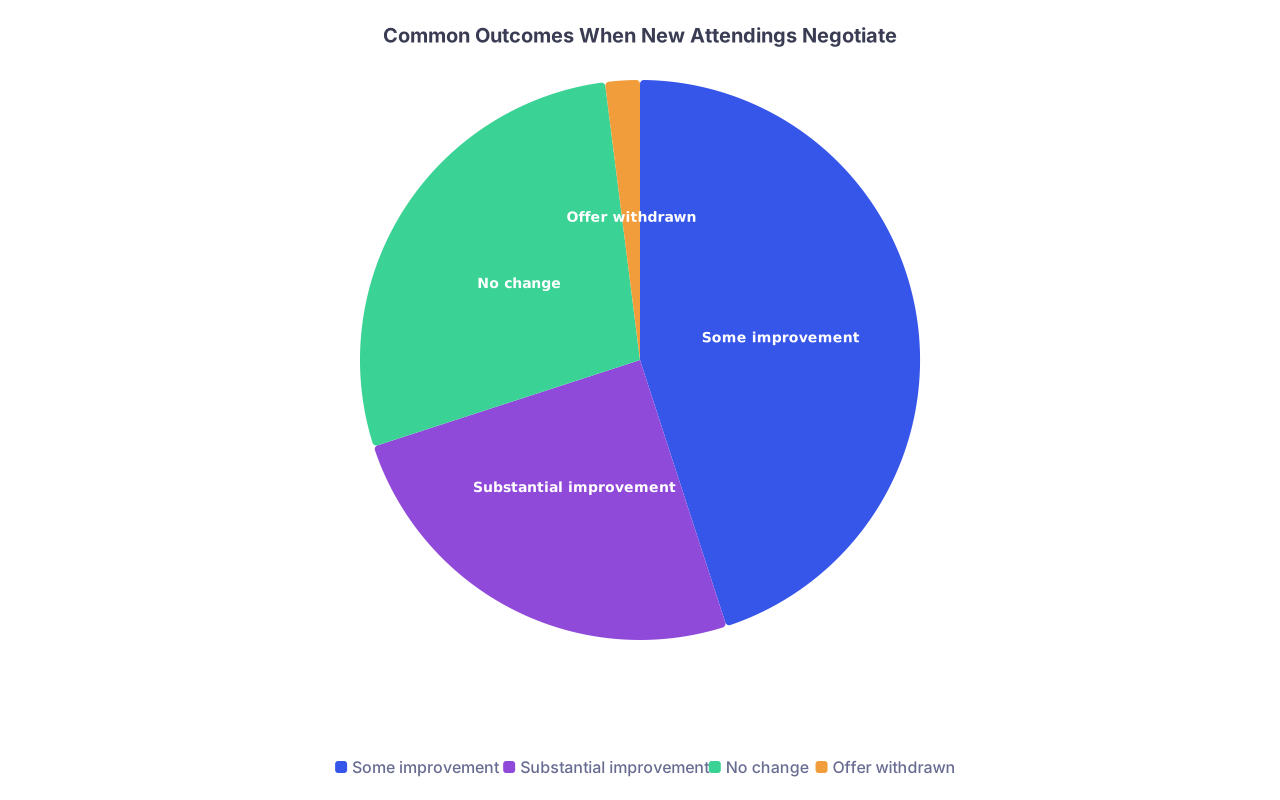
| Some improvement | 45 |
| Substantial improvement | 25 |
| No change | 28 |
| Offer withdrawn | 2 |
In practice, with reasonable, data‑based asks:
- The most common outcome: some improvement in one or more areas (sign‑on, schedule, PTO, call).
- A decent chunk: substantial improvement—especially when there’s another credible offer on the table.
- A minority: no change but no harm done.
- Very rare: offer withdrawn—and in the cases I’ve seen, you did not want to work with that employer anyway.
If an employer rescinds an offer because you politely asked whether the sign‑on or call schedule was flexible, that’s not a bullet you took. That’s a bullet you dodged.
What Actually Matters More Than Squeezing 5k Out of Base
There’s another myth wrapped inside this one: that “negotiation” is purely about bumping your base salary.
That’s amateur hour.
The smartest new attendings I’ve seen focus on structure, not just the headline number.

Things they look at:
- wRVU or productivity thresholds: Is the target realistic based on current panel and visit patterns? Are there ramp‑up expectations?
- Non‑compete radius and duration: Can you actually live with it if things sour?
- Call expectations: Written clearly, or vague “as assigned by the practice” language?
- Termination clauses: Is there without‑cause termination on both sides, or only them? What’s the notice period?
- Support staff and resources: APP coverage, scribes, MA ratios, on‑site imaging, EMR efficiency.
I’ve seen new grads accept “great” salaries and then get destroyed by:
- Unrealistic RVU thresholds that effectively cut their pay after two years.
- Non‑competes that lock them out of the only reasonable city within 100 miles.
- Call burdens that turned into a bait‑and‑switch once “market conditions changed.”
Money matters. But marginal salary improvements don’t compensate for a structurally abusive contract.
How to Negotiate Without Acting Like a TV Lawyer
You don’t need to become a shark. You do need to stop acting like a supplicant.
Here's a simple reality: the strongest candidates usually sound calm, curious, and informed—not aggressive. They ask questions, they name trade‑offs, and they make it clear they’re evaluating fit on both sides.

| Step | Description |
|---|---|
| Step 1 | Receive Offer |
| Step 2 | Gather Market Data |
| Step 3 | Clarify Priorities |
| Step 4 | Identify Negotiable Items |
| Step 5 | Discuss With Employer |
| Step 6 | Review Revised Offer |
| Step 7 | Decide Accept or Decline |
| Step 8 | Employer Response |
The candidates who quietly accept the first draft? They are not “easier to work with.” They’re just cheaper and more compliant.
Two things move the needle the most:
Having another real option.
Not theoretical. Actual written or near‑final offers. That’s where your leverage is. When you can truthfully say you’re choosing between A and B rather than begging A not to abandon you.Knowing the local market reality.
National MGMA numbers help, but local intel is better. Talk to older residents, alumni, fellows. Ask: “What are they actually paying? What is call really like? Who left and why?”
Once you know that, you can say things like:
- “Given current market ranges in this area, I was expecting closer to X for base, or similar base with Y sign‑on.”
- “I’m very interested, but the non‑compete as written would make it impossible to stay near family if things don’t work out. Can we narrow the radius or the scope?”
That’s negotiation. Calm, specific, conditional. Not melodrama.
The Biggest Myth of All: “I’ll Fix It in My Next Contract”
You won’t. Or it’ll be much harder than you think.
Once you’re locked into:
- A brutal call schedule.
- A toxic culture.
- A non‑compete that locks you out of half the state.
You are negotiating from a far worse place. You’re tired. Your kids are in school. Your partner has a job. Your patients know you. Leaving becomes very expensive.
| Category | Value |
|---|---|
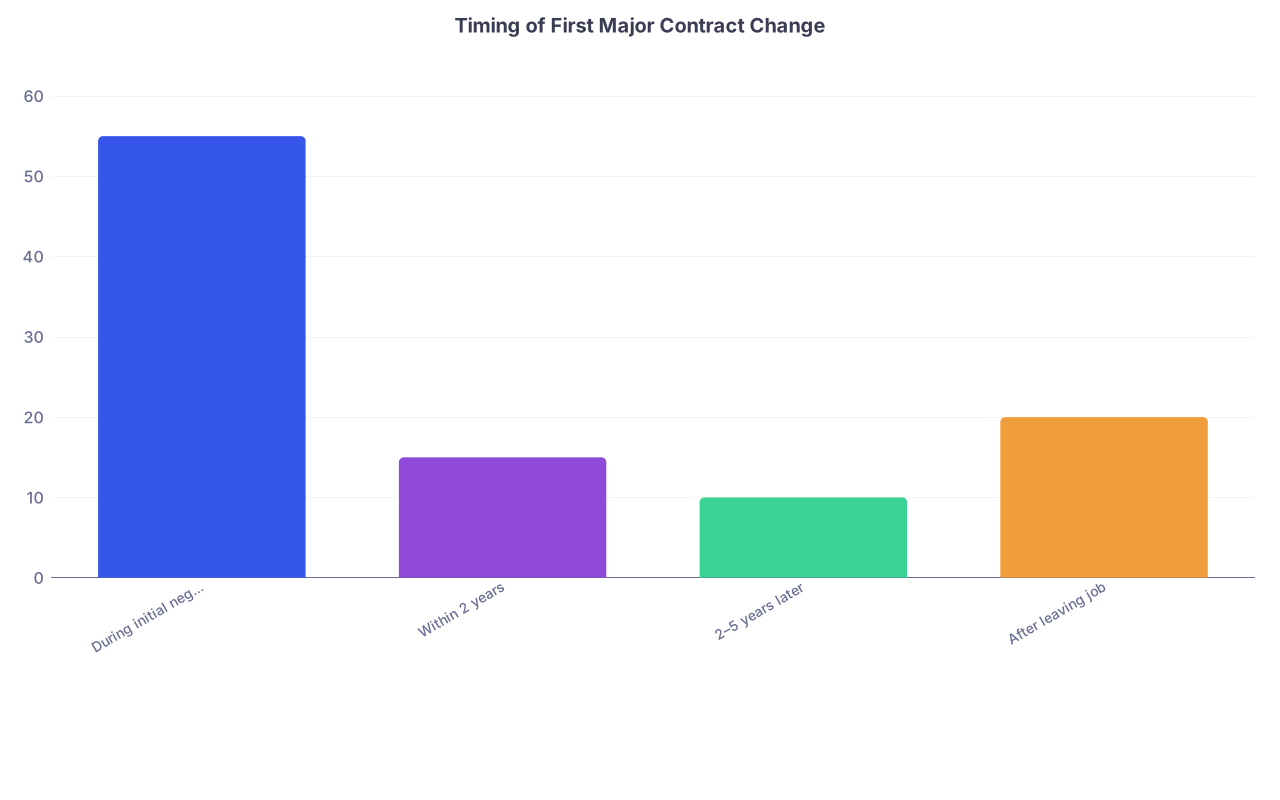
| During initial negotiation | 55 |
| Within 2 years | 15 |
| 2–5 years later | 10 |
| After leaving job | 20 |
Physicians who successfully change their comp model, call burdens, or non‑competes?
Most do it either:
- Up front, before signing.
- Or by leaving entirely.
This is why the “you can’t negotiate as a new attending” myth is so damaging. It encourages passivity at exactly the point when you actually have the most flexibility and fewest roots.
Where You Truly Have Less Leverage (So You Don’t Waste Energy)
I’m not going to pretend everything is negotiable. Some things really are rigid:
- Unionized or civil service settings: VA, county systems, some academic centers. Salaries and step systems may be locked by statute or union contracts.
- Highly standardized academic tracks: Assistant professor base often truly fixed. But start‑up funds, protected time, and expectations? Sometimes very negotiable.
- Large national staffing companies: The written rate per RVU or per shift might genuinely be set across a region, but shift mix, location, and schedule can be flexible.
Even in those environments, you often have room around:
- Start dates.
- Call proportions.
- Clinic templates.
- Academic/leadership time.
- CME, relocation, sign‑on.
You don’t need infinite leverage. You just need enough to tilt the structure a bit in your favor.
The Quiet Evidence You Won’t See in any Journal
You’re not going to find a randomized controlled trial of “negotiating vs not negotiating first attending contracts.” But the signals are all around:

- In every graduating class, there are always a few people who end up with materially better deals. It’s not magic. They asked, from a position of being willing to walk.
- Recruiters quietly acknowledge their ranges when they think you’re informed. I’ve heard: “We might be able to get close to 300 for the right candidate” to people who pushed, after telling another candidate “Our starting salary is 270 across the board.”
- Admins will admit, off the record, that new grads underestimate their bargaining power. I’ve had a CMO say: “Most of them just sign whatever we give them; it’s a relief when someone actually knows the market.”
The myth is convenient for systems trying to control labor costs. It’s catastrophic for physicians who will live inside these contracts for years.
Stop helping them by believing you have no voice.

Bottom Line
Three things to walk away with:
- “New attendings can’t negotiate” is false. Your leverage depends far more on specialty, location, and alternatives than on years out of training.
- Most offers have built‑in ranges. Employers routinely move on sign‑on, schedule, call, and sometimes base—when you ask clearly and back it with data.
- Your first contract sets your trajectory. It’s easier to build a sane, sustainable career from day one than to claw your way out of a bad deal later.
You don’t have to become a jerk to negotiate. You just have to stop acting like you’re lucky to be invited. You are the scarce resource. Start acting like it.