

The way your starting salary gets decided has almost nothing to do with your “value as a physician” and everything to do with internal politics, risk, and spreadsheets you will never see.
Let me walk you into that closed conference room you’re not invited to.
The Room Where Your Number Gets Picked
Here’s the first uncomfortable truth: by the time you’re “negotiating” your first job offer, the number is mostly set. Not by HR. Not by your future partner trying to recruit you. But by a small set of people who have never met you and only see you as a line on a budget.
In most groups, the decision-makers are some combination of:
- Practice administrator or CFO
- Department chair / managing partner
- One or two senior physicians who control the purse strings
- Occasionally HR or legal for hospitals
They sit down with three things on the table:
- Current compensation of existing docs
- MGMA or other benchmark data
- The financial panic level of the group right now
Your CV? Maybe someone glanced at it last week.
Groups are terrified of two things when setting starting salaries:
- Internal revolt (existing docs furious that the new hire makes more than they did)
- Overcommitting to a salary the revenue cannot support
So they anchor hard. MGMA 25th percentile. Local market “norm.” What they paid the last hire, plus or minus 5–10%.
That’s why so many “offers” look eerily similar.
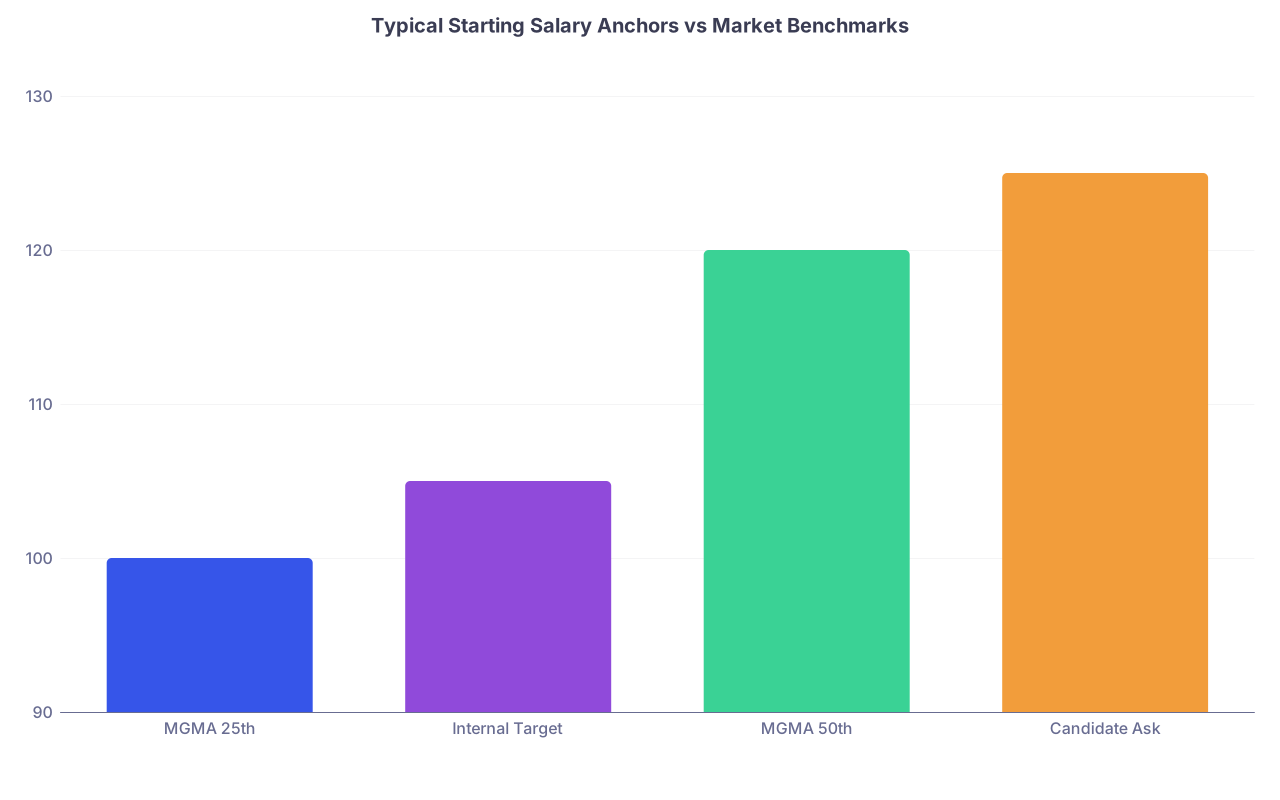
| Category | Value |
|---|---|
| MGMA 25th | 100 |
| Internal Target | 105 |
| MGMA 50th | 120 |
| Candidate Ask | 125 |
That “internal target” number? That’s what they’re quietly aiming for before they ever talk to you.
How They Actually Build Your Starting Salary
Let me show you how this works in a real meeting.
I’ve watched this in a large hospital-employed group:
Admin: “Our current hospitalists are at $270k base with RVU bonus after 4,200 RVUs. The new MGMA says median is closer to $290k.”
Senior doc: “We can’t bump the new people above our existing guys. They’ll riot.”
Chair: “What did we give the last recruit?”
Admin: “$260k with a $20k sign-on and $15k relocation.”
Chair: “Fine. Same thing. Maybe add a small quality bonus to make it look better.”
Nobody said: “But this candidate has extra fellowship training” or “This person has a strong regional reputation.” They reverse-engineered an offer from existing contracts backward, not from your merit forward.
They think in bands, not individuals.
| Level | Percentile Target | Common Range (Base) |
|---|---|---|
| “Safe” | 20–30th | $230–260k |
| “Aggressive” | 40–60th | $260–310k |
| “Desperate hire” | 60–75th+ | $300–360k+ |
If they’re swimming in candidates, you’re getting “safe.”
If they’re losing people and patients are waiting months? Suddenly you’re worth “desperate hire” money.
Your actual value to them is: “How urgently do we need a warm, credentialed body in this slot?”
The Shadow Document: Pro Forma and RVU Math
Every real group runs some version of a pro forma before they sign off on your salary. You’ll never see it unless you ask very specifically and they’re unusually transparent.
Here’s what that spreadsheet quietly controls:
- Expected RVUs for your specialty in year 1
- Expected collections per RVU or per visit
- Overhead load (staff, space, malpractice, benefits)
- Target margin (what they want to clear off your work)
Then they ask: “What base can we pay so we don’t lose money if their volume is mediocre?”
That’s why the first-year offers almost always:
- Use conservative volume assumptions
- Limit upside with opaque bonus structures
- Protect the group, not you
If the model doesn’t show profit by year 2, they don’t magically decide you’re worth more. They lower your base, increase your productivity targets, or get “creative” with bonuses.
You feel like you’re negotiating with people.
You’re actually negotiating against a spreadsheet.
Internal Equity: The Invisible Ceiling on Your Offer
Internal equity is the phrase that silently kills your raise.
I’ve watched this happen in a mid-sized private group. Candidate is a strong interventional cardiologist. Great volume projections. The managing partner wanted to give him a very aggressive offer to lock him in.
Then they checked their own partner compensation.
Problem: a couple of senior guys were still only drawing around $550k comp in a good year. The pro forma suggested the new recruit could easily generate $700k+ equivalent in RVU revenue.
Full panic.
They were not going to let the new doc’s potential comp outshine the existing guys’ actual comp. Egos matter more than fairness.
So what did they do?
- Lowered base
- Increased RVU threshold for bonus
- Added a “ramp” period with lower bonus rates
- Padded partnership buy-in numbers
Publicly they told the candidate:
“We want to be fiscally responsible and sustainable.”
Privately they said in the meeting:
“We are not letting a new guy make more than our partners in year 2.”
If your offer feels strangely underwhelming relative to your projected volume, there’s a decent chance you’re crashing into this internal equity ceiling.
Benchmark Data: How MGMA Gets Weaponized
Everyone loves to wave around MGMA / AMGA / SullivanCotter reports like they’re objective truth. They’re not. They’re tools. And groups cherry-pick like crazy.
Behind closed doors, I’ve heard exactly this:
“We’ll quote MGMA median collection per RVU when we talk to them about productivity, but we’ll base salary on 25th percentile because cost of living here is lower.”
Translation:
They use “national data” to justify paying you less, while maximizing how much work they can squeeze out of you.
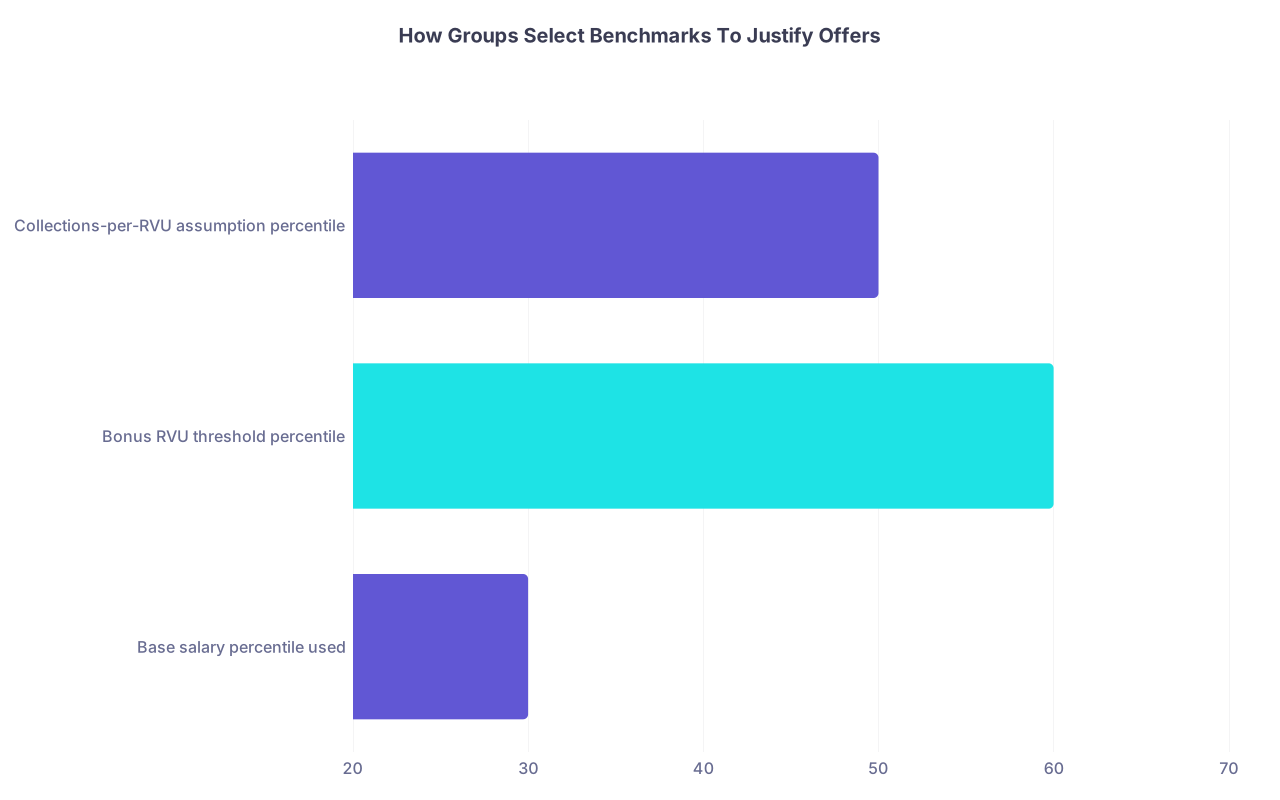
| Category | Value |
|---|---|
| Base salary percentile used | 30 |
| Bonus RVU threshold percentile | 60 |
| Collections-per-RVU assumption percentile | 50 |
Notice the mismatch? Base salary tends to sit lower than the target productivity expectations. You’re being paid like a 30th percentile doc with 60th percentile RVU goals.
You don’t see this on paper. You just feel constantly “behind target.”
If you don’t ask:
- What percentile of MGMA is this base?
- What percentile of MGMA are these RVU expectations?
- What assumed collections per RVU are you using?
…you won’t realize how skewed the deal really is.
The Politics: Senior Docs Protecting Their Turf
Money decisions are rarely purely financial. They’re political.
In private groups and many academic divisions, there are 2–3 power players who care about one thing: their relative status and income inside the group.
When your file comes up, the discussion is not just “What should we pay them?” It’s:
- “If we pay them this, what will it do to our next internal compensation review?”
- “Will X or Y senior doc start agitating for raises?”
- “Will we have to bump everyone if we bump this one?”
So the safe play is always: hold the line.
That’s why you’ll hear:
“We’re very standardized. We use a formula. We want fairness.”
Translation: “We designed a system that keeps new hires from leapfrogging the old guard.”
On the extreme end, I’ve seen a group block a fantastic candidate because they “wanted too much” — “too much” being exactly what the pro forma said they were worth — and then spend two years short-staffed, burning out existing docs, because the partners could not tolerate re-opening compensation discussions.
They’d literally rather suffer than disrupt the power balance.
You’re not negotiating just with a group. You’re negotiating with the psychology of their most insecure senior physicians.
Hospital-Employed vs Private Group: Who Squeezes Harder?
The logic is different depending on who writes your check.
Hospital-employed
Hospitals think in:
- “Strategic service lines” – cardiology, ortho, oncology often overpaid early to capture market share
- Downstream revenue – your procedures, admissions, imaging feed the system
- Loss leader logic – they’ll “lose” money on your salary if they win on facility fees
But they’re hemmed in by:
- HR salary bands
- “Fair market value” compliance concerns
- System-wide compensation policies
So your starting offer is often:
- Rigid on base salary (banded)
- More flexible on sign-on, relocation, student loan assistance, RVU floors
- Occasionally creative with “guarantee” years or retention bonuses
They decide your salary by asking:
“What can we pay and still comfortably say this is within fair market value if we get audited?”
Once compliance enters the room, your leverage drops unless they’re truly desperate.
Private group
Private groups think in:
- “How much can we keep?” not “How much can we pay?”
- Short-term margins over long-term strategic growth
- Emotional things: fairness, loyalty, tradition
So they’re often:
- More flexible if they’re scared of losing you
- Less transparent, more handshake-based
- Very sensitive to anything that sets new precedent
Translation:
Hospitals trap you with policy.
Private groups trap you with culture.
You can push harder in private practice if they’re bleeding and you’re the only realistic recruit. But they’ll never present it like you have that kind of power.
The “Budgeted FTE” Trap You Never See
In bigger systems, you are not a person. You are a budgeted FTE (full-time equivalent) with a number attached.
The business office builds next year’s budget like this:
- 6.0 FTE hospitalists at $270k each
- 3.5 FTE outpatient cards at $330k each
- 1.0 FTE endocrinology at $235k
Once it’s approved by the board, your future boss is already boxed in. If they only got approval for $270k/FTE for your slot, that’s the anchor.
To go above that, the chair or service line director has to:
- Go back to finance
- Justify an exception
- Admit their prior budget was wrong
- Risk looking incompetent
So what do they do instead?
They protect the relationship with finance by holding the line on your salary, then try to sweeten things off-budget:
- Slightly lower call burden
- Protected admin time (on paper)
- Conference money
- Titles: “Assistant Director,” “Section Lead”
Nice, but you can’t pay your loans with a title.

If an offer feels oddly specific, like $272,450 instead of something rounded, that’s a hint you’re just hitting a predetermined FTE line in a spreadsheet.
What Actually Moves Your Starting Number
Here’s the part you need to understand if you want any real leverage: most of what residents obsess about — class rank, alpha omega alpha, abstract count — doesn’t move your starting salary at all.
What does move it?
Time pressure on the group
If they need someone now, they pay more. If they have 10 applicants for one pleasant outpatient gig in a big city, they’ll lowball.Revenue certainty
If you’re walking into a full panel, retiring doc’s practice, or a backlog of cases, you’re more valuable. Your ramp-up risk is low.Niche skill they actually need
Not, “I did an extra research year.”
More like, “I do structural heart,” “I can cover stroke call,” “I do high-risk OB that we’re currently transferring out.”Competing offers they believe are real
Not hypothetical “I think I can get more.” Actual numbers from real places, ideally in writing.Their fear of vacancy costs
Open OR time, delayed consults, lost referrals. An empty seat can cost them far more than a $20–40k bump in your base.
This is why some utterly average candidate walks into $350k in a rural Midwest town, and an absolute superstar gets offered $240k in a coastal metro. Desperation beats merit every time.
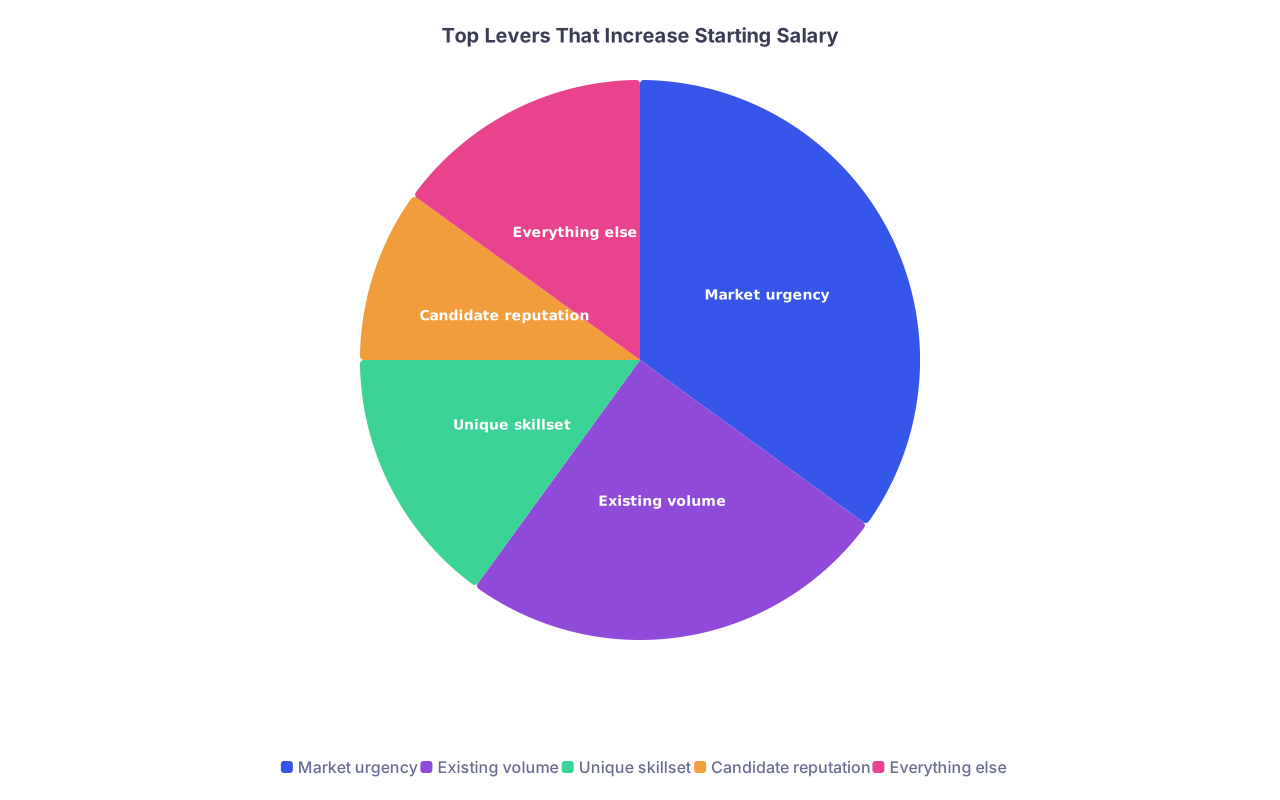
| Category | Value |
|---|---|
| Market urgency | 35 |
| Existing volume | 25 |
| Unique skillset | 15 |
| Candidate reputation | 10 |
| Everything else | 15 |
Look at that sliver for “candidate reputation.” Smaller than you’d like to believe.
What They Say To You vs What They Say To Each Other
Let me translate a few common lines you’ll hear:
“We want you to be very successful here.”
→ “We want you to cover service needs and not complain about the comp structure.”
“This is the standard offer for new grads.”
→ “We’re not going to volunteer more unless you push us.”
“We don’t usually negotiate with new physicians.”
→ “We hate renegotiating because it opens the door for everyone.”
“We are very committed to fairness across the group.”
→ “Our senior docs will mutiny if you get something they didn’t.”
“We are at the top of the range for this position.”
→ “This is the top of what we feel comfortable offering without internal drama. It might not be the top of the market.”
If you could listen outside the door after you counteroffer, you’d hear variations of:
- “Do we really need them or can we wait for the next candidate?”
- “If we go up, will this end up on the grapevine?”
- “What did we give Dr. X last year? We can’t go past that.”
They’re not debating whether you’re “worth it.” They’re debating whether paying you more will create headaches with everyone else.

How To Use This Knowledge Without Torching Bridges
You cannot bargain like a used-car buyer in medicine. That backfires. But you can be deliberately strategic.
Here’s how you use what happens behind closed doors to your advantage:
Force them to say the quiet part out loud.
Ask: “Where does this base fall relative to MGMA percentiles for this region?”
Ask: “What RVU level is this compensation structure modeled on?”Target the pro forma.
“Can you walk me through the volume assumptions behind this offer?”
You’re signaling you understand the business, not just the salary.Leverage vacancy fear, not ego.
Instead of “I’m worth more,” frame it as:
“If we can close this gap, I’m ready to sign and start the credentialing process right away.”
You’re trading a slightly higher number for certainty and speed.Split the problem.
If they’re boxed in on base (budgeted FTE), push on:- Sign-on bonus
- Relocation
- Early productivity bonus
- Loan repayment
Those often live in different budget lines.
Make internal equity your ally.
Use phrases like:
“I absolutely don’t want to create issues with your existing docs. Is there a structure — for example, a temporary guarantee, ramp-up bonus, or early review — that can bridge the gap while keeping your internal parity intact?”
Now you’re not the problem; you’re helping them solve theirs.

The more you talk like someone who understands their side of the equation, the more comfortable they’ll be stretching their constraints for you.
FAQs
1. Is it ever realistic to get a big jump from the initial offer as a new attending?
Yes, but only when the group is under real pressure: hard-to-fill location, urgent coverage need, or clear, immediate volume waiting for you. I’ve seen 15–25% bumps from initial offers when candidates had competing offers and the group was already short-staffed. If it’s a “desirable” metro outpatient gig with 30 applicants, you’re not getting a huge raise. Maybe a sign-on tweak, not a base overhaul.
2. Do groups really get angry if I try to negotiate my starting salary?
What annoys them isn’t negotiation itself. It’s uninformed, adversarial, or entitled negotiation. If you come in swinging — “I deserve X because I’m top of my class” — you will get labeled as “difficult” before you even start. If you ask pointed business questions and propose specific, reasonable adjustments, they might grumble in private, but they’ll respect you. The line you don’t cross is threatening or emotional ultimatums unless you’re truly willing to walk.
3. How much weight do fellowships and extra training actually carry in salary talks?
Fellowship alone? Less than you think. Fellowship that directly increases billable procedures or coverage? Much more. A heme-onc with transplant skills in a center trying to build transplant will have far more leverage than a general cardiology fellow with an extra imaging year in a saturated market. If your extra training makes them money or saves them from outsourcing, tie your ask very explicitly to that.
4. What if they say, “This is our best and final offer”?
Sometimes it’s posturing. Sometimes it’s real because of budgeted FTE caps or rigid HR bands. Your move is to calmly say: “I appreciate the clarity. I’d like 24–48 hours to consider this and compare with my other options.” If they’re bluffing and afraid to lose you, that sometimes magically produces “reconsideration.” If it doesn’t, believe them. At that point you’re deciding whether the whole package — pay, location, schedule, culture — is worth it, not whether you can squeeze another $5–10k.
5. How can I tell if an offer is truly below market or just feels low?
You need three data points: credible MGMA-ish benchmarks (through mentors or specialty societies), 2–3 offers from comparable markets, and candid intel from recent grads in similar jobs. If your base is at or below MGMA 25th percentile with RVU expectations around median or higher, and everyone you talk to in similar markets is 10–20% above your number, you’re below market. If the base is “meh” but the RVU bonus is genuinely achievable with clear thresholds, the total package might actually be fair — just structured to make you earn the difference.
The bottom line?
Your starting salary is anchored by: internal equity, conservative spreadsheets, and the group’s fear — fear of losing money, fear of upsetting senior docs, fear of rewriting the rules.
Your power comes from: their urgency, your replacement cost, and your ability to speak their financial language without acting like a mercenary.
If you remember nothing else, remember this: they are not asking, “What is this physician worth?” They’re asking, “What is the highest number we can live with without causing internal chaos?” Your job is to calmly, strategically, and intelligently push that number up.


