
The partnership track you keep hearing about is often not a career path. It is a marketing funnel.
That “2-year to partnership” line recruiters toss out on the phone? In many groups, it’s about as concrete as a verbal promise from a used car dealer. Some tracks are fair, transparent, and genuinely life-changing. A disturbing number are deliberately vague ladders where the top rung gets moved every time you get close.
Let’s walk through what actually happens—numbers, structures, and the quiet games groups play—so you recognize when a “track” is a path and when it’s bait.
The Myth: Partnership Solves Everything
The story you’re sold post-residency is simple:
Take a slightly lower salary now -> grind for 2–3 years -> become partner -> golden future with high income, stability, and control.
The implied message is: only suckers stay employed; the real winners make partner.
Reality check: lots of “partnership tracks” in physician groups are:
- Underdefined: “Based on mutual fit” and “subject to group vote” with no quantified metrics.
- Constantly moving: The year you arrive, magically the buy‑in structure, compensation model, or timeline “needs updating.”
- Statistically improbable: The group quietly makes 1 partner for every 4–6 associates who cycle through.
I have seen contracts from anesthesia, radiology, EM, GI, ortho, and hospitalist groups that all repeat the same pattern: front-load the risk on you, keep the upside entirely discretionary on them.
The problem isn’t partnership itself. True equity partnership with real transparency can be excellent. The problem is the false promise of partnership sold as a near-certainty when it’s actually more like competing for tenure with no published criteria.
What The Data (And Patterns) Actually Show
We do not have a clean national “partnership attainment rate” registry, so you won’t find a neat NEJM paper on this. But there are enough consistent signals from MGMA data, specialty society surveys, and the financial structure of groups to make some blunt observations.
First, look at where doctors actually work.
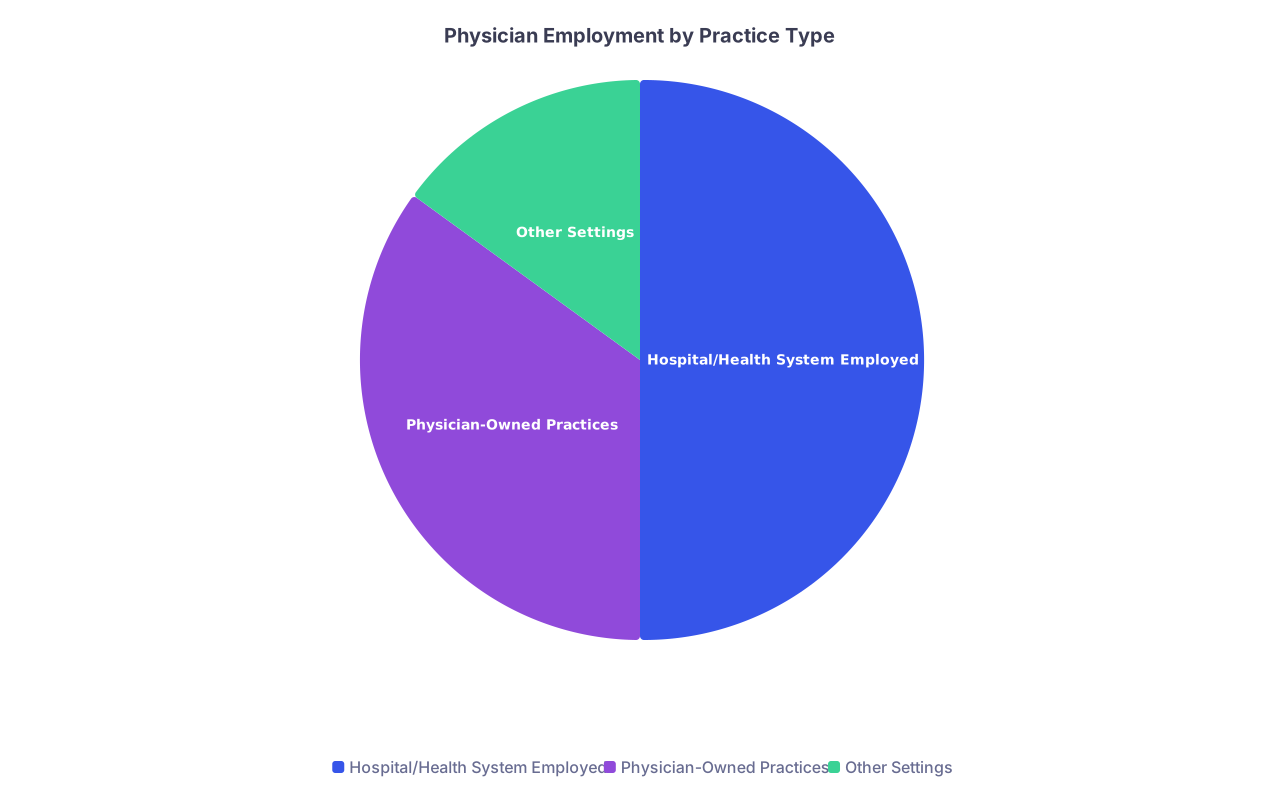
| Category | Value |
|---|---|
| Hospital/Health System Employed | 50 |
| Physician-Owned Practices | 35 |
| Other Settings | 15 |
Roughly half of physicians are now employed by hospitals and health systems. Only about a third are in physician-owned practices—the only place where a traditional “partner track” really exists. And within those physician-owned practices, you have two very different animals:
- Genuine small/medium independent groups with transparent ownership and profit distribution.
- “Groups” that look independent on paper but function like thinly disguised staffing companies, contract-holding entities, or private equity roll-ups.
The false promise thrives in category 2.
Patterns you see again and again:
- Partner compensation numbers are always “top decile MGMA” but never shown in writing, never with K‑1s or historical distributions.
- The number of current partners has been stable for years despite high volume and repeated hiring of new associates “on the track.”
- Changes to the track—extra years, added buy‑ins, new RVU thresholds—mysteriously happen right when associates are approaching eligibility.
If a group has hired 10 associates “on track” in the last 5–7 years and made 1 new partner, you are not on a track. You are in a tournament.
The Structural Games Behind Many “Tracks”
The details tell you more than any recruiter ever will. I’ll walk through the most common structural tricks I see baked into these arrangements.
1. The Vague Criteria Trap
Look for this language. It’s everywhere:
- “Partnership is based on clinical excellence, professionalism, and alignment with group culture.”
- “Partnership requires majority partner approval after 2–3 years.”
Translation: there are no binding requirements on them. All the risk is on you.
If there are no written, objective criteria—RVU thresholds, quality metrics, call participation, citizenship obligations, and a defined voting mechanism—then you’re not promised a track. You’re promised “consideration.”
And “consideration” is code for: if someone retires or leaves, we might promote one of you. If not, we won’t.
2. The Phantom Buy‑In
Here’s a common structure:
Year 1–2: Salary + productivity bonus, clearly spelled out.
Year 3: “Eligible for partnership, subject to a buy‑in to be determined at that time based on practice valuation.”
That little phrase “at that time” is a hand grenade.
I’ve seen situations where:
- The original doctors bought in for $50,000 in the early years.
- New associates are quoted $350,000–$500,000 buy-ins based on a valuation done by a friendly consultant who weights “goodwill” and “brand value” heavily.
- The payment options are 3–5 years of reduced compensation, effectively cutting your income just as you’re supposed to be “enjoying” partner level earnings.
If the buy‑in formula isn’t specified in the initial contract or an attached document, they haven’t actually offered you a partnership track. They’ve offered you the opportunity to negotiate a ransom later.
3. The “We’re About To Sell To PE” Bait‑And‑Switch
This one has exploded in the last decade.
Timeline looks like this:
- You’re recruited with “2–3 year path to partner” language.
- You work your tail off, help grow the practice, increase volumes.
- Right as you approach the supposed partner year, leadership announces: “We’re exploring a transaction with a strategic or financial partner to support growth.”
- Translation: they’re selling to private equity or a hospital system. The equity event happens. Existing partners cash out. Your “track” becomes, at best, equity in the newco with totally different terms—often vapor.
I’ve heard real-world versions of: “We can’t bring associates in as full partners right now because that would complicate the transaction.” That tells you everything about where you sit in the food chain.
4. The Perpetual Junior Partner Tier
Another trick: the group technically makes “partners” regularly, but the partnership is stratified.
- Equity partners: voting rights, real share of profits, own the building, own the ASC, sit on the board.
- Junior partners: called “partners” in marketing, but no building equity, no ASC equity, no governance power, and a much smaller share of ancillaries.
You see this in GI, ortho, cards, and some surgical subspecialties all the time. The brochure says “short path to partnership.” The fine print is “short path to the least valuable slice of the pie.”
The Numbers: What You’re Actually Trading
Let’s be specific. Consider two simplified offers coming out of fellowship.
| Feature | Straight Employed | Partnership Track Group |
|---|---|---|
| Base Salary Years 1–3 | $350,000 | $275,000 |
| Bonus Potential Years 1–3 | $50,000 | $75,000 |
| Total Likely Years 1–3 | ~$375,000 | ~$300,000 |
| Partnership Buy-In | N/A | $300,000 over 3 years |
| Promised Partner Comp | N/A | $550,000–$650,000 |
Looks like the partnership track wins long-term, right?
Maybe. But only if:
- The partner compensation numbers are real.
- The buy‑in stays at the quoted level.
- You actually get offered partnership on time.
- The group doesn’t sell, implode, or lose key contracts.
I’ve seen physicians give up $75k–$100k per year for 3–5 years on the promise of a $200k–$250k compensation bump that never fully materialized. Do that math. That’s a six-figure swing that never gets repaid.
And here’s the ugly part: most doctors never actually calculate the implied IRR on their “investment” in the track. They just absorb the lower first years as “dues” because that’s what everyone around them says is normal.
How To Distinguish a Real Track From a Fake One
Forget the fluff. If you want to know whether a partnership track offer is serious or theater, interrogate five things.
1. Objective Written Criteria
You want to see in writing:
- The expected time to eligibility (e.g., “eligible for partnership vote after 24 full months of employment”).
- The specific clinical benchmarks—RVUs, shifts, procedures, quality metrics.
- Non-clinical expectations—committee work, call coverage, meeting attendance.
- The voting process—what percentage of existing partners must approve, and by what timeline.
If they say, “We don’t like to overdefine it, it’s more about fit,” do not romanticize that. That’s not collegiality. That’s optionality—for them.
2. Buy‑In Structure Now, Not Later
You should know, in your initial contract or at least a binding side letter:
- How the practice is valued (percentage of collections, EBITDA multiple, book value, etc.).
- What you’re actually buying—just professional practice equity, or also building, ASC, imaging center, lab.
- The payment terms—lump sum, payroll deduction, loan with interest rate.
“Determined by partners at that time” is a red flag. So is “fair market value as determined by an appraiser” with no cap, because “fair market value” can be stretched like taffy by whoever hires the appraiser.
3. Historical Track Record
This is where most candidates get quiet, when they should be blunt.
Questions for the managing partner or recruiting lead:
- “How many associates have you hired in the last 7 years?”
- “Of those, how many became partners on the timeline you’re describing?”
- “How many associates have left before partnership, and why?”
If they cannot or will not answer that in specific numbers, you’ve just learned something more valuable than any glossy pro‑forma.
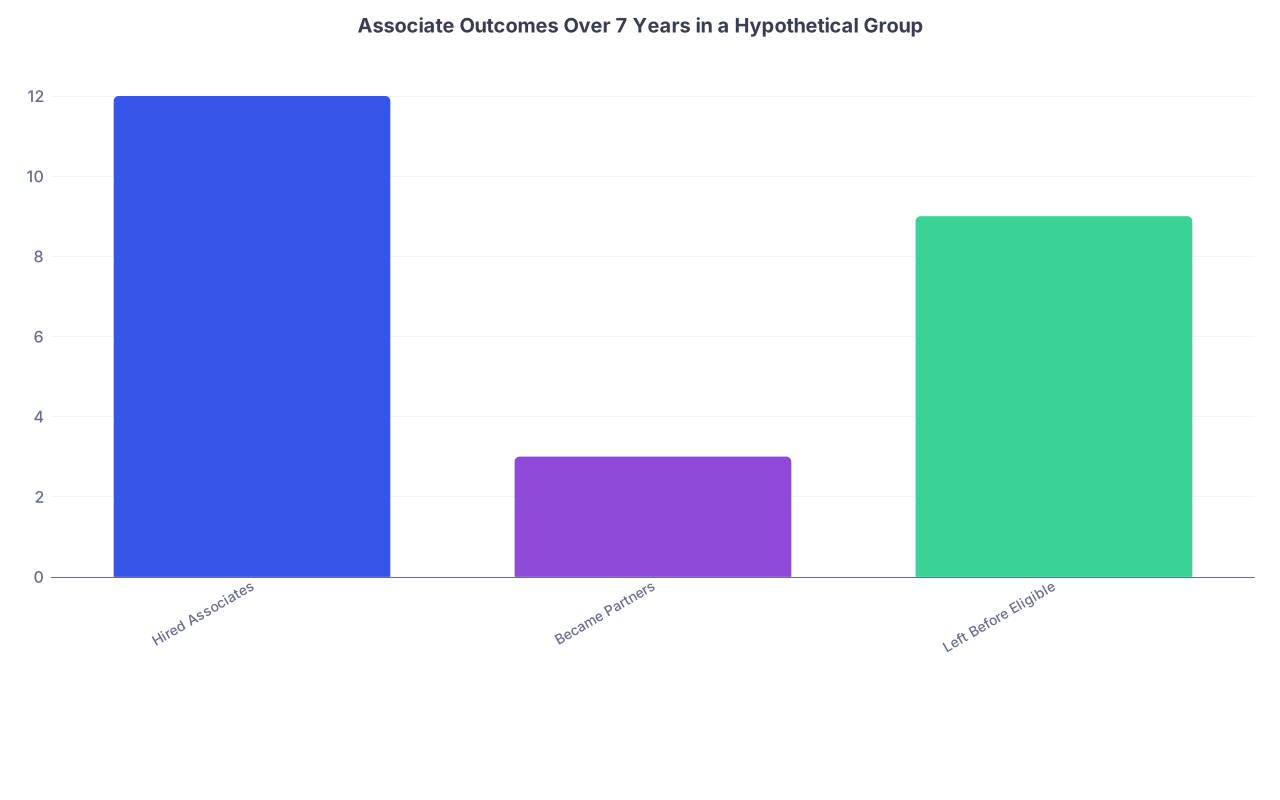
| Category | Value |
|---|---|
| Hired Associates | 12 |
| Became Partners | 3 |
| Left Before Eligible | 9 |
In the chart above, 12 associates hired, 3 become partners, 9 leave. That’s not a track. That’s a sorting mechanism.
4. Transparency of Existing Partner Economics
You should not accept “partners do very well” as an answer. Ask for:
- The compensation formula: base, productivity component, dividend from ancillaries.
- Partner range last year (e.g., “partners made between $520k and $690k”).
- Whether equity is equally held or tiered.
You will probably not get tax returns or K‑1s, but if they won’t even give you a range and formula, it suggests they don’t want you to see something.
5. Contractual Reality vs. Verbal Promises
If it isn’t in your contract, it does not exist.
Recruiters and even well-meaning senior docs will say, “We’ve always done it this way, don’t worry.” But partners retire. Groups merge. Markets shift. Leaders change.
Your only protection is what’s written. So push to include:
- A clear description of eligibility timing.
- Reference to a written partnership policy or operating agreement (that you can review).
- At minimum, a requirement that any material change to partnership terms be disclosed to you within a certain time frame.
A group that is serious about your future is not afraid of putting terms on paper. A group that wants flexibility to drop you before the finish line will fight you on that.
The Psychology: Why Smart Physicians Fall For This
This isn’t just math. It’s ego, fear, and culture.
You come out of residency/fellowship after a decade of being underpaid and overworked. You feel behind your college friends who went into tech or finance. The “partner” label is tempting because it finally sounds like what you think a real physician should be.
On top of that:
- Senior physicians push the story they lived 15–20 years ago, when small group ownership was more common and less predatory.
- You are exhausted and often desperate to sign something before loans crush you.
- You overestimate how unique this opportunity is because you’ve only seen a small slice of the job market.
Groups—especially the more cynical ones—know this. The partnership track is sold not just as a financial upside, but as an identity. That makes it harder to walk away, even when the details stink.
When Partnership Tracks Are Worth It
Not every track is a lie. Some are fair, even generous.
What do those look like?
- The criteria and buy‑in are crystal clear and written.
- The historical conversion rate from associate to partner is high and verifiable.
- The partners are willing to show you concrete numbers for partner income and distributions.
- There is real governance power with partnership—board seats, voting rights, control over schedules and strategy.
- The group is not in quiet talks to sell to a hospital or PE firm next year.
If you land one of those, yes, accepting a few lean years can absolutely be worth it. Ownership, done right, still matters.
The point is not that partnership is bad. The point is that “partnership track” has become so overused and underspecified that you should treat it as a bright, blinking caution sign until proven otherwise.
How To Protect Yourself When Negotiating
Three concrete moves instead of blind optimism:
- Use an experienced physician contract attorney who actually sees local partnership deals, not just a generic employment lawyer. Someone who can say, “This GI group across town has a real track; yours looks weak compared to that.”
- Demand specifics. Ask awkward questions. You are not being “difficult”; you are doing basic due diligence on what may be a seven-figure lifetime decision.
- Get comfortable walking away. If the group won’t clarify criteria, won’t quantify buy‑ins, and won’t discuss historical outcomes, they are not offering you a partnership track. They are offering you hope as a form of compensation.
Do not accept hope as currency.
The Bottom Line
You’re not just negotiating a salary. You’re negotiating whether you spend the next decade as cheap leverage for someone else’s equity event.
Three things to remember:
- “Partnership track” is marketing language until it’s supported by written criteria, defined buy‑ins, and a strong historical conversion rate.
- Vague promises, shifting timelines, and undisclosed partner economics are not quirks; they are structural features designed to keep your upside optional.
- The only real power you have post‑residency is the willingness to say no and walk toward offers where the numbers, not the slogans, make sense.