

The most dangerous contract you’ll ever sign might be a “standard” RVU-based agreement you barely understand.
Let’s fix that.
RVU-based compensation can make you a lot of money. It can also burn you out, wreck your work–life balance, and leave you stunned when the first paycheck hits. The difference isn’t luck; it’s whether you ask the right questions up front.
This isn’t about memorizing CPT codes. It’s about whether your personality, specialty, and life plans actually fit an RVU-driven model.
First: Do You Even Understand What You’re Getting Paid For?
RVUs (specifically wRVUs) are a proxy for clinical work. You’re not paid for “being there.” You’re paid for generating billable work relative to some benchmark (usually MGMA, AMGA, SullivanCotter data, etc.).
Here’s the core structure most people miss:
- Base salary (sometimes)
- Plus/minus productivity pay based on RVUs
- Often with a “conversion factor”: dollars per RVU
- Sometimes with a threshold: RVUs you must hit before you earn extra
If you can’t explain your own offer in one sentence like:
“I get $X per wRVU after I hit Y wRVUs, with a base of $Z guaranteed for N years,”
you don’t understand your contract well enough to sign it.
Let’s put some numbers around this.
| Model Type | Example Structure |
|---|---|
| Pure Salary | $260k flat, no RVU tie |
| Hybrid | $220k base + $50 per RVU over 4,000 RVUs |
| Pure RVU | $0 base, $65 per RVU from first RVU |
| Ramp Up | Year 1: $260k guarantee only; Year 2+: $55 per RVU with 5,000 RVU target |
If your offer doesn’t fit into something like that, it’s either:
- So complex it’s hiding something, or
- So vague it’s basically “trust us”
Both are problems.
Question 1: Are Your Expected RVUs Actually Realistic?
This is the make-or-break. If the RVU target is fantasy, everything else is noise.
Most contracts quietly assume a “target” wRVU number based on national data—but your local reality may be totally different: weaker referral base, too many docs, poor scheduling, slow OR, limited support staff.
You should ask, specifically and in writing:
- What’s the expected annual wRVU production for this role?
- How many RVUs did the last 3 people in this role produce?
- What’s the median wRVU production for your current physicians in my specialty?
If they can’t or won’t give numbers, that’s a red flag.
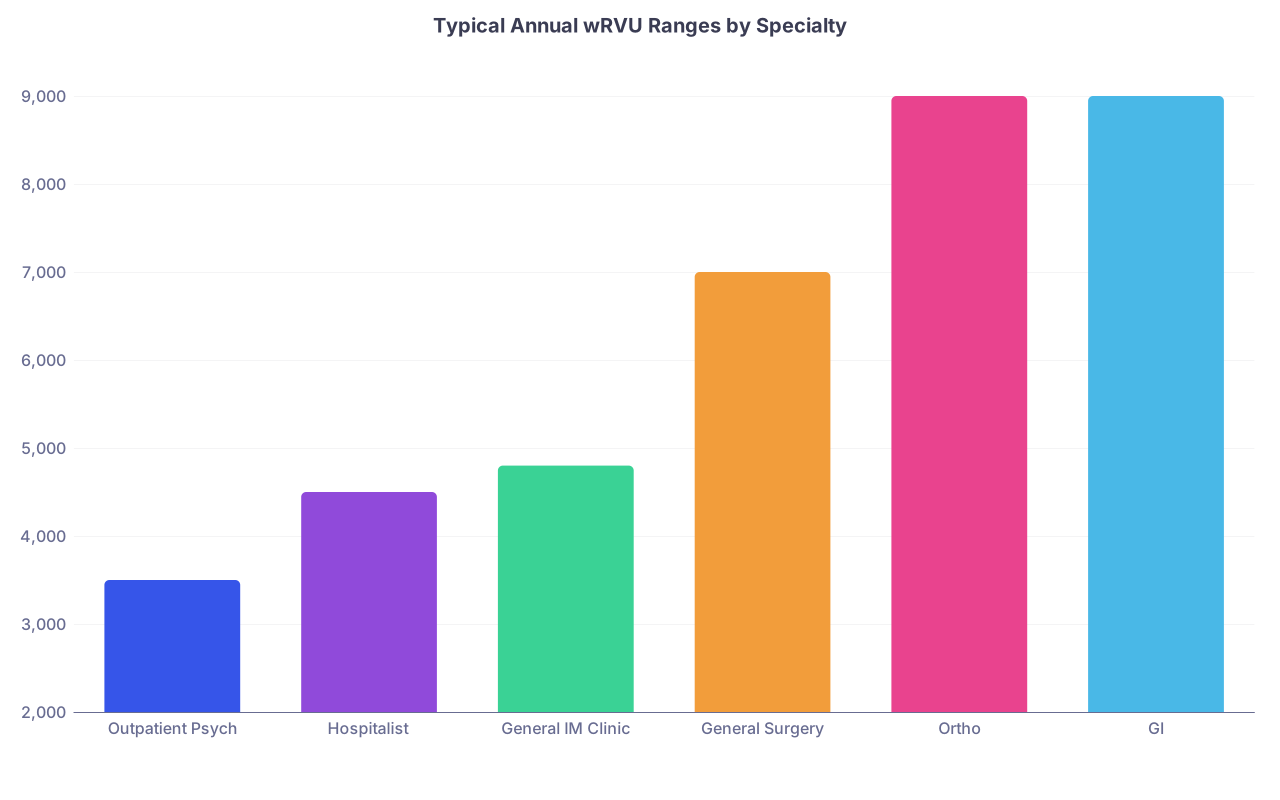
For context, some very rough ranges (these vary a lot by system and region):
| Category | Value |
|---|---|
| Outpatient Psych | 3500 |
| Hospitalist | 4500 |
| General IM Clinic | 4800 |
| General Surgery | 7000 |
| Ortho | 9000 |
| GI | 9000 |
If you’re offered a general IM outpatient role with a “target” of 7,000 wRVUs and everyone else in the group is at 4,500–5,000, you’re being set up to fail or to work insane hours.
Key follow-up questions:
- How many patients per day does this translate to?
- What’s the average no-show/cancellation rate?
- Who controls the schedule—me or the front desk?
If they start hand-waving instead of giving specifics, walk slower. Maybe away.
Question 2: Do You Tolerate (Or Enjoy) Volume-Driven Work?
RVU contracts reward speed and volume. If your style is meticulous, slow, and counseling-heavy, you’re going to feel constantly punished.
You’re a decent fit for an RVU-heavy contract if:
- You like efficiency, templates, and streamlined visits
- You’re comfortable delegating aggressively to APPs, nurses, MAs
- You don’t hate double-booking or tighter follow-ups when indicated
- You’re okay with some days being absolute chaos when the schedule packs out
You’re a terrible fit if:
- You want 30–60 minutes with every patient
- Your specialty has lots of non-billable work (long family meetings, admin, team care)
- You’re prone to burnout when pressured by metrics
RVU systems do not pay you for:
- Phone calls
- Portal messages (usually)
- Care coordination
- Teaching
- Committee work
- “Being the nice, available doc”
So if half your value is in those things, RVU-only systems undervalue you.
Question 3: How Long Is the Guarantee, and What Happens After?
A common trap: Year 1–2 look incredible. Year 3 makes you question your life choices.
You’ll often see:
- 1–2 year guaranteed base salary (no clawback)
- Transition in Year 2 or 3 to pure or mostly RVU-based
You need precise answers to:
- How long is the guarantee?
- During the guarantee, do I still track RVUs? (You want yes.)
- After the guarantee, is my base recalculated based on my own prior RVUs?
- Are there any clawbacks if I don’t hit target during guarantee?
If they say: “Don’t worry, no one ever has a problem with this,” that’s when you absolutely should worry.
Here’s the pattern I’ve actually seen:
- Year 1–2: Great pay, low expectations, they’re just happy you’re there
- Year 3: Base shrinks, heavy pressure to produce, maybe a new administrator breathing down your neck
You want to see the actual math for year 3 and beyond, with an example using:
- Target RVUs
- Dollars per RVU
- Any floor or ceiling on total comp
And you want it in the contract or an attached compensation exhibit. Not just “we’ll review annually.”
Question 4: What’s the RVU Conversion Factor, and How Does It Compare?
This is the most concrete number you can negotiate. The “conversion factor” is how much you’re paid per work RVU. A small difference here adds up fast.
Example:
- $50 per wRVU × 6,000 wRVUs = $300,000
- $60 per wRVU × 6,000 wRVUs = $360,000
Same work. $60k difference.
You want to ask:
- What’s my wRVU rate (conversion factor)?
- Is it the same as other physicians in my specialty here?
- Does it change over time? On promotion? With leadership roles?
- Is it indexed to inflation or CMS RVU changes? (Usually: no. But ask.)
If they say, “We don’t negotiate the RVU rate,” fine. Then you negotiate something else: a higher guarantee, lower threshold, sign-on, or protected non-RVU time.
Question 5: How Much Non-Productive Time Is Built In (Realistically)?
RVU contracts love to pretend that:
- 1.0 FTE = 40 hours/week clinical
- Any non-clinical stuff is magically invisible
Reality: You’ll have meetings, inbox, CME, charting, orientation, onboarding, maybe call that doesn’t generate much RVU.
You need clarity on:
- How many clinic/OR/rounding hours per week are expected?
- How many sessions or half-days are truly protected for admin/teaching/research?
- Are those sessions RVU-neutral (i.e., I’m not punished for not generating RVUs then)?
- Are leadership roles compensated with stipend or RVUs?
If your contract says 1.0 FTE = 10 half-days of clinic, but they also want:
- One half-day of “meetings,”
- One half-day of “float” coverage,
- And they still expect full RVU targets…
They’re quietly asking you to do 1.2 FTE worth of work for 1.0 FTE pay.
Question 6: Who Controls the Levers That Affect Your RVUs?
RVU-based comp only works if you have real control over your schedule and resources. If you’re at the mercy of a clunky system, your “productivity” is fake.
Ask these blunt questions:
- Who controls my template (visit lengths, double-booking, new vs follow-up mix)?
- Can I adjust my schedule, or does admin have to approve it?
- How many MAs/RNs/APPs will I have? Do I share them?
- How is call scheduled, and does call generate RVUs or a separate stipend?
- Who decides which patients go to which doctor?
If they say, “Our centralized scheduler assigns patients,” your income is now tied to someone else’s priorities.
This is where people get burned: They assume they’ll be busy. Then they show up to a half-empty schedule and get told to be “more available” while admin drags their feet fixing it.
Question 7: Is Your Specialty Even a Good Match for RVU Compensation?
RVU models work great for:
- Procedure-heavy specialties (GI, cards, ortho, IR, anesthesia)
- High-volume outpatient (urgent care, some primary care clinics with support)
They work poorly for:
- Cognitive-heavy work with lots of non-billable time (psych, geriatrics, heme/onc with long family meetings)
- Strong teaching/academic roles with large non-clinical commitments
- Administrative-heavy positions
If you’re in an RVU-heavy contract in a low-RVU specialty, you want:
- Lower RVU targets
- High base salary portion
- Explicit compensation for non-clinical time (stipends, percentages, or separate metrics)
Don’t accept a surgeon-style RVU target in a psychiatry job. That’s not “ambitious”; it’s exploitative.
Question 8: How Are Changes to the Plan Made?
This one almost nobody asks—and then they’re blindsided when the hospital “updates” the compensation plan.
You want to know:
- Can the employer unilaterally change the RVU rate or targets?
- Do changes apply to existing contracts or only new ones?
- How much notice do you get before changes take effect?
Your ideal language is something like:
- Compensation plan changes don’t apply to you until contract renewal, or
- Material adverse changes allow you to terminate without penalty
What you don’t want:
“We reserve the right to change the compensation plan at any time, at our sole discretion.”
You’re basically signing a blank check with your name at the bottom.
Question 9: What Happens If You Overperform? Or Underperform?
This is about risk and upside.
Underperformance:
- Is your base salary at risk if you don’t hit RVU targets?
- Are there clawbacks, withholds, or “true-ups” at year-end?
- Could you owe money back if you’re sick, have a baby, or the hospital messes up your schedule?
Overperformance:
- Is there a cap on total compensation?
- Does your RVU rate drop after a certain point?
- Are bonuses discretionary or formula-driven?
The worst combo:
Soft-promise RVU upside, hard-enforce penalties. I’ve seen systems celebrate “high producers” in newsletters while quietly cutting their RVU rate or introducing “caps to protect fairness.”
If there’s upside, make sure it’s:
- Written
- Formulaic
- Not subject to “committee approval”
Quick RVU-Contract Self-Check
If you answer “no” or “I don’t know” to any of these, you’re not ready to sign:
- Do I know my exact RVU rate and realistic target?
- Do I know what everyone else here actually produces?
- Do I understand what happens after the guarantee period?
- Do I know who controls my schedule and staffing?
- Do I know how much non-clinical time I’ll have and how it’s valued?
- Do I know how and when the plan can be changed?
- Do I know if there’s a comp cap or clawback?
If you’re staring at 3+ “I don’t know” answers, push pause. Ask. Get it in writing. Or get a contract review by someone who does this for a living.
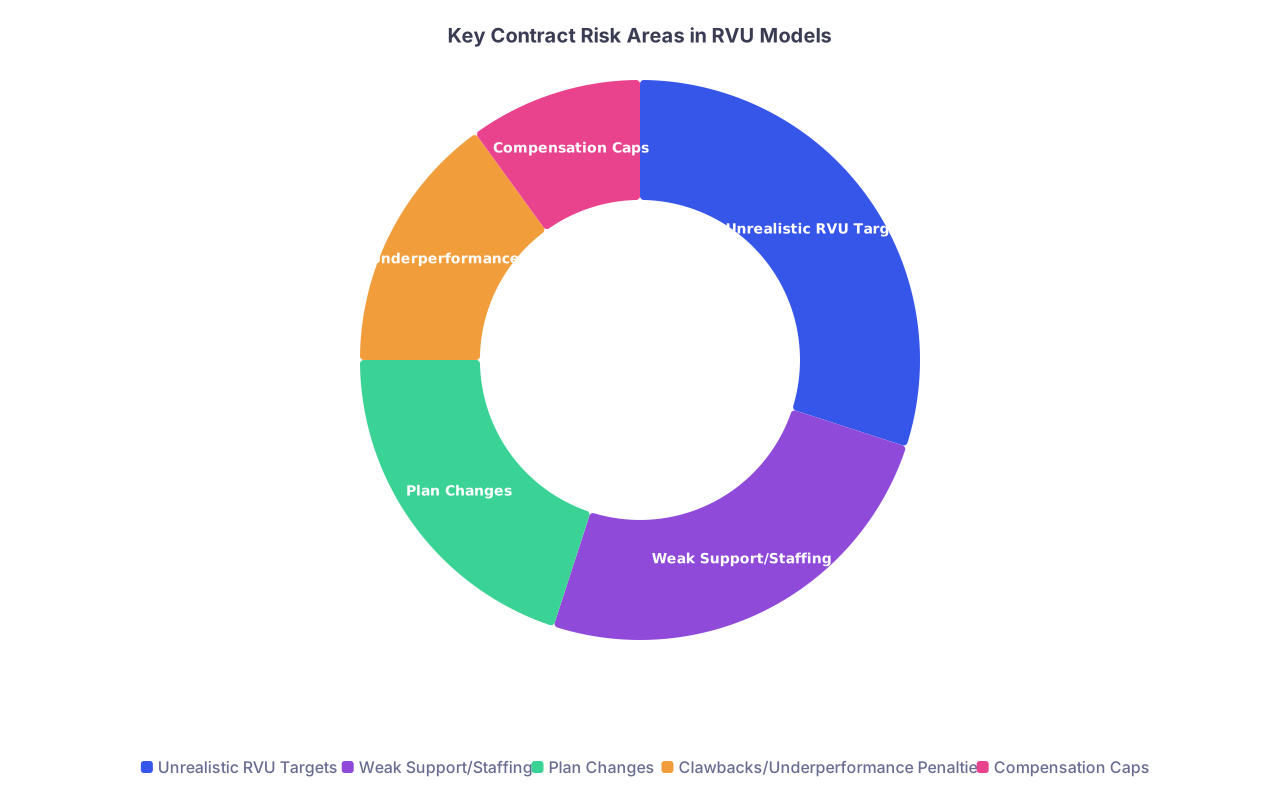
| Category | Value |
|---|---|
| Unrealistic RVU Targets | 30 |
| Weak Support/Staffing | 25 |
| Plan Changes | 20 |
| Clawbacks/Underperformance Penalties | 15 |
| Compensation Caps | 10 |

| Step | Description |
|---|---|
| Step 1 | Offered RVU-Based Contract |
| Step 2 | Ask for Clarification and Examples |
| Step 3 | Negotiate Targets or Base |
| Step 4 | Consider Salary or Hybrid Model |
| Step 5 | Negotiate Higher Base or Floor |
| Step 6 | RVU Model Likely Reasonable |
| Step 7 | Understand Terms Clearly |
| Step 8 | Targets Realistic vs Current Docs |
| Step 9 | Specialty and Style Fit RVU Model |
| Step 10 | Comfortable With Risk and Variability |

Common Negotiation Levers in RVU Contracts
Even if they say “the RVU plan is standard,” you usually still have room to move. You may not get all of these, but you should at least try to move the big ones.
Reasonable asks:
- Longer or stronger guaranteed salary period
- Slightly higher base pay, even with same RVU rate
- Lower RVU target in year 1–2 while ramping up
- Explicit admin/teaching time with no RVU expectation
- Written confirmation of staffing/support level (e.g., 1:1 MA)
- Separate stipend for call or leadership
Unreasonable-but-worth-floating sometimes:
- Higher RVU conversion factor
- Floor on total comp in years 3+
- Protection from mid-contract comp plan changes
If they won’t move on anything, that’s also information. You’re signing into a rigid system. Don’t expect it to flex later “once they see how good you are.”

When an RVU-Based Contract Is Probably Right for You
RVU comp can be a great fit when:
- You’re in a higher-RVU specialty (procedures, busy clinic)
- You like working hard in bursts and don’t mind variability
- The group has a strong track record of stable, high volumes
- The system is transparent about data and past physician performance
- You’re early in your career and want upside, and your life situation can tolerate some risk
It’s probably wrong for you when:
- You’re in a mainly cognitive, long visit, low-RVU specialty
- You value predictability and stable income more than “upside”
- You’re at risk of burnout and don’t trust yourself to set limits
- You’re stepping into a new program with completely unknown volume
RVU systems reward throughput. They rarely reward sanity.

FAQ: RVU-Based Contracts
Is an RVU-based contract always worse than a straight salary?
No. For high-volume or procedure-heavy specialties, RVU-based models can pay significantly more than flat salary. The problem isn’t the concept; it’s unrealistic targets, lack of transparency, and hidden downside. A well-structured hybrid (decent base + fair RVU rate) can be excellent.What’s a “good” RVU conversion factor?
It depends heavily on specialty and region. Hospitalist might see $50–$65/RVU, primary care maybe $40–$55, procedural specialties much higher. You should compare offers to MGMA/AMGA benchmarks and to what your future colleagues in the same group are getting. If they won’t tell you that, be suspicious.Should I ever accept a pure RVU contract with no base salary?
Only if: 1) you’re walking into a guaranteed, proven high-volume situation (e.g., replacing a full, beloved retiring partner), 2) your specialty is procedure-heavy, and 3) you have solid financial reserves. For most new grads, especially in uncertain markets, pure RVU with no base is too much risk.Can I negotiate RVU targets as a new attending?
Yes, and you should. Reasonable asks include: lower targets for year 1 (ramp-up), written clarification that year-1 RVUs won’t be used to slash year-3 salary, and spreading expectations realistically over FTE (e.g., lower targets for 0.8 FTE). Don’t just accept “everyone hits this” without proof.How do call duties interact with RVU pay?
In many places, call generates little or no RVU credit relative to the pain. You want to know: Is call separately stipended? Does call time count toward FTE without added RVU expectations? If call is heavy and unpaid, that’s effectively a pay cut and should be part of your negotiation.What if my employer changes the RVU plan after I start?
Look at your contract. Some let them unilaterally change the plan, which is brutal. Better language ties you to a specific plan or at least gives you an out if changes are materially adverse. If they change the plan mid-stream, keep documentation, track your numbers, and consider legal/contract review if income drops significantly.Who should review my RVU-based contract before I sign?
Ideally: a physician contract attorney who understands RVU models and someone (mentor, senior colleague) in your specialty who can sanity-check the targets. Generic employment lawyers or well-meaning family members are not enough. You’re potentially talking about hundreds of thousands of dollars over a few years—spend the money to get this right.
Bottom line:
- RVU contracts aren’t inherently good or bad—they’re either clear and realistic or they’re traps.
- If you can’t explain your compensation formula and targets in one sentence, don’t sign.
- Volume-driven pay demands you protect your time, your support, and your sanity up front—on paper, not on trust.


