

The biggest mistake physicians make when changing jobs is resigning based on verbal promises. That is how you end up unemployed, out-of-network, and possibly sued.
You should not resign your current physician job until the right things are in writing from your future employer—and, ideally, from your current one too. Let’s walk through exactly what those things are.
The Core Rule: No Written Contract, No Resignation
Let me be blunt:
If your new attending job is “pending” and “they’re just working out the details,” you haven’t actually got a job.
You need, at minimum:
- A fully signed new employment contract (or partnership/shareholder agreement if applicable), not just an offer letter, and
- Clarity on your exit terms with your current employer—ideally confirmed in writing.
Verbal promises vanish the second leadership changes or finances worsen. Emails can be reinterpreted. The contract is the only thing that matters when things go sideways.
What Must Be in Writing From Your New Employer Before You Resign
Here’s the checklist I’d want to see checked off before you even think about giving notice.
1. Fully Executed Employment Contract
Not “draft in your inbox.”
Not “should be ready next week.”
Not “we all agree; legal just needs to finalize.”
You want both signatures: yours and theirs.
At a minimum, that contract must clearly specify:
- Position title and clinical scope
- FTE status (0.8, 1.0, etc.)
- Base salary/comp structure
- Start date
- Work location(s)
If the start date is “anticipated,” get a clause that protects you if the date is delayed (“This agreement shall commence on the later of X or credentialing completion, but no later than Y…”). If you resign and then they delay your start 4 months because “credentialing took longer,” that gap is on you unless the contract says otherwise.
2. Compensation Structure in Detail
You need your entire pay structure in the contract, not “we’ll work that out later.”
Critical details to confirm in writing:
- Base salary (exact number, not “competitive”)
- Bonus or RVU model: thresholds, conversion factors, guarantee period
- Call pay, extra shifts, moonlighting rates
- Sign-on bonus: amount, timing, and repayment terms if you leave early
- Relocation: amount, reimbursement process, and payback schedule
If part of your comp is RVU-based, the contract should say something like:
- RVU target per year
- RVU conversion rate ($/wRVU)
- How often productivity is calculated and paid
- Whether there’s a guarantee period (e.g., $260k base for 2 years, then pure RVU)
“Don’t worry, our docs usually make $400k” means nothing if the written structure makes it almost impossible.
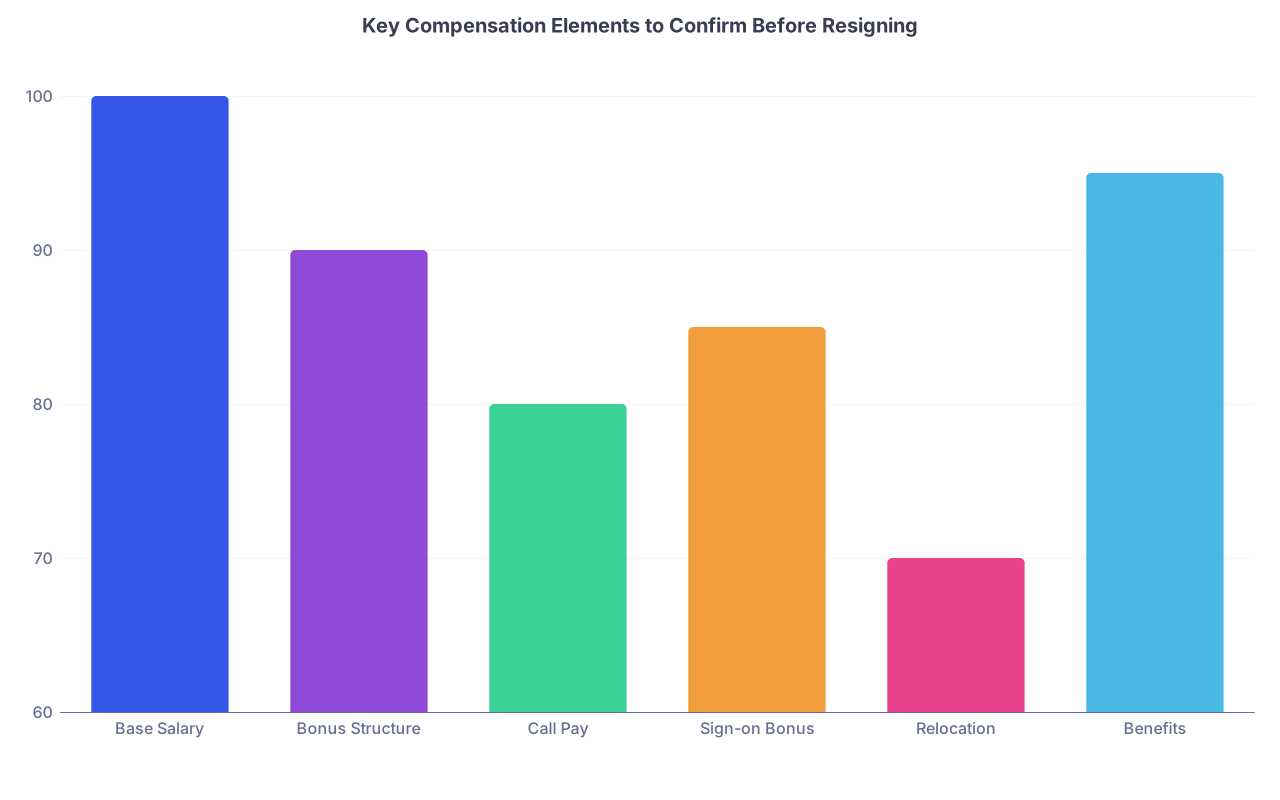
| Category | Value |
|---|---|
| Base Salary | 100 |
| Bonus Structure | 90 |
| Call Pay | 80 |
| Sign-on Bonus | 85 |
| Relocation | 70 |
| Benefits | 95 |
(Think of those numbers as “importance” out of 100. Benefits and base salary are non-negotiable to have in writing.)
3. Workload and Call Expectations
This is where physicians get burned most.
You want specific language about:
- Clinic/OR schedule (e.g., 8 half-days clinic; 2 OR days; 1 admin half-day)
- Average patient volume expectations (or range)
- Inpatient vs outpatient mix
- Call: frequency, type (phone vs in-house), expected volumes, any separate pay
The contract does not need to micromanage every detail, but it should protect you from “bait and switch.” Something like:
“Physician shall provide outpatient primary care services averaging 8 half-day clinics per week with an expected panel size of approximately X patients, subject to mutual agreement.”
If they “can’t” put any of this in writing, that’s a red flag.
4. Location and Travel
Multi-site systems love vague language: “Physician may be assigned to such locations as Employer deems necessary.”
You need:
- Primary work site(s) named
- Any satellite/float expectations
- Whether your primary site can be changed unilaterally and under what conditions
- Any required travel and whether it’s compensated
Push for limits: “No more than X% of shifts at alternate sites without mutual agreement.”
5. Term, Termination, and Non-Compete
You’re about to leave one job. Do not jump into another trap.
Your new contract’s termination and restrictive covenant language should be clear before you resign:
- Is it at-will with without-cause termination? What’s the notice period?
- Who can terminate without cause—you, them, or both?
- What are the “for cause” grounds?
- Non-compete: radius, duration, and exact restricted activities
- Non-solicitation: patients, staff, referral sources
This matters because you’re making a move that might lock you out of your current market later. Know the trade-off.
| Term | What You Need In Writing |
|---|---|
| Start Date | Specific date and what happens if delayed |
| Base Salary | Exact number and period (year 1, year 2, etc.) |
| Call Requirement | Frequency, type, and any differential pay |
| Non-Compete | Radius, duration, and scope of restricted work |
| Termination | Notice period and who can terminate without cause |
6. Benefits and Insurance Coverage
You do not want a coverage gap when you have a family and a mortgage.
Get the following in writing (contract or benefit summary referenced in the contract):
- Health, dental, vision coverage, and when they start
- Disability insurance (short- and long-term)
- Malpractice coverage: claims-made vs occurrence, limits
- Who pays for tail if claims-made
- Retirement: 401k/403b match, vesting schedule
- CME money and time
If malpractice is claims-made and they will not cover tail, calculate what that tail could cost if you leave in 2–3 years. That’s real money. I’ve seen tails cost $40k+ for certain specialties.
7. Contingencies: Credentialing, Board, Visa, etc.
If your offer is contingent on:
- Hospital privileges
- Payer credentialing
- Board certification
- Licensing
- Visa processing (J-1, H-1B)
Then the contract should say exactly what happens if those are delayed or denied. Ideally:
- You’re paid some amount if delays are on their side (hospital admin, credentialing office)
- You can walk away if contingencies are not met by a certain date—without penalties
What You Need in Writing From Your Current Employer Before You Resign
Do not assume you “remember” your original contract correctly. Pull it out. Read it. Then get clarity in writing on the exit logistics.
1. Notice Period and Method
Most physician contracts require 60–180 days written notice.
Things to verify:
- Exact notice period
- How notice must be given: email, certified letter, portal, fax (yes, some still require fax)
- To whom it must be addressed (CEO, CMO, HR, etc.)
Then, when you’re ready, your resignation itself should be in writing, and you should keep proof of receipt.
2. Non-Compete and Geographic Limits
You probably signed something years ago and barely remember the details.
Find out:
- How far the non-compete radius extends (miles from which facilities?)
- Duration (often 1–2 years)
- Does it apply to all specialties or just your current role?
- Are there buyout options?
- What happens if they terminate you without cause—does the non-compete still apply?
If you’re planning to work in the same city, get legal review. I’ve seen physicians resign, start a new local job, and get a cease-and-desist letter within two weeks.
3. Malpractice Tail Coverage Responsibility
Your current contract should say:
- Claims-made or occurrence
- Who pays for tail
- Any exceptions (e.g., if you work less than 2 years, you owe tail)
You want written confirmation from HR or legal that:
- You’re either fully covered after departure, or
- You know exactly what tail you must secure and by when
Get it in an email: “Per your contract, Employer will provide tail coverage upon your departure” or “Tail is your responsibility.” Then plan accordingly.
4. Final Pay, PTO, and Bonuses
Before resigning, clarify in writing:
- What happens to unused PTO or vacation – paid out or forfeited?
- Are you owed any productivity/quality bonus, and when will it be calculated and paid?
- What happens if your last day is mid-quarter or mid-year?
I’ve seen entire bonuses disappear because a physician left one week before the “measurement date.”
The Sequence: What Order Should You Do All This In?
Here’s the sequence I recommend. Don’t skip steps because you’re excited.

| Step | Description |
|---|---|
| Step 1 | Review Current Contract |
| Step 2 | Negotiate and Finalize New Contract |
| Step 3 | Confirm Start Date and Credentialing Timelines |
| Step 4 | Check Non-Compete Overlap |
| Step 5 | Get Written Confirmation on Tail and Bonuses |
| Step 6 | Sign New Contract |
| Step 7 | Submit Written Resignation |
Notice what comes last? Resignation.
You sign the new contract first. You resign second. Anything else is unnecessary risk unless you’re okay with a gap—and possibly unemployment.
Common Traps to Avoid
A few patterns I see over and over:
The “Offer Letter Is Enough” Trap
Offer letters are sometimes non-binding. If the actual contract later contradicts it, the contract usually wins. Do not resign based solely on an unsigned offer letter.The “We’ll Fix It After You Start” Lie
Worse phrase in recruiting: “We’ll work out your schedule/call/comp details once you’re here.” Translation: you have no leverage then. Fix it now.The “Trust Me, Legal Language Only” Excuse
If a recruiter or CMO says, “Oh, that non-compete is just boilerplate; we never enforce it,” ask them to put that in writing or remove/revise it. Watch how fast they backtrack.The Gap in Malpractice Coverage
Leaving on June 30, starting September 1, with no tail and no temp coverage? You’re one malpractice allegation away from personal financial disaster.
Quick Self-Check Before You Hit Send on That Resignation Email
Ask yourself:
- Do I have a fully signed contract from my next employer?
- Do I understand my new comp, schedule, and non-compete in writing?
- Do I know my current non-compete boundaries and tail obligations?
- Do I have a clear, documented start date and contingency plan?
- Am I okay, financially and professionally, if something delays my new role?
If you answer “no” to any of those, you’re not ready to resign.
FAQ: What Should Be in Writing Before You Resign Your Current Physician Job?
1. Is a signed offer letter enough to resign, or do I need the full contract?
You need the full, executed employment contract. An offer letter might not be legally binding and almost never has all the details: termination terms, non-compete language, malpractice coverage, detailed compensation structure. I have seen employers “adjust” terms between the offer letter and final contract. If you resign based on the letter and then hate the contract, your leverage is gone. Wait for the signed contract.
2. How long of a gap between jobs is “safe” if my new start date isn’t firm?
If your start date is not firm, it is not safe. At minimum, you should have a contractual start date or a clear window (e.g., “no later than X date”) plus some protection if delays occur. If you choose to take a voluntary gap for personal reasons, that is different—you plan for it financially. But resigning when the new job’s start is “probably in three months” is gambling with your income, benefits, and malpractice coverage.
3. What if my new employer refuses to spell out call schedule or workload in the contract?
That’s a red flag. You do not necessarily need exact clinic templates, but you should have some guardrails: expected clinics per week, approximate call frequency, or at least written confirmation in an email from a decision-maker that matches what you’re being told. If they insist on total vagueness, assume they want maximum flexibility to increase your workload later.
4. Can I negotiate my non-compete before I resign from my current job?
Yes, and you should—on both sides if needed. With your new employer, try to narrow the radius, duration, and scope before signing. With your current employer, some physicians negotiate non-compete waivers or modifications as part of their resignation, especially if they’re leaving on good terms or going into a non-competing niche. Get any waiver or modification in writing, signed by someone with authority.
5. What’s the single most important thing to confirm from my current employer before resigning?
If I had to pick one: your non-compete and tail coverage obligations. Those two can blow up your entire plan if you’re wrong. Non-compete can block your new local job. Tail can cost tens of thousands out of pocket. Pull your contract, read the clauses, and get an email from HR or legal confirming how they’ll be handled in your specific situation.
Open your current contract and your new offer right now. Highlight anything that affects your exit (non-compete, tail, notice) in one color and anything that affects your new role (start date, comp, call, location) in another. If any of those areas are still fuzzy or verbal only, your next step is not resignation—it is getting those details in writing.


