

Most new attendings are accepting sign-on bonuses that are too low and too restricted.
Let me walk you through what actually counts as a good sign-on bonus today—and what’s just shiny bait.
1. The Real Numbers: What’s “Good” in 2024–2025?
Let’s stop with vague words like “competitive.” You want ranges.
For full-time new attendings in the U.S., here’s what I’d call reasonable vs strong sign-on bonuses today, assuming a standard 2–3 year commitment and non-academic, employed roles:
| Setting / Specialty Level | Weak / Meh | Reasonable | Strong / Very Strong |
|---|---|---|---|
| Primary Care (FM, IM, Peds) | <$15,000 | $15,000–$35,000 | $40,000–$75,000 |
| Outpatient Psych | <$10,000 | $10,000–$30,000 | $35,000–$60,000 |
| Hospitalist | <$15,000 | $15,000–$40,000 | $45,000–$80,000 |
| Non-surgical specialties (cards, GI, heme/onc, pulm/crit, etc.) | <$20,000 | $20,000–$60,000 | $65,000–$100,000+ |
| Surgical (ortho, neurosurg, ENT, urology, etc.) | <$25,000 | $25,000–$75,000 | $80,000–$150,000+ |
Those “strong” numbers aren’t fantasy. I’ve seen:
- Rural hospitalist: $100,000 sign-on + $100,000 loan repayment over 3 years
- Ortho in upper Midwest: $150,000 sign-on spread over 3 years
- GI in medium-sized city: $75,000 sign-on, paid half at signing, half at start
On the other hand, $5,000–$10,000 for a full-time new attending? Today, that’s closer to a “we hope you don’t know better” offer in most non-academic settings.
Quick rule of thumb
As a rough, dirty heuristic for non-academic jobs:
- A good sign-on bonus is usually around 10–25% of your expected first-year base salary
- Under 5% of base? Weak.
- Over 30%? Either very aggressive recruiting … or a red flag job they can’t keep filled.
2. The Context: Factors That Change What “Good” Means
You can’t judge a sign-on bonus in a vacuum. The same $25,000 can be excellent in one setting and terrible in another.
Here are the big levers that actually move the needle.
Geography
Bluntly: the worse the desirability, the bigger the bonus.
- Rural / poor recruitment areas
Bonuses are often double what you’ll see in major metros.
A “good” rural primary care sign-on: $40,000–$75,000 isn’t unusual. - Mid-size/secondary cities
Usually middle of the ranges I gave above. - Major metros / coastal cities (Boston, SF, NYC, Seattle, LA)
You’ll see lower sign-on bonuses because demand is high. A “good” sign-on might be half the rural number for the same specialty. Sometimes almost nothing.
Specialty supply and demand
This is harsh but real: some specialties just get better checks.
- Historically strong bonuses: ortho, neurosurg, GI, heme/onc, pulm/crit care, anesthesiology in some regions, EM in truly underserved areas, hospitalist for nights or 7-on/7-off with lousy location.
- Moderate: cards, urology, ENT, radiology, outpatient psych.
- Lower end: pediatrics, outpatient IM in big cities, academic-heavy specialties, highly desirable metro jobs in any field.
Employer type
This is where a lot of residents get surprised.
- Independent or small groups
Often lean more on base salary and productivity than big sign-on checks. They sometimes structure it as a partnership track benefit instead. - Large hospital systems
Often have standardized packages, but can still move on sign-on bonuses if they’re really hurting for coverage. - Private equity–backed or staffing companies
These groups frequently throw big bonuses around. Looks great. Read the obligations carefully—buyout terms are often brutal. - Academic centers
Usually lower or no sign-on bonus. If you’re getting $5,000–$15,000 at a big-name academic hospital, that can be “good” in that lane because the whole comp philosophy is different.
3. The Part Everyone Misses: Terms Matter More Than The Sticker
A $50,000 sign-on bonus with nasty strings attached can be worse than a clean $15,000.
Here’s what actually determines whether the bonus is good or not.
1. Repayment / forgiveness period
You need to know:
- How long do you have to stay to avoid repaying it?
- Is it cliff-based (all or nothing) or pro rata (forgiven gradually)?
Strong structure:
- Two- or three-year commitment
- Forgiven monthly or quarterly over that time
- If you leave early, you only repay the unforgiven portion
Example:
$60,000 bonus, 3-year term, forgiven monthly.
You leave at 18 months → you repay ~$30,000, not the whole $60,000.
Weak structure (and I see this too much):
- “If you do not complete the 3-year term, the full sign-on bonus is due back.”
Translation: leave at month 35 of 36 and they could technically come after all of it.
You should absolutely push for pro rata forgiveness. That’s often negotiable even when the total number isn’t.
2. How and when it’s paid
Timing matters more than people think.
Common structures:
- At start date: Standard. Fine.
- Split payment: Half at signing, half at start; or split across year 1 and year 2.
- Over time: Buried in your paycheck as “retention pay” every pay period.
Better for you:
- A chunk upfront (at or near start date) to offset relocation, boards, initial expenses.
- Minimal delay. “Paid after 6 months” is not a sign-on bonus; it’s a retention carrot.
Bad signs:
- “Paid at the successful completion of year 1.” That’s not a sign-on. That’s a delayed retention bonus. Different risk profile.
3. Tax handling
One painful surprise: your $50,000 bonus is taxed like ordinary income. It’s not magically $50k in your checking account.
A smart move:
- Ask them to break it into multiple payments in separate tax years if possible.
- Or negotiate other tax-advantaged items: relocation reimbursement, CME funds, signing retention labeled differently, etc.
You’re not getting around taxes, but you can spread the hit.
4. Don’t Let the Bonus Distract You From the Real Money
This is where a lot of new grads get burned.
A hospital flashes a $60,000 bonus and you stop noticing they’re offering $40,000 less in base salary every year than another job.
Do the basic math.
If Job A pays:
- $275,000 base + $20,000 bonus
And Job B pays:
- $315,000 base + $10,000 bonus
You’d be crazy to pick Job A just for the extra $10,000 up front unless there are massive lifestyle/location advantages.
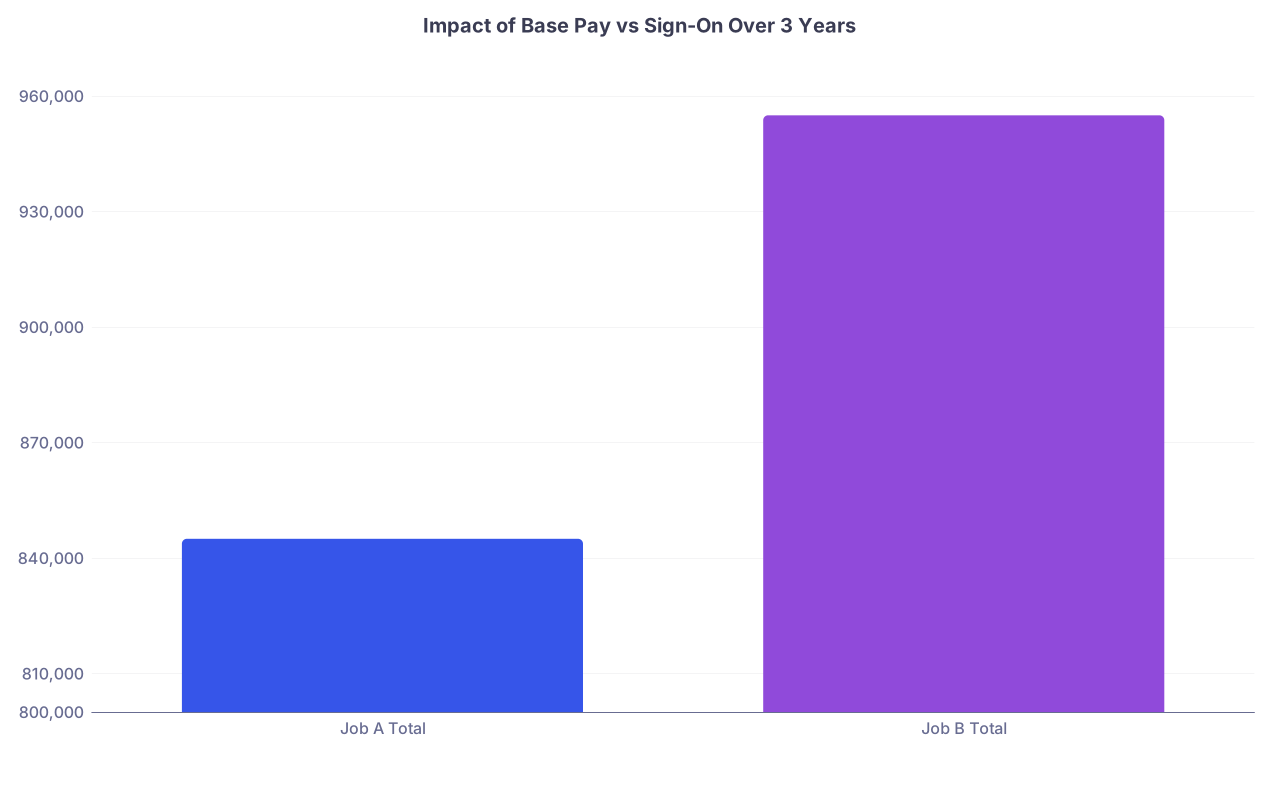
Over three years:
- Job A: $275k x 3 + 20k = $845k
- Job B: $315k x 3 + 10k = $955k
That “weaker” sign-on is attached to a $110,000 higher total 3-year package.
So the right way to think about this:
- The sign-on bonus is one piece of total compensation: base, bonus, productivity, call pay, benefits, loan repayment, tail coverage, CME, retirement contributions.
- A “good” sign-on bonus attached to a bad compensation structure is not good.
| Category | Value |
|---|---|
| Job A Total | 845000 |
| Job B Total | 955000 |
5. What You Can Actually Negotiate (And How)
You’re not powerless here. But you do need to be deliberate.
Levers that are often negotiable
If they say the base salary is locked, ask about:
- Higher sign-on bonus (especially if they’ve been trying to fill the spot for a while)
- Adding or increasing loan repayment (sometimes easier for them than true bonus)
- Better repayment structure (pro rata forgiveness instead of all-or-nothing)
- More relocation or covering specific expenses (board fees, licensing, DEA, initial housing stipend)
- A retention bonus at the end of year 2 or 3
They may not move on the headline number, but will move on structure.
Concrete phrases you can use
You don’t need to sound like a lawyer. Something like:
- “Given the market rates I’m seeing for [your specialty] in [region], is there room to increase the sign-on bonus closer to $X?”
- “I’m concerned about the all-or-nothing repayment language. Would you consider structuring the sign-on to be forgiven monthly over the 3-year term instead?”
- “If the sign-on number is fixed, could we look at additional loan repayment support or an end-of-year-2 retention bonus?”
Most residents never ask. And they leave $10k–$50k on the table because of it.
6. Red Flags Hidden Behind Big Bonuses
Big checks can mean big problems. If the number looks amazing, zoom in harder, not softer.
Watch for:
- High sign-on + tiny base salary
Especially combined with “productivity expectations” that sound vague or excessive. - Very short partnership track with huge buy-in
Some groups front-load a big “bonus” then claw it from you on the back end. - Brutal non-competes
High bonus + a non-compete that blocks you from working anywhere within 50–100 miles for 2 years. That’s handcuffs. - Aggressive repayment terms
Full repayment if you leave for any reason, even if they cut your hours or change your schedule.
If the bonus seems too good for the market, ask: Why can’t they keep this job filled?
Then ask the nurses, staff, and current docs what the real story is.

| Step | Description |
|---|---|
| Step 1 | Receive Offer |
| Step 2 | Check Base Salary vs Market |
| Step 3 | Compare Bonus to Specialty Range |
| Step 4 | Ask to Increase or Improve Terms |
| Step 5 | Review Repayment Terms |
| Step 6 | Investigate Red Flags |
| Step 7 | Check Commitment Length |
| Step 8 | Ensure Pro Rata Forgiveness |
| Step 9 | Decide Accept, Negotiate, or Walk |
| Step 10 | Bonus Seems High or Low |
FAQ: Common Questions About New Attending Sign-On Bonuses
1. Is a $10,000 sign-on bonus good for a new attending?
Usually no, unless you’re:
- Going into academics,
- A highly desirable metro location, or
- A lower-paid specialty like peds in a saturated market.
For most non-academic new attendings, $10,000 is on the weak side now. You might accept it if the overall package and lifestyle are great, but don’t kid yourself that it’s “strong.”
2. What’s a good sign-on bonus for a hospitalist right now?
For a full-time adult hospitalist:
- Weak: under ~$15,000
- Reasonable: $15,000–$40,000
- Strong: $45,000–$80,000+ (upper end more common in rural or unpopular locations, or nights-heavy roles)
If they’re offering less than $10,000 and claiming it’s “standard,” I’d be skeptical and compare to other regional offers.
3. Is it better to take a higher sign-on bonus or higher salary?
Over 3–5 years, base salary almost always wins.
A one-time bump of $20,000–$40,000 doesn’t compete with being underpaid by $20,000–$30,000 every single year. Use the sign-on to break ties between roughly similar offers, not to justify accepting a structurally underpaid job.
4. Can I negotiate a sign-on bonus as a new grad or do I have no leverage?
You absolutely can negotiate. You won’t always get everything, but:
- Ask for a specific higher number (“Can we get closer to $40,000?”)
- Or ask to improve terms: pro rata forgiveness, earlier payout, additional loan repayment or relocation.
Hospitals and groups expect some negotiation. The people who don’t negotiate are the ones who quietly subsidize everyone else.
5. What happens if I leave before my commitment period is over?
Whatever the contract says. That’s why reading the sign-on section carefully is non-negotiable.
Better contracts:
- Define a clear time period (e.g., 3 years)
- Forgive the bonus pro rata over that period
- Require you to repay only the remaining unforgiven amount
Worse contracts say you must repay the entire bonus if you leave for any reason. I’d push hard to change that before signing.
6. Are loan repayment and sign-on bonus basically the same thing?
No. They’re related but different:
- Sign-on bonus: Cash to you, taxable as income, often paid early.
- Loan repayment: Often paid directly to your lender, sometimes over several years, sometimes with clawbacks.
Loan repayment can be very valuable but is usually more spread out and more restrictive. Ideally, you want some of each: upfront cash + long-term help with debt.
7. What’s one concrete benchmark I can use to sanity-check my sign-on bonus?
Use this simple test:
- Compare your offer to 10–25% of your first-year base salary.
- Compare your number to other offers in your specialty and region.
- If you’re below 5–10% of base and other offers are higher, you likely have room to ask for more.
Bottom line?
- A “good” sign-on bonus today usually falls into the mid to high range for your specialty and region, and is around 10–25% of your base salary.
- The structure and strings (repayment terms, timing, non-compete) matter more than the raw number.
- Don’t let a big check distract you from total compensation and job quality—that’s where the real money and your sanity live.


