
The most dangerous number in a physician contract is not your RVU rate, your signing bonus, or your relocation stipend. It is the number of guaranteed salary years.
That shiny “3-year guaranteed base” or “2-year income floor” you’re so relieved to see? It often functions less like stability and more like a delayed pay cut wrapped in soothing language. I’ve watched too many new attendings walk right into that buzzsaw, proud of their “secure” contract… and shell-shocked when the guarantee ends.
Let’s tear this apart properly.
The Big Myth: “Guaranteed Years = Long-Term Security”
The myth sounds reasonable: “I’ve got a 2–3 year guaranteed salary; they can’t touch my income in that time, so I’m safe while I ramp up. After that I’ll be established and making more.”
Here’s what actually happens in a huge percentage of employed physician jobs, especially hospital-employed and large multispecialty groups:
Year 1–2: You get a generous-looking guarantee, often pegged to a national percentile of compensation. You feel like you “won” the negotiation.
Year 3+: You are dropped onto a production-heavy model (RVU or collections) that was never explained clearly. Your expected output is quietly set at or above the 75th–90th percentile. Your compensation per RVU is adjusted. Your “target” jumps. Suddenly the math does not work.
In other words, the “guarantee” isn’t them being kind. It’s them giving you a temporary subsidy to get you through the door and locked into the system, betting that by the time the subsidy ends you will be:
- Too busy and entrenched to leave easily.
- Too geographically or personally tied down to move.
- Too unfamiliar with benchmarks to realize how bad the new deal is.
The stability is front-loaded. The pay cut is back-loaded.
And the contract you signed already consented to it.
What Guarantee Years Really Signal to the Employer
Let me be blunt: the existence and length of guaranteed salary years tells you more about the employer’s risk than your security.
They are using you to solve a problem.
Sometimes that problem is benign: they’re building a new service line, need a ramp period, or the referral pattern truly isn’t predictable.
Sometimes that problem is uglier: poor payer mix, weak existing volumes, an RVU model that no sane established clinician would accept, or a history of physicians churning out of the department every 3–4 years.
So they do what any rational business would do: they buy your risk tolerance with short-term “guarantees,” good marketing copy, and a signing bonus.
Here’s the pattern I see over and over when reviewing contracts for new attendings:
- Very confident, specific language about the guaranteed years: “Base salary of $300,000 per year for years 1 and 2.”
- Vague, hand-wavy language after that: “Beginning in year 3, physician will transition to the employer’s standard productivity-based compensation plan as may be amended from time to time.”
Translation: We’ll show you the candy; trust us about the vegetables.
If your contract says “as may be amended from time to time” about the future comp plan, you did not sign up for stability. You signed up for a blank check—for them, not for you.
The Data: Why Guarantees So Often Precede Pay Cuts
This is not just paranoia. The underlying economics are ugly.
Physician compensation surveys (MGMA, SullivanCotter, AMGA) consistently show something like this: base salaries and total comp tend to be highest in the first 1–3 years of employment, then flatten or even dip when guarantees expire and productivity models kick in.
New grads are expensive to recruit. Employers front-load the package (signing bonuses, relocation, loan assistance, guarantee) to get you in the building, then claw it back on the back end with productivity thresholds that only the top productivity tier can reach.
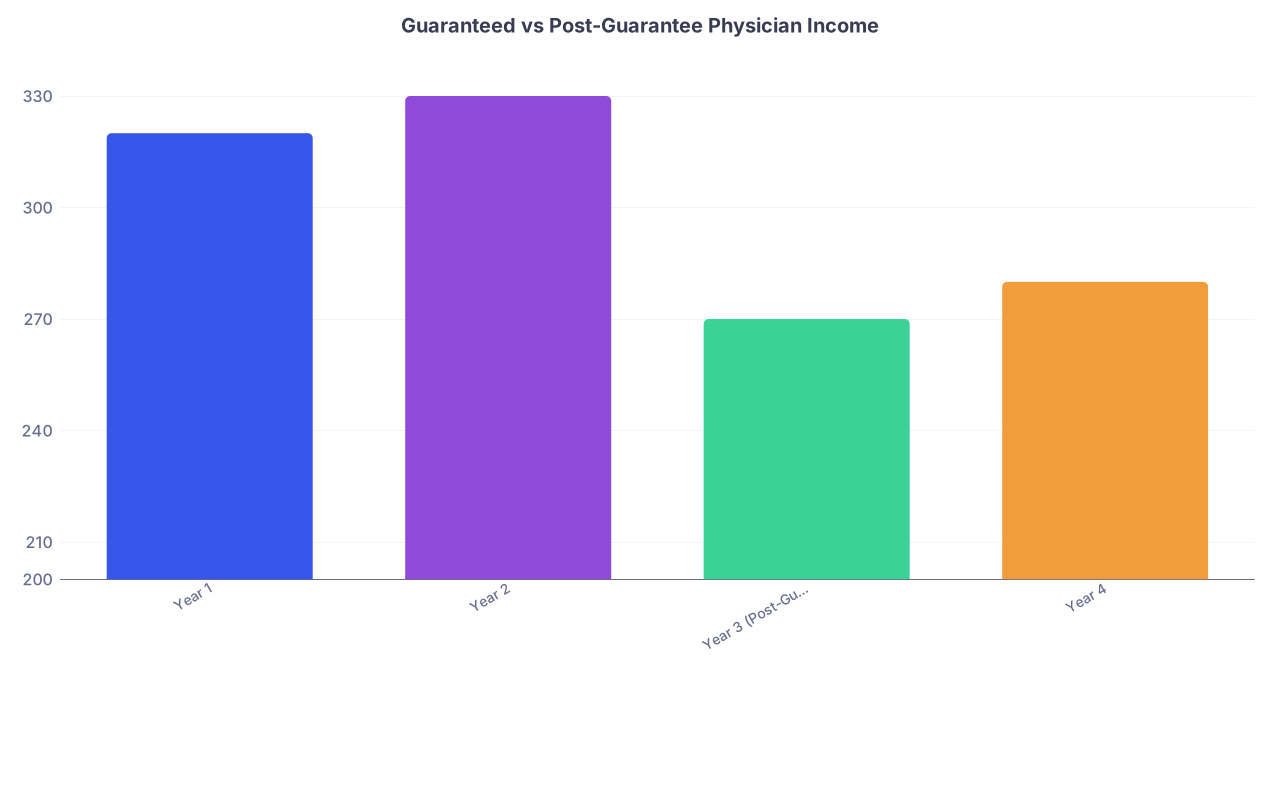
| Category | Value |
|---|---|
| Year 1 | 320 |
| Year 2 | 330 |
| Year 3 (Post-Guarantee) | 270 |
| Year 4 | 280 |
That simple pattern shows what I’ve actually seen dozens of times in practice reviewing contracts:
Years 1–2: You’re overpaid relative to your actual RVU generation. They know it. You feel “valued.”
Years 3–4: You’re underpaid relative to your workload. Now you know it. They call it “transitioning to the standard plan” or “aligning incentives.”
The guarantee is not evidence of their generosity. It’s evidence that the long-term comp structure is weak enough that they can’t recruit without hiding it.
If the long-term comp model was truly fair and competitive, they wouldn’t need two years of smoke and mirrors to get you to sign.
The Classic Trap: RVU Models After Guarantee Years
Most post-residency employed jobs tie the post-guarantee world to RVUs. Here’s where the trap lives.
Typical structure:
- Years 1–2: Base salary guaranteed (say $300–350k) with a nominal RVU target you’re “not really held to.”
- After that: You’re paid $X per RVU plus maybe a small base, with a “threshold” you must hit before any bonus.
Two ways this gets weaponized against you:
Unrealistic RVU expectations
I’ve seen contracts where the “expected” RVUs jump from 4,500 in year 2 (a joke number, no one enforces it) to 7,000–8,000+ in year 3, with no change in clinic support, OR time, or referral base. Oh, and they keep the RVU conversion factor modest, because “this is our standard rate.”Quietly falling effective pay per RVU
Sometimes they don’t even change the posted RVU rate. They just add thresholds, claw-backs, or restructure the tiers so your effective dollars per RVU drop once you’re in full production.
The end result: same or higher workload than in your guarantee years, for substantially less money.
| Phase | Expected RVUs | Total Comp | Effective $/RVU |
|---|---|---|---|
| Year 1 (Guaranteed) | 3,500 | $320,000 | $91 |
| Year 2 (Guaranteed) | 4,000 | $330,000 | $82 |
| Year 3 (RVU model) | 7,000 | $280,000 | $40 |
| Year 4 (RVU model) | 7,500 | $290,000 | $39 |
That table is not hypothetical. I’ve seen versions of this where the docs hit 7,000+ RVUs and still earn less than they did “ramping up” under guarantee.
You do not feel “stable” when that happens. You feel bait-and-switched.
How Guarantees Hide Structural Problems
There are predictable red flags that get covered up by guaranteed salary years. If you see these, your “stability” years are almost certainly a mask.
1. Weak or inconsistent volumes
If the group actually had a stable, overflowing patient pipeline, they wouldn’t need a long guarantee to lure you. You’d make strong RVU money out of the gate.
Longer guarantee + no hard data about average RVUs for current physicians in your role? That’s code for: “We do not know if this will work.”
2. Toxic payer mix or geography
Medicaid-heavy or low-commercial markets can absolutely support physicians, but the RVU compensation table has to acknowledge reality. Many don’t.
Instead, they slap on a 2-year guarantee anchored to some national median salary, then drop you on an RVU plan that assumes suburban-commercial volumes in year 3—without changing the reimbursement reality of your zip code.
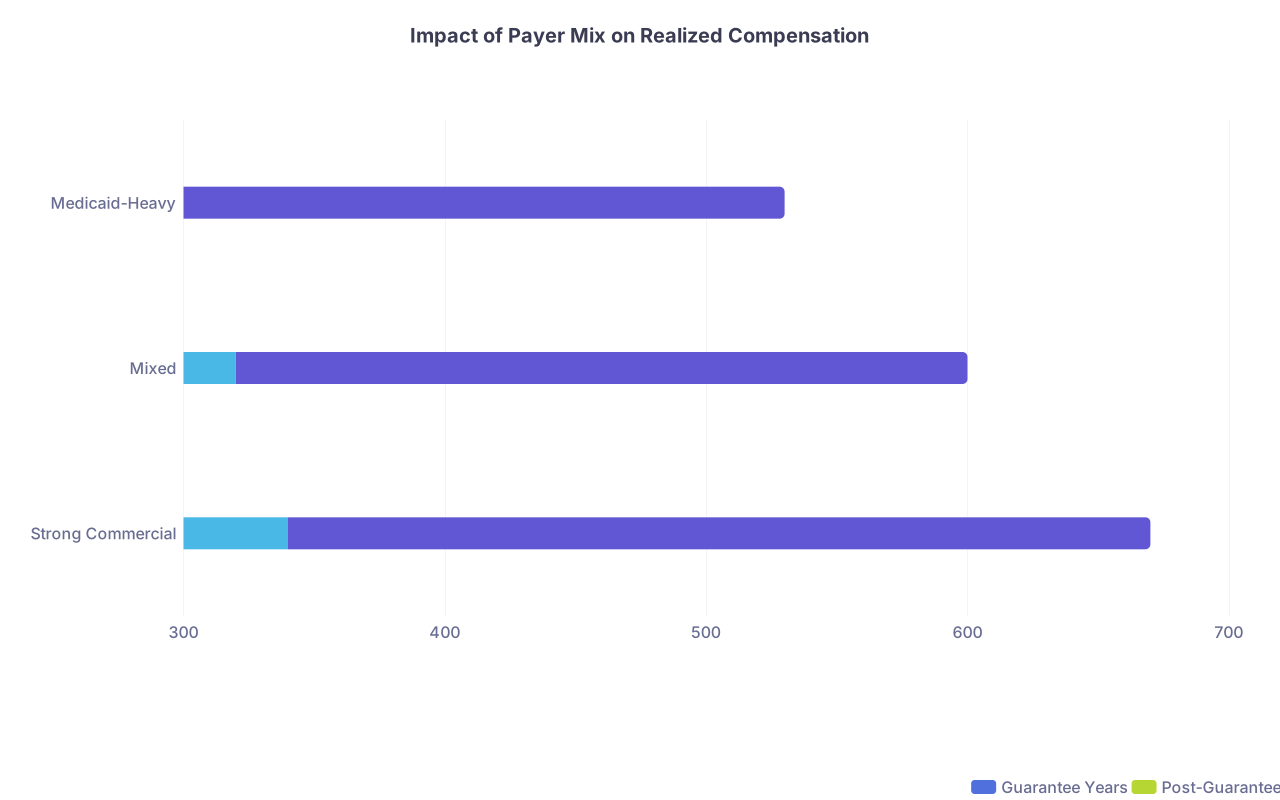
| Category | Guarantee Years | Post-Guarantee |
|---|---|---|
| Strong Commercial | 340 | 330 |
| Mixed | 320 | 280 |
| Medicaid-Heavy | 300 | 230 |
Notice the same pattern: guarantees compress the difference for a couple of years, then the real economics punch through.
3. History of rapid physician turnover
Few groups will admit this outright, but if you hear phrases like “we’ve had some changes in the last few years” or “people moved for family reasons” on repeat, that’s turnover being sanitized.
Turnover is expensive. One way to temporarily paper over a bad environment or bad comp model is to throw guarantees at fresh grads, assuming 1–2 of them will stick long enough to cover the recruitment cost.
If the place really was a long-term haven, they wouldn’t be dangling unusually long guarantees. They’d be talking about physicians who’ve stayed for 10–15 years and how their incomes have grown over time.
4. “Standard plan may change”
This little clause should set off alarms: “Compensation model may be modified by employer in its discretion,” paired with your guarantee ending in year 2 or 3.
Again, a guarantee in that situation does not protect you. It protects them. It buys them time to change the plan before you get there, and you’ve already agreed in writing to accept whatever “standard plan” is in effect at that time.
What You Should Actually Focus On (Instead of Just “Years”)
This is where most residents and fellows get it backwards. They obsess about how many years of guarantee they can squeeze out, and don’t spend nearly enough energy dissecting what happens after.
Your real questions should sound like this:
- “What would my compensation have been last year under your post-guarantee model, using the average RVUs of current physicians in my role?”
- “What RVU numbers did your last three new hires hit in years 1, 2, and 3, and what did they actually take home each year?”
- “Has your RVU rate, thresholds, or compensation tiers changed in the last three years? How?”
If they can’t or won’t answer with specifics, that’s more informative than any guarantee.
Let me be even more specific: you should be modeling your year 3–5 income with real numbers today, before you sign.
Ask for anonymized data of current physicians in your specialty: RVUs, total compensation, years in practice. If they dodge, that’s your answer.
How to Negotiate So “Guaranteed Years” Don’t Become Future Pay Cuts
You are not going to eliminate all risk. Medicine is still a business. But you can prevent the most common bait-and-switches.
Some tactics that actually move the needle:
1. Lock in the post-guarantee structure in writing
Do not accept vague “standard plan” language. Your contract should specify:
- The exact RVU rate (or collection percentage).
- Whether that rate can change and under what conditions.
- Thresholds, tiers, and how they’re calculated.
- How non-clinical time is treated (RVUs? distinct stipend? unpaid?).
If they insist “this is our standard document,” fine. You can insist that you’re not signing up for a blank future.
2. Add a floor or safety net in year 3
If they truly believe their volumes and model are robust, they should have no problem agreeing to some version of:
“If physician generates at least X RVUs in year 3, total compensation shall not be less than $Y.”
Yes, some will say no. But now you’ve learned something important about how much they believe their own sales pitch.
3. Clarify support and capacity, not just pay
Income is not just about the pay table. It’s about throughput.
Make them spell out:
- Number of clinic rooms.
- Dedicated MA/NP/PA support ratios.
- Protected OR block time or procedure slots.
- Call burden and how it’s compensated.
A good RVU rate with bottlenecked capacity is a stealth pay cut waiting to happen.
4. Be willing to walk away from pretty guarantees
This is the hard part. New attendings get dazzled by big early numbers. A $350k guarantee looks intoxicating after a $65k resident salary.
But if the long-term model caps you at $280k while your peers elsewhere are making $350–400k once established, that guarantee is not a gift. It’s a trap.
I’ve told more than one client, “You’d be financially better off taking a $280k year-1 offer with a transparent, strong RVU model than a $330k two-year guarantee that crashes in year 3.”
That’s not hypothetical. Run the 5–7 year math and you’ll often see it clearly.

When a Guaranteed Salary Is Actually Reasonable
Not every guarantee is sinister. Context matters.
Guarantees make more sense when:
- You’re building a new service or location from scratch, and everyone acknowledges the ramp risk.
- The post-guarantee model is clearly spelled out, benchmarked, and reasonable.
- You’ve verified that established physicians in the practice actually beat the guarantee on the long-term plan.
- The guarantee period is short (1 year) and functions as a true ramp, not a marketing ploy.
The key test: if the guarantee disappeared tomorrow and you were on the long-term model from day 1, would you still seriously consider the job? If the answer is “absolutely not,” then the guarantee is lipstick on a pig.
The Bottom Line: Stability Is Not What You Think It Is
Guaranteed salary years feel like stability because they shield you from early volatility. Psychologically comforting. On paper, simple.
But financially, they often serve three purposes for the employer:
- Mask a weak or unfair long-term compensation model.
- Buy your commitment while you’re least experienced and most geographically vulnerable.
- Delay the moment you realize your true market value (or lack of it in that system).
You do not protect yourself by maximizing guarantee years. You protect yourself by understanding, quantifying, and negotiating the post-guarantee world—and being willing to walk if it stinks.
If you remember nothing else from this:
- The guarantee is the teaser rate, not the real rate. Always model your year 3–5 income with real assumptions before signing.
- Vague “standard plan” language is not your friend. Lock in specifics about RVU rates, thresholds, and support, or treat the job as high risk.
- A lower initial guarantee with a strong, transparent long-term model will usually beat a flashy 2–3 year guarantee followed by a quiet pay cut. Over a career, that difference is massive.