
More volume does not guarantee more income on an RVU contract. Sometimes, it guarantees burnout for free.
Let me be blunt: I’ve watched too many new attendings proudly tell me, “I’m on RVUs, so at least I control my own pay,” while their employer quietly pockets the upside of their extra effort. They think more patients = more RVUs = more money.
They’re missing three nasty details: conversion factor, uncompensated work, and structural caps.
You’re post‑residency, in the job market, maybe staring at your first productivity-based contract. If you take the RVU language at face value, you’re walking into a game where the house already set the rules. And the house knows exactly how physicians behave when you dangle “unlimited upside.”
Let’s dismantle the biggest RVU myths one by one so you actually know what you’re signing.
How RVU Pay Really Works (Not How Recruiters Pitch It)
First principle: RVUs don’t pay you. The conversion factor does.
Your income from productivity = work RVUs × conversion factor (CF).
Everything else—the “you’ll see 18–20 patients a day,” the “average doc here is at the 70th percentile,” the “you can easily hit 7,000 wRVU your first year”—is marketing.
Here’s the basic structure most post‑residency RVU contracts use:
- A base salary (sometimes called a “guarantee” for 1–3 years)
- A work RVU target (e.g., 5,500 wRVU/year)
- A conversion factor above that threshold (e.g., $45 per wRVU over 5,500)
- Sometimes: a tiered CF (e.g., $40 up to 6,500, then $47 after that)
On paper, it looks like: “The more you produce, the more you earn.” That’s technically true. It’s also completely misleading, because:
- That conversion factor can be set so low that each extra patient is worth less to you than your time, energy, and malpractice exposure.
- Not all RVUs you generate get credited to you.
- Fixed resources (rooms, staff, OR time, imaging slots) cap how much you can produce, no matter how hard you work.
So yes, more patients could mean more pay. It also might not. The differences are in the fine print.
Myth #1: “If I See More Patients, I’ll Automatically Make More Money”
No, you’ll only make more money if the marginal dollar per RVU is actually worth your extra work.
I’ve seen internal med contracts where the CF is $40, and others at $70–80 in the same city. Same CPT codes. Same E/M levels. Different pay for the same work.
Let’s anchor this with numbers. Imagine a general IM outpatient job:
- Typical level 4 visit: ~1.92 wRVU
- You add 4 extra patients/day to “boost productivity”
Your extra daily wRVU:
4 patients × 1.92 wRVU = 7.68 wRVU/day
Assume 220 clinic days/year:
7.68 × 220 ≈ 1,690 extra wRVU/year
Now look at what that’s actually worth to you:
| Conversion Factor | Extra wRVU/Year | Extra Pay/Year |
|---|---|---|
| $40 / wRVU | 1,690 | $67,600 |
| $50 / wRVU | 1,690 | $84,500 |
| $70 / wRVU | 1,690 | $118,300 |
Same extra work. Huge spread in pay. And that’s before overhead, call, meetings, and your non-RVU work.
Now here’s where it gets ugly: in many health systems, your base salary was already set assuming a certain RVU level (often “median MGMA for your specialty”), but the conversion factor is quietly low. So your base essentially pre-pays part of your RVUs, and you get less marginal value for working more.
In practice, that means:
- If your CF is low, you’re subsidizing the system by grinding.
- If you don’t hit target, your base covers it—but future years may drop your salary or increase your target.
So more patients doesn’t automatically mean more pay. It depends on where you are relative to:
- Your base
- Your RVU target
- Your real (not advertised) conversion factor
The myth survives because most physicians never run the math.
Myth #2: “RVUs Are Objective, So The System Is Fair”
“RVUs are standardized by CMS, so at least it’s fair.” I hear that constantly from new attendings.
The RVU values are standardized. What’s not standardized is:
- What work counts
- What gets credited to you
- How much you get paid per RVU
- How often those targets and CFs get “recalibrated”
A few common traps:
1. Not All Your Work Generates RVUs
You know what doesn’t generate RVUs?
- Patient messages in the portal (unless you’re in a system coding some as e-visits—and even then, not all)
- Most phone calls
- Reviewing outside records
- Peer-to-peer calls with insurers
- Teaching residents
- Committee work, quality meetings, leadership meetings
- “Can you just look at this one thing” hallway consults
You know what your employer loves? A contract where only RVU-producing work gets you paid more, but non-RVU work is expected, measured, and affects your evaluations.
So the more “busy” your practice becomes—more inbox, more complex patients, more coordination—the less linear the RVU model feels. You can be slammed all day and still not see your paycheck move.
2. Your Documentation and Coding Gate the RVUs
If you’re undercoding, that’s not the RVU system being “fair,” that’s you donating work.
I’ve watched smart new attendings bill half their visits as level 3s out of paranoia, while senior partners bill level 4 and 5 correctly (and aggressively) with the same population. On paper, the partner is “twice as productive.” In reality, the partner just understands coding and uses templates.
RVUs are objective only if:
- You’re coding to the level of service provided
- Your documentation supports it
- Your employer’s billing department is competent and not losing charges
That’s a big “if.”
3. Credit Leakage
In system-employed groups, RVUs can “leak” in ways you’ll never see on a spreadsheet:
- Hospitalists doing work but subspecialists getting the RVU
- APP work credited to the physician—or worse, to the “service line” but not your individual tally
- Procedures done in shared visits but only one provider gets the RVU
- New facility fees or technical components enriching the hospital, but your CF stays flat
So no, the system is not intrinsically fair. It’s manipulable. And you’re the easiest part to manipulate, because you’re busy and you trust that “it’s all standardized.”
Myth #3: “High RVU Compensation = A Great Job”
A high total compensation number does not prove the job is good. It proves somebody did well on RVUs in that environment. Maybe you. Maybe the unicorn before you who worked 70-hour weeks and had zero boundaries.
You need to look at RVU compensation per unit of your life:
- wRVU per clinic day
- Patients per day
- Panel size
- Call burden
- OR block or resource constraints
- Support staff quality
And then: what does that convert to in dollars per actual hour?
Here’s the thing employers won’t show you: for the same specialty, different job structures have wildly different productivity expectations for similar money.
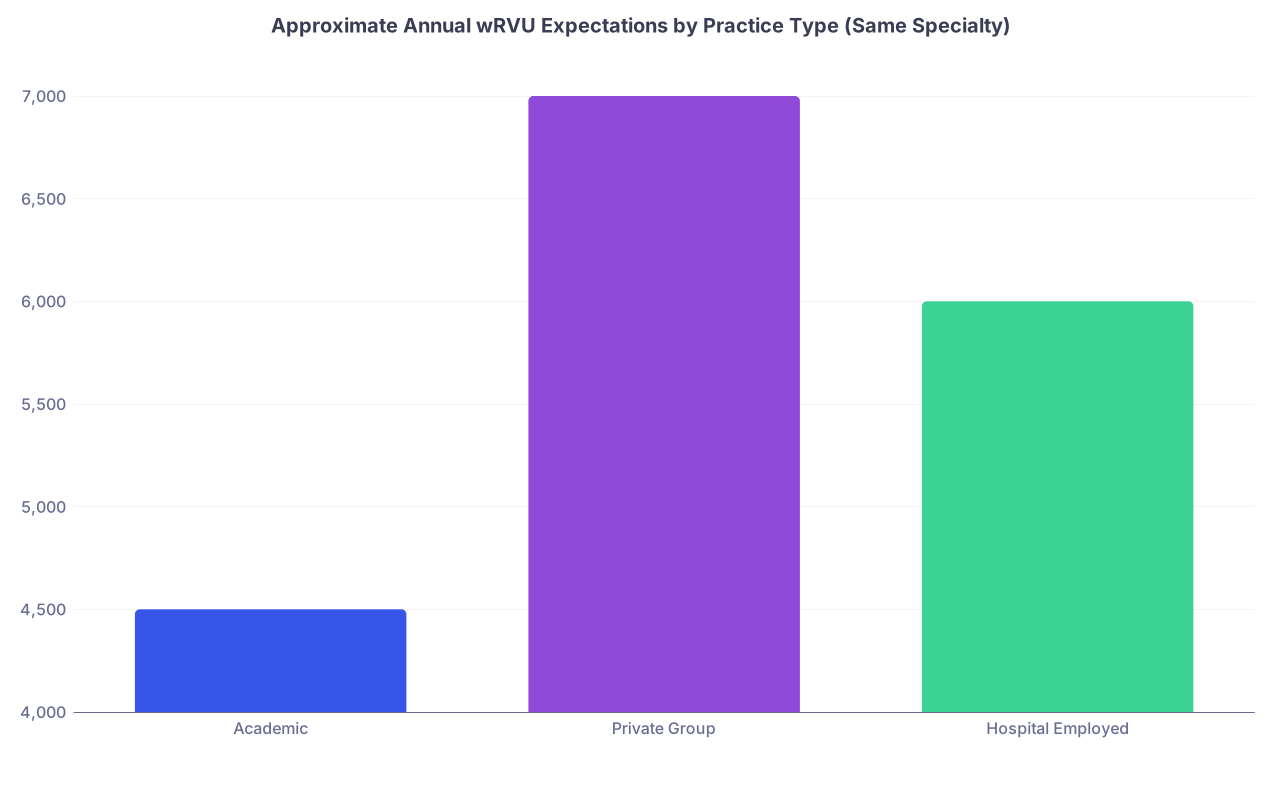
| Category | Value |
|---|---|
| Academic | 4500 |
| Private Group | 7000 |
| Hospital Employed | 6000 |
All three might advertise “competitive compensation.” They’re not lying. They’re just not telling you the denominator: your time and effort.
The myth that “RVU-heavy job = high earning potential = great job” falls apart the moment you ask:
- What wRVU level gets me to the advertised median salary?
- What do your top earners actually produce in wRVUs?
- How many hours are they here?
- What’s their panel size?
- What’s the average patient load per clinic session?
When you ask those questions bluntly, you start to see which “high income” jobs are actually just efficient, well-staffed practices—and which are production mills paying you slightly above median to burn yourself out.
Myth #4: “RVUs Let Me Control My Income”
Only partially. RVUs let you influence your income. Structural limits decide the ceiling.
Most post‑residency RVU jobs have hard constraints you can’t work around by sheer hustle:
- Limited clinic slots / rooms
- Fixed OR block times
- Imaging or procedure bottlenecks
- Staffing shortages (RN, MA, front desk, APP)
- System scheduling rules (no double-booking, template constraints)
I’ve watched surgeons hit a wall because they lack OR time, not patient demand. GI docs with six-month waitlists but no additional procedure time. Outpatient IM with more than enough demand but only one MA and a broken scheduling system.
Productivity incentives don’t magically create capacity.
So you grind, the days feel busier, the inbox grows, the RVUs go up a bit, but the income doesn’t move the way you thought.
RVUs give you control over:
- Coding accurately
- Scheduling efficiently within the system
- Minimizing no-shows and dead space
- Choosing higher-value work (e.g., procedures vs low-level E/M)
You do not control:
- Conversion factor
- RVU thresholds
- Block time
- Staffing levels
- System policies that waste your time
Your leverage is not your work ethic; it’s your willingness to walk away at the contract stage. After you sign, control shifts heavily to the employer.
Myth #5: “The Guarantee Protects Me—Then I’ll Crush RVUs Later”
The “guarantee” years are one of the most misunderstood parts of these contracts.
The script usually goes like this:
“We’ll pay you a guaranteed $260,000 for the first two years while you build your practice. Our doctors average 6,500 wRVUs and make around $320,000 total. You’ll get there once things ramp up.”
Sounds safe. Looks generous. Often it’s just a delayed productivity squeeze.
Key questions most new grads never ask:
- Is my guarantee tied to RVU expectations? (e.g., they “expect” 5,500 your first year and 6,500 your second)
- After the guarantee, does my compensation drop to a straight RVU formula that might actually pay less at the same productivity?
- Can they reset the conversion factor after the guarantee? (Many systems do, citing “market updates” or new MGMA data)
- Are there “clawback” or “reconciliation” provisions if your RVUs are below some level?
I’ve seen the following painful scenario more than once:
- Year 1–2: $260k base, low expectations, system is happy just to have coverage
- Year 3: Now comp is base $200k plus $42/wRVU over 5,500
- You hit 6,000 wRVU (not bad for a young IM doc, with a busy inbox and lots of complexity)
- Your productivity bonus is 500 × $42 = $21,000
- Total pay: $221,000—a big pay cut from your guarantee despite being “more productive”
You did more work and got paid less. Because the game board changed.
“RVU upside” that starts after a guarantee can be a mirage if the post‑guarantee structure is weak. You shouldn’t accept “we’ll figure it out later” as an answer.
How to Actually Evaluate an RVU Offer (Without Getting Snowed)
You’re not going to become a compensation consultant overnight. But you don’t need to. You just need to stop buying the myths and start interrogating the structure.
At minimum, for any RVU-heavy contract, get all of this in writing or email:
- The RVU target they expect for your specialty and FTE
- The conversion factor at and above that target, and whether it’s tiered
- What counts as credited RVUs (APP work, shared visits, procedures, hospital work)
- Historical data: average and 75th percentile wRVUs for physicians in that group, and their corresponding total comp (not just “MGMA says…”)
- How the comp model changed in the last 5 years (if it changed)
- Exactly what was included in the guarantee and what changes when it ends
If they won’t give you that data, that’s your answer. You’re not being hired as a partner; you’re a plug for coverage.
Then do the back-of-the-envelope math:
- “If I hit your average wRVU, what will I make in year 3?”
- “If I hit your top quartile wRVU, what will I make?”
- “At what wRVU level do I match my guaranteed salary?”
- “Is that wRVU level realistic given your staffing and schedule?”
Once you see those numbers, you won’t be seduced by vague words like “upside” and “uncapped.” You’ll know the trade-off: how much of your life you’re selling for each marginal dollar.
The Reality: RVUs Are a Tool, Not a Prize
RVU-based pay is not automatically good or bad. I’ve seen it work beautifully:
- Private specialty groups with high CFs and tight, efficient operations
- Ortho practices where one additional half‑day of procedures meaningfully moves the income needle
- GI or IR positions where you truly control volume through procedure selection
And I’ve seen it be a disaster:
- Hospital-employed primary care with bloated panels, broken inboxes, and low CF
- Academic jobs that pretend to be RVU-neutral but quietly judge you by wRVU anyway—with no upside
- Systems that cut CF or raise thresholds just as young attendings finally ramp up
The key is understanding that more patients does not automatically mean more pay. It can mean:
- More work for the same pay
- More burnout for a modest raise
- More liability and complexity without proportional compensation
- More profit—for the hospital
The myth lives because “work harder and earn more” feels morally clean. But you’re not being paid in morality. You’re being paid in dollars per RVU, inside a system you didn’t design.
So when you read that contract—and you should read every word yourself, then again with someone who does this for a living—ask a simple, ruthless question:
“If I work exactly as hard as you hope I will, who actually wins the most from this RVU structure—me or you?”
Years from now, you won’t remember the exact RVU target or conversion factor, but you will remember how it felt to be either trapped in a grind you didn’t understand or confident that you knew the rules and chose them on purpose.