

The biggest financial mistake most new attendings make is not missing a stock tip. It is signing a terrible first job contract they do not fully understand.
You are walking into a gunfight with a butter knife if you think, “They are a big health system, they will be fair,” or “The chief seems nice, I trust him.” I have watched too many smart new attendings lock themselves into toxic, underpaid, overworked situations because they missed the traps baked into that “standard contract.”
Let us walk through the seven repeat offenders—the contract traps new attendings fall for again and again—and how you avoid joining that list.
1. Believing the “Standard Contract” Myth
The most dangerous phrase in physician employment: “This is our standard contract. Everyone signs it.”
That line is not information. It is a negotiation tactic. And it works on people who are tired, eager, and worried about “making waves” in their first job.
Common mistakes:
- Accepting the first draft as non‑negotiable.
- Feeling guilty or “difficult” for asking questions.
- Letting HR or recruitment coordinators rush you: “We really need this back by Friday.”
I have seen residents sign:
- 2‑year contracts with no without‑cause termination rights.
- RVU targets that no one in the group is actually meeting.
- Non‑competes that cover the entire metro area.
All after being told it was “standard.”
Red flags:
- Any resistance to you having the contract reviewed by an attorney.
- “Our other doctors did not use lawyers.” (Translation: we prefer uninformed signers.)
- Refusal to provide anything in writing to clarify verbal promises.
- “We do not change contracts for anyone.”
How to avoid this trap:
- Decide ahead of time: you will never sign a first draft.
- Normalize pushback: “I appreciate this. I always have my contracts reviewed and typically there are a few revisions. I will get back to you.”
- Ask specific questions:
- “How many changes did your last three new hires request?”
- “Can you show me an example of a modified contract you approved in the past?”
- Use time as leverage: Take the contract. Leave the meeting. Do not agree verbally to terms before you see them written.
You are not being “difficult.” You are being a professional with a multi‑hundred‑thousand‑dollar agreement on the line.
2. Misunderstanding Compensation Models and RVU Traps
The fastest way to become a bitter attending is to sign a contract with a compensation formula you do not actually understand.
Where people get burned:
- Overvaluing the “guarantee” and ignoring what happens when it ends.
- Focusing on the base salary and not the production formula.
- Not realizing that the per‑RVU rate is meaningless without realistic volume.

| Category | Value |
|---|---|
| Year 1 (Guarantee) | 340000 |
| Year 2 (Production) | 245000 |
In real life, I have seen:
- A hospitalist happy with a $260k guarantee… until year 2 dropped to $195k because shifts were cut and wRVUs fell.
- An outpatient doc with a $275k guarantee tied to an RVU target no one had actually hit in that clinic for years.
Critical questions you must be able to answer:
What happens after the guarantee?
- Is it pure RVU? Salary + RVU bonus? Collections?
- Is there a clawback if your production does not meet the guarantee?
What is the real per‑RVU deal?
- What is your wRVU target?
- What is your per‑RVU rate?
- What do current physicians at your site actually generate?
What is under your control?
- Are you assigned patients or expected to “build your panel”?
- Who controls your schedule template? (Admin? You?)
- Are there enough exam rooms, MA support, and referral sources to hit targets?
Red flags:
- “Do not worry, everyone hits their numbers.” (Without data.)
- No written report of average wRVUs and total comp for existing physicians at your location.
- RVU target is higher than the current median for your specialty, but support is mediocre.
How to protect yourself:
- Demand historical data for your exact clinic/service line: average RVUs, average total comp, physician turnover.
- Ask: “How many new hires in the last 5 years failed to meet their RVU target?”
- Push for:
- Lower RVU thresholds in the first 1–2 years; or
- Extended guarantee period; or
- Hybrid model (reasonable base + achievable bonus) rather than all‑or‑nothing.
If you cannot explain your compensation model—in plain English—to another resident in under two minutes, you do not understand it well enough to sign.
3. Underestimating Non‑Competes and Restrictive Covenants
New attendings routinely treat non‑competes like boilerplate fine print. Then 18 months later they realize they have to move their kids to a new state because they hate their job.
Common errors:
- Only looking at the mileage (“10‑mile radius is fine”) and ignoring scope and carve‑outs.
- Assuming “they probably would not enforce it” without any evidence.
- Forgetting that hospital systems keep getting bigger. The more they own, the more land your non‑compete covers.
| Clause Type | Risk Level | Target Term for New Attendings |
|---|---|---|
| Duration | High | 0–12 months (avoid >18 months) |
| Radius | High | 5–10 miles from *primary* site |
| Geography Defined | Critical | Specific addresses, not systems |
| Scope of Practice | High | Narrowly tied to your specialty |
| System-Wide Ban | Extreme | Avoid if possible |
Key pieces you must examine:
- Duration: 24 months is a huge problem. Twelve months or less is more survivable.
- Radius: Is it measured from:
- One primary practice site?
- Every facility you ever step foot in? (Disaster.)
- Geographic definition: “Any facility owned or affiliated with XYZ Health” often equals entire regions.
- Scope: Does it block all clinical practice or only that specific subspecialty?
Red flags:
- Non‑compete applied to the entire health system footprint.
- You cover multiple hospitals, and the radius stacks around each one.
- No exceptions for termination without cause or if they breach the contract.
Better options to push for:
- Narrow to:
- One primary practice location;
- 5–10 miles;
- 6–12 months.
- Ask for non‑solicitation (cannot poach patients or staff) instead of non‑competition, especially in rural or underserved areas.
- At minimum, carve‑outs for:
- If they terminate you without cause.
- If you leave due to documented breach (e.g., unpaid comp).
If the recruiter says, “Legal will never change the non‑compete,” your answer is simple: “Then I may not be your candidate.”
4. Ignoring Termination Clauses and Exit Costs
Most new attendings read the salary, skim the call schedule, and then completely ignore: how do I get out of this thing?
That is like checking the leather seats on a car and never asking where the brakes are.
Two main landmines:
- Without‑cause termination (your escape hatch).
- Financial penalties tied to leaving (your ankle weights).
Without‑cause termination
You must have unilateral without‑cause termination:
- You can leave, for any reason, with X days written notice.
- Reasonable notice is typically 60–90 days.
- Anything over 180 days starts to become restrictive.
If the contract only allows termination:
- For cause (with a high bar for proof), or
- Only at the end of the term,
then you are trapped if the job turns toxic.
Exit costs
Here is where people get crushed:
- Relocation claws: “Repay relocation if you leave before 3 years.”
- Signing bonus repayments: Often prorated over 1–3 years.
- Tail coverage: You leave, you pay. That can be $20k–$60k+ depending on specialty and state.
- Loan repayment forgiveness: Lose it if you leave early.
Red flags:
- No clear without‑cause termination right for you.
- Asymmetrical rights: employer can terminate you without cause on 30 days’ notice; you need 180+.
- You pay 100% of tail no matter the reason for separation.
- Repayment of all bonuses/relocation even if you stay most of the term.
How to fix this before signing:
- Push for:
- 90‑day without‑cause termination, both sides.
- Tail covered by employer, or at least employer pays if they terminate you without cause.
- Prorated bonus/relocation payback:
- Example: 1/36 forgiven each month for a 3‑year requirement.
- Get the math in writing:
- “If I leave after 18 months, exactly how much do I owe and for what?”
You might think you will never leave early. That is exactly what all the burned attendings thought, too.
5. Overlooking Call, Workload, and “Other Duties As Assigned”
“Call is light.”
“You will only round on weekends every third month.”
“Most of our docs are out by 4:30.”
I have heard every one of these lines followed by: “My actual life looks nothing like what they sold me.”
Where contracts hide the pain:
- Vague call language:
- “Reasonable call as assigned by group.”
- No limits on:
- Clinics per week.
- Patients per half‑day.
- In‑basket/EMR responsibilities.
- “Administrative duties” not clearly defined or compensated.

Questions you must ask senior partners or current attendings (not just leadership):
- “How many nights of call did you take in the last 12 months?”
- “How often are you actually called in?”
- “How many patients are you scheduled per half‑day in clinic?”
- “What is your average workday start and end time—including charting?”
Then see if the contract matches reality.
Contract language to avoid:
- “Call as determined by employer.”
- “Physician will render such other services as reasonably requested.” (With no limits.)
- “Average clinic schedule” with no numeric cap.
Language you want:
- Specifics, like:
- “Physician will work 8 half‑day clinics per week.”
- “New patient visits scheduled for 40 minutes; follow‑ups 20 minutes.”
- “Call no more than 1:4 weekdays and 1:4 weekends, absent mutual written agreement.”
- If call is heavy, compensation for:
- Extra call shifts.
- Extra procedures.
- Extra sites covered.
If their answer is, “We do not put that in contracts, we prefer to be flexible,” read it correctly: they want flexibility for them, not for you.
6. Blind Spots Around Malpractice, Tail Coverage, and Liability
Malpractice language is where a lot of new attendings admit, “I kind of skimmed that part; it sounded standard.” Then they get a quote for tail coverage at $45,000 and nearly pass out.
Pieces you cannot ignore:
Type of coverage:
- Occurrence vs claims‑made.
- Most employed positions are claims‑made. That means tail coverage matters.
Who pays premiums and tail:
- During employment: usually employer.
- After you leave: often buried under “Physician responsible for all tail coverage.”
Coverage limits:
- Common: $1M / $3M.
- Verify it is consistent with local norms and your specialty risk.
Tail coverage traps:
- You pay 100% of tail unless they terminate you without cause.
- Tail required even if they breach first.
- No cap or cost‑sharing language.
In some specialties (OB, surgery, EM), tail is not a rounding error. It can be a six‑figure anchor that completely locks you into a bad job.
Better structures:
Employer pays:
- 100% of tail, or
- Tail if they terminate without cause, or
- A prorated share based on years of service (e.g., 25% per year for 4 years).
Or they agree to:
- Accept “nose coverage” from your next employer instead of tail (if standard in your market).
Ask directly:
- “If I leave this job after 2 years, who is responsible for tail, and what is the estimated cost today?”
- “Under what circumstances do you pay any portion of tail?”
If the recruiter cannot answer, that is not harmless ignorance. It means they did not expect you to ask.
7. Rushing the Process and Skipping Professional Review
The final, and probably most common, trap: speed.
You are finishing residency or fellowship, maybe pregnant, maybe moving states, definitely exhausted. The offer hits your inbox and your brain goes: “Finally. I need to lock this in.”
That is when people:
- Sign without a physician‑contract attorney review.
- Neglect to compare offers meaningfully.
- Ignore their own red flags because they “do not have time to start over.”
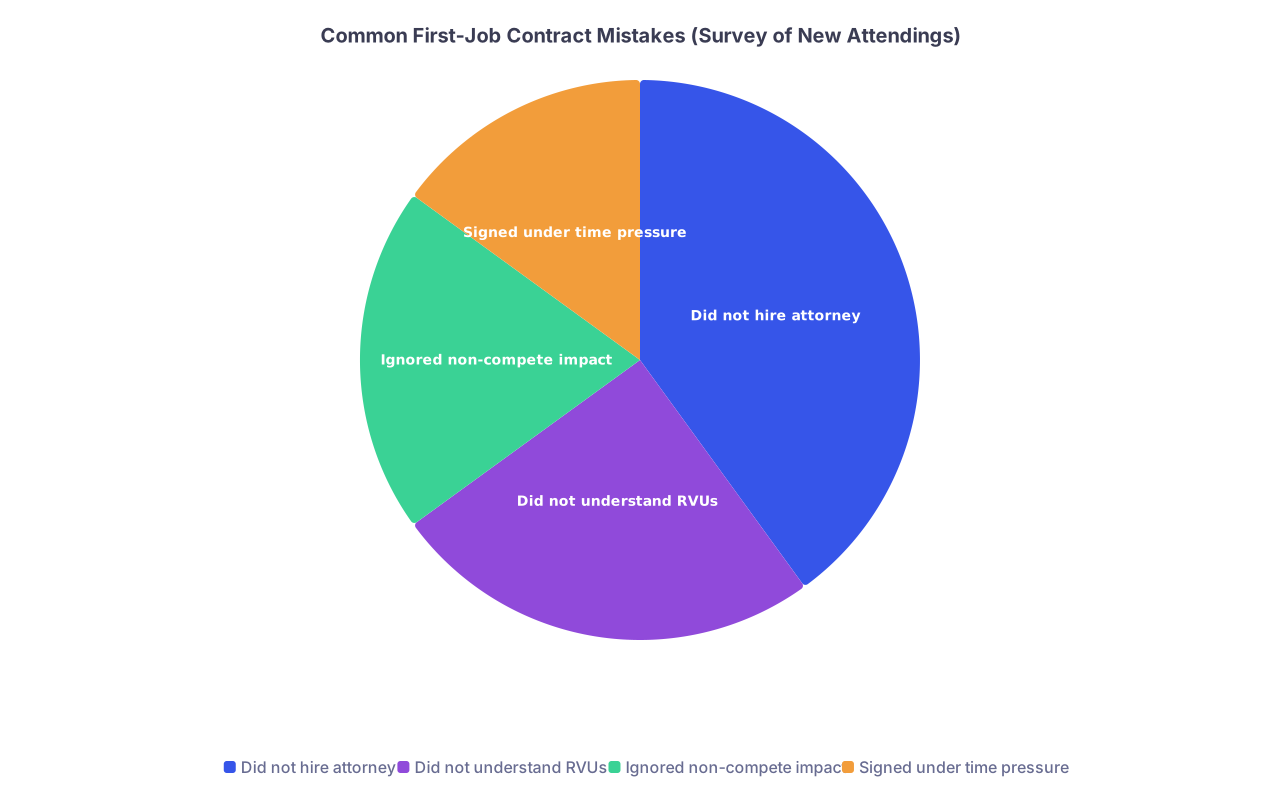
| Category | Value |
|---|---|
| Did not hire attorney | 40 |
| Did not understand RVUs | 25 |
| Ignored non-compete impact | 20 |
| Signed under time pressure | 15 |
Real consequences I have seen:
- A new cardiologist lost $60k in year 2 because he did not understand how his “quality bonus” was actually calculated.
- A pediatrician found out she owed $30k relocation + $20k tail when she tried to leave a toxic clinic at 18 months.
- A surgeon signed a 3‑year contract with a 50‑mile non‑compete. Her spouse’s job and kids’ schools were locked into a city where she could not practice after things blew up.
What you should do instead:
Build “contract review” into your job timeline.
- Assume 2–4 weeks for lawyer review and negotiation.
Hire an attorney who does physician contracts all day.
- Not your uncle who does real estate.
- Not “general business” counsel with no RVU/non‑compete experience.
Get multiple offers if possible.
- Not for greed. For leverage and perspective.
- Seeing three contracts side by side makes the outlier obvious.
Treat signing as a business decision, not a favor.
- “I appreciate the offer. I always have contracts reviewed. I will get back to you in 2–3 weeks.”
You train for a decade and then rush a 10‑page document that dictates your income, workload, and mobility. That is backwards.
Quick Reality Check Before You Sign
Use this as a pre‑signature triage. If you answer “No” to any of these, you are not ready to sign.
- Do you understand exactly how you will be paid in years 1, 2, and 3—and can you state it clearly in 2–3 sentences?
- Do you know your non‑compete radius, duration, and exactly what geography it covers?
- Do you know:
- Who pays for malpractice premiums?
- Who pays for tail, and under what circumstances?
- Is your call schedule and clinic load described with numbers, not vague phrases?
- Do you have a unilateral, without‑cause termination clause with 60–90 days’ notice?
- Have you had a physician‑contract attorney review the document and explain it to you?
If any of those are fuzzy, slow down. Ask questions. Push back.
You only get one shot at being a new attending. That label is what lets you say, “This is my first contract; I am being cautious.” Use it.
FAQs
1. Do I really need a lawyer for my first physician contract?
Yes. This is not optional. The first contract sets your baseline expectations, your compensation structure, and often your geographic freedom for years. A physician‑specific contract attorney will:
- Translate vague language into real‑world implications.
- Flag non‑competes, tail coverage obligations, and termination traps.
- Suggest concrete revisions that actually move the needle, not cosmetic edits.
The few thousand dollars you spend is trivial compared with the tens or hundreds of thousands at stake over the life of the contract.
2. How many things can I realistically negotiate as a new attending?
More than recruiters want you to believe, fewer than you might wish. You will usually have the most leverage around:
- Non‑compete scope (radius, duration, locations).
- Tail coverage structure (cost‑sharing, when employer pays).
- RVU targets in the first 1–2 years and guarantee duration.
- Call burden and clinic schedule specifics.
- Repayment terms for bonuses and relocation (making them prorated).
You are unlikely to double your base salary, but you can often materially improve your risk, workload, and exit costs.
3. Is a strong non-compete ever a dealbreaker?
Sometimes, yes. If the non‑compete effectively bans you from practicing in your city or region for 1–2 years, and they refuse to narrow it, you need to be prepared to walk. Especially if:
- Your family is tied to the area.
- They want system‑wide restrictions (all facilities they own).
- They will not soften it even if they terminate you without cause.
Jobs are replaceable. Having to uproot your life because of a contract you signed at 32 is much harder to fix.
4. What if the employer refuses almost all requested changes?
Then they just did you a favor. A blanket “we do not change this for anyone” is not a sign of stability, it is a sign of control. Strong, physician‑respecting organizations will usually negotiate:
- At least some modifications to non‑compete terms.
- Clarifications to workload and call expectations.
- More reasonable bonus/repayment schedules.
If every request is shut down, believe them. That is how they will treat you when you are inside the system, too.
Key points to walk away with:
- Never sign a “standard” contract without fully understanding compensation, non‑compete, termination, and malpractice/tail.
- Use your status as a new attending to be cautious, ask direct questions, and insist on reasonable changes.
- If the written contract does not match the rosy verbal promises, trust the contract. Then fix it—or walk.


