

The most dangerous part of your first attending job isn’t the salary. It’s the non-compete you barely read.
If you get this wrong, you can lose the freedom to practice where you want, when you want, and on your own terms. I’ve watched good physicians boxed out of entire cities, forced to move their kids’ schools, or eat a year of underemployment—all because of a few contract phrases they thought were “standard.”
Let me walk you through the landmines. And more important, how to spot them before you sign anything.
1. “Any Facility Owned or Affiliated With…”
This one sentence has ruined more careers than a low RVU rate ever will.
You’ll see a clause that looks innocent:
“Physician agrees not to practice medicine at any facility owned, operated, managed, or affiliated with Employer or its parent, subsidiaries, or related entities within a 50-mile radius for 24 months following termination.”
Your brain reads: “Okay, I can’t work at this clinic or maybe that hospital across town.”
Reality: You just agreed not to work for an entire health system. Or their affiliates. Or their “management company” that quietly owns half the practices in the state.
Here’s the problem: the “affiliated with” language is intentionally vague and massively expands the scope of the non-compete.
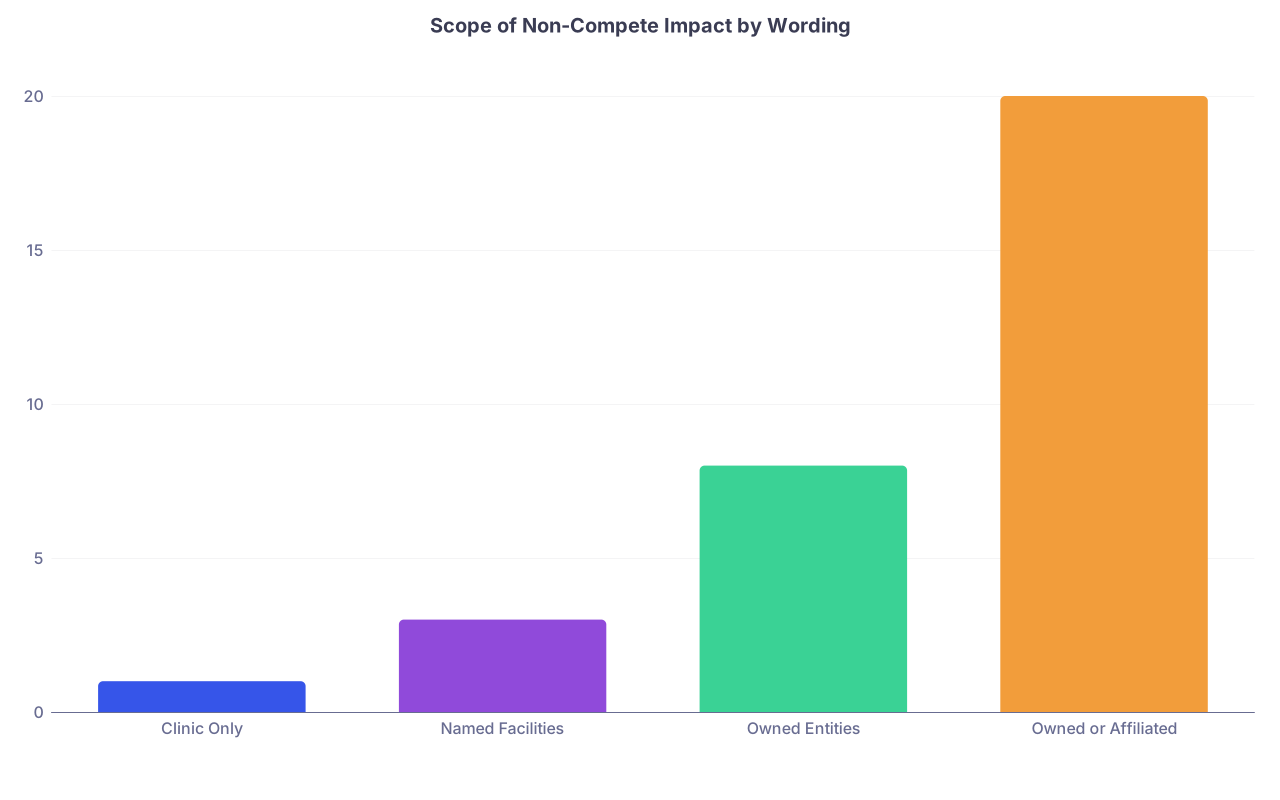
| Category | Value |
|---|---|
| Clinic Only | 1 |
| Named Facilities | 3 |
| Owned Entities | 8 |
| Owned or Affiliated | 20 |
What this usually means in practice:
- You think: “If I leave this group, I’ll just work at the other hospital across town.”
- Contract says: That hospital’s in a joint venture with your employer’s parent company → you’re blocked.
- You think: “I’ll just join a private group nearby.”
- Contract says: That private group uses your employer’s management services organization (MSO) → you’re blocked again.
Red flag phrases in this category:
- “Owned, operated, or controlled by”
- “Directly or indirectly affiliated with”
- “Any entity under common ownership or control”
- “Any present or future affiliate of Employer”
How to avoid this mistake:
- Push to limit the non-compete to:
- Specific named facilities, listed in an attached exhibit, or
- The primary practice location(s) where you personally work, by address
- Delete “affiliated with” and “any related entity” whenever possible.
- At minimum, demand a list of all entities currently considered “affiliates” and get it attached to the contract. If they “can’t” provide that list, the answer is no.
The worst-case scenario is signing a contract that secretly blocks you from 80% of the jobs in your city and only learning that after you resign. I’ve seen it. HR will shrug and say, “Well, it’s in the contract.”
2. “Within X Miles of Any Location Where You Provided Services”
Non-competes should be tied to where you actually work in a reasonable way. Bad contracts twist that into something else entirely:
“Physician shall not practice within 25 miles of any location where Physician provided services on behalf of Employer during the three years prior to termination.”
Sounds technical. It’s not. It’s a trap.
Imagine this:
- You’re hired for an outpatient clinic 5 miles from your home.
- Once a month, they “ask for a favor” and send you to cover a satellite clinic 20 miles away.
- Once a quarter, they add an outreach clinic 45 miles out.
With that clause, your restricted areas are:
- 25 miles around clinic A
- 25 miles around clinic B
- 25 miles around clinic C
Overlap those circles on a map. You’ve just lost a giant swath of the state.

Phrases that should scare you:
- “Any location where physician provided services”
- “Any site to which physician was assigned”
- “Any facility at which physician rendered care on behalf of employer”
- “Any current or future location”
What you want instead:
- Limit the geography to:
- A radius around your primary practice site only, and
- Possibly one or two explicitly named additional sites you actually work at regularly
- Or, best case: no geographic non-compete at all, just a non-solicitation clause (you can’t steal patients, staff, or referral sources for a defined period).
If you see “any location,” mentally translate that to “everywhere we can possibly send you.” Then decide if you’re still comfortable signing. You probably shouldn’t be.
3. “Two Years After Termination for Any Reason”
Duration matters. A lot. But many physicians read right past it.
“These restrictions shall apply for a period of 24 months following termination of Physician’s employment for any reason.”
“Any reason” is the loaded part.
That means:
- You get fired without cause → still bound.
- You resign because they breached the contract → still bound.
- They cut your pay by 30% and refuse to fix it → still bound (if you leave).
- They close your clinic and eliminate your position → still bound.
| Clause Type | Practical Risk Level |
|---|---|
| 12 months, only if you resign | Low |
| 12 months, for any reason | Moderate |
| 24 months, only if you resign | High |
| 24 months, for any reason | Very High |
Watch for:
- “For any reason whatsoever”
- “Whether initiated by physician or employer”
- “Regardless of cause”
- “Survives termination of this agreement for any reason”
What you should push for:
- 12 months max for most specialties.
- Shorter if possible in high-turnover or low-margin fields (urgent care, hospitalist).
- Tied to physician-initiated resignation without cause, not:
- Termination by employer without cause
- Termination due to employer breach
- Layoffs, closures, loss of contract, or loss of privileges for reasons unrelated to your misconduct.
Also, pay attention to tolling language. If you see:
“The restricted period shall be extended by any period during which Physician is in violation of these covenants.”
That means if they accuse you of violating the non-compete and drag you through court for a year, they “toll” the restriction and add time back on after. Ugly.
4. “Relief Without the Need to Prove Actual Damages”
Here’s where the teeth are.
You’ll see something like:
“Physician acknowledges that any breach of the restrictive covenants would cause irreparable harm to Employer for which monetary damages would be inadequate. Employer shall be entitled to injunctive relief without the need to prove actual damages.”
What this really says:
- They don’t have to prove they lost money.
- They can go straight for a court order blocking you from working at the new job.
- They’ll likely sue both you and your new employer. New job may back away.
- You’ll spend money on lawyers just to keep working.
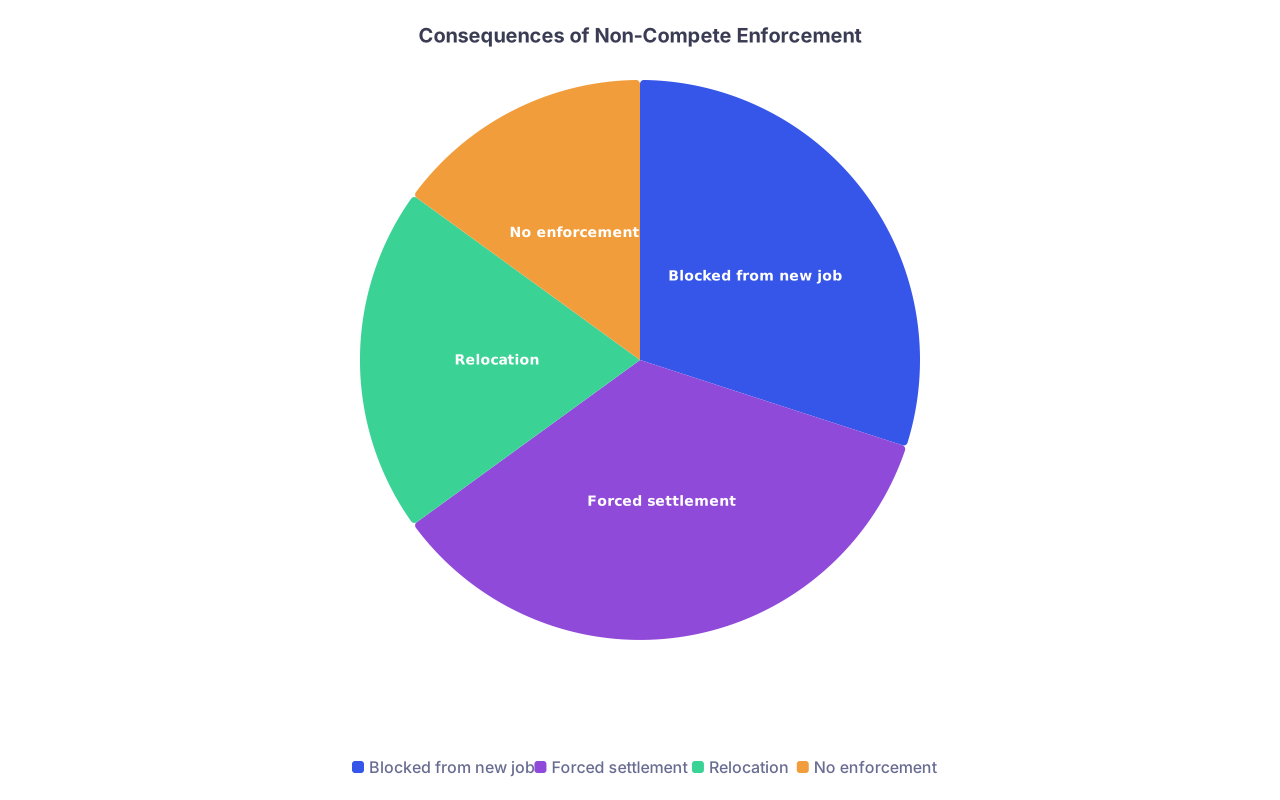
| Category | Value |
|---|---|
| Blocked from new job | 30 |
| Forced settlement | 35 |
| Relocation | 20 |
| No enforcement | 15 |
Red flag combo:
- “Irreparable harm”
- “Injunctive relief”
- “Without the necessity of posting bond”
- “Without the need to prove actual damages”
Courts often expect some version of this language. The real mistake is treating it as harmless when combined with:
- A massive geographic scope
- A long duration
- Over-broad “affiliate” and “any location” wording
The more aggressive the geography and duration, the more dangerous this paragraph becomes. Because injunctive relief is what turns vague words into you being escorted out of your “new” employer’s office.
You’ll rarely be able to delete this section entirely. What you can do:
- Argue for narrower non-compete terms so what they can actually enjoin is smaller.
- Add explicit carve-outs (e.g., “Except in the case of termination without cause by employer or termination by physician for employer’s material breach”).
- Make sure there’s no attorney fees shifting that automatically makes you pay their legal costs if a court enforces any part of the clause.
Speaking of which…
5. “Prevailing Party Shall Be Entitled to Recover Attorneys’ Fees”
You sign a bad non-compete. You leave for a new job. Old employer sues.
You think: “They can’t really enforce this.”
Then you realize: even if they only partially win, you might owe their legal bill.
Common clause:
“In any action to enforce this Agreement or the restrictive covenants contained herein, the prevailing party shall be entitled to recover its reasonable attorneys’ fees and costs.”
On paper, this cuts both ways. In the real world, who has the deeper pockets and more experience litigating this stuff? Not you.
Why this matters:
- It raises the risk of them suing just to scare you (because they might get their fees back).
- It pressures you to settle on worse terms because the downside is huge.
- It punishes you for even trying to argue that the non-compete is unreasonable.
You can’t always get this removed. Some groups will dig in. But do not ignore it. If your non-compete is already broad and ugly, this clause makes it much more dangerous.
If they won’t budge:
- Your leverage moves to fixing the non-compete itself (shorter, tighter, fewer locations).
- Or negotiating for a buy-out option (more on that later).
6. “Non-Solicitation” That Secretly Acts Like a Non-Compete
There are two different concepts:
- Non-compete = where you can work.
- Non-solicitation = who you can actively recruit or contact for business.
Many employers will say, “We don’t really enforce the non-compete; this is more about non-solicitation.” Then the contract says this:
“Physician shall not, directly or indirectly, solicit, divert, accept, or provide services to any patient, referral source, or payor of Employer with whom Physician had contact during the two years preceding termination, for a period of two years thereafter.”
Read that again. “Accept” or “provide services to.” That’s not just “don’t market to them.” That’s “if they find you on their own, you’re still in trouble.”
Dangerous phrases:
- “Or accept business from…”
- “Or render services to…”
- “Or have any professional contact with…”
- “Any patient who has ever received services from Employer”
This is how groups convert a fair-sounding non-solicit into a de facto non-compete. You might technically be allowed to work across town, but if you:
- Can’t see any patient who ever touched their system
- Can’t take referrals from anyone who ever referred to them
You’re basically unemployable in that market.
What reasonable looks like:
- You will not actively reach out to or solicit:
- Patients you personally treated in the last 12 months
- Staff of the employer
- Referral sources you directly managed
- But if a patient independently finds you, you can see them. That’s the critical distinction.
Ask for that “patient choice” carve-out in writing, not as a verbal reassurance. Verbal reassurances don’t survive leadership changes. Contracts do.
7. “Employer May, In Its Sole Discretion, Reassign Physician…”
This one doesn’t look like a non-compete clause on its face. It lives in the duties/assignment section. But it connects directly to your non-compete risk.
You’ll see:
“Employer may, in its sole discretion, assign Physician to provide services at any of its existing or future locations as operational needs dictate.”
Combine this with:
- “Any location where Physician provided services” non-compete language, and
- A 20–50 mile radius restriction
Now they can:
- Move you once to a faraway clinic you never wanted to work at
- Instantly expand your restricted territory
- Set you up so if you leave, your options are gutted

| Step | Description |
|---|---|
| Step 1 | Sign Contract |
| Step 2 | Assigned to Primary Clinic |
| Step 3 | Employer Reassigns to Satellite |
| Step 4 | Non-compete Covers Both Sites |
| Step 5 | You Try to Leave |
| Step 6 | Huge Restricted Area |
This is not theoretical. I’ve seen physicians “temporarily” assigned to a far satellite clinic, only to discover later that their non-compete now blocks them from a much wider radius because they “provided services there.”
What to ask for:
- Limit assignment language:
- To specific locations listed in the contract, or
- Within a small radius of your primary site (e.g., “within 10 miles”)
- Tie non-compete specifically to:
- Your primary practice site(s), not wherever they randomly send you once.
If recruitment says, “We never really move people around,” your response should be: “Great, then you won’t mind putting reasonable limits in writing.”
8. “Buy-Out” Options That Are Financial Handcuffs
Sometimes contracts include a non-compete buy-out:
“Physician may be released from the non-compete upon payment to Employer of an amount equal to Physician’s total compensation for the preceding 12 months.”
On its face, this looks like flexibility. In practice, it can be a financial choke collar.
Example:
- You earn $350,000 your last year.
- You want to stay in the city but change jobs.
- Your “option” is to write a $350,000 check. After tax dollars. After possibly moving, after covering your own tail coverage if that’s separate.
Most early-career physicians cannot exercise that. Employers know this.
This is a common pattern:
- “We’ll give you an out clause; see, we’re reasonable.”
- The out clause is priced so high it’s effectively useless.
Reasonable buy-out language:
- A fixed amount that’s painful but doable (think $25k–$75k depending on specialty and market), or
- A percentage of one year’s base salary (not total comp) capped at a clear amount.

If they insist on a buy-out, do not just celebrate that it exists. Run the actual numbers and ask yourself, “Could I realistically pay this in 18–24 months?” If the answer is no, it’s not a real option.
9. “State Law and Venue” That Make Fighting Back Impossible
Buried at the end of your contract is the governing law and venue section:
“This Agreement shall be governed by the laws of the State of X. Any disputes shall be brought exclusively in the state or federal courts located in County Y.”
This seems boring. It’s not. It determines:
- How friendly courts are to enforcing non-competes.
- How expensive it is to defend yourself.
- Whether fighting the clause is even practical.
The mistake:
- Signing a contract governed by a state with strong non-compete enforcement when you actually practice in a more moderate or physician-friendly state.
- Agreeing to litigate in a county far from where you live or where you’ll work next.
Do a quick check:
- Some states (as of my last update, like California, Oklahoma, North Dakota) traditionally disfavor or ban physician non-competes.
- Other states routinely uphold them if they’re drafted halfway competently.
If your contract says it’s governed by a state more lenient to employers than where you actually practice, that’s not an accident.
You probably won’t have massive leverage to change this early in your career. But at minimum:
- Know what law you’re signing up for.
- Don’t assume “my state is protective” if the contract quietly points to another one.
10. The Biggest Meta-Mistake: Trusting Verbal Reassurances Over Written Reality
If you remember nothing else, remember this:
Anything promised verbally that contradicts the contract does not exist.
Common lines I’ve heard:
- “We’ve never enforced that non-compete.”
- “Legal just puts that in there; we’d never sue you.”
- “We only added affiliates language for corporate reasons; it won’t affect you.”
- “We’d absolutely let you stay local if things don’t work out.”
Then leadership changes. Or business dries up. Or they lose a key contract. Suddenly, you aren’t a colleague—they see you as competition.
And they discover they have:
- A broad non-compete
- A strong injunctive relief clause
- Fee-shifting language
- A history of you treating thousands of their patients
Guess what happens.

Your protection is not what they “usually do.” It is what the contract allows them to do when someone decides to enforce it.
You avoid the big mistake by:
- Having every critical promise in writing.
- Having a healthcare contract attorney in the state where you’ll practice review it. Not your cousin who does real estate.
- Being willing to walk away from deals where the non-compete is objectively hostile.
Plenty of residents obsess over a $10k signing bonus and ignore the multi-year geographic straitjacket. That’s backwards. A signing bonus is a one-time sugar hit. A bad non-compete can cost you hundreds of thousands and your professional freedom.
Final Takeaways
Cut through the noise and remember three things:
- Broad phrases like “any facility owned or affiliated with,” “any location where you provided services,” and “for any reason” turn a standard clause into a career trap. If you see those, slow down.
- The enforcement teeth live in the injunctive relief and attorney fee language. Combined with a big radius and long duration, they’re not “boilerplate”—they’re a loaded weapon pointed at your future.
- Verbal reassurances are worthless against written terms. Get promises in the contract, get a real healthcare attorney to review it, and be willing to walk away. Your first attending job should launch your career, not handcuff it.


