

You just got the offer you have been grinding toward for the last decade. Base salary looks great, sign‑on bonus is more than your resident salary for the whole year, relocation money is solid. They want an answer in 7 days. You skim the contract, your eyes jump to PTO and RVU thresholds. Malpractice looks “covered.” You sign.
Fast forward three years. You are burned out, or you got a better offer, or the group is crumbling. You resign.
Then HR emails you:
“Per Section 7.3, you are responsible for purchasing your own malpractice tail coverage. Current estimate: $78,000. Due within 30 days of termination.”
Now you are scrambling, calling malpractice brokers between cases, checking your savings, wondering if you just worked three years for free.
This is the costly mistake: ignoring tail coverage in your physician contract.
Do not be that story.
What Tail Coverage Actually Is (And Why Claims‑Made Is the Trap)
Let me strip away the insurance jargon.
Malpractice insurance has two basic flavors:
- Occurrence coverage
- Claims‑made coverage (the problem child)
With occurrence coverage, the policy protects you for any incident that happened while the policy was active, even if the lawsuit shows up years later. You can walk away from a job and you are still covered for that time period. No tail needed.
With claims‑made coverage, the policy only protects you if:
- The incident occurred while the policy was active, and
- The claim is filed while the policy (or its extension) is active
When you leave a job with claims‑made coverage, the policy stops. Lawsuits can still roll in years later. That gap between leaving the job and future claims? That is the exposure. Tail coverage is the plug.
Tail coverage is a one‑time policy you buy when your employment ends to extend the time during which claims can be reported for your past work.
Miss this in your contract and you are volunteering for one of three equally bad options:
- Write a huge check you did not plan for
- Stay stuck in a toxic job because you cannot afford to leave
- Walk away without tail and risk your license, your assets, and your sanity

The Hidden Cost: What Tail Coverage Really Costs (In Numbers You Cannot Ignore)
Too many physicians think tail is a few thousand dollars. That delusion comes from never asking for real quotes.
A rough rule: tail coverage often costs about 150%–250% of your annual malpractice premium, depending on specialty and state. More competitive or high‑risk specialties tend toward the higher side.
Here is what that can look like in real life:
| Specialty | Annual Premium | Estimated Tail (1.5–2.5×) |
|---|---|---|
| Family Medicine | $10,000 | $15,000–$25,000 |
| Hospitalist | $15,000 | $22,500–$37,500 |
| General Surgery | $35,000 | $52,500–$87,500 |
| OB/GYN | $60,000 | $90,000–$150,000 |
| Emergency Medicine | $25,000 | $37,500–$62,500 |
Now connect this to your paycheck.
If your after‑tax monthly income is $12,000 and your tail is $60,000, that is basically five months of post‑tax income. And you owe it at exactly the moment you are between jobs or moving states.
Here is how this blindsides people:
- You assume “the practice provides malpractice insurance” means they also handle tail
- You never ask what type of coverage it is
- You never ask what the annual premium actually is
- You do not understand that tail is a lump‑sum, not a payment plan
Then three years later, you are hit with a five‑figure bill that was 100% predictable the day you signed.
To make the risk painfully clear:
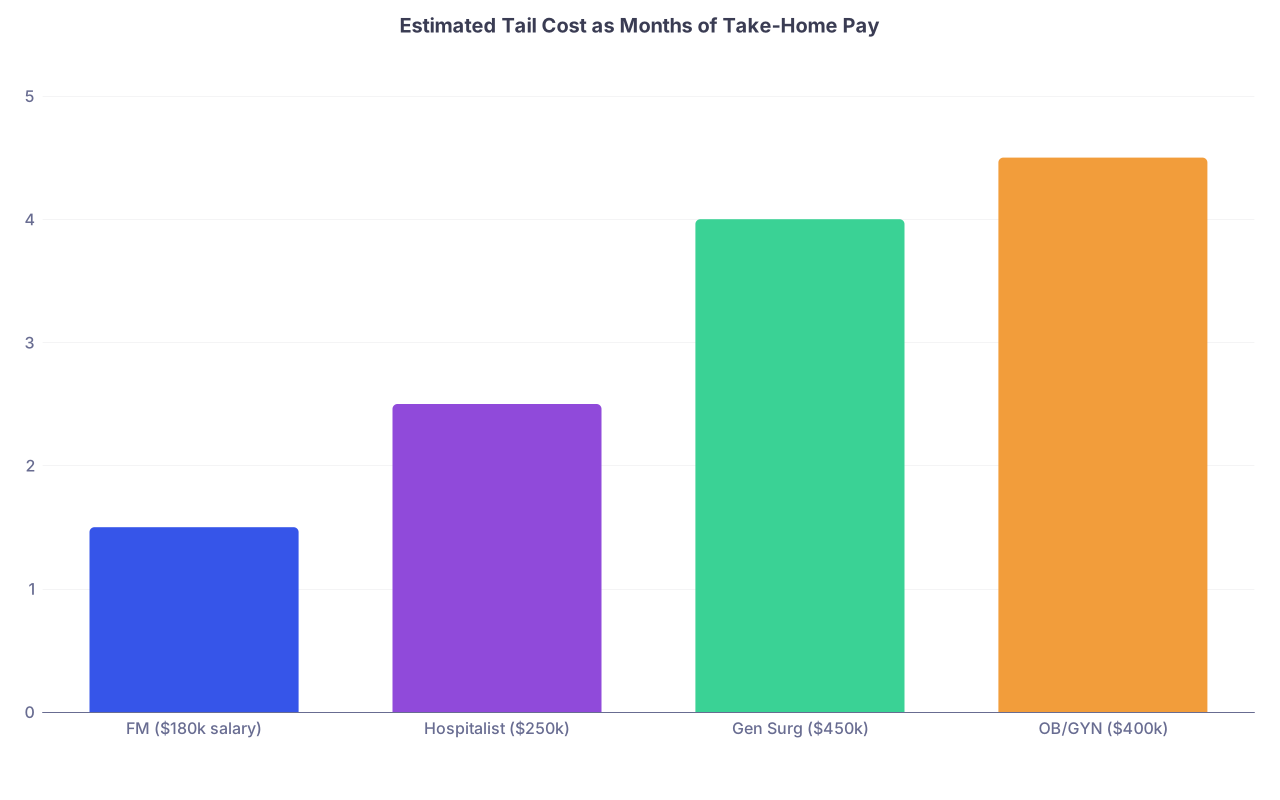
| Category | Value |
|---|---|
| FM ($180k salary) | 1.5 |
| Hospitalist ($250k) | 2.5 |
| Gen Surg ($450k) | 4 |
| OB/GYN ($400k) | 4.5 |
This is why ignoring tail is not a “tiny fine print” mistake. It is a life‑planning mistake.
The Contract Language That Will Burn You (And What It Should Say Instead)
The most expensive sentence in your contract is rarely the salary line. It is the malpractice clause.
Here are the red‑flag patterns I keep seeing:
1. “Employer provides claims‑made coverage” – and then silence
Translation: they are covering the policy while you work there. That says nothing about what happens when you leave.
If there is no explicit tail language, assume you are on the hook. If you sign anyway, that is not an accident. That is you agreeing to buy your own tail later.
2. “Upon termination, physician shall be responsible for purchasing extended reporting endorsement (tail coverage).”
This is the classic “you pay for tail regardless of how or why you leave” clause.
You are responsible if:
- You resign for a better job
- They cut your pay by 25% and you refuse to sign
- They fire you without cause
- The group dissolves
I have watched physicians walk from these jobs with $80,000–$120,000 in unexpected tail bills. OB/GYNs and surgeons get hit hardest.
3. Sneaky conditional promises
Language like:
- “Employer may, at its discretion, purchase tail coverage.”
- “Employer intends to provide tail coverage, budget permitting.”
- “Employer shall pay for tail coverage only after five years of continuous employment.”
Translation: they are promising you exactly nothing.
If tail is “discretionary,” you should assume they will forget their generosity the day you resign.
If it is tied to 3–5 years of continuous service, recognize what that actually is: a financial handcuff. Leave early and you either:
- Eat the tail cost
- Stay in a bad environment because you cannot afford to leave
4. No mention of amounts, carriers, or limits
If your contract does not specify:
- Policy type (claims‑made vs occurrence)
- Limits (e.g., $1M/$3M)
- Who pays tail
- Under what circumstances
…then you are signing a blank check with your future self’s money.
Better contracts spell this out. For example:
- “Employer shall maintain occurrence malpractice coverage with limits of $1M/$3M.”
- “Employer shall provide claims‑made malpractice coverage and, upon termination of this Agreement for any reason, shall purchase tail coverage for Physician.”
That is what protection looks like.

| Step | Description |
|---|---|
| Step 1 | Read Malpractice Clause |
| Step 2 | No Tail Needed |
| Step 3 | Lower Risk |
| Step 4 | High Financial Risk |
| Step 5 | Assume Physician Pays |
| Step 6 | Policy Type |
| Step 7 | Tail Responsibility Defined |
Employer Types: Who Usually Pays for Tail (And Who Tries to Dump It on You)
Not all employers behave the same way. Some almost always cover tail. Others almost never do. You are making things harder for yourself if you ignore these patterns.
| Employer Type | Usual Tail Responsibility | Risk Level if Ignored |
|---|---|---|
| Large hospital system | Employer often pays | Lower–Moderate |
| Academic medical center | Employer pays, occurrence | Low |
| Private single-specialty group | Often physician | High |
| Multi-specialty group | Mixed / negotiable | Moderate–High |
| Locums agency | Usually provides occurrence | Low–Moderate |
Let me be blunt:
- Hospitals / systems – Often better about tail. They may use occurrence or agree to buy your tail. But do not assume; I have seen systems quietly shift this cost in newer contracts.
- Academic centers – Often use occurrence policies or institutional coverage. Tail is usually a non‑issue, but still confirm.
- Private groups – This is where careers go sideways. Many groups are built on the idea that junior physicians subsidize their own tail and then some.
- Locums – Typically occurrence coverage through the agency, which is cleaner. But verify each specific assignment.
The huge mistake is assuming “everyone does it this way” without verifying what your contract says.
Groups will absolutely let your ignorance fund their balance sheet.
The Non‑Financial Pain: How Lack of Tail Coverage Traps You
The money is obvious. The emotional and career cost gets underappreciated.
Here is how I have seen this play out:
1. You feel trapped in a toxic job
You realize your tail will be around $70,000–$100,000 if you leave now. You:
- Put up with unsafe staffing
- Tolerate abusive leadership
- Accept unfair call schedules
- Avoid confrontation because you “need” to stay three more years
That is not a job. That is financial captivity masked as employment.
2. You downgrade your career moves
You get an offer from a better group. Or a dream academic job. Or a better city for your family.
You run the numbers and tail destroys the deal. You either:
- Decline the offer
- Accept a much lower sign‑on because it is being diverted to tail
- Delay the move for years
You just let a bad contract control your career trajectory.
3. You gamble on “maybe I will not be sued”
Some physicians simply walk away without buying tail. Often because they literally cannot pay.
That is a dangerous fantasy. Malpractice claims can surface years after an encounter, especially in specialties like pediatrics, OB, surgical fields.
If you are sued for a patient you treated while uninsured for that period:
- You may not have defense coverage
- Your license and NPDB record are still on the line
- Plaintiff attorneys will see you as a personally collectible target
Saving $50k now to risk your entire future earnings is not “courage.” It is denial.

| Category | Value |
|---|---|
| FM/Primary Care | 2 |
| Hospitalist | 3 |
| EM | 5 |
| General Surgery | 6 |
| OB/GYN | 8 |
(Scale 1–10, not actual claim counts, but you get the point. The higher you are on this ladder, the dumber it is to shortcut tail.)
How to Avoid Getting Crushed by Tail Coverage (Concrete Moves, Not Platitudes)
Let me walk you through the practical steps you should take before you sign anything.
Step 1: Get the actual malpractice details in writing
Ask directly:
- Is the coverage claims‑made or occurrence?
- What are the policy limits?
- What is the annual premium for my specialty?
- Who owns the policy – the employer or me?
If they will not answer those questions, that is an answer. And not a good one.
Step 2: Demand clear language about tail responsibility
You want a sentence that leaves no room for “interpretation.” For example:
Best case:
“Employer shall be solely responsible for the cost of any required tail coverage upon termination of this Agreement for any reason.”Acceptable compromise if you must:
“If Physician is terminated for cause, Physician shall be responsible for tail; if Physician is terminated without cause, Employer shall be responsible for tail.”
What you do NOT want:
- Vague “may provide” language
- Silence on tail
- “Employer and Physician shall negotiate responsibility at time of termination.” (Translation: you will get steamrolled when you have zero leverage.)
Step 3: Use numbers, not vibes, in negotiation
Do not just say, “Tail can be expensive.”
Say:
“I understand malpractice premiums for OB/GYN in this state are around $50,000–$70,000 annually, so tail could easily be $75,000–$150,000. I need clarity that the group will cover this.”
Then shut up and let them respond. Watch who tries to minimize or deflect. That is where you see character.
Step 4: If they refuse to cover tail, shift the burden back
You have options besides just swallowing the cost.
You can push for:
- A sign‑on bonus specifically earmarked to fund future tail
- A forgivable loan that vests over time to cover tail
- Occurrence coverage instead, even if it slightly lowers your salary
You can also insist on “pro‑rated employer responsibility” for tail. Example:
- Employer pays 25% of tail per year of service, fully covering it after 4 years.
Still not ideal, but much better than “you pay 100% no matter what.”
Step 5: Always, always show the contract to someone who actually knows this stuff
This is where a lot of physicians get stubborn. “I can read English. I do not need a lawyer.”
Sure. You can also read an EKG; that does not mean you are ready to interpret a 12‑lead on a crashing patient without training.
Get:
- A physician contract attorney (who reads these daily, not your cousin who does real estate)
- Or a reputable physician contract review service
- Or both
Yes, it costs money. You know what costs more? Writing a $90,000 check for tail because you missed one sentence.
Special Situations Where Tail Coverage Really Bites
A few scenarios I have seen repeatedly:
1. Changing states or going into fellowship after a job
You work as a hospitalist for two years after residency, then decide to pursue a fellowship. You leave clinical practice in that state.
You now have:
- No ongoing income from that employer
- Moving costs
- Possibly lower fellowship salary
And then a tail bill drops in your lap on the way out. This is common, and it is brutal when you are stepping backward in pay.
2. Joining a group that is quietly unstable
You sign with a private group that seems fine. Three years later:
- They lose a hospital contract
- They merge with another group
- Two partners leave and the RVU model collapses
You want out. So does everyone else. The group is bleeding cash. Guess what they are not paying for?
Your tail.
Your only protection is the contract you signed on day one. That is why you fix this up front, not at the exit interview.
3. Short‑term or “trial” employment
I see this especially with new grads: a “trial year,” with vague promises of partnership later.
They tell you, “We will talk about tail once you are partner.”
If you flame out, hate the culture, or they decide you are not a fit, you are the one paying tail after just 12–18 months. Exactly when your savings are still thin.
That is not a trial. That is a trap.
Quick FAQ: Common Myths That Get Physicians Hurt
FAQ 1: “The recruiter said the group takes care of malpractice, so I am fine, right?”
No. “We provide malpractice” does not mean “we pay for your tail.” Recruiters are often paid to fill positions, not to protect you from future liability. The only thing that matters is the written contract, and it must say who pays for tail, in plain language.
FAQ 2: “If I plan to stay long‑term, do I really need to worry about tail now?”
Yes. People rarely plan to leave when they sign. Jobs change. Leadership changes. Compensation models shift. Hospitals close. You might want to move for family, health, or sanity. You negotiate tail from a position of strength at the beginning. At the end, you have no leverage, and they know it.
FAQ 3: “Can I just rely on my future employer to cover my old tail?”
Sometimes a new employer will pay your prior tail to recruit you. Sometimes. But counting on that is like planning your retirement around lottery tickets. You do not control future offers, the malpractice market, or how desperate the next employer is. Your baseline plan should be: if no one else pays, am I protected by this current contract?
The Bottom Line: Do Not Sign Blind
Three points, and then I am done:
- Tail coverage on a claims‑made policy is not a detail. It is a five‑ or six‑figure liability that can trap you in bad jobs and wreck your finances if you ignore it.
- If your contract does not clearly say who pays for tail and under what circumstances, assume that person is you. Then fix it before you sign.
- Paying a contract expert now is cheap. Paying for someone else’s clever malpractice clause later is not.
Read the malpractice section like your future self is sitting next to you, watching. Because that is who pays if you get this wrong.


