

It’s July 5th. You just finished residency, your inbox is full of “Welcome aboard!” emails, and HR just sent over your employment contract. There it is in bold:
Relocation Bonus: $25,000 (taxable)
You’re exhausted, you have loans breathing down your neck, and you’re about to move across the country. That money feels like oxygen.
This is exactly where too many smart physicians blow it. They see “bonus” and stop reading. Or they skim the pay number, sign, and figure “Everyone does this, it’s fine.”
Then two years later, burned out and underpaid, they try to leave. And suddenly they’re staring at a $30,000+ repayment demand plus interest, plus threats of collections, maybe even legal letters.
You are not getting trapped like that. Not if I can help it.
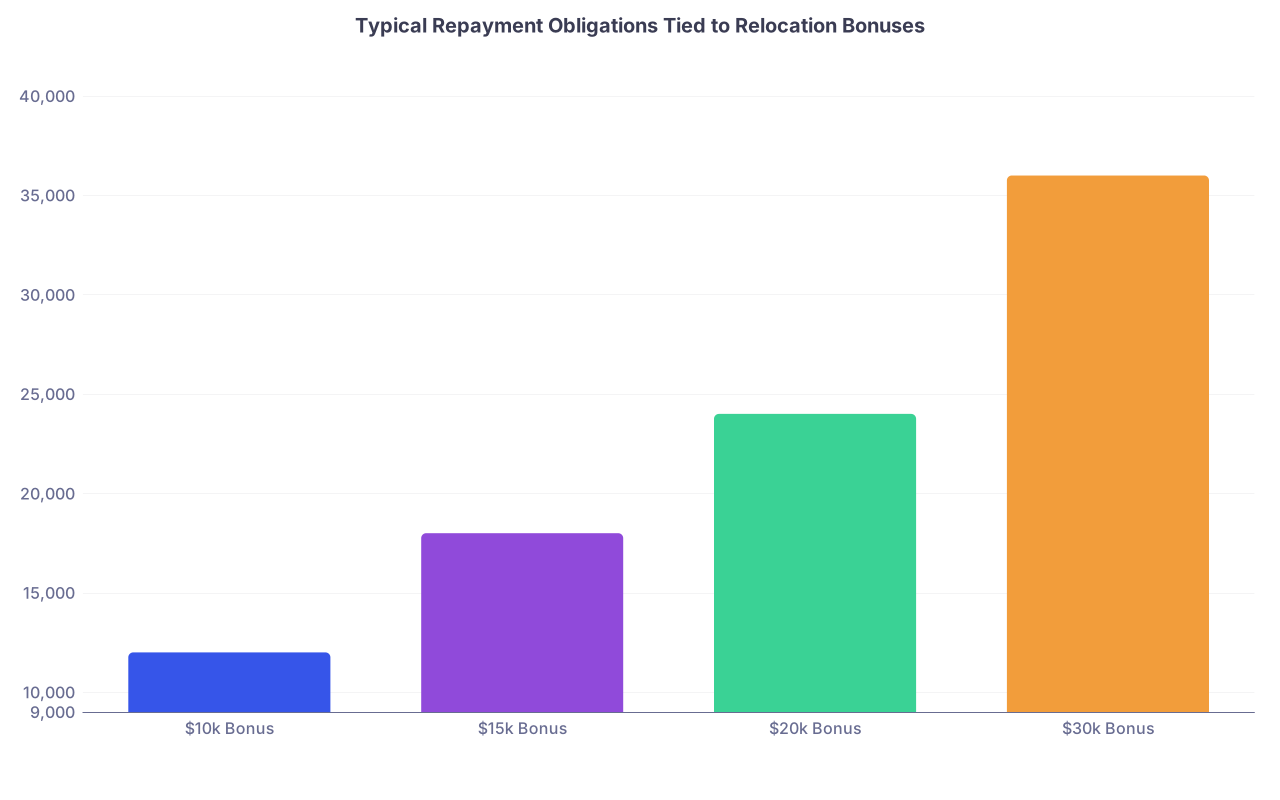
| Category | Value |
|---|---|
| $10k Bonus | 12000 |
| $15k Bonus | 18000 |
| $20k Bonus | 24000 |
| $30k Bonus | 36000 |
The Biggest Myth: “It’s Free Money”
Let me rip the bandage off: relocation bonuses are almost never free money. They are:
- A disguised retention tool
- A way to lock you into a multi‑year commitment
- A booby trap if the job is worse than advertised
Common ugly surprises:
- You owe 100% of it back if you leave “for any reason” before X years
- Repayment is not prorated (you stay 23 months of a 24‑month term and still owe everything)
- Interest, “administrative fees,” or collection costs get added
- The repayment is due within 30 days of termination
If you see language like:
“Physician agrees to repay the full relocation bonus if employment terminates for any reason within 24 months.”
That’s not a benefit. That’s a leash.
Classic mistake #1: Thinking “I’ll definitely stay at least 3 years”
I’ve heard versions of this play out dozens of times:
“I mean, worst case I’ll stay 3 years, get experience, then re‑evaluate.”
Then reality:
- Call is worse than promised
- RVUs are impossible to hit
- Admin is toxic
- Spouse can’t find work in that town
- Or they simply underpay you compared to the market
Suddenly year 2 rolls around and you want out. But you’re shackled to a relocation “bonus” you already spent on movers, deposits, and paying off a credit card.
Do not assume you’ll stay. Assume there’s a real chance you’ll want to leave early, and read the relocation terms with that in mind.
The Subtle Contract Tricks That Trap You
Here’s where they get you. Buried in the legal soup.
1. “Repayment Period” Games
Watch out for:
- Long repayment periods: 2–3 years is common; some try for 4–5
- No proration: you either pass the cliff or you owe everything
- Restart clauses: repayment period restarts if you transfer within the system
Example ugly clause:
“If Physician transfers employment within the System to another affiliate, the two-year obligation shall recommence as of the transfer date.”
Translation: you move from Hospital A to Hospital B in the same health system because of a better fit, and suddenly you’re locked in for two more years.
2. “For Any Reason” Traps
They love the phrase “for any reason.” It’s deliberately broad.
Psychologically, physicians think:
- “If they fire me, surely I won’t owe it back.”
- “If they breach the contract, I won’t be punished.”
The contract often says the opposite.
Common variants:
- Repayment if you resign for any reason
- Repayment if you’re terminated with or without cause
- Repayment even if the employer changes compensation terms or reduces your role
If the clause isn’t crystal clear about exceptions, assume there are none.
3. “Voluntary vs Involuntary” Landmines
Some contracts switch between “voluntary” and “involuntary” termination in different sections. This is not an accident.
Watch for:
- One section says: “No repayment if involuntary termination without cause.”
- Another section on relocation says: “Full repayment if employment terminates for any reason.”
That conflict doesn’t help you. Ambiguity usually gets interpreted in the employer’s favor or at least means a fight you cannot afford.
You want one clean statement that ties directly to the relocation benefit:
“Physician shall not be required to repay the relocation bonus if employer terminates employment without cause or if Physician terminates due to employer’s material breach.”
If you do not see something like that, you should assume full repayment is coming your way if things sour.

| Step | Description |
|---|---|
| Step 1 | Offer includes relocation bonus |
| Step 2 | High risk - renegotiate |
| Step 3 | Ask for changes or higher base |
| Step 4 | Consider accepting with caution |
| Step 5 | Is repayment prorated? |
| Step 6 | Are exceptions defined? |
| Step 7 | Comfortable with risk? |
Repayment Amounts: The Silent Financial Ambush
You see “$20,000 relocation bonus” and think “Nice cushion.” You forget taxes, interest, and repayment structure.
The tax trap
Relocation bonuses are usually taxed as income. So on paper:
- Bonus: $20,000
- After taxes (say 30% effective): ~$14,000 hits your account
Then two years later:
- You leave early
- They demand the full $20,000 back
You already paid income tax on it. The IRS doesn’t care that you returned it unless you go through the hassle of deducting it or amending taxes (and even then, not always simple).
So in real life you:
- Net $14k initially
- Repay $20k later
- Lose $6k plus your time, plus any interest/fees
That “bonus” becomes a negative.
The interest and collection trick
Look for sneaky sentences:
- “Any unpaid amount shall accrue interest at the maximum legal rate.”
- “Physician shall be responsible for reasonable attorney fees and costs of collection.”
Translation: if you do not have $20k sitting around the day you leave, that debt starts growing. And if they send it to collections or lawyers, you pay for that too.

Red Flags in Relocation Bonus Language
Let’s get concrete. Here’s what should set off sirens in your head:
Red flag phrases
If you see these, proceed very carefully:
- “Repayment shall not be prorated.”
- “For any reason whatsoever.”
- “At employer’s sole discretion.”
- “Physician agrees that repayment obligation shall survive termination.”
- “Repayment due within ten (10) days of termination.”
- “Regardless of the reason for termination.”
That’s “we own you” language.
Red flag structures
The worst ones I see over and over:
Short fuse repayment
- “Due within 10–30 days of termination.”
- Unless you have that cash liquid, this is brutal.
No carve‑outs for employer breach
- So they can cut your pay 20%, violate your call schedule, and if you walk, you still owe.
-
- Sometimes they quietly link the relocation to enforcing the non-compete, strengthening their position if you fight it.
Massive combined clawbacks
- Relocation bonus + sign‑on bonus + loan forgiveness all stack.
- Suddenly you owe $60k–$100k the day you decide to leave.
| Feature | Safer Version | Risky Version |
|---|---|---|
| Repayment period | 12–24 months | 36+ months or restarts with transfer |
| Proration | Monthly or quarterly prorated | All-or-nothing cliff repayment |
| Termination exceptions | Clear carve‑outs for no‑cause & breach | “For any reason” language |
| Repayment due date | 60–180 days, payment plan allowed | 10–30 days, lump sum only |
| Amount owed | Net or prorated bonus only | Full gross bonus + interest + fees |
Smarter Ways to Structure Relocation Support
You do not have to accept the hospital’s first structure. You have more leverage than you think—especially early‑career when they know you’re cheaper than a seasoned hire.
Here’s how to avoid the worst traps.
1. Push for proration
If you do nothing else, do this.
Example: 24‑month obligation, $24,000 relocation bonus.
Better structure:
- Obligation: 24 months
- Forgiveness: $1,000 per month of completed employment
- If you leave at 18 months, you owe $6,000 (not $24,000)
That’s sane. Anything else is predatory.
What to ask for:
“Can we structure the relocation as a forgivable loan that is forgiven monthly over the 24‑month term rather than all‑or‑nothing?”
2. Demand clear exceptions
You want explicit language like:
- No repayment if:
- Employer terminates without cause
- You terminate for employer’s material breach
- Employer reduces base compensation by more than X%
- Employer requires permanent relocation outside defined geographic area
You will not always get all of that, but asking forces them to show their hand. If they refuse every reasonable exception, that tells you a lot about how you’ll be treated later.
3. Stretch the repayment window
Thirty days is a threat, not a reasonable term. Ask for:
- 90–180 days to repay
- Or explicit option for a payment plan over 12–24 months
If they want you badly enough, they often bend on timing before they bend on amount.
4. Consider trading bonus for salary
Here’s the move almost nobody makes but should:
Tell them you’re willing to take less relocation bonus in exchange for:
- Higher base salary
- Better call structure
- Sign‑on bonus with better terms
Relocation money is one‑time. Base salary affects everything—loan payments, retirement savings, future raises, even how recruiters view your current compensation.
Trade the trap money for something you keep.
Common Physician Mindset Errors About Relocation Bonuses
You’re not just fighting the contract; you’re fighting your own thinking. Here are the mental traps I see over and over.
“I need the cash now. I’ll deal with the rest later.”
This is how people end up with:
- A bad job
- A non-compete
- A giant clawback
- And zero leverage
If you really need the cash:
- Ask family for a temporary loan
- Use a low‑interest personal loan or 0% promo card smartly
- Or ask the employer for direct payment of actual moving invoices instead of a lump sum bonus
Reimbursement for actual moving expenses often comes with less toxic strings than a lump sum “bonus.”
“They’re a big, reputable health system. They’ll be fair.”
Some of the most aggressive contracts I’ve seen are from large, “brand name” systems. They have:
- In‑house lawyers
- Templates designed to maximize control
- HR departments trained to be very nice while changing nothing
Do not confuse “nice recruiter” with “fair contract.”
“My co‑residents signed similar deals. It must be standard.”
“Standard” just means “they’ve been getting away with it.”
Your peers are not lawyers. Many of them:
- Didn’t read the whole contract
- Didn’t understand the relocation language
- Plan to “figure it out later”
Do not copy mistakes just because they’re popular.
How to Review a Relocation Bonus Clause (Step by Step)
Here’s how to go through it without missing the landmines.
Step 1: Is it a bonus or a loan?
Look for words like:
- “Forgivable loan”
- “Advance”
- “Subject to repayment”
If it’s structured as a forgivable loan, that can be okay if:
- Forgiveness is monthly or yearly
- Terms are clear
- Exceptions for no‑cause termination/employer breach exist
But do not let the word “loan” scare you more than “bonus.” Sometimes the “bonus” is actually worse.
Step 2: What’s the time commitment?
Find:
- Length of required service (12, 24, 36+ months)
- Whether the clock restarts with role changes or transfers
- Whether partial completion reduces the amount owed
Write it out yourself:
“If I leave at 6, 12, 18, 24 months, how much do I owe?”
If the answer is “full amount” for anything less than full term, that’s a problem.
Step 3: When and how must you repay?
Check:
- Exact number of days after termination
- Whether they allow payment plans
- Whether interest and fees apply
If you’d have to scramble to borrow from family or take on high‑interest debt to repay within that window, do not ignore that risk.
Step 4: Under what conditions do you not repay?
Find:
- Termination without cause
- Termination for cause (you lose here almost always)
- Constructive termination (employer makes your job untenable)
- Material breach by employer
If there’s no list of exceptions, assume none exist. “We’d work with you” verbally means nothing.
Step 5: Get a physician contract lawyer to review
Yes, it costs something. A couple hundred to a thousand dollars, usually.
Compare that to:
- $20k+ clawback
- Being stuck an extra year just to avoid paying it
- Lawsuits or collections on your record
The math is not subtle.
What to Do if You’re Already Trapped
Maybe you’re reading this too late. You already signed. The job is souring. You’re staring at a clawback clause.
You still have options, but do not stumble through this alone.
1. Get the exact numbers
Before you panic, get details in writing:
- Exact amount you would owe
- Whether it’s prorated at all
- Timing of repayment
- Whether they’ve ever waived it in the past (HR will sometimes hint at this)
Ask hypothetically:
“If I were to leave at the end of this year, how would the relocation bonus repayment work?”
2. Negotiate an exit instead of a fight
Sometimes you can trade:
- Longer notice period
- Help recruiting a replacement
- Smooth hand-off
In exchange for:
- Waiver or reduction of repayment
- Payment plan for the remainder
Administrators care a lot about coverage and continuity. Use that.
3. Time your departure strategically
If you’re:
- 3 months from forgiveness
- 6 months from a major proration drop
It might be worth enduring a bit longer to avoid tens of thousands in repayment. But make that decision consciously, not by default.
4. Get legal advice before you resign
Do not send a resignation email and then call a lawyer. Call the lawyer first.
A well‑phrased resignation letter that cites material breach or specific contract provisions can sometimes put you in a stronger position on repayment negotiations.
FAQ (Exactly 4 Questions)
1. Is it ever smart to refuse a relocation bonus entirely?
Yes. If the repayment language is brutal and they refuse to modify it, you’re better off walking away from the money than locking yourself into a bad job or a huge clawback. I’ve seen physicians negotiate a slightly higher base salary or extra CME funds instead of a relocation bonus and come out far ahead. If you can cover moving expenses another way—even if it stings—you keep your freedom.
2. Are hospital relocation bonuses usually negotiable, or are they “standard”?
They’re more negotiable than they pretend. HR will often say “this is our standard package,” but I’ve watched those “standard” terms change after a candidate calmly asked for proration, longer repayment windows, or clear carve‑outs for no‑cause termination. You may not get everything, but even one or two tweaks (like monthly forgiveness) dramatically cut your risk.
3. What’s a reasonable relocation amount for a new attending?
It depends on geography and specialty, but common ranges are $5,000–$15,000 in lower‑cost areas and up to $20,000–$30,000 for high‑cost or hard‑to‑recruit locations. If they’re dangling an unusually large relocation bonus (like $40k+), I start wondering what they’re trying to hide: awful call, impossible RVUs, remote town nobody stays in. Big relocation bonuses are often danger signs, not gifts.
4. Should I prioritize the relocation bonus or the sign‑on bonus when negotiating?
Neither. You should prioritize base salary and workable contract terms. Relocation and sign‑on bonuses are nice, but they’re one‑time and almost always come with strings or clawbacks. If you have to choose, I’d rather see you negotiate a safer, prorated sign‑on bonus and a modest, clearly structured relocation reimbursement than a giant relocation bonus with a harsh repayment clawback. And if they won’t budge on terms, treat those “bonuses” like handcuffs, not perks.
Open your contract today and find the relocation section. Physically write in the margin:
“What do I owe if I leave at 6, 12, 18, 24 months?”
If you can’t answer that from the language on the page—or you do not like the answer—your next step is to email a physician contract lawyer and get that clause fixed before you sign anything.


