

Vague “productivity” language in physician contracts is one of the quietest ways your employer can drain six figures from your take-home pay.
If you sign on the dotted line without forcing clarity, you’re not being “easy to work with.” You’re subsidizing someone else’s profit margin.
Let me be blunt: I’ve seen new attendings lose $50,000–$150,000 in a single year because they trusted phrases like “standard productivity expectations,” “to be determined by administration,” or “consistent with similar physicians.” Those words look harmless. They are not.
This is how you get trapped in a job where:
- Your RVUs never seem to match your schedule.
- Your bonus is “under review” every quarter.
- Partners swear “this is just how we’ve always done it.”
And your paycheck never looks like the number that made you sign in the first place.
You’re post-residency. You’re exhausted. You finally have an offer. This is the exact moment you’re most likely to get played by vague productivity language.
Let’s make sure you don’t.
1. The Core Mistake: Treating “Productivity” Like a Fuzzy Concept Instead of a Math Formula
Productivity compensation is not a vibe. It’s math.
If the contract doesn’t let you do the math, you’re already losing.
Here’s the mistake almost every new attending makes:
They read “productivity-based compensation” and assume it means “if I work hard, I’ll get paid accordingly.”
No. What it actually means is:
“Whoever wrote this contract controls the definition of productivity, and they just gave themselves the right to change the rules later.”
Watch for phrases like:
- “Productivity to be determined by employer policies.”
- “As defined in the employer’s compensation plan, which may be amended from time to time.”
- “Bonus structure consistent with practice norms.”
- “Subject to annual review by administration.”
None of those tell you:
- What exactly is being measured.
- How it’s being measured.
- When it’s being calculated.
- Who is allowed to change it.
- What protections you have if the system shifts.
If you can’t take the exact language in your contract, plug in numbers, and calculate your pay, you’re signing up for surprises. And not the good kind.
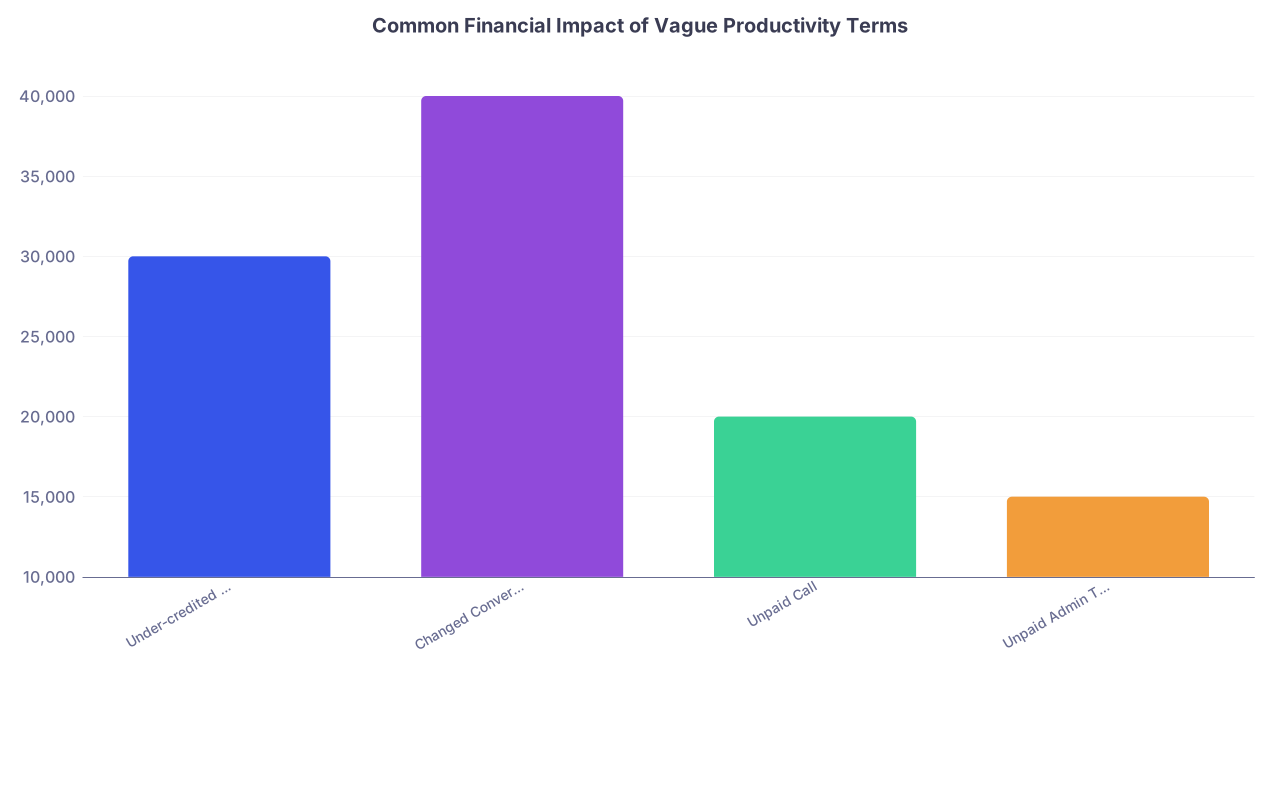
| Category | Value |
|---|---|
| Under-credited RVUs | 30000 |
| Changed Conversion Rate | 40000 |
| Unpaid Call | 20000 |
| Unpaid Admin Time | 15000 |
That’s a rough picture of how “minor” ambiguities stack up into real money.
2. The 5 Most Dangerous Vague Phrases in Productivity Clauses
You’re tired. You skim. You see “RVU” and think “OK, standard.” That’s how you get burned.
Here are the biggest red flag phrases that silently slash your take-home pay.

2.1 “As Defined in Employer Policy” (The Black Box)
Typical wording:
“Work Relative Value Units (wRVUs) will be calculated as defined in the Employer’s Compensation Policy, which may be updated periodically.”
Translation: “We’re not telling you the rules here, and we can change them.”
Why this quietly cuts your pay:
- You don’t see:
- Which RVU schedule they’re using (Medicare? Modified?)
- Any carve-outs or reductions.
- How changes are communicated.
- They can:
- Reclassify procedures.
- “Reconcile” credits months later.
- Adjust credit for APP work without telling you.
Protective fix: Demand the policy as an exhibit.
- The contract should say something like:
- “wRVUs will be calculated according to Employer’s Compensation Policy dated [specific date], attached as Exhibit A. Any material change to this policy that reduces Physician compensation will require Physician’s written consent.”
If they refuse to attach the policy? That’s not an oversight. That’s strategy.
2.2 “Standard Productivity Expectations” (The Moving Goalpost)
Typical wording:
“Physician is expected to meet standard productivity expectations consistent with similar physicians in the Employer’s practice.”
Sounds innocent. It’s not.
Problems:
- What does “standard” mean? 4,000 wRVUs? 7,000?
- Who are “similar physicians”? Partners working 1.5 FTE? Someone with no call? Someone with four midlevels feeding them patients?
This phrase is how you end up:
- Working 1.0 FTE with 1.2 FTE expectations.
- Getting labeled “underperforming” without any written benchmark.
- Having your bonus or renewal threatened because the “standard” magically shifted.
Protective fix:
You want actual numbers, in ink:
- “Productivity expectations are 5,000 wRVUs annually for 1.0 FTE.”
- “Productivity will be pro-rated for FTE status and for any Employer-mandated non-clinical duties exceeding X hours per week.”
2.3 “Subject to Annual Review” (The Quiet Pay Cut Clause)
Typical wording:
“The wRVU conversion factor is $52 per wRVU, subject to annual review by Employer.”
You see $52 and stop reading. Big mistake.
“Subject to annual review” is the line that lets them quietly cut your per-RVU pay in year 2 or 3—after you’ve moved, built a panel, and are now financially stuck.
I’ve seen this:
- Year 1: $52/wRVU
- Year 2: $48 (“system-wide adjustment based on payer mix”)
- Year 3: $45 (“market alignment”)
You’re seeing more patients and bringing in more revenue. Your per-unit pay is going the wrong direction.
Protective fix:
Either:
- Lock in a minimum:
- “The wRVU conversion factor shall not be less than $X per wRVU during the term of this Agreement unless agreed to in writing by Physician.”
Or:
- Tie changes to a neutral benchmark:
- “Changes to the wRVU conversion factor will be proportional to changes in Medicare conversion factors, and shall not reduce total potential compensation by more than 5% in any contract year without Physician consent.”
If they tell you, “Don’t worry, we never lower it,” your response should be: “Perfect. Then put that in writing.”
2.4 “Bonus at Employer’s Discretion” (The Phantom Bonus)
Typical wording:
“Physician may be eligible for a productivity bonus at Employer’s discretion.”
“May.” “Eligible.” “Discretion.”
That is three levels of non-commitment in one sentence.
What this actually means:
- You have no enforceable right to any bonus.
- If the hospital’s margin is thin one year, your “bonus” disappears.
- There’s no formula, no timing, and no appeal.
You’d be shocked how many attendings mentally include this “bonus” in their expected income. Then act surprised when it never shows up.
Protective fix:
Insist on clear, formula-based, non-discretionary language:
- “Physician will be paid a productivity bonus of $X per wRVU for all wRVUs above 6,000 annually, to be calculated and paid quarterly within 60 days of quarter-end.”
If they insist on keeping “discretion,” you must treat that amount as zero when evaluating the offer. Because practically, that’s what it is.
2.5 “Consistent with Market Standards” (The Excuse Shield)
Typical wording:
“Compensation is intended to be consistent with fair market value and community standards.”
This line exists for one reason: to protect them, not you.
They will wave “fair market value” around whenever they want to:
- Cap your productivity.
- Reject a renegotiation.
- Explain why your specialist colleague in another city makes 30% more.
It does not guarantee:
- You’re being paid fairly relative to your actual work.
- They won’t lower your rate and call it “market adjustment.”
Protective fix:
Use this to your advantage by locking in:
- Specific benchmarks (e.g., “based on MGMA 50th percentile for [specialty] in [region] as of [year]”).
- A scheduled review:
- “Compensation will be reviewed every two years and adjusted toward the MGMA [X] percentile, subject to mutual agreement.”
If they want to hide behind “market,” they should be willing to name the market.
3. The Structural Traps: How Vague Language Turns Into Lost Income
Vague words don’t just “sound confusing.” They manifest as very predictable ways your paycheck shrinks.

| Step | Description |
|---|---|
| Step 1 | Sign Vague Contract |
| Step 2 | Unclear RVU Rules |
| Step 3 | Flexible Conversion Rate |
| Step 4 | Discretionary Bonuses |
| Step 5 | Under Crediting Work |
| Step 6 | Lower Rate After Year 1 |
| Step 7 | Unpaid Promised Bonus |
| Step 8 | Lower Than Expected Income |
3.1 Under-credited Work: The “Oh, That Doesn’t Count” Problem
You work like a maniac. The RVU report comes. Numbers look low. You ask questions.
Suddenly you learn:
- APP visits under your supervision don’t count for you.
- Certain procedures are capped.
- Hospital rounding with residents is “educational,” not billable.
- “No-shows” and overbooked templates prevent you from hitting thresholds, even though your day is packed.
Where do they hide those rules? You guessed it: in that mysterious “Employer Compensation Policy” they didn’t attach.
What you want in writing:
- Clarification of:
- Who gets credit for APP work.
- How inpatient consults, follow-ups, and procedures are credited.
- Whether teaching and admin time reduce RVU expectations or are just unpaid.
And explicitly:
- “Productivity expectations will be adjusted proportionally for Employer-required non-clinical duties exceeding X hours per week.”
If you’re the one doing QI projects, committees, or teaching, and there’s no written adjustment, you’re losing money. Period.
3.2 The “Threshold + Cliff” Trick
Classic setup:
- Base salary: $260,000
- wRVU threshold: 6,000
- Bonus: $50 per wRVU over 6,000
Problems hidden in vague language:
- No clear statement on:
- How often this is reconciled.
- Whether unused RVUs roll over.
- What happens if the hospital changes your schedule or referral sources mid-year.
So you get:
- Quarter 1: Volume low (clinic still building).
- Quarter 2–4: You’re slammed, but “annual” threshold means your early slow months drag down your year.
- Finally hit just below 6,000 because they cut clinic hours or didn’t replace a departing partner. Zero bonus.
Fix:
Push for:
- Lower threshold with tiered bonus.
- Quarterly reconciliation with rolling thresholds.
- Language adjusting thresholds if:
- Employer reduces clinic time.
- Employer changes call structure.
- Employer closes a site or redirects referrals.
If they control the levers but you carry all the productivity risk, you’re being set up.
4. The RVU Conversion Factor Games (Where Big Money Disappears)
Conversion factor games are a quiet art form.
| Scenario | Conversion Rate | Annual wRVUs | Total RVU Pay |
|---|---|---|---|
| Original Offer | $52 | 7,000 | $364,000 |
| Year 2 Cut | $48 | 7,000 | $336,000 |
| “System Alignment” | $45 | 7,000 | $315,000 |
That is a $49,000 annual swing with zero change in your workload.
The vague clause that makes this possible?
- “Subject to annual review.”
- “May be adjusted by Employer based on market conditions.”
- “At Employer’s sole discretion.”
You should treat any unprotected conversion factor as a future pay cut.
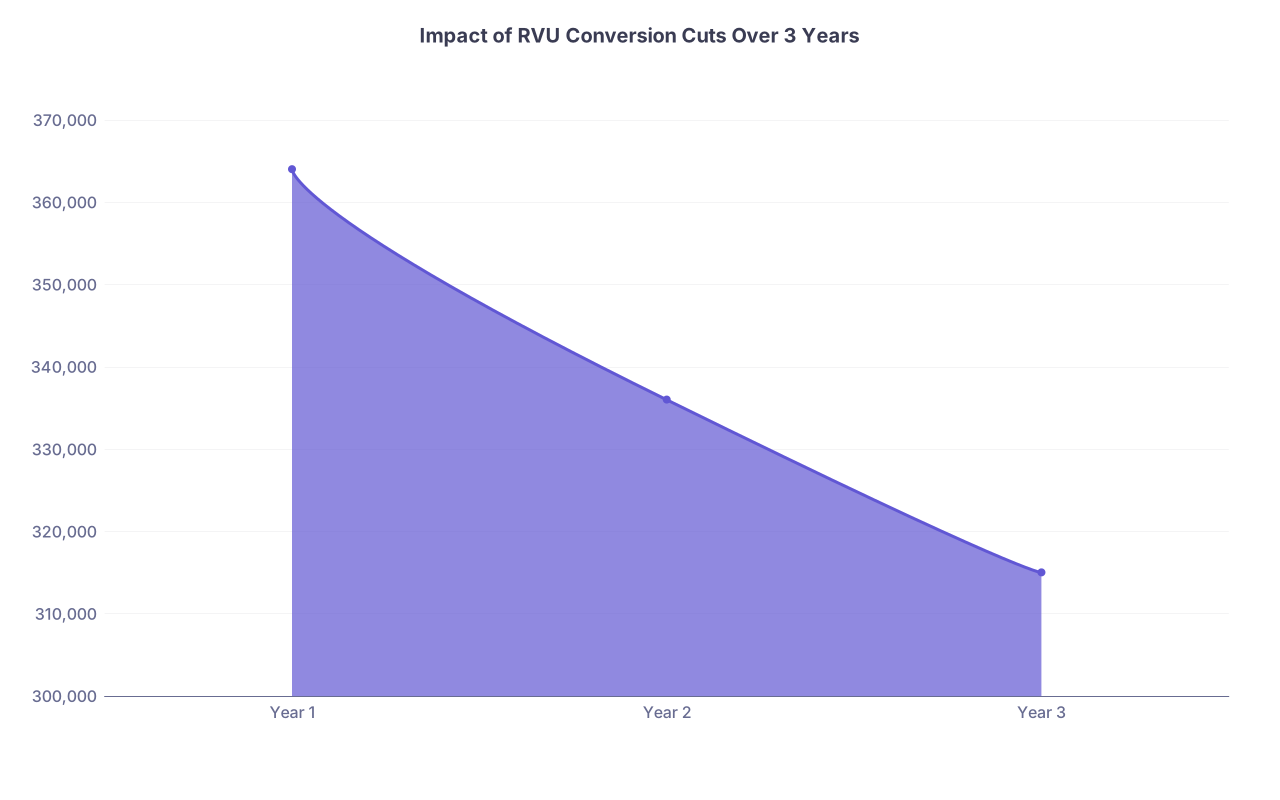
| Category | Value |
|---|---|
| Year 1 | 364000 |
| Year 2 | 336000 |
| Year 3 | 315000 |
Non-negotiable protections to push for:
Floor for conversion factor
“The wRVU conversion factor will not be reduced below $X per wRVU during the initial term.”Mutual consent for material reduction
“Any reduction in the wRVU conversion factor greater than 5% requires Physician’s written consent.”Exit right if they slash it anyway
“If Employer reduces the wRVU conversion factor by more than 5% without Physician’s consent, Physician may terminate this Agreement with 60 days’ notice without penalty or repayment obligation.”
If they won’t give you any of that, understand what they’re really saying:
“We plan to keep our options wide open, and your future income is the cushion.”
5. Collections-Based and “Hybrid” Productivity: Double the Vagueness, Double the Risk
Collections-based productivity is where language gets really slippery.
Typical wording:
“Physician will receive 30% of net collections above the base salary equivalent, as determined by Employer.”
Key landmines:
- “Net collections” – after what?
- Billing costs?
- Bad debt?
- Denied claims?
- Contractual write-offs?
- “As determined by Employer” – based on whose report? When? Auditable?
Hybrid models (base + RVU + collections + quality) multiply the ambiguity if none of it is nailed down.
At minimum, you need:
- A precise definition of “net collections.”
- Confirmation on:
- Who controls billing and coding (you? them?).
- Whether you can review detailed monthly reports.
- How quickly they refile or appeal denied claims.
If their answer to everything is, “We handle that; you don’t need to worry,” you absolutely need to worry.
6. How to Force Clarity Without Being “That Difficult Doctor”
You’re afraid: “If I push too hard, they’ll pull the offer.”
In reality:
- Good employers expect you to ask these questions.
- Shady employers hope you don’t.

Step-by-step: What to actually do
Get the full compensation plan in writing
- “Can you please send me the full written compensation policy and RVU schedule that this contract refers to? I need it to review the productivity terms.”
Ask for sample actual payouts
- “For a physician in this specialty and practice with similar FTE and call, what were the total RVUs and total compensation for the last 12 months?”
- If they can’t or won’t answer, that’s not a good sign.
Run the numbers yourself
- Take:
- Expected wRVUs
- Conversion factor
- Base pay
- Thresholds
- Build best-case, expected, and worst-case income scenarios.
- Take:
Target the vague phrases, in writing
- Send a short, pointed email:
- “I’d like to clarify a few productivity terms so we both have the same expectations.”
- Then list:
- How RVUs are calculated.
- Whether conversion factor can be reduced.
- Exact bonus formula and timing.
- Adjustments for admin/teaching/call.
- Send a short, pointed email:
Use a healthcare contract attorney
- Yes, even if it’s “just a standard hospital contract.”
- They’ve seen dozens of these. They know where the bodies are buried.
7. The Psychology That Gets You Trapped (And How to Override It)
What gets smart physicians to sign these vague messes?
Not stupidity. Fatigue and optimism.
You tell yourself:
- “They seem nice.”
- “It’s a big-name system; they won’t screw me.”
- “I’ll renegotiate once I prove myself.”
- “Everyone here seems happy.”
Reality:
- Admin turnover is constant.
- “We’d never do that” people leave.
- HR and legal care about risk exposure, not your mortgage.
- Renegotiating once you’re already there is harder than you think, especially in a one-employer town.

| Stage | Activity | Score |
|---|---|---|
| End of Residency | Exam fatigue | 4 |
| End of Residency | Loan anxiety | 5 |
| Offer Stage | First offer excitement | 5 |
| Offer Stage | Contract overwhelm | 3 |
| Decision | Pressure to sign quickly | 4 |
| Decision | Careful review temptation | 2 |
Your job is to build a little delay between “offer excitement” and “pen to paper.” Long enough to translate every vague phrase into a clear, enforceable term.
If a group tries to rush you—“We need this back in 48 hours”—you should hear, “Please don’t look too closely.”
8. The Red-Line Test: Questions Your Contract Must Answer in Plain English
Before you sign, your contract must allow you to answer these, without needing a separate policy you’ve never seen:
- Exactly how is “productivity” measured?
- What’s the conversion factor, and can it ever go down? How?
- What are the thresholds, and how often is productivity reconciled and paid?
- How will non-clinical duties (admin/teaching/research) impact my expectations or pay?
- What specific right do I have to review my productivity data and dispute errors?
If any of these answers are still “it depends” or “we’ll work it out later,” you are relying on goodwill, not a contract.
And goodwill does not pay your loans.
FAQ (Exactly 5 Questions)
1. Is any vague productivity language acceptable, or should I reject all of it?
Some flexibility is normal, but here’s the line: if the language prevents you from calculating your expected income under realistic scenarios, it’s too vague. Flexibility about how reports are delivered? Fine. Vague about what gets counted or how much you’re paid per unit of work? Not fine. At least the core formula—RVU definition, conversion factor, thresholds, and payment timing—must be explicit.
2. What if the employer says, “We can’t change the standard contract language”?
That line gets used constantly. Sometimes it’s true. Often it’s lazy. You don’t need them to rewrite their whole template; you can ask for an addendum or exhibit that clarifies productivity terms. If they refuse even that, they’re really saying, “We like ambiguity because it benefits us.” You can still take the job—but do it knowing you’re assuming real financial risk.
3. How do I know if the RVU conversion factor I’m offered is fair?
Compare it with:
- MGMA or other comp survey data (through an attorney or mentor who has access).
- Colleagues in your specialty and region with similar practice settings. If your rate is significantly lower, “but we have great benefits” is rarely enough to make up the gap. And remember: a slightly lower rate with strong contractual protections can be better than a high rate that can be cut at any time.
4. Should I walk away from an offer just because of vague productivity terms?
Sometimes yes. Especially if:
- They refuse to share the comp policy.
- They won’t define thresholds or conversion factors.
- Everything is “discretionary” or “subject to review.” There are plenty of solid jobs that will put clear numbers on paper. Your first job shapes your trajectory; don’t chain yourself to a black box.
5. When’s the best time to push on productivity language—before or after they give me the formal contract?
Push as soon as you see any numbers. Once they’ve decided you’re their candidate, you have leverage. The worst time to raise concerns is after you’ve already verbally agreed and they think you’re locked in. When you get the draft, flag the vague phrases immediately and send a concise list of clarification requests. Employers take you more seriously when you do this early and systematically.
Open your contract (or the offer you’re about to get) today and underline every phrase about productivity, RVUs, collections, or bonuses. If you can’t turn those sentences into a clear, specific math formula, stop right there and get them rewritten before you sign.


