

It’s April. You’ve finished a full clinic day, stayed late to finish notes, and now you’re sitting in a small admin conference room with the “comp committee” rep, an HR person, and the CMO. On the table: your new contract. On page three: a “revised productivity structure” with RVU targets that look… aggressive.
You say, as professionally as you can:
“These RVU targets seem high for this market and my specialty. I’d like to revisit them.”
They smile. They say things like “alignment,” “market-competitive,” “everyone’s on the same plan.”
You’re hearing words. What they’re thinking is something else entirely.
Let me walk you through what actually runs through the mind of a hospital CEO and their inner circle when a physician pushes back on RVUs. This is the stuff they won’t put in an email and will never say out loud at a town hall.
First Reality: You Are a Line Item Before You Are a Colleague
Start with the cold truth: by the time you’re pushing back on RVU targets, the CEO has already seen a spreadsheet with your name on it and a profitability projection next to it.
For you, the RVU target feels personal. For them, it’s a cell in a budget model.

Here’s the mental backdrop they’re operating from—whether you’re primary care, ortho, GI, or hospitalist.
| Item | How Admin Actually Frames It |
|---|---|
| Your salary | Fixed cost |
| Your RVUs | Revenue driver |
| Your benefits | Additional fixed cost |
| Your call coverage | Service coverage requirement |
| Your clinic time | Capacity block on template |
| Your contract term | Risk exposure window for the system |
So when you say, “I’m concerned about these RVUs,” a CEO is mentally translating that to:
“This doctor may not hit the productivity we baked into the budget forecast.”
That triggers very specific questions in their head:
- Did we mis-price this hire?
- Do we need to adjust the service line plan?
- How many like this do we have?
- Is this a one-off, or do we have a pattern of physicians pushing back?
Notice what’s missing? Anything about your personal burnout, training background, or how long it takes to manage complex patients. That only enters the conversation if you are valuable enough or loud enough to create real risk.
Harsh, yes. But that’s the frame they start from.
What They Really Think When You Say “These RVUs Are Too High”
Let me decode the subtext. When you push back on RVUs, the CEO’s internal monologue falls into a few categories, depending on your specialty, leverage, and market.
1. “Is this someone who doesn’t understand the game yet?”
The first thought is often: you’re naïve.
They’ve seen residents fresh out of fellowship who still think in “visits per half day” and “panel size,” not in “work RVUs per year.” Admin lives in RVUs. You live in patients and pathology. There’s a mismatch.
So if you say, “This looks high,” without numbers, comparables, or understanding of how your volume translates to RVUs, they label you internally:
“Not business savvy yet. We can probably hold the line.”
They won’t say that. But I’ve sat in those rooms:
- “He’s new. He’ll ramp.”
- “She’s coming from an academic environment; she’ll adjust.”
- “Let’s reassure him; the target will be fine once his panel matures.”
You want to avoid being put in that “naïve” box. Once you are, they stop taking your pushback seriously and start thinking in scripts and platitudes.
2. “Is this a future problem physician or a future leader?”
Now the more sophisticated CEOs ask a deeper question:
Is this person pushing back because they’re lazy/problematic… or because they’re smart and looking at data?
That distinction matters.
If you walk in with:
- Median RVU benchmarks from MGMA or SullivanCotter for your region and specialty
- Volume data from your prior job or training
- A realistic on-ramp curve (year 1 vs year 2)
…then the CEO’s internal tone shifts.
Now the thought becomes:
“Okay, this one understands the business. I can’t just hand-wave it. If I ignore this now, I may be looking at an early exit, bad press, or a vocal internal critic later.”
Good CEOs don’t mind pushback. They mind sloppy pushback, emotional pushback, and vague pushback. If you’re clear and grounded, many of them quietly respect it—even if they still try to hold firm.
3. “How replaceable are you really?”
Here’s the sentence nobody says to your face but absolutely says in the closed-door debrief:
“How hard would it be to replace this person?”
That one question completely colors how your RVU pushback lands.
Let me be explicit:
- If you’re a general IM doc in an oversupplied metro market with multiple residency programs feeding it, your leverage is low.
- If you’re an interventional cardiologist in a rural region with no backup pipeline, you are suddenly “strategic” and “critical to our growth.”

| Category | Value |
|---|---|
| Derm | 90 |
| GI | 80 |
| Ortho | 75 |
| Hospitalist | 40 |
| Primary Care | 30 |
Those percentages? That’s roughly how “hard to replace” you feel to the C-suite. Not exact, but you get the picture.
So when you push back on RVUs, the CEO is silently running a calculus:
- If we bend here, what precedent do we set for others?
- If we don’t bend and they walk, how badly does that hurt our coverage, call, and referral patterns?
- How long to recruit a replacement? At what cost?
If you’re in a “90” category (derm, GI, some surgical subspecialties), suddenly your “I’m not comfortable with these RVU targets” hits very differently than the hospitalist in a saturated city.
Does that feel fair? No. Is it real? Yes.
Common CEO Interpretations of Your RVU Pushback
Let’s break down a few exact phrases you might use, and what they often hear behind the words.
“These RVU targets are higher than market benchmarks.”
What you mean:
I’ve done my homework. This contract is more aggressive than fair.
What they’re thinking:
“OK, they’ve looked at MGMA. Are we actually out of range? Can I justify this as ‘top quartile’ linked to higher comp? Do we have others on the same plan?”
If they know they’re off-market, they’ll usually do one of three things:
- Try to distract you with signing bonus or relocation money.
- Shift focus to “unlimited upside” and “our top docs exceed these numbers.”
- Offer a tiny “ramp-up” concession in year one to make you swallow the long-term target.
“This panel / referral base can’t realistically support that RVU level.”
What you mean:
I’m not going to kill myself to make up for your lack of infrastructure.
What they’re thinking:
“Is that actually true… or just fear talking?”
Behind closed doors, they will ask the clinic manager, CMO, or service line director:
- “How many RVUs did Dr. X in this same clinic hit last year?”
- “What are the new patient wait times?”
- “What does the referral pipeline look like from our employed network?”
If they see evidence that others are hitting or exceeding the target with the same infrastructure, they chalk your pushback up to anxiety and will be less inclined to move.
If they see that no one is close, now they know they have exposure. And your pushback just flagged a system problem.
This is why bringing data about existing volumes in that clinic or service line is so powerful. You’re not whining; you’re auditing.
“I’m worried about burnout at that level of productivity.”
What you mean:
I’ve seen what this treadmill does to people. I don’t want to become one more statistic.
What they’re thinking depends heavily on the CEO:
- The old-school volume-obsessed ones basically translate it as: “This doc may not be a workhorse.”
- The smarter ones, burned by turnover and recruiting costs, translate it as: “If we push too hard, we risk losing them in 2–3 years, which is expensive.”
The trick is that “burnout” is a soft word. CEOs are numbers people. If you just say “burnout” without linking it to turnover cost, recruitment delays, lost revenue, and locums cost, you’ll get sympathetic nods and zero structural change.
But if you say:
“Turnover in this specialty costs the system $500–700k easily between recruitment, lost volume, and onboarding. Unrealistic RVU expectations make that more likely. I want to design something sustainable for both of us.”
Now you’re speaking their language. That gets their attention.
How They Actually Set Those RVU Targets (The Part Nobody Explains)
You probably think someone carefully looked at your clinic capacity, referral patterns, patient acuity, and local benchmarks, then set a thoughtful target.
Sometimes. But often, I’ve watched it happen like this:
- Finance pulls MGMA or SullivanCotter data.
- They pick a percentile—often median or 60th for RVUs.
- They decide what they’re willing to pay in base salary.
- They reverse engineer an RVU target that makes your total comp fit whatever “comp-to-collections” ratio looks not insane in a board slide.
That’s the “design.”
Then someone in medical staff leadership glances at it and says either “seems fine” or “our other GI doc is at that level.”
Rarer than you think: an honest question of
“Is this realistic in our actual clinic, with our EMR, our support staff, and our payer mix?”
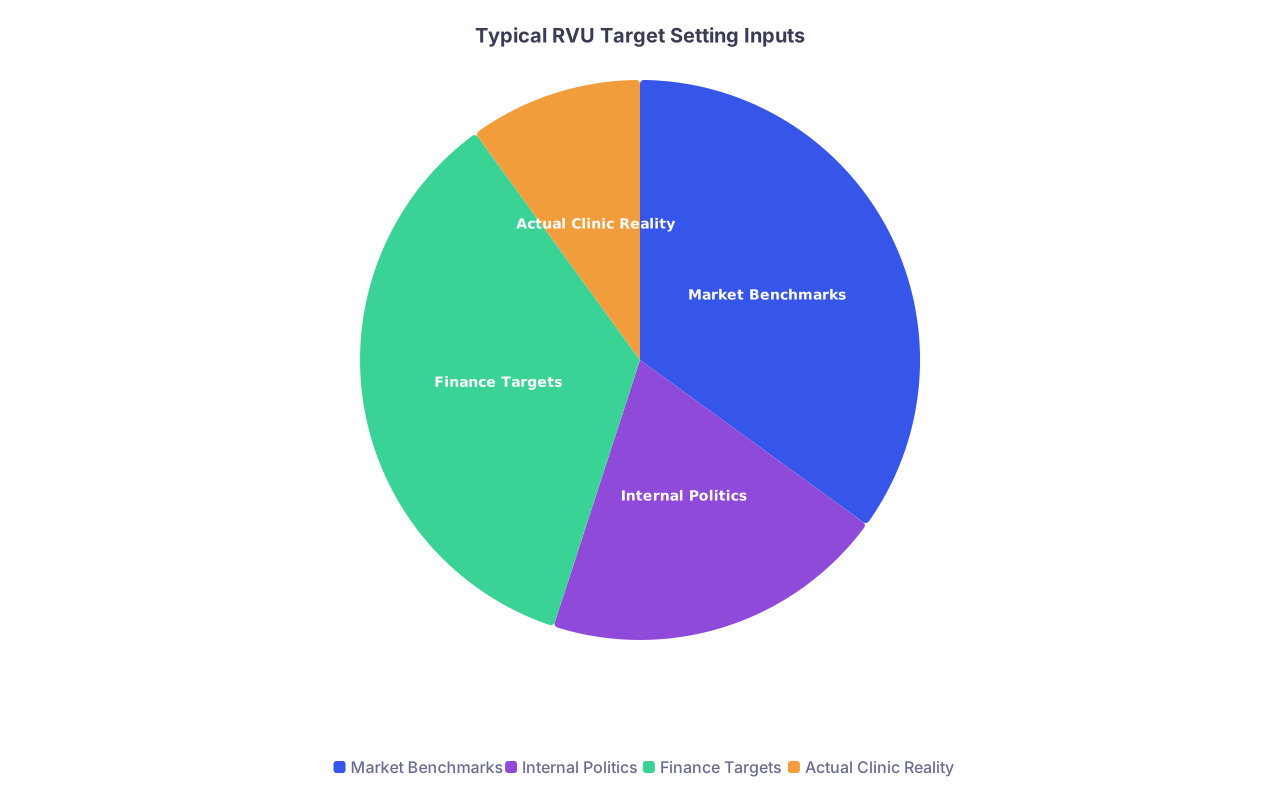
| Category | Value |
|---|---|
| Market Benchmarks | 35 |
| Internal Politics | 20 |
| Finance Targets | 35 |
| Actual Clinic Reality | 10 |
That “Actual Clinic Reality” sliver? That’s about right at many places. Not all, but many.
So when you push back on RVUs, what you are really doing—if you do it well—is forcing them to confront the 10% they’ve been ignoring.
How to Push Back So a CEO Actually Respects You
Now the part you actually care about: what works.
I’ve seen physicians torpedo themselves here by coming in emotional, vague, or adversarial. CEOs have limited patience. Once they label you “difficult,” you’re done.
You want them to think three things about you:
- This doctor understands the business side.
- This doctor is reasonable and collaborative.
- This doctor is not scared to walk if treated unfairly.
That combination is gold.
Here’s how you signal it.
Come in with comparables, not complaints
Saying “this is too high” is noise. Saying:
“MGMA 2023 for our region shows median RVUs for [specialty] at ~5,500 and 75th percentile at ~7,000. This contract is asking for 7,200 as the target just to hit base-plus-bonus. That’s not aligned with market norms.”
…is signal.
You don’t need to lecture. Two sentences with data is enough to shift the tone.
Tie your ask to shared goals, not just your comfort
CEOs hear “I want” all day. They tune it out.
Instead of “I don’t want that RVU target,” try:
“If we set this at 6,000 with a realistic ramp in year one, I’m confident we can build a sustainable practice, retain patients, and avoid the cycle of turnover we’ve seen in this market.”
You’re talking retention, growth, stability. That’s what they repeat to the board.
Be explicit about the ramp
Most RVU fights go sideways because the CEO’s thinking year 3 “steady state” and you’re thinking year 1 chaos.
Spell it out:
- Year 1: lower base target with guarantee or minimum
- Year 2: step up
- Year 3: final target, revisited once you have real data on actual volumes
Frame it as risk-sharing, not “give me a free year.”
Something like:
“I’m comfortable with a 2–3 year ramp to 7,000 if volumes support it. For year one, let’s set the RVU target at 5,000 with a guaranteed floor, then revisit based on actual clinic data.”
Now you sound like a partner, not a supplicant.
What Changes in Their Head When You Hold Your Ground
Let’s walk through the mental sequence of a reasonably smart CEO when you don’t just roll over.

| Step | Description |
|---|---|
| Step 1 | Physician pushes back on RVUs |
| Step 2 | Seen as savvy and prepared |
| Step 3 | Seen as naive or anxious |
| Step 4 | Minor concessions only |
| Step 5 | Meaningful negotiation |
| Step 6 | Revisit broader comp plans |
| Step 7 | One off exception |
| Step 8 | Has data and comparables |
| Step 9 | High replaceability? |
| Step 10 | Systemic risk flagged? |
If you’re prepared and not easily replaced, a strong, calm pushback does two things:
- It forces them to question whether their target is realistic.
- It forces them to think about what happens if they lose you.
That’s where you want them.
And occasionally, you trigger something bigger: they realize they’ve been quietly over-targeting a whole specialty and creating long-term retention risk. I’ve sat through those “oh… we may have a systemic problem” conversations. They usually start with one physician who wouldn’t shut up and actually had the numbers.
The Quiet Fears They Never Admit
Let me give you the other side—the stuff CEOs actually worry about when you resist RVU pressure.
Fear #1: “If we don’t tighten productivity, our margins collapse.”
Hospitals are under real financial pressure. Rising labor costs, flat reimbursements, capital projects. They lean on physicians because that’s where the revenue is.
When you push back, they worry you’re one more crack in a dam that’s already leaking.
The trick is: you can acknowledge that without surrendering. A simple:
“I get that the system needs to hit certain margins. I’m not asking to be unproductive. I am asking for targets that reflect reality, not just budget gaps.”
You’ve removed the “you don’t understand our pressures” card from their hand.
Fear #2: “If I give this doc a better deal, I’ll have 10 more at my door.”
This is the “precedent” fear. They live in terror of internal comparisons.
That’s why they love standardized comp plans. They can always say, “This is the structure everyone is on.”
When you push back, they’re thinking: if I let you carve out a lower target or higher comp, will word get out?
You blunt that by tying your ask to very specific facts:
- Your unique subspecialty training
- Your prior RVU history and documented performance
- The specific clinic set-up or market conditions
Now they can justify your variation without rewriting the whole plan. You’ve given them political cover.
Fear #3: “If this goes badly, will this doc torch us on the way out?”
CEOs read the same physician blogs and social media you do. They’ve seen viral posts about “toxic systems” and “impossible RVU demands.”
So when you push back, a small part of them thinks:
“If we mishandle this and they quit, are we going to be the next cautionary thread?”
When you show up measured, prepared, and not out for blood, you lower that fear and increase their willingness to deal in good faith.
How Your Phase of Career Changes the Power Dynamic
You’re in the “post residency and job market” phase—not ten years in, not department chair.
Here’s how CEOs mentally sort you when you walk into that negotiation:
| Stage | CEO Lens |
|---|---|
| New grad (0–2 years) | High risk, high moldability |
| Early career (3–7 yrs) | Proven or problematic |
| Mid-career (8–15 yrs) | Stable producers or flight risks |
| Senior (15+ yrs) | Politically sensitive |
As a new or early attending, you get slotted as “moldable.” That’s bad news if you’re passive. It’s good news if you’re savvy.
Because early on, you can still frame the relationship. You can still signal:
- I understand productivity.
- I will work hard.
- I will not sign something that sets me up to fail.
If you cave now, you teach them that physicians at your career stage will accept whatever template comp plan they hand out. That’s exactly what many systems are counting on.
The Line Between Strong and Self-Sabotaging
One last thing, because I’ve watched people blow this.
You can absolutely overplay your hand.
The red flags for a CEO that you’ve moved from “thoughtful advocate” to “problem child”:
- You refuse to acknowledge any financial realities on their side.
- You insist on totally uncapped upside with minimal targets and high base.
- You drag the process out with endless nitpicking but no clear bottom line.
- You threaten to walk constantly but never actually show you have other options.
Smart negotiating looks like this:
- You’re clear about 2–3 non-negotiables (e.g., realistic RVU target, fair ramp, protected time).
- You’re flexible on the rest (CME dollars, small bonus structures, minor perks).
- You demonstrate you have other interviews or offers without theatrics.
- You can say, calmly, “If we can’t get closer on these points, I think we’re not aligned, and I’ll likely look elsewhere.”
That last sentence, delivered without anger, carries more weight than any rant about burnout ever will.
FAQ – What You’re Probably Still Wondering
1. How do I know if an RVU target is actually unrealistic?
Compare three things:
- MGMA or similar benchmarks for your specialty and region.
- Actual RVUs of similar physicians in that same system or market (ask current docs bluntly).
- Your own historical production if you’ve been in practice elsewhere.
If your target is >75th percentile AND no one locally is hitting that number with similar resources, it’s unrealistic. If they insist it’s fine “because our top doc does it,” ask how many other people besides that unicorn have hit it.
2. Should I ever accept a high RVU target if the base salary is good?
Sometimes, yes—but only if:
- The base is guaranteed and not clawed back for at least 1–2 years.
- The bonus structure is truly upside only (no penalty below target).
- You treat the bonus like lottery money, not mortgage money.
The trap is when they quietly link future base adjustments to “historical productivity” using that inflated target. That’s how you get pay cuts in year 3.
3. How much can I realistically move an RVU target in negotiation?
In practice, I’ve seen 10–20% shifts more often than complete redesigns. Sometimes the real win is not lowering the target, but:
- Adding a sensible ramp in year one
- Lowering the “threshold” at which bonus kicks in
- Adding alternative credit (admin, teaching, leadership) that counts toward productivity or separate stipends
You measure success not only by the final number, but by whether the deal gives you room to breathe and grow.
4. What if the CEO or admin just will not budge on RVUs?
Then you’re at a decision point, not a negotiation problem.
If they’re rigid now, when they’re trying to recruit or retain you, they won’t be more flexible later. Ask yourself:
- Do I have or can I get other offers in this specialty and geography?
- Is what they’re offering sustainable for me physically and mentally over 3–5 years?
- Will staying here close doors, or keep them open?
Sometimes the most powerful thing you can say is:
“Thank you for your time and clarity. This doesn’t work for me long term, so I’m going to step back before we both invest more and end up disappointed.”
They remember the people who are willing to walk. And you’ll be in a stronger position at the next table.
With all of this in your back pocket, the next time you sit across from a CEO or CMO and see that inflated RVU target, you won’t just feel vaguely uneasy. You’ll know exactly what they’re thinking—and exactly how to respond.
You’ve handled the first real test of your post-training career: translating your value into numbers and refusing to sign up for a rigged game. With that skill growing, you’re better prepared for the next phase: not just getting a job, but building a career on your own terms. The politics of promotion, leadership roles, and renegotiations are coming. But that’s a story for another day.


